
Nearshore vs Offshore Software Development: Costs, Time Zones and Risks Compared (2027)
4 Views 12 min October 22, 2026

Avinash Kumar is a highly experienced technical writer with 5+ years in B2B and technology content. He specializes in simplifying complex tech topics into clear, engaging, and conversion-focused content. At Apptunix, he helps startups and enterprises make informed digital decisions through insightful blogs, guides, and strategic storytelling that drives real business growth.
In 2026, nobody wins the money-transfer business anymore just by getting funds from A to B. That part’s basically solved. What separates the winners now is how it feels to the user: fast, cheap, safe, and ideally something they barely have to think about.
That’s opened up a real opportunity for fintechs, banks, remittance players, and payment companies willing to rethink cross-border money movement from scratch.
But here’s the catch: adding payment functionality onto an app isn’t the same as building a competitive product.
The success depends on exchange rates, transaction routing, fraud detection, KYC/AML checks, regulatory requirements, banking integrations, and real-time processing. All these have to work together behind the scenes to give a seamless transaction experience.
So are you looking to create a money transfer app for your business? If yes, you’re in the right place.
From AI capabilities and key features to security, compliance, and cost, dive into a complete money transfer app development guide for 2026.
Over the past few years, the way people move money has changed. Digital remittance is moving beyond traditional transfer counters toward mobile apps, digital wallets, bank transfers, and faster payment networks. This shift is creating opportunities for businesses to develop a money transfer app that competes on speed, transparency, security, and lower transaction costs.
Let’s explore where the market actually stands:
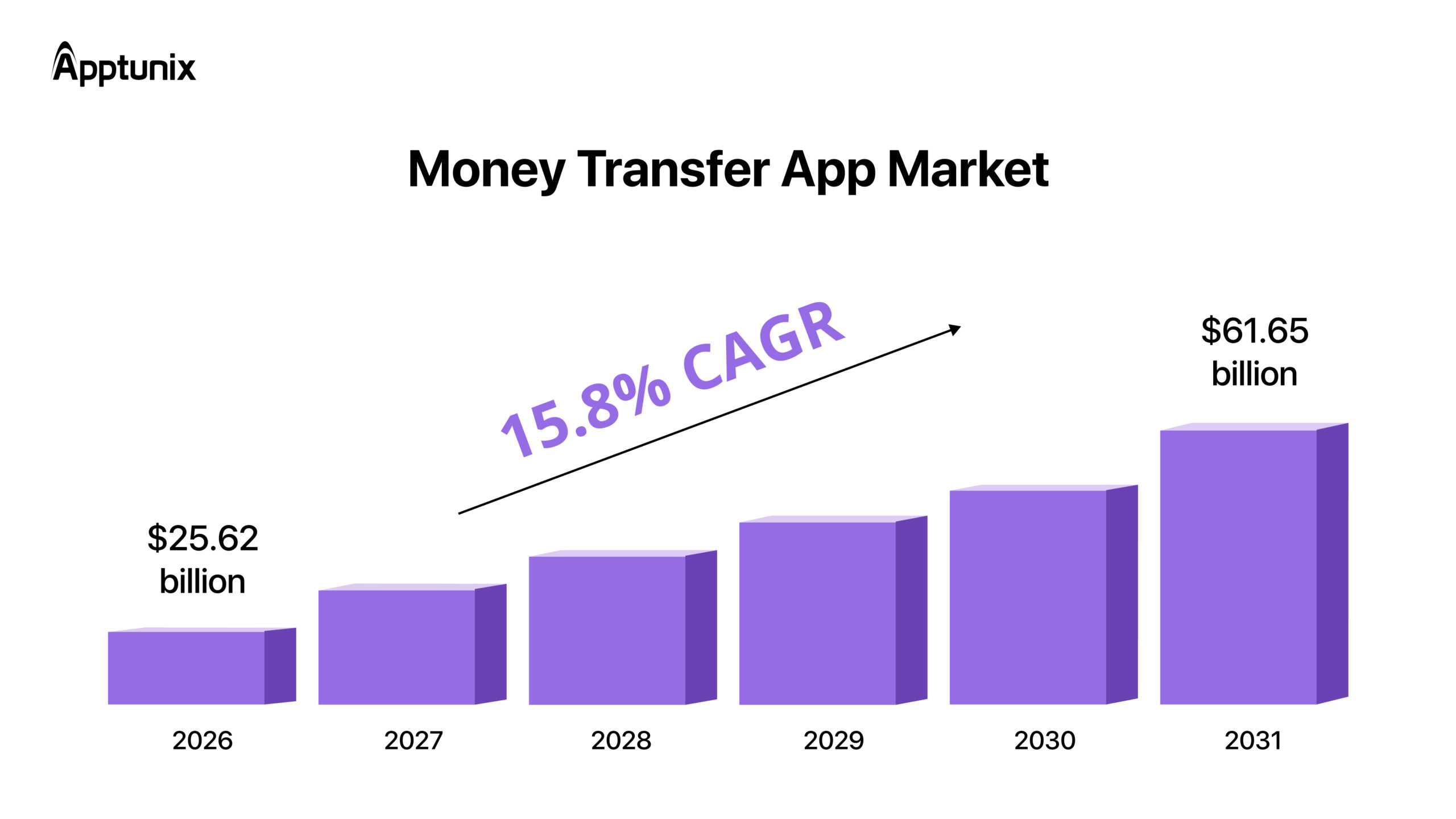
-> According to Research and Markets, the money transfer apps market is expected to be worth $61.65 billion by 2031.
-> Currently, the money transfer app market stands at $25.62 billion and is growing with a CAGR of 15.8% between 2026 and 2031.
-> India, China, the United States, Brazil, and the United Kingdom lead the world with the largest transaction volumes, making them perfect countries to launch a money transfer application.
-> Asia Pacific will be the leading region, sharing 46.5% of the world’s total mobile wallet market by 2035.
-> CNBC stated that Venmo is the best money transfer app for paying friends, Cash App is best for ease of use, PayPal is best for larger payments, and Apple Cash is best for using at checkout.
There are several types of money transfer apps that, of course, serve different purposes. The factors that actually determine which type fits your idea include your target users, transaction volume, geography, and business model.
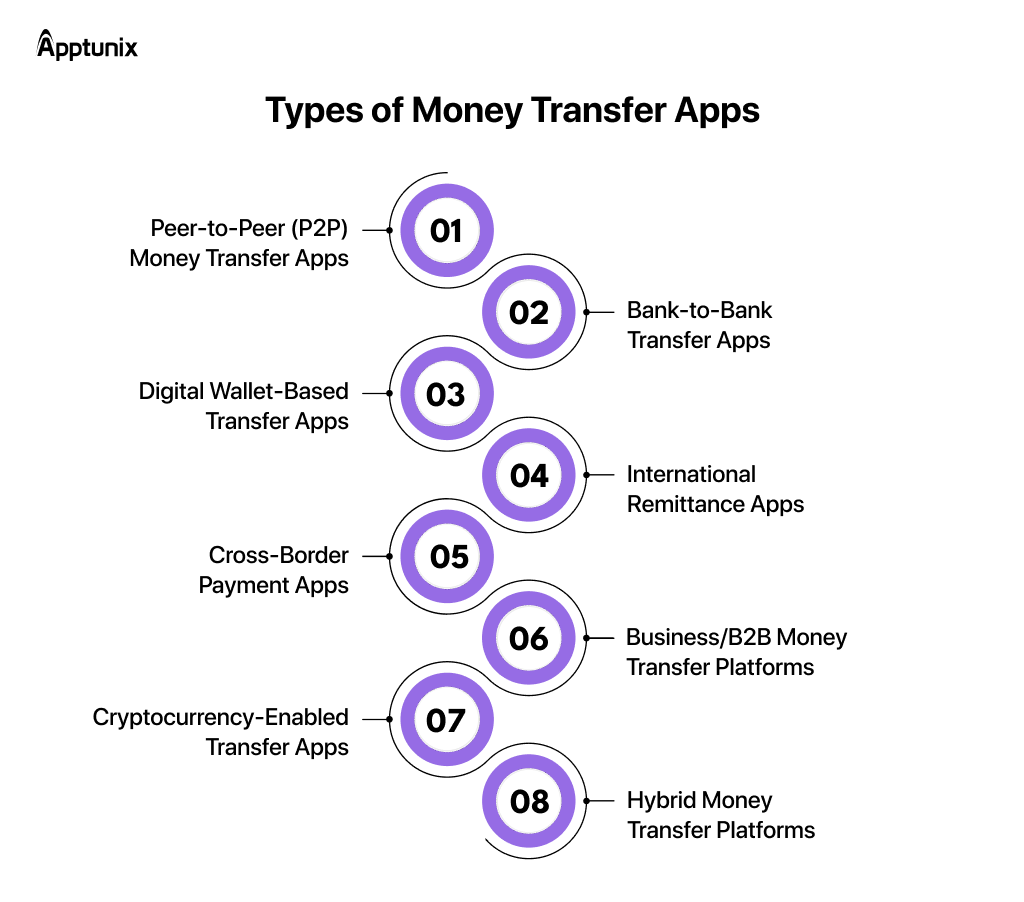
Well, a P2P money transfer app allows users to send money directly to family, friends, or any individual without visiting a bank or transfer office. This type of application supports instant transfers, contact-based payments, transaction history, and digital wallets for everyday money movement.
Example: Venmo and Cash App
Bank-to-bank money transfer applications connect users with bank accounts to facilitate direct transfers between financial institutions. Users primarily use these apps for domestic payments, bill payments, and larger transactions. It operates with features like transaction tracking and beneficiary management.
Example: Zelle
These applications let users store funds digitally and send or receive money directly from their wallet balance. Moreover, they also support merchant transactions, card payments, bill payments, and wallet-to-bank transfers. This gives users an all-in-one payment experience.
Example: PayPal
These applications are designed for users who regularly send money across countries. Cross-border payment applications typically support multiple currencies, exchange rate calculations, receipt management, transfer tracking, and compliance checks required for cross-border transactions.
Example: Remitly and Wise
Cross-border payment apps sound like international remittance apps, but both are different in some ways. Unlike an international payment app, a cross-border payment app often serves individuals, businesses, and other purposes. For example, a US-based company pays a UK supplier. They require integrations with banks or financial institutions across supported markets.
Example: Wise Business and Airwallex
They often include bulk payments, recurring transfers, approval workflows, transaction reconciliation, reporting, and role-based access to support business operations. A B2B money transfer application helps businesses send money to suppliers, employees, contractors, partners, or international accounts.
Example: Airwallex and Wise Business
Cryptocurrency-enabled transfer apps allow users to transfer digital assets between wallets or convert cryptocurrency into traditional currencies. These applications include crypto wallets, exchange functionality, blockchain transactions, identity verification, and transaction monitoring based on the business model.
Example: Coinbase Wallet
These platforms combine multiple transfer methods or financial services within one application. Hybrid applications actually support several things, including P2P transfers, international remittances, digital wallets, bank transfers, and currency exchange. This gives users more flexibility with a single platform.
Example: PayPal and Venmo
Of course, to create a money transfer app, the development team develops a mobile interface and connects a payment gateway. However, the app handles real money and sensitive financial data; as a result, it is essential to plan an incredible business strategy, payment infrastructure, security, compliance, and user experience from the beginning.
As of 2026, a successful online money transfer app development process includes:
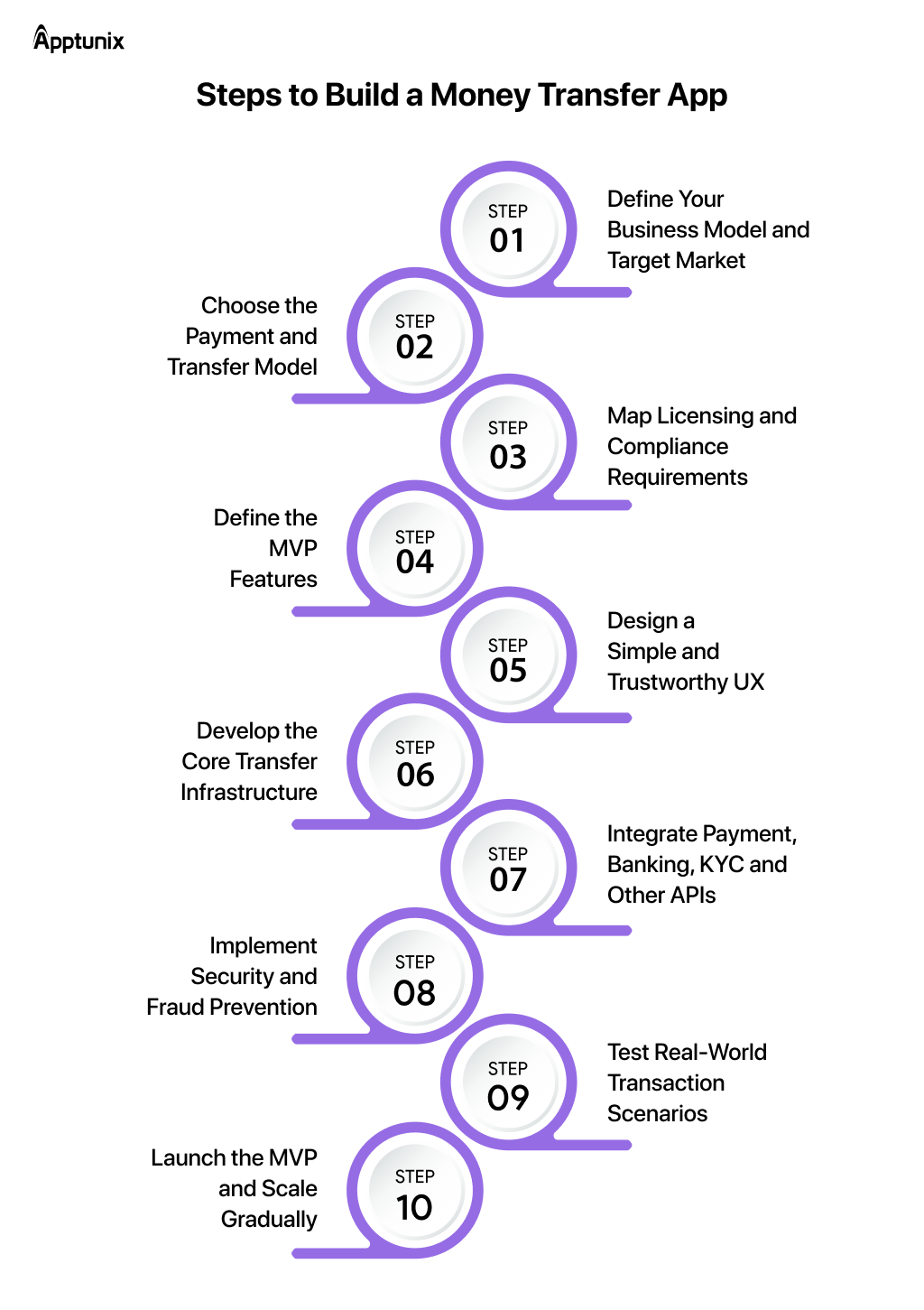
Step 1:Define Your Business Model and Target MarketDecide who will use your application and what type of transfers it will support in the initial phase. Here, you can target P2P payments, domestic transfers, B2B payments, international remittances, B2B payments, or a specific market corridor.
Apart from that, your target geography also matters because licensing, KYC/AML requirements, payment methods, currencies, and banking partnerships can vary significantly between countries. Once you define these requirements early, you can easily prevent expensive changes later.
Step 2:Choose the Payment and Transfer ModelOnce you define your business model and target market, determine how money will actually move through your platform. You can use bank-to-bank transfers, digital wallets, cards, local payment rails, or third-party and banking providers depending on your business model.
Moreover, you could also need multi-currency support, foreign-exchange services, correspondent banking, or remittance partners for international payments. The infrastructure you choose will directly influence your app’s capabilities, transaction speed, and operating costs.
Step 3:Map Licensing and Compliance RequirementsIdentify the regulations that apply to your target market and business model before development begins. Understand that money transfer services fall under different licensing and regulatory frameworks depending on the jurisdiction.
Your compliance planning may include:
The FATF recommendations give you a useful international baseline for tackling money laundering and terrorist financing, but don’t stop there; you’ll still need to map those principles onto the specific laws of every market you plan to serve.
Step 4:Define the MVP FeaturesIt is best to avoid launching every possible financial feature at once, especially if you’re developing the solution for the very first time. First, define MVP development solutions around the core transfer experience.
A typical minimum viable product could include:
When you confirm your core payment journey works reliably, you can integrate advanced functionalities like AI fraud detection, recurring transfers, multi-currency wallets, etc.
Step 5:Design a Simple and Trustworthy UXOnce you and the development team decide on the final features, UI/UX designers design the application user interface. These applications need to make users feel confident before they press send. So designers create an interface that clearly shows the transfer amount, fees, exchange rate, recipient details, and expected delivery time before confirmation.
So you have to keep the transfer journey straightforward while providing clear status updates when a transaction is completed, pending, failed, etc.
Step 6:Develop the Core Transfer InfrastructureAfter ensuring the design, now comes the actual money transfer app development. The development team creates the mobile application, backend services, transaction engine, databases, APIs, authentication systems, and admin dashboard.
Here, the backend is especially essential because it manages several things, including transaction states, balances, user information, payment instructions, notifications, and integration with external financial services.
The architecture of the application should be designed to handle increasing transaction volumes without compromising performance or reliability.
Step 7:Integrate Payment, Banking, KYC, and Other APIsThird-party integrations form a major part of a modern money transfer app. Depending on your model, you may need integrations for:
For cross-border products, additional integrations may be required for international payment networks, currency conversion, and country-specific payment methods.
Step 8:Implement Security and Fraud PreventionThe development team, of course, keeps security on their list from the very first development phase. After integrating payment, banking, KYC, and other APIs, the architecture should incorporate security from the outset rather than adding it just before launch.
Well, they use measures like encryption, multi-factor authentication, secure API communication, tokenization, role-based access, transaction monitoring, and fraud-risk controls. Apart from that, AI and ML can also support real-time fraud detection by identifying unusual transaction patterns and assigning risk scores.
Step 9:Test Real-World Transaction ScenariosOnce everything is complete, the quality assurance team thoroughly tests the application, ensuring that buttons and screens function correctly. A highly experienced team tests successful transfers, failed payments, duplicate transactions, incorrect beneficiary details, network interruptions, refunds, chargebacks, exchange-rate changes, and high transaction volumes.
Remember, security and compliance testing must be performed before the app handles real customer funds.
Step 10:Launch the MVP and Scale GraduallyWhen the QA team ensures the product passes functional, security, and compliance checks, it’s time to launch it in your chosen market instead of trying to support multiple countries immediately.
Improve the product as needed by monitoring transaction success rates, failed transfers, onboarding drop-offs, fraud alerts, customer complaints, and support requests. These insights will help you improve the application before expanding into new payment methods, currencies, and international markets.
Your goal should not be just to simply launch a money transfer app but to build a financial product that users can trust every time they send money.
So this is how you build custom money transfer apps. Now, let’s look at the key features you must include to build a money transfer app successfully in 2026.
Anyone can build an app that pushes money from one account to another. The hard part is doing it well: fast, transparent on rates, genuinely secure, and pleasant enough that people don’t dread opening it.
Some things just aren’t optional anymore. Biometric login and AI fraud detection– skip these, and you’re basically asking users not to trust you. So here’s the list we keep coming back to: 12 features worth building for your money sending app in 2026.
Onboarding that verifies identity without feeling like an interrogation.
Hold several currencies at once, send and receive freely.
Quick transfers, domestic or cross-border, with status you can actually track.
Hook up bank accounts, cards, and other payment methods, safely.
Rates update live, fees stay visible, nothing hidden.
Users always know where their transfer stands, with receipts saved.
Save the people users pay often; skip re-entering details.
Ping users when transfers succeed, payments fail, or rates move.
Face ID or a fingerprint- that’s all login should take.
Costs and limits shown clearly before anyone hits confirm.
AI watches for anything that looks off, flags it fast.
One place to run it all: users, transactions, KYC, fees, disputes, compliance.
As you now understand the importance of security in online payment app development, let’s discuss the ideas that will help your platform protect financial transactions in 2026.
Security isn’t something you sprinkle on top once the app works. It’s the thing the whole app has to be built around, because you’re dealing with people’s money and their personal data, and one bad breach undoes years of trust in an afternoon. Money transfer app security can include
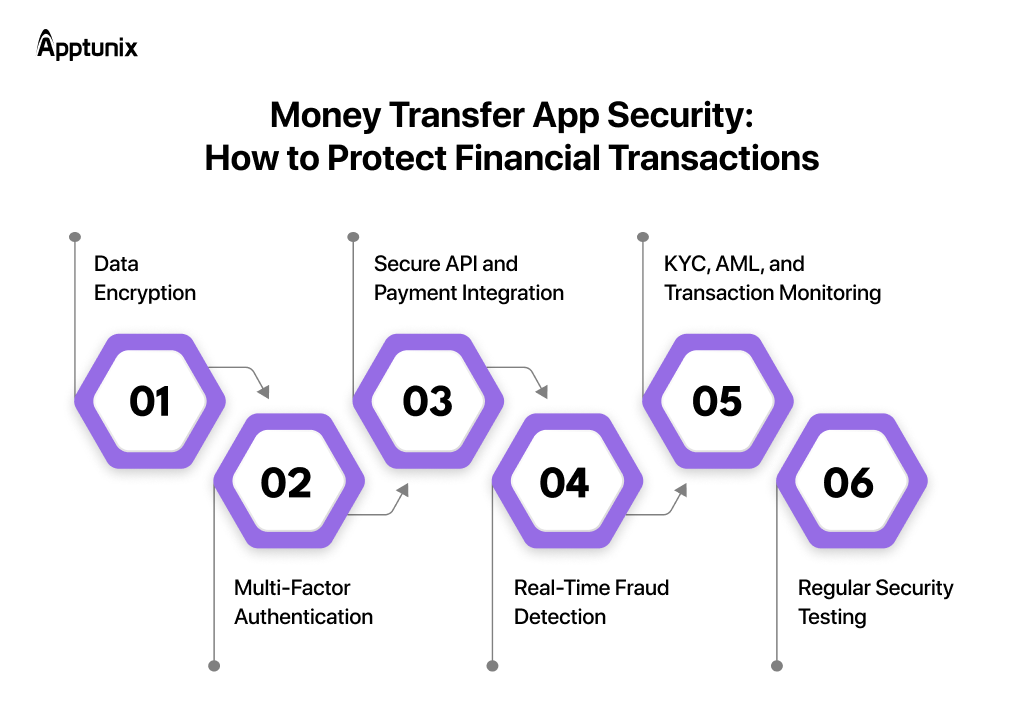
Everything sensitive- personal info, payment details, login credentials, transaction records- needs encryption both while it’s moving and while it’s sitting in storage. No exceptions.
Use MFA through OTPs, biometrics, PINs, or device verification to prevent unauthorized account access. For high-value or unusual transactions, add step-up authentication for an extra layer of protection.
Payment gateways, banking APIs, KYC providers, and other third-party services should communicate through secure APIs. Use strong authentication, authorization, encryption, input validation, and rate limiting to protect these connections.
Use rule-based systems and AI-powered fraud detection to identify unusual transaction amounts, locations, devices, frequency, or user behavior. High-risk transactions can then be flagged, reviewed, or temporarily blocked.
Verifying who someone is matters just as much after signup as it does during it. Keep KYC, AML screening, and sanctions checks running continuously, woven into the transaction process itself, not sitting off to the side.
Conduct vulnerability assessments, penetration testing, API testing, and security audits before launch and throughout the app’s lifecycle. Regular testing helps identify weaknesses before attackers can exploit them.
Custom money transfer apps operate in a highly regulated financial environment, and requirements vary by transaction type, business model, and country. To successfully launch a money transfer app, your business needs the appropriate financial license along with KYC, AML, data protection, and transaction monitoring measures.
Compliance and licensing requirements are crucial to avoid regulatory issues and expensive redesigns later. Examine the table below to understand the importance of compliance and licensing in 2026:
So this is how you secure compliance and licensing requirements while doing international money transfer app development. However, many people get confused about whether they should build an MVP or a full-scale platform. Well, let’s find the core differences between the two.
Either you build an MVP for money transfer services or build a full-scale money sending app; it all depends on your business goals, target market, and expected transaction volume. A minimum viable product lets you launch essential features, validate demand, and gather user feedback without spending large amounts of money on full-scale solutions.
However, a full-scale money transfer app requires a broader feature set, stronger infrastructure, advanced security, and high-end scalability.
The cost to build a money transfer app ranges from $20,000 to $120,000, depending on the complexity of the platform. The other factors that influence the pricing include app features, technology stack, integrations, security requirements, development team expertise, and location. A basic MVP money transfer app can be built for $20,000 or $30,000; however, a full-scale platform requires more than $60,000.
Here’s the table showcasing app complexity and its estimated cost, along with the timeline.
Remember, the final pricing varies significantly based on KYC/AML implementation, payment gateway integrations, fraud detection, regulatory requirements, and the number of platforms you plan to support.
So it’s time to end the online money transfer app development guide. However, before wrapping up, examine the ways money sending apps actually generate revenue.
Also Read: Mobile App Development Cost Guide in 2026
A money transfer app can make money in more than one way; it really comes down to your target users, the markets you’re in, and how transfers actually work on your platform. Transaction fees tend to be the go-to approach, but FX margins, subscriptions, business accounts, and premium services can all stack on top as extra revenue streams.
This is one of the first things to map out early in AI money transfer app development, since it shapes almost every other decision down the line.
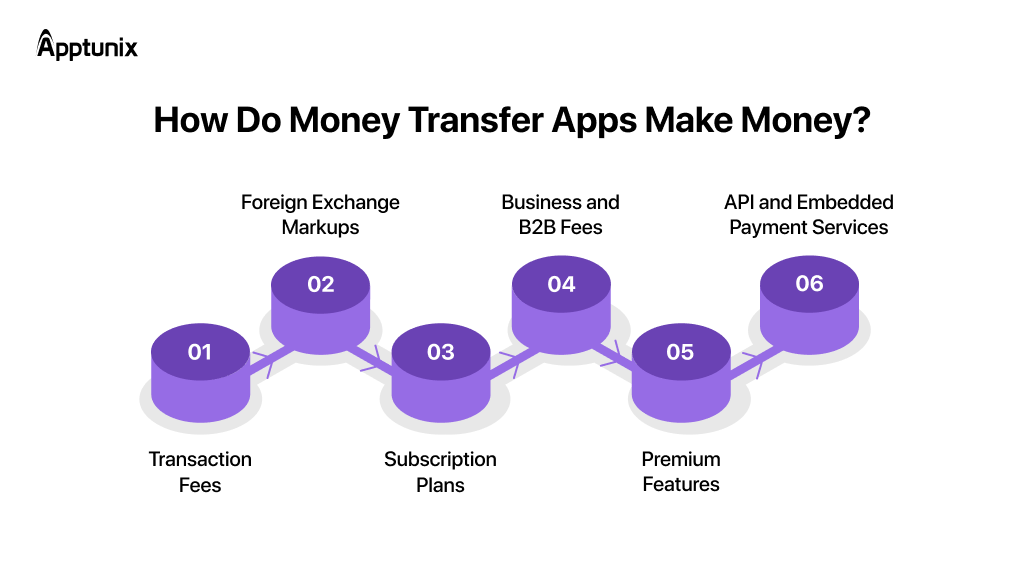
1:Transaction FeesSome apps charge a flat fee, others take a percentage of whatever’s being sent. Plenty use tiered pricing too, where the fee shifts depending on the amount, where it’s headed, the payment method, or how fast the transfer needs to happen.
2:Foreign Exchange MarkupsFor apps handling international money transfer app development, the exchange rate itself becomes a revenue source. The app buys at a wholesale rate, then offers customers a slightly adjusted one, pocketing the difference. Simple in theory, but it needs to stay fair enough that users don’t feel nickel-and-dimed.
3:Subscription PlansHeavy users and businesses often respond well to monthly or annual plans, lower fees, higher limits, faster processing, and better rates. It’s a smart way to build recurring revenue instead of leaning entirely on one-off transactions.
4:Business and B2B FeesBusinesses bring bigger volumes and steadier income. Charging for bulk payments, payroll transfers, supplier payments, automated transfers, reporting, or API access turns B2B customers into one of the more dependable revenue streams a money sending app can have.
5:Premium FeaturesHigher limits, instant transfers, multi-currency accounts, priority support, deeper analytics, and extra security. These all work well as paid add-ons for users who want more than the basic experience.
6:API and Embedded Payment ServicesOnce your infrastructure is solid, other businesses may want to plug into it directly. Offering transfer capabilities through APIs lets them add money movement to their own apps without building payment rails from scratch, another angle worth considering among the different types of money transfer apps on the market today.
There’s no doubt in saying that the future of money movement is faster, smarter, and increasingly digital. However, crafting a successful money transfer app takes more than seamless transfers. Essentially, it requires reliable payment integrations, secure infrastructure, regulatory readiness, intelligent fraud protection, and a user experience people can trust.
It doesn’t matter if you’re launching an MVP, entering the remittance market, or making a full-scale cross-border payment system; you must follow the right technology strategy that can turn a complex financial product into a competitive advantage.
To achieve that, you must partner with a reliable partner like Apptunix. With 13+ years of experience in providing digital solutions across global markets, Apptunix, a fintech app development company, has helped businesses transform fintech ideas into secure and scalable platforms.
By using modern technologies, robust integrations, and business-focused development strategies, Apptunix leads the market in providing money transfer applications to the fintech industry.
So, are you ready to move your idea forward? If yes, partner with an experienced AI money transfer app development firm like Apptunix and stand out in the competitive marketplace.

Q 1.How to develop a secure money transfer app?
Build security into the architecture from day one with encryption, multi-factor authentication, secure APIs, fraud detection, KYC/AML checks, transaction monitoring, and regular penetration testing.
Q 2.What features should a money transfer app have?
The key money transfer app features include secure registration, KYC verification, bank or card linking, beneficiary management, money transfers, transaction tracking, notifications, currency conversion, authentication, and an admin dashboard for monitoring.
Q 3.How much does it cost to build a money transfer app?
The cost to build a money transfer app ranges between $20,000 and $120,000, depending on the business goals, app complexity, feature integrations, development team experience, and location.
Q 4.How long does it take to develop a money transfer app?
It takes 2-3 months to build a basic/MVP version of the money transfer app and 3-5 months to develop a moderate application with some advanced features. However, a complex or enterprise-level application requires up to 8 months or even more, depending on the developers’ expertise and experience.
Q 5.How to choose a money transfer app development company?
Pick a company with proven fintech experience, strong payment and banking integration expertise, security capabilities, relevant case studies, compliance knowledge, transparent pricing, and reliable post-launch support.
Get the weekly updates on the newest brand stories, business models and technology right in your inbox.
Avinash Kumar is a highly experienced technical writer with 5+ years in B2B and technology content. He specializes in simplifying complex tech topics into clear, engaging, and conversion-focused content. At Apptunix, he helps startups and enterprises make informed digital decisions through insightful blogs, guides, and strategic storytelling that drives real business growth.
4 Views 12 min October 22, 2026
21 Views 12 min October 9, 2026

36 Views 12 min October 8, 2026
Book your consultation with us.
Book your consultation with us.


One Central, The offices 3, Level 3, DWTC, Sheikh Zayed Road, Dubai
+971 50 782 1690