
Cost to Build an App Like Eventbrite: Complete Development & Pricing Guide (2026)
12 Views 11 min September 16, 2026

With over 20+ years of experience in driving global digital initiatives, Nikhil Bansal is the CEO & Director of Apptunix. He specializes in orchestrating large-scale digital transformations, enterprise-grade software solutions, and high-level business strategies that redefine industry standards. Nikhil is known for his ability to bridge the gap between complex business challenges and innovative technology, helping Fortune 500 companies and startups alike achieve sustainable growth. A visionary leader, he empowers enterprises to navigate the digital landscape with agile, ROI-focused models and future-ready business strategies.
Three years ago, a mid-sized solar operator had a strange problem. They weren’t struggling to generate energy; they were struggling to predict it.
On paper, everything looked solid. Panels installed. Demand is rising. The government pushes in their favor. But every wrong forecast meant wasted capacity, missed bids, and real money left on the table.
That’s when it clicked: the next battle in energy isn’t just production. It’s intelligence.
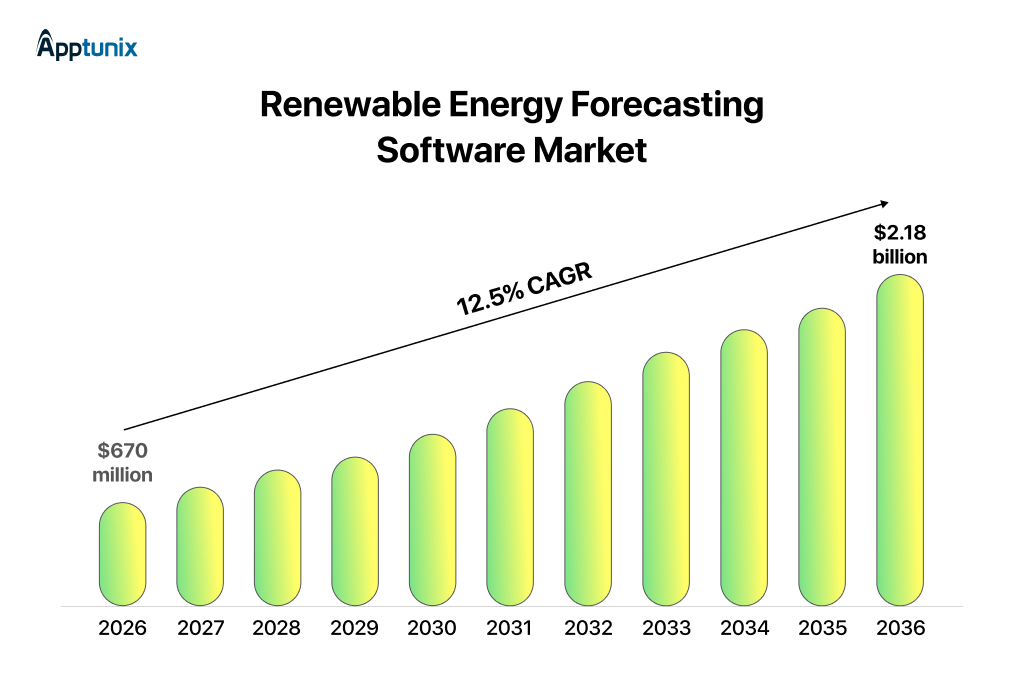
The numbers are already pointing there. The renewable energy forecasting software market is sitting around $670 million in 2026 and is expected to hit $2.18 billion by 2036, growing at 12.5% CAGR. That’s not hype. That’s a shift.
And it’s opening a new layer of opportunity for founders, operators, and investors: renewable energy software development is quietly becoming the backbone of modern energy businesses.
If you’re thinking about entering this space, the real question isn’t why now. It’s how to build renewable energy software that actually works in the real world, where data is messy, grids are unpredictable, and decisions have financial consequences.
Let’s get into it.
Here’s how successful teams build renewable energy software. Follow this, and you reduce risk.
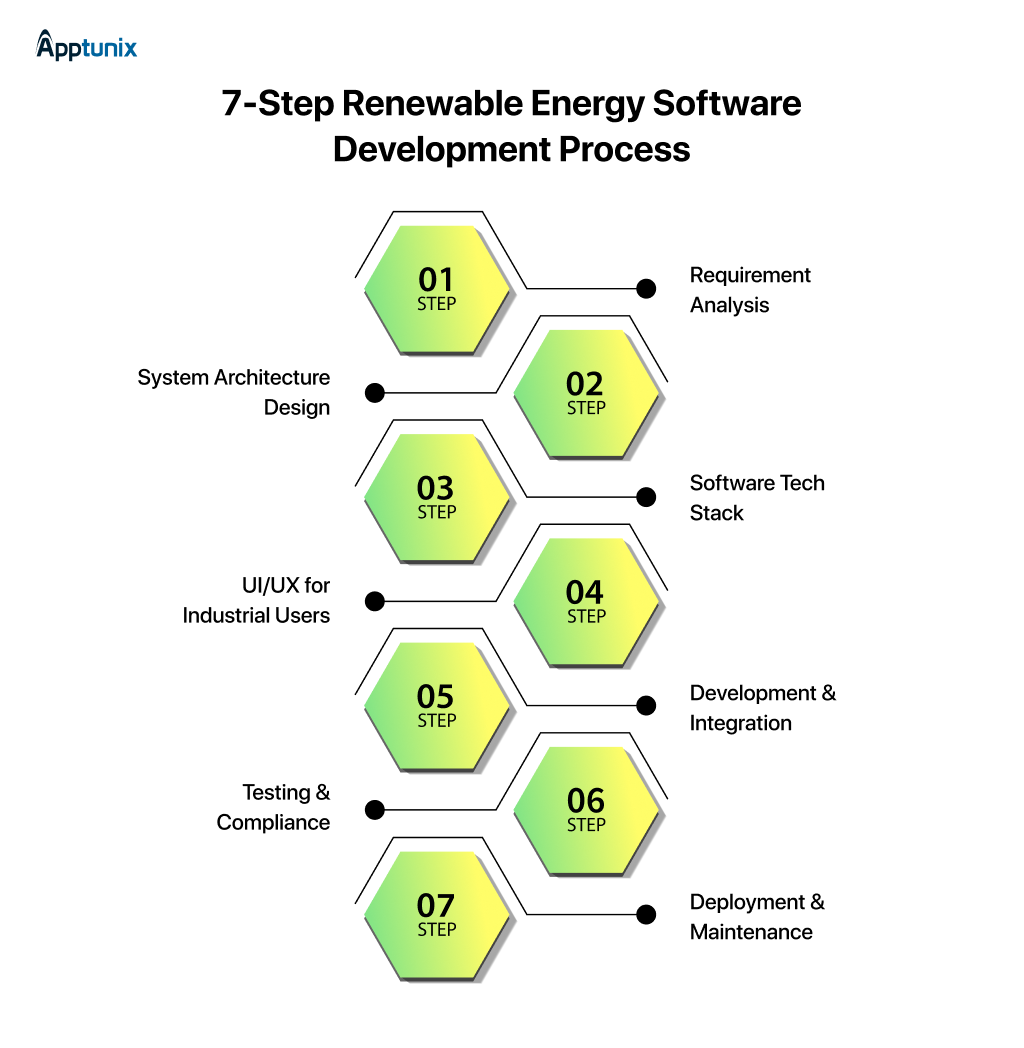
In this space, “requirements” aren’t just user needs. They include hardware constraints, grid rules, and operational edge cases.
Companies care because missing one detail here doesn’t cause a bug; it causes downtime or lost energy.
Good teams spend more time talking to operators than writing specs.
Renewable systems are messy data from sensors, APIs, third-party tools, and sometimes even spreadsheets. If your architecture isn’t built for scale and noise, it collapses fast.
For founders, this is the backbone of energy management software development. Real-time pipelines, fault tolerance, flexibility.
Get this right, and everything else gets easier. Get it wrong, and you’ll keep patching forever.
Energy systems demand speed, reliability, and flexibility. Your tech stack either enables that or constantly gets in the way.
| Tech Layer | Technology |
| Backend | Node.js (NestJS/Express), Python (Django/FastAPI), Java (Spring Boot) |
| Frontend | React.js (Next.js), Vue.js, Angular |
| Database | PostgreSQL, MongoDB, MySQL |
| APIs | REST, GraphQL, gRPC |
| Cloud / Hosting | AWS, Google Cloud, Microsoft Azure |
Here’s the truth: your users don’t care about design trends. They care about speed, clarity, and not making mistakes.
Operators are often under pressure. They need to see what’s wrong in seconds, not explore dashboards.
Companies invest here because a better UI/UX design directly reduces human error. Less confusion = fewer costly decisions. Simple interfaces win in complex environments.
This step always takes longer than planned.
Not because of coding, but because nothing integrates cleanly. Different hardware vendors. Legacy systems. Inconsistent data formats.
This is where most energy management software development efforts slow down. Here’s how the development procedure helps to handle your software development.
| Energy Software Development | What it handles |
| Frontend | Displays energy data, dashboards, reports, and user interactions. Helps users monitor usage, analyze trends, and make decisions. |
| Backend | Processes incoming data from sensors and systems, manages business logic, stores and analyzes energy data, and ensures everything runs reliably in real time. |
The business impact is obvious: delays in integration delay revenue. The faster you connect systems, the faster you deliver value.
Testing isn’t just about bugs. It’s about reliability under real conditions, weather changes, load spikes, and hardware failures.
And then there’s compliance. Regulations, safety standards, and grid requirements. Companies care because failure here isn’t a bad review. It’s penalties, outages, or worse.
This is where serious players separate from demo products.
Shipping is just the start. Renewable environments change constantly. New assets, changing demand, evolving regulations.
So deployment needs to be flexible. And maintenance needs to be continuous. The real business value shows up in post-launch optimizations, updates, and performance tuning.
Teams that treat this as a long-term system, not a one-time build, end up owning the relationship (and the revenue).
These are the best features of energy management software systems. Miss any of them, and you’re compromising on performance.
Most operators don’t need a beautiful dashboard. They need to know what’s broken and what’s about to break. A useless dashboard shows you lots of metrics (active power, reactive power, temperature curves, voltage harmonics, and data vomit).
A useful one shows you, “Is the system healthy or not?” If not, what do I fix first?
If your software is just showing what’s happening now, you’re a monitoring tool. If it’s predicting what’s next, you’re a revenue tool. Predictive analytics means pulling in weather data, historical patterns, and grid signals to forecast what’s coming. Not tomorrow. The next few hours.
The software sends alerts for everything. Temperature above 40°C. Efficiency below 95%. Some weird oscillation in the inverter. After 100 useless alerts, nobody reads any of them. The feature that matters is smart alerting.
Automated reporting is the other half. Most operators spend hours every week compiling performance reports for customers or regulators. If your software can generate those reports automatically (daily, weekly, monthly), that’s an operator hour you just saved.
Monitoring and alerting are table stakes. Optimization is where the money moves. Most renewable systems are running in manual mode or “good enough” mode.
Real optimization means asking: Given the weather forecast, the grid prices in the next 8 hours, the battery state of charge, and upcoming demand, what’s the smartest way to operate?
If you need a technician on-site to make every change, you don’t have a scalable business. This is the feature that turns a regional operation into a national one. You go from managing 20 installations with 4 technicians to managing 200 with the same 4 technicians because 95% of adjustments happen remotely.
Renewable energy software isn’t one thing. It’s a layered ecosystem. Here are the key types.
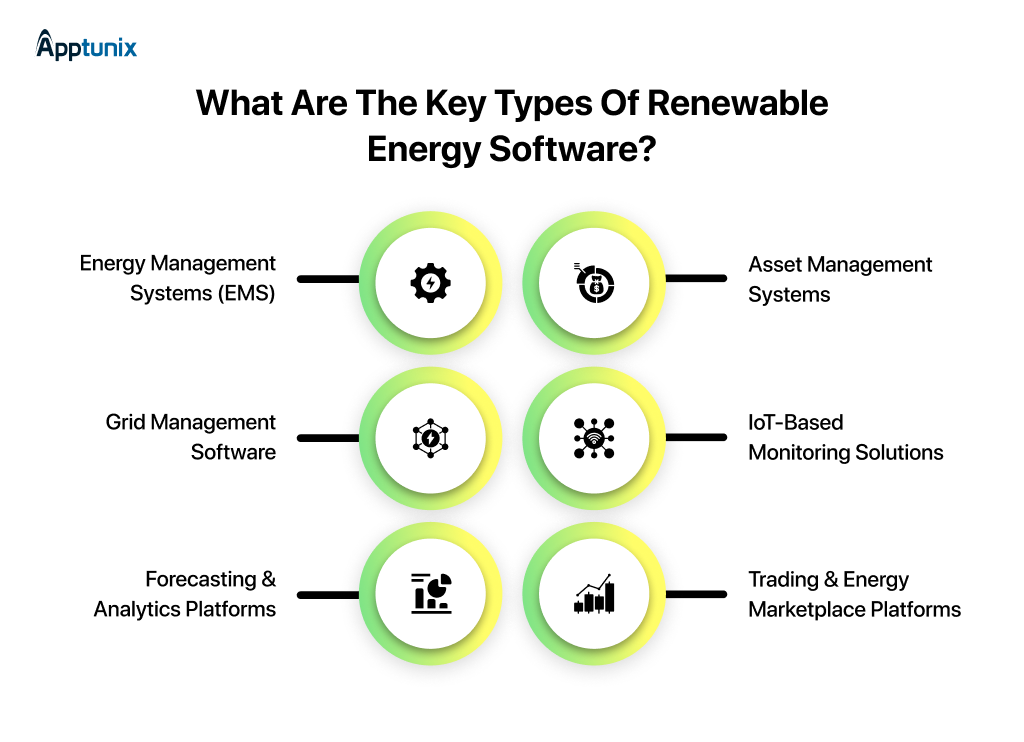
Everyone talks about generating energy. Fewer talk about using it well. That’s where EMS shows up.
Companies don’t just want power. They want control: when to use it, where to route it, and how to reduce cost spikes. Especially with distributed energy setups.
This is where battery energy storage software solutions and solar energy software development start to overlap.
Storage + consumption = real optimization.
The grid is getting messy. Too many sources. Too much variability. Legacy infrastructure is trying to keep up with modern demand. Utilities care because stability is money. Downtime is political.
Smart grid analytics software is becoming less of a “nice-to-have” and more of a survival layer. Real-time balancing, load distribution, and fault detection are all software now.
Renewables are unpredictable. That’s the core problem. If you’re running a solar or wind operation, your revenue depends on something you can’t fully control: the weather. So forecasting becomes a business function, not just a technical one.
Good platforms combine weather data, historical performance, and real-time inputs to reduce uncertainty.
Here’s something operators learn the hard way: assets degrade faster than expected. Panels lose efficiency. Turbines need maintenance. Batteries age. Without visibility, you’re just guessing.
Power plant monitoring software and asset systems help teams track performance at a granular level down to individual components. The companies that invest here don’t just maintain assets. They extend lifespan and protect ROI.
Sensors everywhere. Constant data streams. Immediate alerts. In theory, it sounds straightforward. In practice, it’s messy hardware failures, connectivity issues, and noisy data. But when it works, it’s powerful.
Wind turbine monitoring software and solar IoT stacks give operators a live pulse of their infrastructure. They can react before failures happen. This is less about visibility and more about speed. Faster response = less downtime.
Energy is becoming tradable in more dynamic ways. Not just long-term contracts, but real-time markets. Producers want to sell at the best price. Consumers want flexibility. Software is enabling that matching.
This is where EV charging management software development also connects charging networks, acting as demand-response assets in broader energy markets.
The companies building here aren’t just tech providers. They’re shaping how energy gets priced and exchanged.
The cost of renewable energy software development depends on its complexity and ranges from USD $25,000 to $180,000+. This range is consistent across multiple industry estimates, showing:
| Project Type | What it Includes | Estimated Cost in USD |
| MVP / Basic Software | Core dashboards, basic energy monitoring, limited integrations, and simple reporting | $25,000 – $50,000 |
| Mid-Level Platform | IoT integrations, analytics, automation features, multi-site monitoring, and custom reports | $50,000 – $100,000 |
| Enterprise-Grade Solution | AI forecasting, real-time grid/SCADA integration, digital twins, advanced analytics, and high security | $100,000 – $180,000+ |
Several factors influence the cost to build renewable energy software:
Unpredictability demands sophistication. Here are the five technologies that make renewable systems manageable.
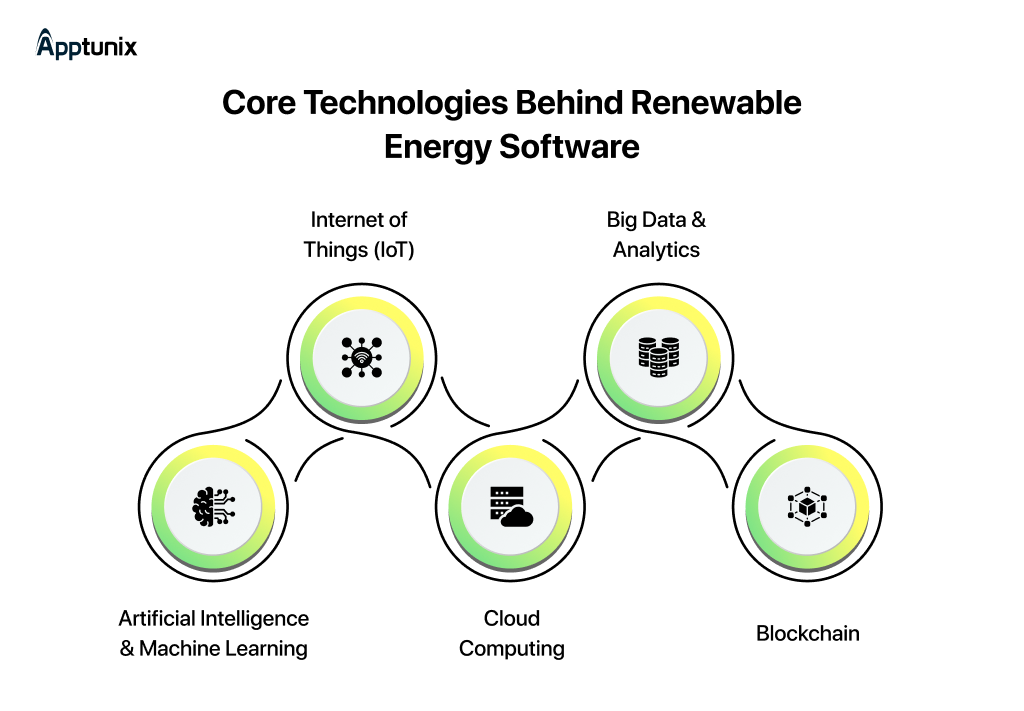
Renewables are unpredictable, supply shifts, demand spikes, and weather changes everything.
That’s why AI in renewable energy is showing up everywhere, from forecasting to automated decision-making.
Companies care because better predictions mean better pricing, fewer losses, and tighter operations. This is where margins get protected.
Without real-time data, you’re basically guessing.
That’s why IoT-based energy monitoring systems are foundational. Sensors on panels, turbines, and batteries feed constant signals back to the software.
The challenge isn’t collecting data. It’s handling messy, unreliable inputs at scale.
But when it works, operators get visibility they never had. And visibility turns into faster decisions, less downtime, and better output.
Renewable infrastructure is distributed by default. Different locations, different assets, constant data flow. That’s why cloud-based energy management software is becoming the default layer.
Companies care because the cloud gives flexibility to scale up, integrate faster, and update continuously. It turns energy systems into something you can actually manage, not just monitor.
There’s no shortage of data in this space. The problem is making sense of it. Panels, turbines, and grids all generate noise. The value comes from extracting patterns.
This is where predictive analytics for energy consumption becomes a real advantage. Not just reporting what happened, but anticipating what’s next.
For operators, this means fewer surprises. For businesses, it means better planning and stronger unit economics.
With decentralized generation, you now have multiple producers and consumers interacting in real time. Trust and transparency start to matter.
That’s where blockchain in energy trading comes in: tracking transactions, enabling peer-to-peer exchanges, and reducing dependency on centralized systems.
Companies care because it opens new revenue models. Not just generating energy, but actively trading it.
Even great ideas can fail if the software isn’t built the right way. These are the most common mistakes businesses make and how to avoid them.
Software that works for a few users may struggle when your business grows. A strong architecture keeps your platform fast, stable, and ready to scale.
Renewable energy platforms often need to connect with smart meters, IoT devices, ERP systems, and other tools. Poor integration leads to data gaps and inefficient operations.
Security and regulatory requirements shouldn’t be an afterthought. Addressing them early saves time, reduces costs, and prevents future issues.
Trying to build everything at once delays launches and increases costs. Start with the features that solve real business problems and expand from there.
Real-time monitoring and energy analytics need a reliable, high-performance tech stack. Choosing the wrong technologies can hurt speed, reliability, and future growth.
At Apptunix, we focus on building software that is scalable, secure, and future-ready. From planning and development to integration and deployment, we help businesses avoid costly mistakes and launch solutions that deliver long-term value.
The right development partner can accelerate your roadmap by years. The wrong one derails it. Use these tips to select the right one.
You get a dev shop that’s great at building software with excellent architecture and clean code. They’ve built 50 SaaS products. But they’ve never built for energy companies. They don’t know that grid interconnection takes 6 months and will cost only money.
You need someone who’s actually built renewable energy software development projects before. Not just energy projects. Not just software projects. Both together.
How do you check? Ask about their last three projects.
Off-the-shelf solutions are fast and cheap upfront. Pick a platform, configure it, and go live in 3 months. Looks good in a board meeting. But renewable energy companies rarely have the same workflows.
Custom renewable energy software development means starting from scratch. More expensive. Longer timeline. Here’s the real question: How differentiated is your energy business?
A good software development company will tell you honestly which way to go. Not always the way that makes them more money.
Green energy software development services should scale with you. Most dev shops build your MVP. Ship it. Move on to the next customer. They’re not thinking about what happens when you grow from 10 installations to 1,000.
You need a partner thinking about scale from day one. Not “we’ll optimize it later.” Now.
Ask your potential partner, “Walk me through how your architecture scales. What breaks at 1,000 customers? At 10,000?” If they give you generic answers about cloud and microservices, they’re not thinking deeply about it.
What happens after launch matters more than launch. Here’s the honest part: Building the software is the easy part.
Making it actually work for your customers. Handling edge cases. Fixing the bugs nobody thought of. Adding features based on real usage. That’s the hard part. That’s where most partnerships fall apart.
You need a partner who’s committed to post-launch success. Not as an add-on service; they upsell you. As part of how they work.
Renewable energy software development isn’t about the fanciest dashboard; it’s about infrastructure that actually works when the stakes are high. The companies winning this space aren’t the ones with the most features. They’re the ones with partners who’ve actually built renewable energy software before.
You need someone thinking about scale from day one, committed to post-launch success, and honest about what your business actually needs. Someone who understands that better predictions, fewer losses, and faster decisions are what protect margins.
At Apptunix, we provide software development solutions end-to-end:
We’ve handled the messy integration, scaled systems from pilot to enterprise, and stayed through the hard part: making it work for your customers.
Let’s build it right.
Q 1.What is renewable energy software?
Renewable energy software includes digital platforms for managing, optimizing, and integrating sources like solar, wind, and storage across their lifecycle. AI enhances this field through forecasting, grid optimization, and predictive maintenance. Energy management systems (EMS) monitor and control energy in smart grids for efficiency.
These tools support utilities and developers in performance tracking, efficiency gains, and sustainability. They cover solar, wind, hydropower, geothermal, and storage, aiding lifecycle management from generation to integration.
Q 2.How does AI help in renewable energy?
AI improves power forecasting using weather data and trends, reducing imbalances. It enables smart grid management, fault detection, and predictive maintenance to cut costs and downtime. Applications include optimizing solar output and wind energy distribution.
Q 3.What is an energy management system?
An EMS is software for monitoring, controlling, and optimizing electrical energy generation, flow, and use in grids. It integrates renewables, balances supply and demand, and reduces environmental impact. Key functions involve power sharing, distribution control, and efficiency optimization.
Q 4.How much does renewable energy software cost?
Monthly costs scale by system size: residential (5-20 kW) at $50-$200; commercial (100 kW-5 MW) at $1,000-$15,000; utility-scale (50+ MW) at $100,000+.
Development ranges from $25,000-$40,000 for MVP to $180,000+ for enterprise solutions with ongoing maintenance at $1,500-$4,000/month.
Q 5.Which technologies are used in energy software development?
Common stacks include Python, Java, and Node.js for the backend; React and Angular for the frontend and AWS/Azure for the cloud. IoT platforms like AWS IoT Core, databases (PostgreSQL, InfluxDB), and ML tools (TensorFlow, PyTorch) handle data and analytics. SCADA, big data, and edge computing support monitoring and forecasting.
Q 6.How long does it take to build renewable energy software?
The development timeline depends on the scope, integrations, and complexity of the platform. A basic MVP with dashboards and monitoring can take around 3 to 4 months, while a mid-level platform with analytics and automation may take 4 to 6 months. Enterprise-grade renewable energy software with AI forecasting, SCADA integration, and advanced security can take 6 to 12 months or more.
Q 7.Should businesses choose custom renewable energy software or off-the-shelf solutions?
Off-the-shelf solutions are faster to deploy and may work for standard operational needs, but they often become limiting when workflows, integrations, or reporting requirements grow. Custom renewable energy software is better for businesses that need flexibility, scalability, real-time control, and tighter integration with existing infrastructure. The right choice depends on how unique your operations and long-term goals are.
Q 8.Can renewable energy software integrate with IoT devices, smart meters, and SCADA systems?
Yes, modern renewable energy software can integrate with IoT sensors, smart meters, SCADA systems, battery storage platforms, weather APIs, and third-party analytics tools. These integrations help operators collect real-time data, automate decision-making, monitor asset performance, and improve energy forecasting. Strong integration capability is essential for building a connected and scalable energy ecosystem.
Q 9.What security and compliance features should renewable energy software include?
Renewable energy software should include role-based access control, data encryption, secure APIs, audit logs, backup and disaster recovery, and continuous monitoring. Depending on the market and deployment environment, it may also need to support industry-specific compliance, grid regulations, and cybersecurity standards. Strong security is critical because these platforms often manage operational data, remote assets, and infrastructure-level decisions.
Get the weekly updates on the newest brand stories, business models and technology right in your inbox.
With over 20+ years of experience in driving global digital initiatives, Nikhil Bansal is the CEO & Director of Apptunix. He specializes in orchestrating large-scale digital transformations, enterprise-grade software solutions, and high-level business strategies that redefine industry standards. Nikhil is known for his ability to bridge the gap between complex business challenges and innovative technology, helping Fortune 500 companies and startups alike achieve sustainable growth. A visionary leader, he empowers enterprises to navigate the digital landscape with agile, ROI-focused models and future-ready business strategies.
12 Views 11 min September 16, 2026
5 Views 11 min September 14, 2026

15 Views 11 min September 8, 2026
Book your consultation with us.
Book your consultation with us.


One Central, The offices 3, Level 3, DWTC, Sheikh Zayed Road, Dubai
+971 50 782 1690