
How to Build a Multi-Agent AI System for Supply Chain Forecasting and Procurement
11 Views 12 min July 30, 2026

With over 20+ years of experience in driving global digital initiatives, Nikhil Bansal is the CEO & Director of Apptunix. He specializes in orchestrating large-scale digital transformations, enterprise-grade software solutions, and high-level business strategies that redefine industry standards. Nikhil is known for his ability to bridge the gap between complex business challenges and innovative technology, helping Fortune 500 companies and startups alike achieve sustainable growth. A visionary leader, he empowers enterprises to navigate the digital landscape with agile, ROI-focused models and future-ready business strategies.

South Africa is home to more than 120,000 professional developers, the largest developer population of any country in Africa. Statista’s chart on Africa’s developer ecosystem puts real numbers behind what many international companies are already sensing: this isn’t a niche outsourcing spot anymore.
It’s a deep, mature market for software development talent to hire.
So if you’re trying to figure out how to hire software developers in South Africa the right way, this guide walks through the whole thing. What it costs, which hiring model actually fits your situation, what to watch out for, and how to avoid the mistakes that slow other companies down.
Before you pick a hiring model or a candidate, it helps to understand why this market is worth your attention in the first place. South Africa’s tech scene didn’t grow overnight.
Strong universities, a large English-speaking workforce, and a mature financial sector centered in Cape Town and Johannesburg all played a part.
The banking and fintech industry here has produced some genuinely skilled engineers over the last decade. Many of whom now work with international clients through remote development teams.
Here’s what makes the market stand out:
Rates sit well below the US and Western Europe, but the engineering standard stays high.
South Africa runs on GMT+2. That means near full overlap with the UK and Central Europe and a solid overlap with the Middle East too.
English is the default language for business. No translation delays, no confusion in code reviews or sprint calls.
Mobile development, cloud, and now AI and machine learning are all growing fast, pushed by local fintech and telecom investment.
Companies that outsource software development to South Africa aren’t settling for a cheaper option. They’re tapping into a market that combines cost, skill, and communication in a way few other regions do.

Once you know why South Africa makes sense, the real question is how to actually do this without wasting time or money.
This is the part most companies rush, and it’s exactly where things go wrong. Here’s the process we’d recommend to hire any software development individual in South Africa, step-by-step.
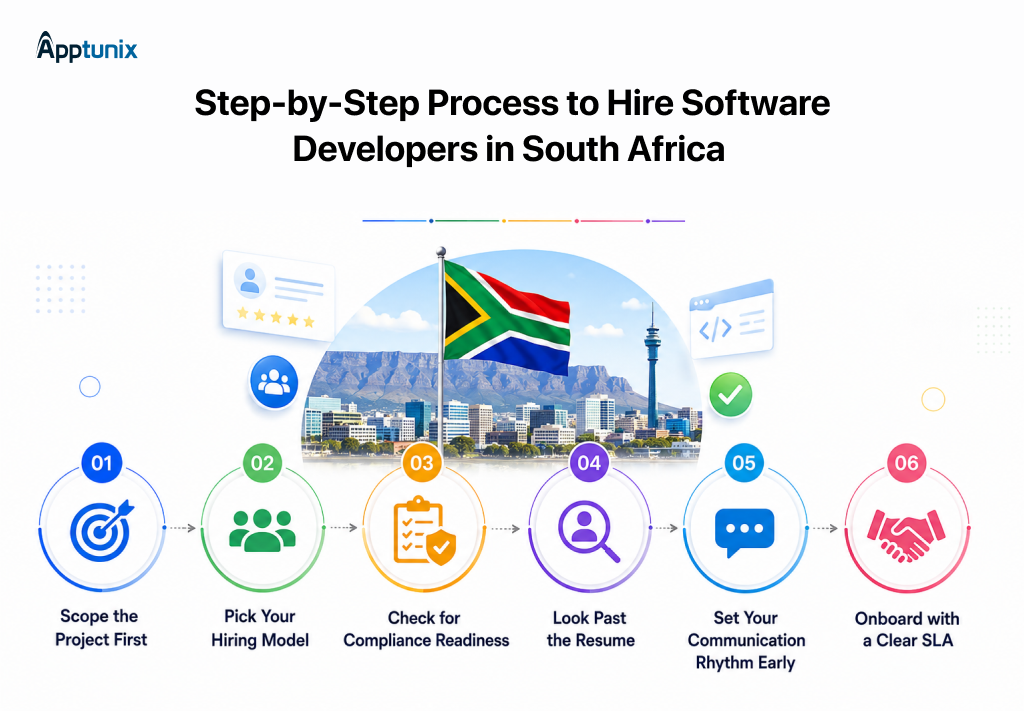
Every successful hire starts before you ever look at a candidate profile. You need to nail down what you’re actually building: the architecture, the tech stack, and any compliance work involved.
This is the groundwork that turns a vague “we need developers” request into a real, fundable project. It’s also the step most companies skip when they’re in a hurry to scale, and it’s usually the reason projects run over budget later.
Once you know what you’re building, you need to decide how you want to build it. A lot of companies default to the first option they hear about, usually freelancers or a quick outsourcing deal, without weighing what actually fits their timeline and budget.
The model you choose changes everything downstream: how much control you keep, how fast you can move, and what you’ll actually pay per hour once the work starts.
Compliance isn’t something you deal with after the fact. It should be part of how you evaluate every developer or partner from the start, especially if your product touches user data in any way.
South Africa’s data protection law, POPIA, mirrors a lot of what GDPR requires in Europe, so any serious partner should already be building with both in mind, not scrambling to catch up later.
Certificates and LinkedIn badges tell you very little about how someone actually works under pressure. What matters is a track record you can verify: real products that shipped, real clients who’ll vouch for the work, and a portfolio that goes beyond a polished case study slide.
If you’re planning to hire software developers for anything beyond a small task, this step deserves real time, not a five-minute skim.
Remote hiring lives or dies on communication. Before day one, agree on how often you’ll talk, how updates get shared, and who owns which decisions.
South Africa’s GMT+2 time zone makes this easier than most offshore markets, since it overlaps well with both Europe and the Middle East, which means real conversations instead of waiting a full day for a reply.
The final step is where speed actually shows up. With a structured partner, senior engineers can be sourced, vetted, and onboarded in as little as 48 hours.
But that speed only works because of everything before it. Skip the scoping, the compliance check, or the communication plan, and even a fast placement will run into friction within the first few weeks.

With your process mapped out, the next decision is who you’re actually hiring.
South Africa’s talent pool covers a lot more than basic web development, and knowing which specialty fits your project saves you from mismatched hiring.
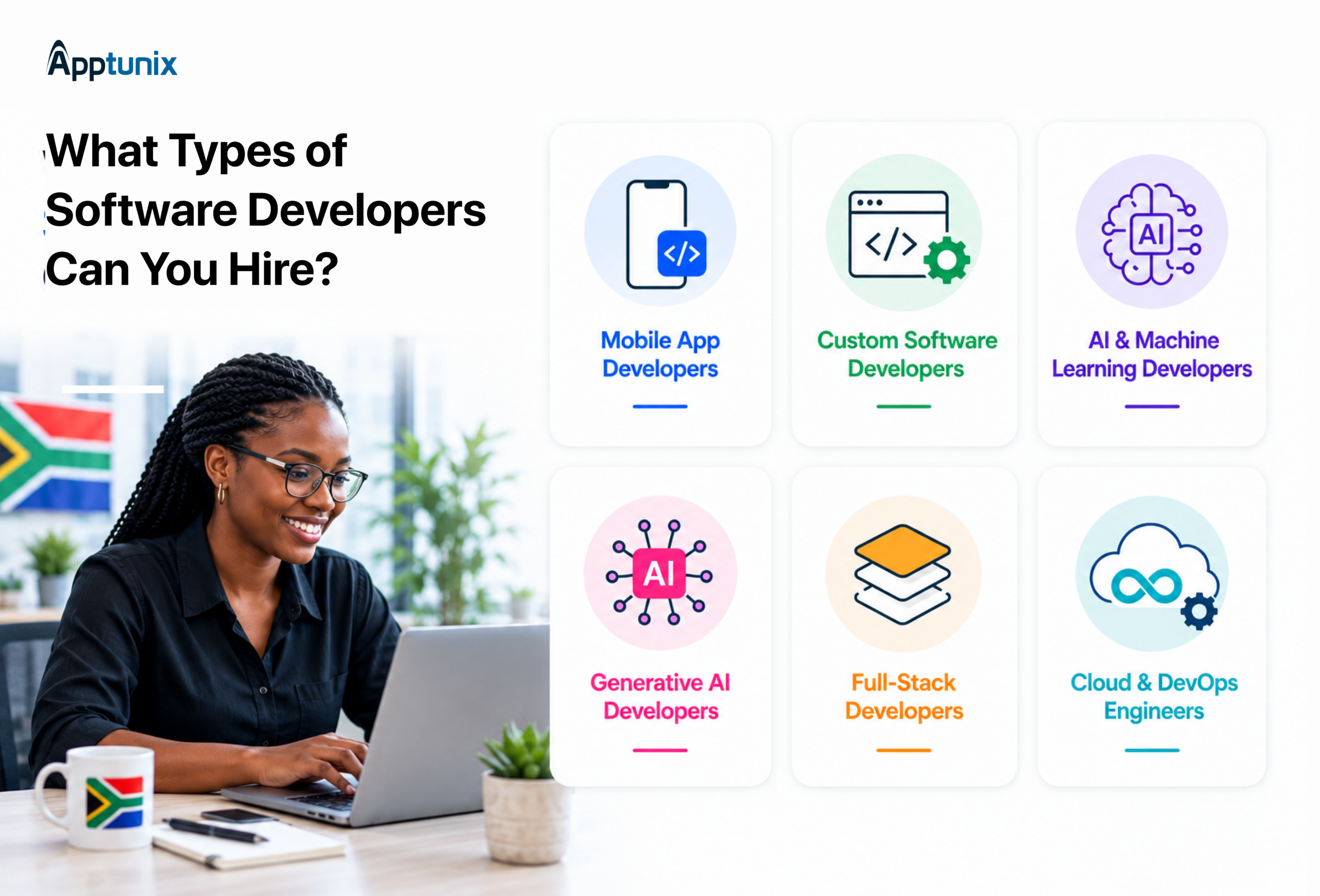
You’ll find strong iOS developers working in Swift, Android developers working in Kotlin, and cross-platform experts using Flutter and React Native.
If you’re building a consumer app or an internal tool, mobile app development services in South Africa cover everything from a simple MVP to a full enterprise rollout.
These are engineers who build software around your exact workflow, not a generic template pulled off a shelf. This matters if your product needs to be a real differentiator rather than just another tool in a crowded market.
A dedicated software development company can shape a build plan around your specific process instead of forcing you into theirs.
Engineers who can build predictive models, recommendation systems, and data pipelines that turn raw operational data into something you can actually act on.
Demand for this skill set has grown fast, and South Africa’s fintech sector has quietly produced developers who understand how to apply AI development solutions to real business problems, not just demo projects.
This is one of the fastest-growing specialties in the market right now. Think LLM integration, retrieval-augmented generation, and AI copilots built into existing products.
Companies working with generative AI development solutions early are already pulling ahead of competitors still running on older, static tooling.
These developers handle both backend and frontend, usually Node.js or Python paired with a modern frontend framework. A great fit for lean teams that need one person to own a feature end-to-end, without waiting on handoffs between separate backend and frontend hires.
Specialists in AWS and Azure, CI/CD pipelines, and containers. They build the infrastructure that lets your product scale without a full rebuild every time your user base grows. This role matters more than people expect once a product moves past its first few thousand users.
Now that you know what kind of developer you need, it’s worth revisiting how you’ll actually bring them on.
There’s no single best way to hire any software developer. It depends on how much control you want, how fast you need to move, and how long you need the team for.
| Hiring Model | Cost in ZAR | Control Over Team | Best Fit For |
|---|---|---|---|
| Freelancers | ZAR R280 to R2,000+ | Low | Small, short-term, well-defined tasks |
| In-House Developers | R280-R1,000+/hr | Low | Long-term core product teams with local presence |
| Staff Augmentation | ZAR R420-R1500+/hr | High | Scaling an existing team quickly without full HR overhead |
| Dedicated Development Teams | ZAR R330-R800/hr per developer | High | Ongoing product development with a stable, embedded team |
| Software Development Companies | ZAR R300-R1,500/hr | Shared | End-to-end delivery, especially without in-house tech leadership |
For most companies scaling into a new market, staff augmentation and dedicated teams work best. You get senior talent and real control over the output, without building an HR function from scratch.
Once you’ve settled on a model, cost is usually the next question, and it’s the hardest one to answer with a single number.
The cost to hire software developers in South Africa depends on seniority, specialization, and how complex your product actually is. Here’s a general benchmark to work from:
| Developer Type | Hourly Rate (RAND) | Hourly Rate (USD) |
|---|---|---|
| Junior developers (0–2 years) | R250,000-R450,000/year | $15,000-25,000/year |
| Mid-level developers (2–5 years) | R500,000-R800,000/year | $28,000-50,000/year |
| Senior developers (5+ years) | R800,000-R1,200,000+/year | $50,000-80,000+/year |
Note: These are approximate figures, based on current market benchmarks and USD to ZAR exchange rates. Specialized skills like AI, machine learning, or cloud architecture usually sit at the higher end.
Niche skills like generative AI, security, and cloud architecture cost more than general development work.
Freelance pricing looks very different from a managed, dedicated team with built-in QA and delivery support.
Integrations, compliance needs, and scale requirements all add to the real effort involved.
A blended team, a few seniors supported by mid-level engineers, is often cheaper than an all-senior team for the same output.
Cape Town and Johannesburg tend to sit at the higher end of the rate range, since demand and cost of living are both higher there than in smaller tech hubs.
Short-term, project-based work often carries a premium over a longer retainer, since a partner has to plan staffing around less predictable utilization.
A rate that includes a dedicated project manager, QA testing, and structured reporting will run higher than a bare developer rate, but it usually saves you money in rework down the line.
Since most engagements are billed in USD, GBP, or EUR against Rand-based delivery costs, exchange rate swings can shift your effective monthly spend, especially on longer contracts.
There’s no flat rate that fits every project. If you want an accurate number instead of a guess, it’s worth reviewing a full mobile app development cost in South Africa breakdown once you’ve scoped your product.
With a budget in mind, the last piece before you commit is knowing what actually separates a good hire from a risky one.
Beyond the tech stack, here’s what skill set you must look for when choosing software developers in 2026:
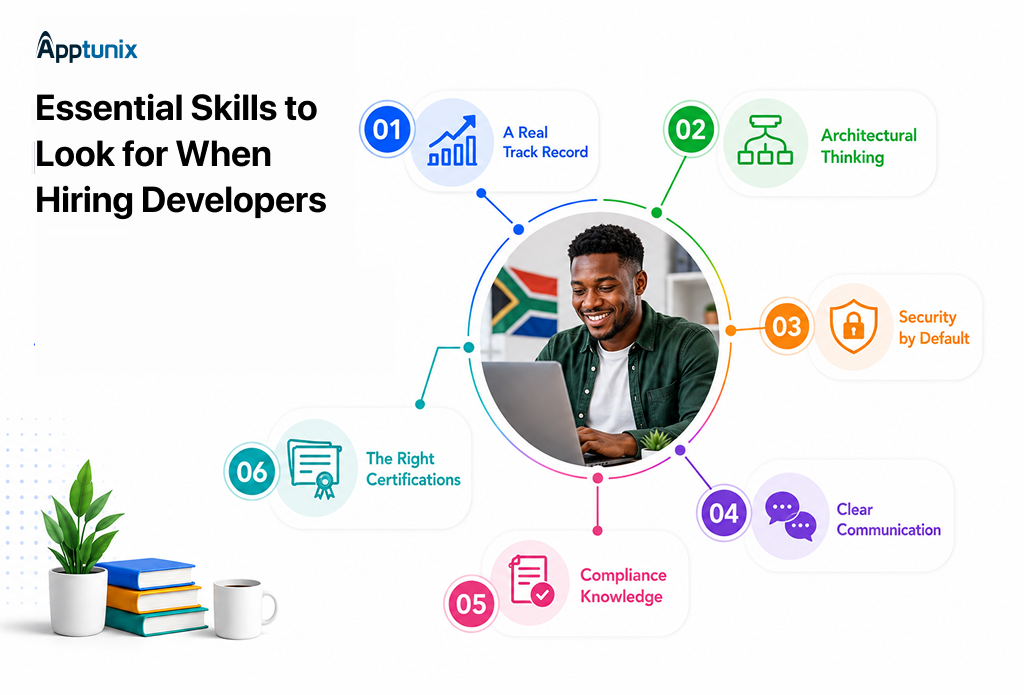
A live portfolio of shipped products beats a stack of course certificates every time.
Someone who designs for scale from day one, not just writes code that works today.
Data protection and secure coding should be built in, not bolted on later.
This matters even more when you’re working across time zones.
Familiarity with POPIA and GDPR, where it applies to your data.
ISO 27001 for security and ISO 9001 for quality are strong signals when you’re evaluating a partner rather than an individual freelancer.
Knowing what to look for is one thing. Actually asking the right questions on a call is where most of that gets tested. Here’s a simple checklist you can run through with any developer or software development company in South Africa before you sign anything, whether you’re hiring one freelancer or bringing on a full dedicated team.
Run through these before you commit to anyone, a freelancer or a full software development firm. It takes an extra hour upfront, and it saves you weeks of cleanup later.

Hiring in a new market comes with real risk. Quality can be inconsistent. Compliance gaps happen. Communication breaks down. Apptunix removes that risk by acting as the bridge between you and the talent market, not just a name on a contract.
With more than 3000+ projects delivered, we place senior engineers within 48 hours, backed by a vetting process built for quality.
South Africa’s GMT+2 zone overlaps well with Europe and the Middle East. That means real-time communication, not guesswork.
Every project follows GDPR and POPIA standards, backed by our ISO 27001 and ISO 9001 certifications.
No hidden billing, no surprise scope changes. You know what you’re paying for, from the first estimate to the last sprint.
With 13+ years of experience, our teams are built to speed up your launch timeline and control cost at the same time. Some clients have seen execution speed up by 3X.
If you’re ready to hire software developers in South Africa and want a partner who already knows the market, this is where that experience actually pays off.
Here’s our South Africa region portfolio: Apptunix’s portfolio South Africa.
We didn’t walk into the African market without experience. For Isuzu, we built a centralized dealer intelligence platform across their Africa sales network. Before this, their reporting was manual and scattered across different dealers.
After launch, reporting time dropped by 90%, and the team got real-time visibility across the whole network.
This is the kind of result you can expect when local market knowledge meets disciplined engineering. It’s also why companies trust us to do more than fill a role. We help build teams that actually move the business forward.
Read the full case study: ISUZU Automotive Enterprise App Case Study.
Q 1.How much does it cost to hire a software developer in South Africa?
Rates usually range from ZAR R250 to R470 ($15-$25) an hour for junior developers, up to ZAR R670 to R1100 ($40-$65) an hour for senior specialists. The exact number depends on the skill set and how complex your project is. Niche skills like generative AI or cloud architecture tend to sit above these ranges, while a blended team of mid-level and senior developers often costs less overall than an all-senior bench. Scoping your product first gives you a much more accurate number than any general average, and it’s the step most quick quotes skip.
Q 2.Is South Africa a good country to outsource software development to?
Yes. You get skilled, enterprise-grade engineers, an English-first work culture, and a time zone that overlaps well with Europe and the Middle East. That combination is hard to find elsewhere at this price point. It’s also a market with real depth rather than a handful of standout names, so you’re not competing with every other company for the same small pool of senior talent.
Q 3.Which hiring model is best for a startup versus an enterprise?
Startups usually do best with staff augmentation or a dedicated team. You get senior talent and real control without building an entire HR function. Enterprises often go with a mix: a core in-house team, plus staff augmentation or a full-service partner for specialized or fast-moving projects. The right fit usually comes down to how predictable your workload is. Steady, ongoing work justifies a dedicated team, while short bursts of specialized work are often handled better through staff augmentation.
Q 4.How long does it typically take to hire a dedicated developer or team in South Africa?
With the right partner, this moves fast. Senior engineers can be vetted and placed in as little as 48 hours. Compare that to the weeks or months a typical in-house hiring process takes. Building a fully dedicated team usually takes a little longer, closer to one to two weeks, since it involves matching multiple roles and skill sets rather than a single hire.
Q 5.What industries commonly outsource software development to South Africa?
Fintech, banking, automotive, e-commerce, and telecom are some of the biggest industries hiring out of South Africa. The market is especially strong in backend, mobile, and enterprise platform work. Additionally, healthcare and logistics companies have also started tapping into the market more, mainly for data-heavy platforms and internal tools that need to scale without a large upfront engineering hire.
Q 6.How can I verify the quality of a South African software development company?
Check for certifications like ISO 9001 or ISO 27001. Look at a live portfolio of shipped work. And always ask for client references before you sign anything. A quick 15-minute call with a past client usually tells you more about how a team actually works than any case study on their website.
Q 7.Do I need a local legal entity in South Africa to hire developers there?
No, not if you’re working with a development partner or an outsourcing model. Most companies hire through staff augmentation, a dedicated team, or a development company, and the partner handles local employment, payroll, and compliance on their end. You only need a local entity if you’re planning to hire developers directly as full-time employees on your own payroll.
Q 8.What's the best way to manage communication with a remote South African development team?
Set a fixed cadence early: daily standups, weekly sprint reviews, and a single point of escalation for issues. South Africa’s GMT+2 time zone makes live communication easier than most offshore markets, so it’s worth scheduling real syncs instead of relying only on async updates. Tools matter less than the habit of talking regularly. Even a quick 15-minute call can catch issues that get missed in a Slack thread.
Q 9.Can I start with a small pilot project before committing to a larger team?
Yes, and it’s usually the smarter move if you’re hiring in South Africa for the first time. A small, well-specified pilot lets you test how a developer or team actually works, how they communicate, and how they handle unexpected issues before you commit to a longer engagement. Most staff augmentation and dedicated team models are built to flex this way, so scaling up later is straightforward once you’re confident in the fit.
(1 ratings, average: 5.00 out of 5)
Get the weekly updates on the newest brand stories, business models and technology right in your inbox.
With over 20+ years of experience in driving global digital initiatives, Nikhil Bansal is the CEO & Director of Apptunix. He specializes in orchestrating large-scale digital transformations, enterprise-grade software solutions, and high-level business strategies that redefine industry standards. Nikhil is known for his ability to bridge the gap between complex business challenges and innovative technology, helping Fortune 500 companies and startups alike achieve sustainable growth. A visionary leader, he empowers enterprises to navigate the digital landscape with agile, ROI-focused models and future-ready business strategies.
11 Views 12 min July 30, 2026
14 Views 12 min July 28, 2026
12 Views 12 min July 27, 2026
Book your consultation with us.
Book your consultation with us.


One Central, The offices 3, Level 3, DWTC, Sheikh Zayed Road, Dubai
+971 50 782 1690


Offer Ends Soon
Get a quick expert response in under 5 minutes.