
AI Compliance Automation: How AI Is Transforming Regulatory Compliance
36 Views 8 min October 13, 2026

Reena Bhagat is a seasoned technology strategist with a deep-rooted expertise in emerging technologies. She began as an engineer in Android and React Native, moved into Delivery Manager and Program Manager roles, and now leads AI at Apptunix, setting the technical vision for high-performance SaaS infrastructure across AI and ML integration, product engineering, and cloud management. Her programs land on time, within scope, and aligned with strategic objectives, and the systems behind them are secure, scalable, and decentralized.
Let’s Be Honest: This Isn’t a Simple Choice
If you’re researching Replit vs custom software development in 2026, you’re facing a real decision. Build fast with managed tools, or invest in software built to actually grow with your business?
The answer seems obvious until you dig deeper. Replit gets you to market fast, great for MVPs and proof-of-concept work. But custom development does something different: it builds the foundation you’ll live with for years. The cost delta keeps shrinking. The capability gap? That’s widening.
The real question isn’t speed vs. custom anymore. It’s whether you’re building something to test today or something that scales tomorrow. Choose wrong, and you’ll feel it in technical debt, locked-in costs, and missed opportunities.
Replit is a cloud-based IDE (Integrated Development Environment) that lets you code directly in your browser with built-in AI assistance.
No installation. No environment setup. Just open it and start building.
There are several reasons why people prefer Replit over custom software. These include:
Here’s the part most people don’t discuss until it’s too late.
Replit is incredible until your application actually needs to grow.
The Real Limitations:
Custom software development is building software specifically designed for your business.
The custom development benefits you with full control of the architecture, security, scalability, and experience.
This is where custom software development services differ fundamentally from platform-based tools like Replit.
Here’s exactly the process that your enterprise software development partner should follow:
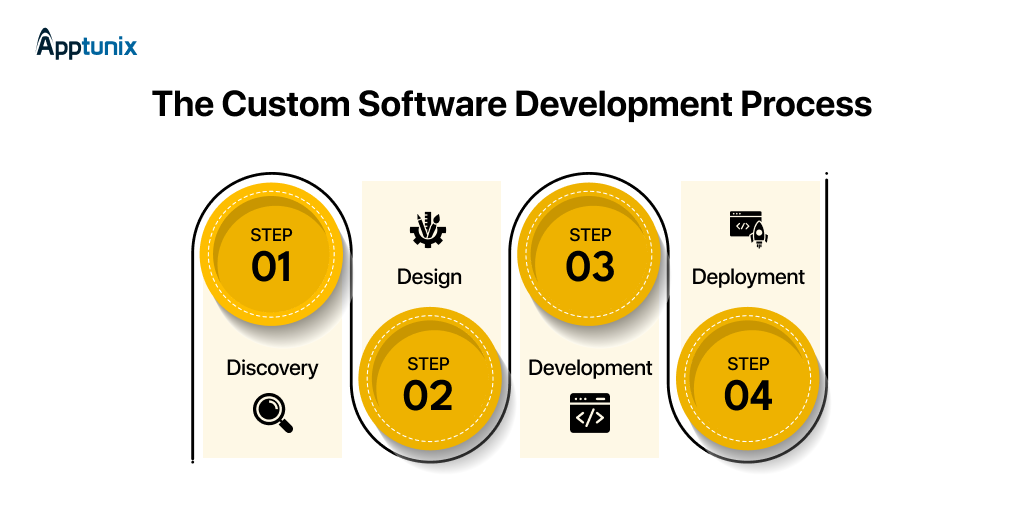
The discovery phase is the foundation of professional custom software development.
The custom software development company you partner with must take this initial step before getting started with the coding process.
Unlike Replit’s “just start coding” approach, we invest time in understanding:
Not skipping this phase, like Replit encourages (as they will encourage you to do), leads to rebuilding later. We skip nothing.
Design in web application development is about creating something your users will actually love.
This phase includes:
Replit skips this entirely. You code first, design later (if ever). That’s backward.
This is where AI-powered software development meets professional engineering practices.
We leverage cutting-edge AI tools while maintaining enterprise-grade quality standards:
Replit: Code → Deploy. Done. No testing framework. No optimization strategy. Just hope it works.
Professional custom software development services include:

This structured methodology is why custom software development outperforms quick-and-dirty platform solutions.
| Factor | Replit | Custom Application Development |
|---|---|---|
| Development Speed | Hours–Days (Fast but incomplete) | Weeks–Months (Structured & complete) |
| Cost | Low upfront ($0–500/month) | Higher upfront, predictable long-term |
| Scalability | Limited at scale, significant constraints | Unlimited, enterprise-grade scaling |
| Customization | Platform constraints limit options | Build anything you imagine |
| Security | Good baseline, platform-defined limits | Enterprise-grade, fully customizable |
| Development Process | Ad-hoc, no structured approach | Discovery → Design → Development → Deployment |
| Vendor Lock-in | Yes, completely dependent | No, you own everything |
Be fair: Replit is genuinely useful in specific situations.
Now this is where things shift dramatically.
The reality: Most businesses that start with platform solutions eventually realize they’re outgrowing them.
This is where Replit vs custom software development scalability becomes a fundamental difference.
Enterprise software engineering requires:
Can Replit do this?
Technically, maybe. Practically, absolutely not.
Enterprise software development demands a foundation Replit simply wasn’t built for.
One of the most important factors influencing many people’s decisions is the price they would pay to build an app via either method. So let’s do a quick comparison to decide which method will cost you the most.
Replit’s Pricing Model:
Replit looks cheap on day one. The free tier is genuinely useful for learning and small projects. But the moment you go into production:
Quick math: A team of 4 developers + infrastructure for a basic production app = $600-1,500/month before you’ve shipped anything serious.
Custom Software Development:
Initial investment is front-loaded, but here’s the breakdown:
Replit’s unit economics collapse as you scale:
| Cost Factor | Replit | Custom Software |
|---|---|---|
| Team Collaboration | Expensive per user | One-time investment |
| Custom Features | Limited or impossible | Built-to-spec |
| Data Privacy & Compliance | Third-party dependency | Full control |
| Performance at Scale | Rapidly degrading ROI | Predictable costs |
| Vendor Lock-in | Migration is painful | You own it |
| Support & SLAs | Community-based (standard tier) | Contractual guarantees |
Year 1-2 scenario: A SaaS startup on Replit with 50 users and growing might pay $8K-15K/month. The same app on custom infrastructure: $4K-8K/month, plus you own the codebase.
This is where custom development wins decisively.
Replit trajectory (5 years):
Custom software trajectory (5 years):
The crossover point: 18-24 months. After that, custom development becomes cheaper, and you own the asset.
Don’t build custom for:
When outsourcing your mobile app or custom software development, you should look at all the aspects of pricing and must clearly convey your requirements. This would not only help you get a clear estimate upfront but also help you avoid any surprise costs in the future.
Also Read: How Much Does Custom CRM Software Development Cost in 2026
Replit charges you for convenience. You’re renting a platform with vendor lock-in, limited customization, and cost structures that punish scale.
Custom development charges you upfront for ownership. You get control, scalability, integration capability, and an asset that doesn’t depreciate.
The choice comes down to this: Do you need to get to market fast and pivot quickly? Or do you need to build something that survives contact with customers, scales profitably, and remains competitive in 2027?
For idea validation, prototype creation, and development at the initial stages, Replit is a great platform. It accelerates teams to test ideas, rapidly develop, and swiftly launch products. It’s a great solution for start-ups and innovators to rapidly convert ideas into solutions that work with little friction.
However, when a platform needs to be launched quickly while also supporting long-term growth, ownership, scalability, security, and reliability, businesses need more than just a rapid development platform. With a professional custom software development company, businesses can have the flexibility and control they need to meet their ever-changing needs. It makes sure that technology supports business and not the other way round.
The most successful scaling companies are not those that are refocusing on their products because they grew out of their tools. They are the ones who have made the right choice of foundation since the beginning. Early investment in custom development means that they will not be stuck with expensive migrations and can build systems that can expand as needed.
There is an advantage to moving quickly and gaining momentum, but this momentum needs to be built on a sustainable basis. Custom Software allows companies to break the constraints of off-the-shelf software and expand without interference. This means less time dealing with technical issues and more time dedicated to growth, customers, and competitive advantage.
If you’ve decided custom software development is right for your business, you don’t need to figure it all out alone.
At Apptunix, we specialize in application development using our proven 4-phase methodology.
Whether you’re building enterprise software, custom web applications, or leveraging AI-powered solutions, we’ve got the expertise.
No hype. No shortcuts. Just software built right.

Q 1.What's the difference between Replit vs custom software development for startups?
Replit is perfect for pre-launch validation. Custom software is essential once you have customers. However, startups going for a custom software development from day one gain an 18-24 month competitive advantage.
Q 2.Is Replit good for building production applications?
For small-scale apps with light traffic, yes. For anything serving customers where uptime matters, no. Enterprise software development requires reliability that Replit can’t guarantee.
Q 3.What's the cost comparison: Replit vs custom software development cost?
Replit: $0-500/month initially, then escalates unpredictably. Custom development: Higher upfront investment, then predictable maintenance costs. Over 3 years, custom typically costs 40% less (accounting for rebuilds on Replit).
Q 4.Can I start with Replit and switch to custom development later?
Yes, but it’s expensive. You’ll need data migration, system redesign, and team retraining. Starting with custom development from day one is often cheaper than this transition.
Q 5.What makes enterprise software development different from Replit?
Enterprise software requires security compliance, scalable architecture, redundancy systems, and regulatory adherence. Replit handles none of these. Enterprise software development is purpose-built for these demands.
Q 6.Is custom application development worth it for small teams?
Absolutely, if the software drives your business. Even small teams benefit from the structured methodology and professional foundation that custom development provides.
Q 7.What about AI-powered software development? Can Replit do that?
Replit has AI-assisted coding. But professional AI-powered software development integrates AI strategically throughout your application for competitive advantage, something platform tools can’t fully support.
Q 8.How long does custom web application development take?
Simple apps: 6-8 weeks. Medium complexity: 3-4 months. Enterprise: 6+ months. This includes discovery, design, rigorous testing, and deployment, the phases Replit skips entirely.
Q 9.What's the biggest mistake in Replit vs custom software development decisions?
Focusing only on speed without considering scalability. Most businesses eventually realize their platform-built solution limits growth. Planning for future needs from day one saves money and headaches.
Q 10.Can custom software development platforms compete with traditional approaches?
No. Software development platforms have inherent constraints. True custom development gives you unlimited possibilities, the opposite of platform limitations.
Q 11.Why is the 4-phase development process important?
Each phase builds on the previous. Discovery informs Design. Design guides Development. Proper Deployment ensures success. Skipping phases (like Replit encourages) creates expensive problems later.
Q 12.Which is better: Replit or traditional software development?
If “traditional” means professional custom software development with structured methodology, custom wins every time for serious projects. Replit wins for quick experiments only.
Get the weekly updates on the newest brand stories, business models and technology right in your inbox.
Reena Bhagat is a seasoned technology strategist with a deep-rooted expertise in emerging technologies. She began as an engineer in Android and React Native, moved into Delivery Manager and Program Manager roles, and now leads AI at Apptunix, setting the technical vision for high-performance SaaS infrastructure across AI and ML integration, product engineering, and cloud management. Her programs land on time, within scope, and aligned with strategic objectives, and the systems behind them are secure, scalable, and decentralized.
36 Views 8 min October 13, 2026

52 Views 8 min October 8, 2026

79 Views 8 min October 8, 2026
Book your consultation with us.
Book your consultation with us.


One Central, The offices 3, Level 3, DWTC, Sheikh Zayed Road, Dubai
+971 50 782 1690