Medicine Delivery App Development: Step-by-Step Guide for 2026
21 Views 10 min September 14, 2026

With over 20+ years of experience in driving global digital initiatives, Nikhil Bansal is the CEO & Director of Apptunix. He specializes in orchestrating large-scale digital transformations, enterprise-grade software solutions, and high-level business strategies that redefine industry standards. Nikhil is known for his ability to bridge the gap between complex business challenges and innovative technology, helping Fortune 500 companies and startups alike achieve sustainable growth. A visionary leader, he empowers enterprises to navigate the digital landscape with agile, ROI-focused models and future-ready business strategies.

Have you ever thought what’s more expensive than building software right the first time? Well, it’s rebuilding it again as the team ignored compliance the first time.
GDPR is the General Data Protection Regulation, which stands as one of the strongest privacy and security compliance regulations globally. GDPR applies to any organisation that processes and manages personal data of individuals in the EU or EEA, regardless of where the company itself is based.
“According to DLA Piper’s GDPR Fines and Data Breach Survey, regulators have issued more than €7.1 billion in GDPR fines since enforcement began in 2018”.
But fines only address the surface-level problem. Delayed launches, lost customer trust, emergency engineering sprints, and disrupted operations impact businesses more than the penalty itself.
That is why teams can no longer treat GDPR as a legal checklist to review before launch. It belongs in the product from day one, which means it’s engineered in, not added on. Most businesses still treat privacy compliance as the last thing to review before launch.
Teams end up patching consent flows at the last minute, leaving audit trails incomplete, data ownership unclear, and legacy architecture that costs more to fix with every passing sprint.
In practice, most GDPR failures are not legal failures, but they are more architectural ones.
At Apptunix, we’ve seen enterprises lose time and budget while trying to upgrade privacy controls in systems that were never designed for them. The smarter route is building compliance into discovery, architecture, development, and QA from the beginning.
This is the same principle behind how we approach enterprise software development, as security and compliance here are architectural decisions, not final touchups.
For most, GDPR seems like a legal document, but for the software team its different. It translates into technical decisions about architecture, data flows, access controls, and system behaviour.
GDPR compliance is built on seven core data protection principles. Each principle directly shapes how your software should be designed and how personal data should be handled. Take a look at the table below on each principle to see what it demands from your codebase.
Let’s discuss what GDPR software requirements look like when translated into engineering work.
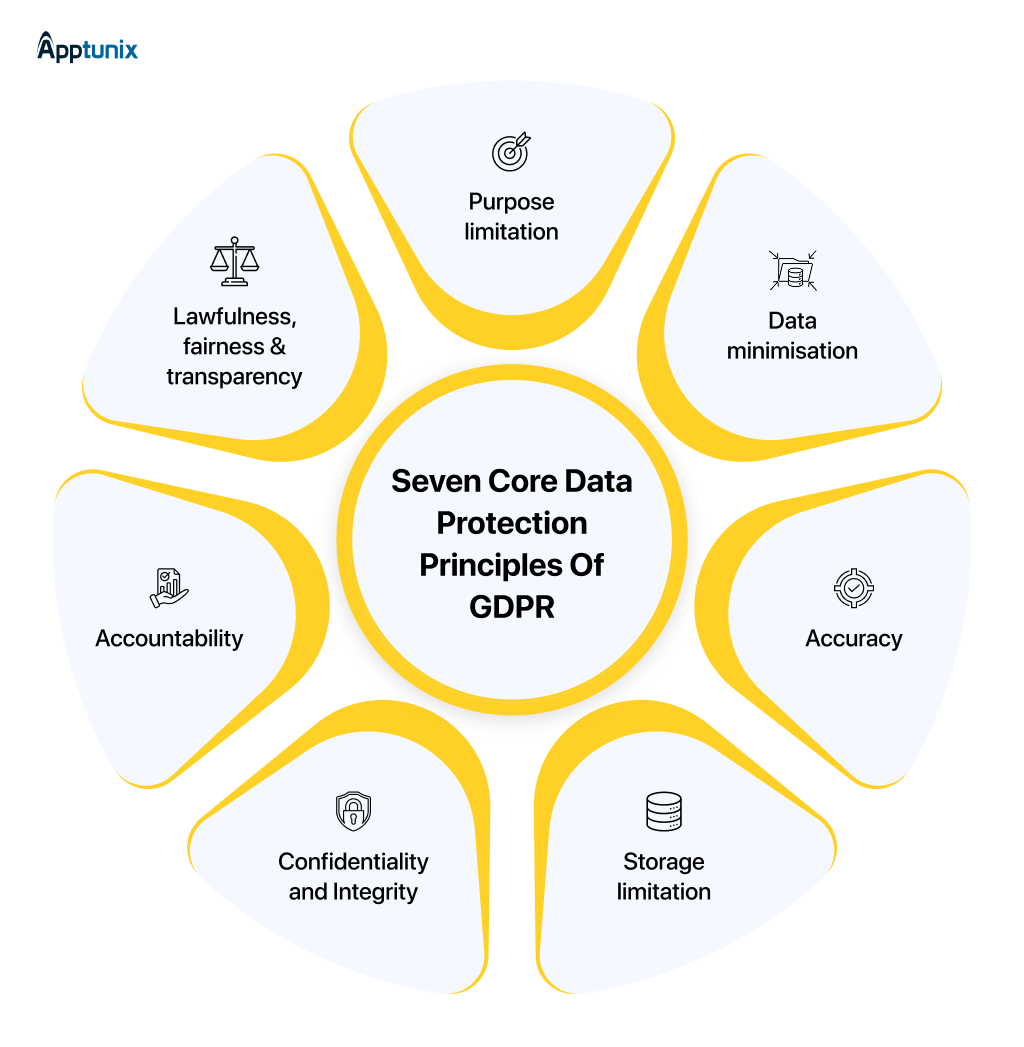
Along with these seven principles, GDPR creates four specific rights your software must support. These are not optional features, but they are legally enforceable obligations that your users can invoke at any time.
->Right of Access: Users can request a complete copy of the personal data you store about them. Your system should have a clear subject access request process that can gather and deliver this within 30 days.
->Right to be Forgotten: Users can request the permanent deletion of all their personal data and records. Centralized systems handle this more easily, but teams face far greater complexity in microservice setups with separate databases, connected third-party tools, and cached data, so they should plan for it from the start.
->Right to Portability: Requires that users can receive their data in a structured, machine-readable format. This means building data export endpoints, typically JSON or CSV, as a standard part of your user data layer.
->Right to Object: Users can object to certain types of processing, including automated decision-making. If your software uses any form of profiling or automated logic that affects users, you need mechanisms to flag, pause, or exclude individual users from those processes.
This is especially relevant in 2026 as more enterprise software incorporates AI-driven features. If your product uses machine learning to make or influence decisions about users, such as credit scoring, content filtering, or hiring tools, Article 22 of the GDPR imposes specific obligations on transparency, human oversight, and the right to contest automated outcomes.
It is an area most development teams overlook entirely.
Every enterprise that has to go through costly compliance fixes has one thing in common, and that is the delay in integrating GDPR compliant software.
The smarter approach is to treat GDPR the same way you treat security or performance. It should guide product decisions from the beginning, not be added after development is complete. When privacy is built into the processes early, it avoids delays, rework, and unnecessary risk later.
GDPR also requires you to notify regulators within 72 hours of discovering a data breach. This means your incident response process needs to be built and tested before launch, not written the night a breach occurs.
Let’s understand the different phases of bringing it into practice.
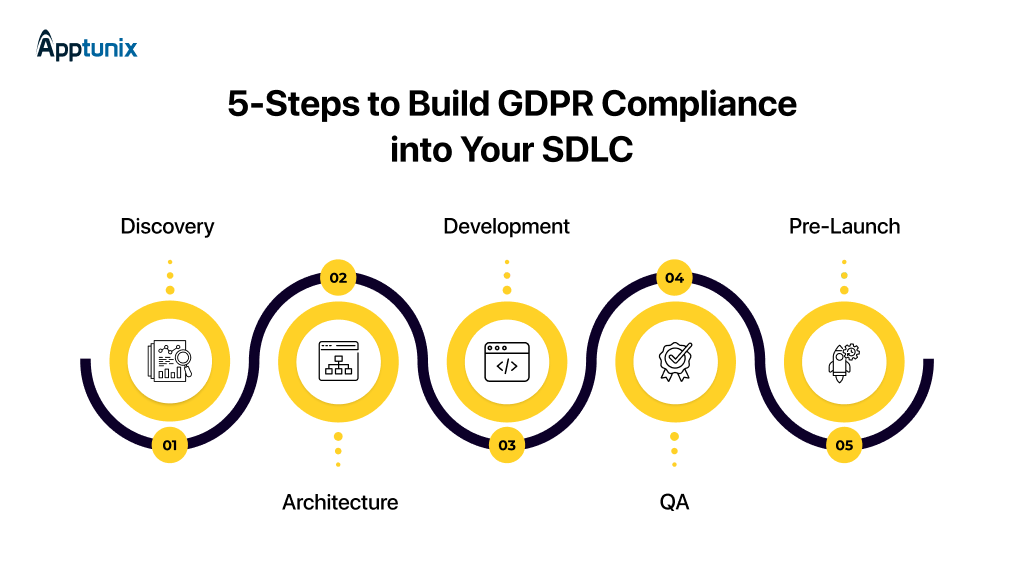
Before you jump into the coding part, your team needs to be clear about certain questions:
Here comes the importance of Data Protection Impact Assessment (DPIA). It helps to detect sensitive data flows, third-party risks, and compliance gaps early.
A clear data map, processing records, and a list of GDPR requirements that frame the product roadmap from the start.
Privacy by design means building privacy into the product structure before development begins. If you are building on a legacy codebase, this phase requires extra attention as legacy system maintenance costs multiply significantly when security and compliance were never part of the original architecture.
This involves practical decisions such as:
To keep GDPR on track during development, include it in feature requirements.
For example:
Testing is more than bugs and usability; it also assures correct handling of personal data
This includes checking:
Before launch, key compliance documents should already be prepared.
They usually include:

This is the question most enterprises ask once they understand the scope of what is GDPR compliance in practice. And it is justified because the cost varies significantly depending on one key decision: whether you build compliance in from the start or try to induce it later.
Let’s break down the honest pricing modules:
When GDPR compliance software development includes compliance from the first day, it typically adds 15 to 25 per cent to your total development budget.
Here is what that investment actually buys you:
The range is wide, as the variables like architecture complexity, volume of third-party integrations, and data sensitivity are broad too.
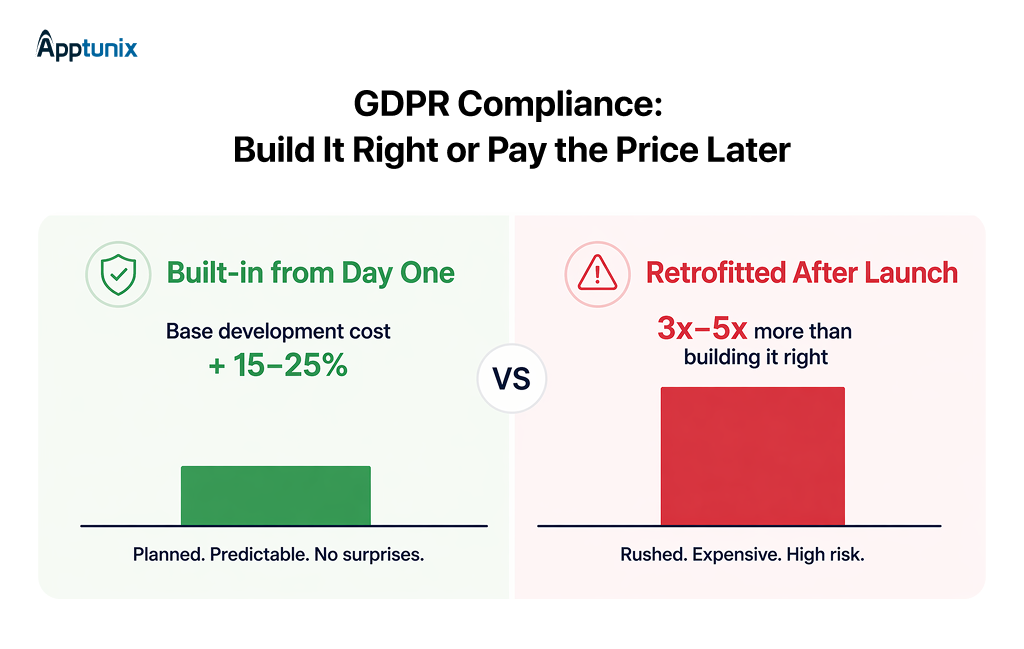
If you leave it aside to integrate GDPR compliance into software products later, then costs spike up to 3x to 5x times more. Assembling GDPR software requirements later means changing foundations, not adding features. This leads to revising almost every part of your system once, and that’s complicated.
Enterprises comparing the custom software development cost versus generic solutions often discover that compliance is the deciding factor to adapt in a specific way your system needs to handle personal data, or just stick to ordinary processes.
As most development parts take GDPR compliance secondary, something they handle towards the end of a project. A checklist to review before launch, or maybe a legal sign-off before going live. This is not how we work.
At Apptunix, our approach is different; we think about the GDPR compliant software development from the very first conversation and plan the rest considering it.
That’s how it looks in practice when you work with us, as we prioritise quality over cost in IT partnerships.
1 We start with your data, not your codeBefore any development begins, we sit down with your team and ask a simple set of questions. What personal data will your system collect? Where does it go? Who can see it? And why does your business actually need it?
These questions sound straightforward. But the answers directly shape how your system is built and how much it costs to keep it compliant down the line. Getting this right at the start saves significant time, money, and stress later.
This is especially important for enterprises handling sensitive information, whether that is financial records, health data, or personal data at scale. The earlier these conversations happen, the better the outcome.
2 Compliance is built in, not bolted onEvery product we build starts with three things in place before development begins: we collect only the data fields you actually need, encrypt all data by default, and restrict access to personal information to authorised people and systems only.
This means by the time your product goes live, you are not rushing to verify compliance. It is already in the product. That’s the way we design, code, and document that comes with it.
3 Your developers build it, so they own itOne of the most common reasons enterprise builds fail on GDPR software compliance is simple: the compliance requirements are in a separate document that the development team rarely visits. Everything seems fine until the end of the project, when gaps suddenly come to the surface; it gets expensive to fix.
We solve this by making compliance part of the development work itself. Consent logging is operational within the authentication segment, while data deletion is a part of the data management section. Access control requirements sit inside the relevant feature tickets.
That’s how we make sure that nothing falls through the cracks.
4 We deliver more than just working softwareOnce we finish the development process, our handover involves three documents that most development partners do not provide as standard.
->Records of Processing Activities: It’s a legally required document under Article 30 that lists every type of personal data your system processes and why your system processes it.
-> Privacy notice- Written to reflect how your system actually works, not copied from a generic template.
-> Incident response runbook- A clear, step-by-step guide for what your team does if a data breach occurs. GDPR gives you 72 hours to notify regulators. This document means you are not figuring out the process in the middle of a crisis.
GDPR compliance for software products is not one-size-fits-all. The risks, the data types, and the regulatory overlap are different depending on your industry. We work regularly across:
->In Fintech and Banking software development, where GDPR sits alongside PCI-DSS and financial data regulations.
->In Healthtech, where patient data carries the strictest compliance requirements of all.
->In HR and workforce platforms, employee data across multiple EU countries needs particularly careful handling.
->In SaaS platforms, where personal data moves across multiple customers, regions, and third-party tools at the same time.
->In E-commerce and retail, where consent, cookies, and customer data are under constant regulatory scrutiny.
If your business falls under any of these, the best time to enter this debate is once you finalize the architecture. Whether you are thinking of introducing a new system or maybe updating an existing platform.
Building GDPR compliant software the right way from the start costs significantly less than fixing it later. We have worked with enterprises on both sides of that situation. The difference in time, cost, and stress is not small.

Q 1.What is GDPR compliance in software development?
GDPR compliance in software development means building your product so it collects, stores, and deletes personal data according to the regulation. By enabling consent management, access controls, audit trails, and documented data flows.
Q 2.What are the core GDPR software requirements developers must implement?
Key GDPR software requirements include consent logging, right to erasure workflows, data portability endpoints, role-based access controls, encryption by default, immutable audit trails, and records of processing activities.
Q 3.How much does GDPR-compliant software development cost?
GDPR compliance software development typically costs between $30,000 and $300,000, depending on system complexity, data sensitivity, and the number of third-party integrations. Integrating compliance later costs three to five times more.
Q 4.What is Privacy by Design in GDPR?
Privacy by Design is given under Article 25, which means data protection is built into your system architecture from the start, not added afterwards. It is a core principle of GDPR-compliant software development.
Q 5.How do I make an existing system GDPR compliant?
Start with a gap analysis against the current gdpr software requirements. Common fixes include rebuilding consent flows, adding erasure workflows, and reviewing third-party data agreements — all significantly cheaper when done early.
Q 6.What are the risks of using software that is not GDPR compliant?
Software that does not comply with GDPR can expose businesses to regulatory penalties, data privacy issues, security risks, and loss of customer trust. Businesses may need to identify compliance gaps and implement measures such as consent management, access controls, data protection, and deletion workflows to address them.
Q 7.Can Apptunix help make an existing platform GDPR compliant?
Yes. Apptunix can help assess an existing platform for GDPR-related gaps and implement the required technical changes, such as data access controls, consent management, encryption, and data deletion workflows. However, legal compliance should also be reviewed with a qualified privacy professional.
(1 ratings, average: 5.00 out of 5)
Get the weekly updates on the newest brand stories, business models and technology right in your inbox.
With over 20+ years of experience in driving global digital initiatives, Nikhil Bansal is the CEO & Director of Apptunix. He specializes in orchestrating large-scale digital transformations, enterprise-grade software solutions, and high-level business strategies that redefine industry standards. Nikhil is known for his ability to bridge the gap between complex business challenges and innovative technology, helping Fortune 500 companies and startups alike achieve sustainable growth. A visionary leader, he empowers enterprises to navigate the digital landscape with agile, ROI-focused models and future-ready business strategies.
Book your consultation with us.
Book your consultation with us.


One Central, The offices 3, Level 3, DWTC, Sheikh Zayed Road, Dubai
+971 50 782 1690