
PIPEDA Compliance Checklist for Mobile Apps in Canada (2026): Everything Developers Need to Know
86 Views 11 min June 9, 2026

Pallavi Nautiyal is a seasoned Tech Consultant at Apptunix, specializing in the intersection of global finance and decentralized technology. With a deep-rooted expertise in banking infrastructure, digital payment gateways, and Web3 ecosystems, she guides businesses through the complexities of modern financial engineering. Pallavi is recognized for her ability to architect secure, compliant, and scalable solutions—ranging from smart contracts and crypto-wallets to robust digital banking platforms. Her strategic insights help organizations navigate regulatory landscapes while leveraging the power of Blockchain to ensure transparency and seamless user experiences in every transaction.
Building custom software is a high-stakes decision for any business. Whether you’re launching a SaaS product or modernizing enterprise systems, the vendor you choose can directly impact your timelines, budget, and product quality.
This is where a software development RFP (Request for Proposal) becomes critical.
A well-structured RFP for software development does more than just invite proposals. It helps you clearly define your requirements, align internal stakeholders, and evaluate vendors using a standardized framework. Without it, businesses often face common challenges such as scope creep, miscommunication, delayed timelines, and unexpected costs.
In fact:
Despite this, many companies either skip the RFP process or create overly generic documents that fail to attract the right vendors.
So, if you are wondering how to write an rfp for software development, you’re at the right place.
In this blog, we will cover everything from key concepts and structure to a practical sample RFP for software development, along with a modern evaluation framework to help you select the right development partner.
An RFP (Request for Proposal) is basically a blueprint. It’s the document that forces you to think clearly about what you actually need before you spend money on it. And many founders tend to skip this step.
Here’s what a solid software development RFP does for you:
Around 52% of software projects experience scope creep, according to studies on IT project management. The majority of that creep happens because expectations weren’t clearly defined upfront. An RFP isn’t a cure-all, but it’s preventative medicine.

Before we go any further, let’s clarify the procurement terms because vendors often use these interchangeably:
For custom software projects where strategy, technical expertise, and problem-solving are critical, an RFP for software development is the right approach. In this case, vendors are not simply quoting predefined services, but they are proposing tailored solutions based on your specific requirements.
An effective software development RFP doesn’t need to be lengthy. It needs to be clear, structured, and complete. Every section should serve a specific purpose and help vendors quickly understand your requirements and expectations.
Below is a structure that works in real-world scenarios:
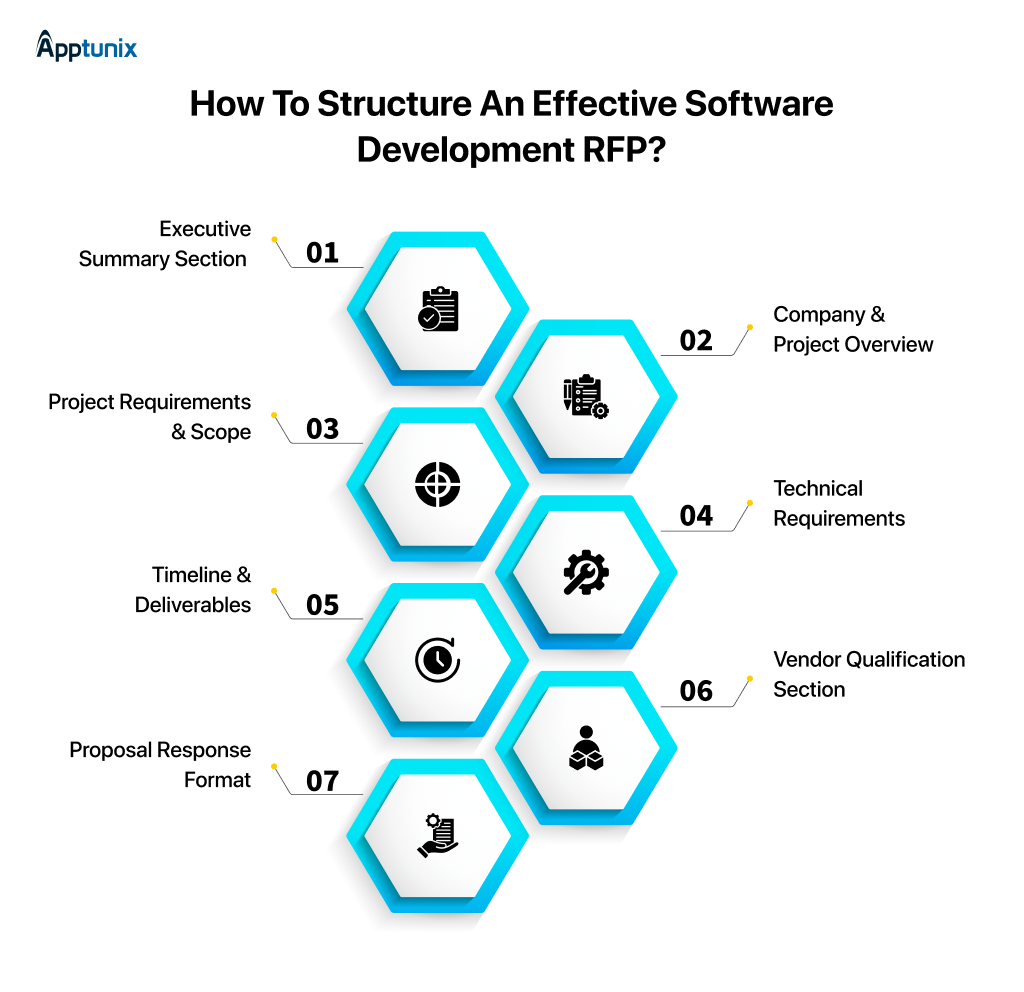
1: Executive Summary SectionStart with a concise overview of your project. This section should be 2-3 short paragraphs that clearly explain:
A well-written executive summary provides vendors with immediate clarity on market traction, scale requirements, integration complexity, and timeline.
2: Company & Project OverviewThis is your “about us” section. But don’t make it boring. Tell vendors why this matters because it helps them understand your priorities and working style. Include the following:
Vendors also want to partner with founders who know what they’re doing. Providing this information helps them tailor their proposals more effectively.
3: Project Requirements & ScopeThis is one of the most critical sections of your RFP for software development. Clarity here directly impacts project success. Avoid vague statements. Instead, define measurable expectations.
Example:
Instead of: “The system should be fast and reliable.”
Use: “The platform must support 5,000 concurrent users with response times under 500ms and maintain 99.99% uptime.”
Break your requirements into categories:
Pro tip: Rank your requirements. Mark them as Must-Have, Should-Have, and Nice-to-Have. Vendors will bid differently based on complexity.
4: Technical RequirementsDefine your technical expectations and constraints.
Include:
If you are open to suggestions, state it clearly. For example:
“We are open to vendor recommendations for a scalable, cloud-native architecture using modern frameworks.”
This encourages vendors to propose optimized solutions rather than simply following instructions.
5: Timeline & DeliverablesClearly defined timelines reduce vagueness and improve execution. Instead of a general deadline, break the project into phases:
->Phase 1 (Weeks 1-4): Finalize system architecture, database schema, and API structure
Deliverable: System design document and initially deployed API.
->Phase 2 (Weeks 5-12): Build and integrate core features, including user authentication, dashboards, and key workflows
Deliverable: Functional MVP with core modules, staging environment deployment, and initial QA validation.
->Phase 3 (Weeks 13-16): Conduct end-to-end testing, performance optimization, and production setup
Deliverable: Fully tested application, load testing reports, and production-ready deployment.
->Phase 4 (Post-Launch): Provide ongoing maintenance, bug resolution, and minor feature enhancements.
Deliverable: Defined SLA (e.g., 4-8 hour response time), regular updates, and performance monitoring reports.
6: Vendor Qualification SectionDefine the type of vendor you are looking for. This helps filter out unsuitable proposals early. Consider including:
Be honest about culture fit. Some founders love detailed processes and documentation. Others want autonomous teams. Neither is wrong, but a mismatch creates friction.
7: Proposal Response FormatTo ensure consistency, define how vendors should structure their responses.
A recommended format:
Recommended length: 8-10 pages
Total: 8-10 pages. That’s it. Long proposals are lazy and difficult to comprehend. Focused proposals take thought.
When you receive 5-10 proposals, how do you actually choose? You can’t just gut-feel it. You need a scoring framework.
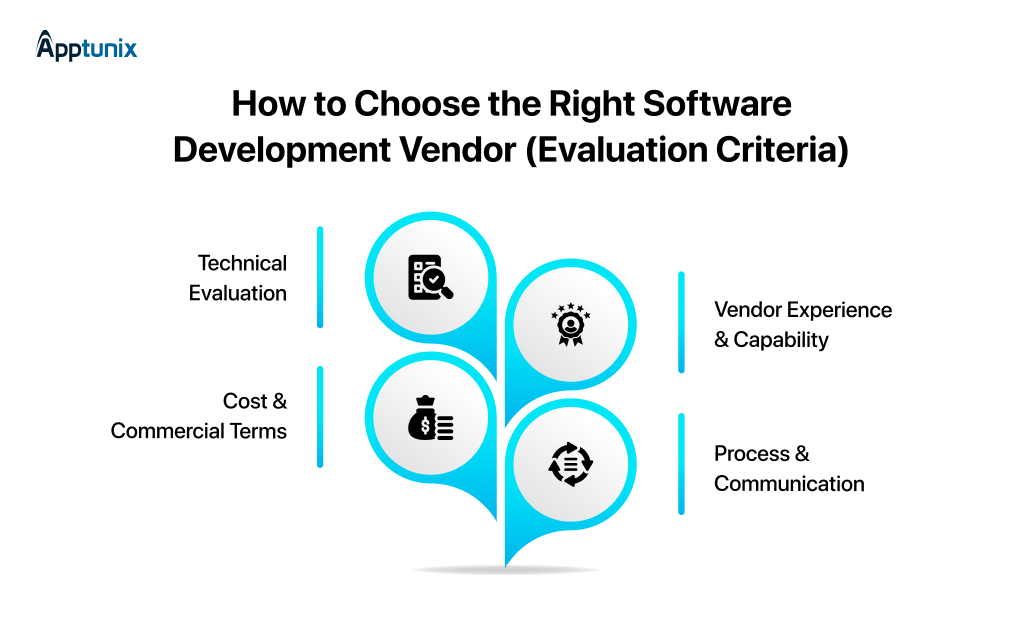
1: Technical EvaluationRate each vendor on:
Score out of 10 for each. Don’t overthink it. This step is important because you’re getting a sense of whether they understand your problem.
2: Vendor Experience & CapabilityThis section helps you evaluate whether the vendor has real, proven ability to deliver projects like yours, or if they’re just claiming lies on their website.
Sometimes the cheapest option has high turnover and junior teams. This turns out to be very expensive due to delays, rework, and management overhead.
3: Cost & Commercial TermsThis section is not just about price. It’s more about understanding how costs are structured and how financial risks are managed during the engagement.
You should note that sometimes a slightly higher fixed-price contract with well-defined milestones is often more predictable and cost-efficient than a lower T&M estimate that expands over time.
4: Process & CommunicationIn this step, we evaluate how the vendor works day-to-day and how effectively they collaborate with your team.
This is often underestimated, but it plays a critical role in project success. In many cases, a highly skilled team with poor communication delivers worse outcomes than a moderately skilled team that communicates clearly and consistently.
Here’s what a lean sample RFP for software development looks like when you put it all together:
Total length: 4-6 pages. You can send this to 10 vendors at once and get real, comparable responses.
With the advancing technology, many organizations are turning to AI-powered tools like ChatGPT, Gemini, Claude, etc, to speed up parts of the RFP process.
While AI cannot replace the need for human judgment and project-specific expertise, it can streamline the writing tasks, improve clarity, and reduce time spent on repetitive work.
This shift is also changing how teams think about early-stage product decisions and planning, especially in areas like AI in product development, where structured thinking and AI-assisted workflows are becoming more common in how digital products are shaped.
To get the best results from an AI tool, you’ll need to feed it with structured inputs. It is like that, a fresh-out-of-college intern in your office. It has the potential to give out the best results, but they’ll only be as good as the guidance you give it.
Before you paste anything into ChatGPT or any other AI tool:
Here’s a practical prompt you can use:
I’m a SaaS founder building a [brief description of product]. We have [stage, e.g., MVP/growth stage] with [key metric like users or revenue]. We are looking to build or scale our software and need help creating a structured RFP for software development to share with vendors.
We need to include:
- Key product or technical requirements (e.g., performance, integrations, scalability)
- Core features and modules
- Any compliance or security requirements
- Timeline expectations and delivery milestones
- Budget range (if applicable)
- Team or vendor expectations
Please create a clear, structured RFP template for software development that I can send to potential vendors. The format should be professional, easy to evaluate, and include sections like scope of work, technical requirements, timeline, and evaluation criteria.
Once you get the AI-generated draft, don’t treat it as final. Refine it carefully to match your actual context. Remove generic wording, simplify overly complex language, and replace placeholders with real project details.
Even the best founders make these mistakes when writing an RFP for software development:
Writing an RFP for software development is not about creating a perfect document. It’s about forcing yourself to think clearly before you spend money.
A good software development RFP template is clear, specific, realistic, and focused. Anyone reading it should understand the project without confusion.
When you send a well-structured RFP to vendors, strong vendors take it seriously because they see you are clear about what you want. Weak vendors often drop out early because they know they can’t meet those expectations. That alone saves a huge amount of time.
A one-page idea note is not enough to build complex software. A structured RFP, on the other hand, brings clarity, alignment, and accountability before development even begins.
Start with the framework, customize it for your product, and share it with a shortlist of vetted vendors. Compare responses side by side instead of relying on gut feeling. That shift alone can completely change your outcomes.
If you’re looking for an experienced development partner, Apptunix brings that execution depth to the table. As a global mobile app development company, Apptunix operates across 50+ countries and has delivered 5,000+ digital products across industries. Working with experienced teams like this helps ensure your RFP doesn’t just stay a document but turns into a working product that scales.
In the end, a strong RFP doesn’t just help you hire better. It helps you build better.

Q 1.What is the ideal length of a software development RFP?
There is no fixed length, but most effective RFPs range between 5 and 15 pages. The focus should be on clarity and completeness rather than length. A concise RFP that clearly defines scope, requirements, and expectations is more effective than a lengthy but vague document.
Q 2.Should startups use an RFP for software development?
Yes, startups should definitely use an RFP, especially for high-budget or complex projects. While early-stage startups may start with informal discussions, a structured RFP becomes essential when multiple vendors are involved or when the project scope needs to be clearly defined.
Q 3.What is the difference between an RFP and a Statement of Work (SOW)?
An RFP is used to invite proposals from vendors, while a Statement of Work (SOW) is a finalized document created after vendor selection. The SOW defines the exact scope, deliverables, timelines, and responsibilities agreed upon by both parties.
Q 4.Is it necessary to include a budget in an RFP for software development?
Including a budget in an RFP is optional but recommended. It helps vendors tailor their proposals realistically and prevents misalignment in expectations, especially for large or complex projects.
Q 5.Is it better to choose a specialized vendor or a full-service development company?
Specialized vendors may offer deep expertise in a specific area, while full-service companies provide end-to-end support. The right choice depends on whether you need a focused solution or a long-term development partner.
Get the weekly updates on the newest brand stories, business models and technology right in your inbox.
Pallavi Nautiyal is a seasoned Tech Consultant at Apptunix, specializing in the intersection of global finance and decentralized technology. With a deep-rooted expertise in banking infrastructure, digital payment gateways, and Web3 ecosystems, she guides businesses through the complexities of modern financial engineering. Pallavi is recognized for her ability to architect secure, compliant, and scalable solutions—ranging from smart contracts and crypto-wallets to robust digital banking platforms. Her strategic insights help organizations navigate regulatory landscapes while leveraging the power of Blockchain to ensure transparency and seamless user experiences in every transaction.
86 Views 11 min June 9, 2026
84 Views 11 min June 3, 2026

72 Views 11 min May 28, 2026
Book your consultation with us.
Book your consultation with us.


One Central, The offices 3, Level 3, DWTC, Sheikh Zayed Road, Dubai
+971 50 782 1690