10 Best Construction Project Management Software & How To Build Your Own?
65 Views 8 min August 27, 2026

With over 20+ years of experience in driving global digital initiatives, Nikhil Bansal is the CEO & Director of Apptunix. He specializes in orchestrating large-scale digital transformations, enterprise-grade software solutions, and high-level business strategies that redefine industry standards. Nikhil is known for his ability to bridge the gap between complex business challenges and innovative technology, helping Fortune 500 companies and startups alike achieve sustainable growth. A visionary leader, he empowers enterprises to navigate the digital landscape with agile, ROI-focused models and future-ready business strategies.
Walk into any factory and, at first glance, nothing seems different. The machines are still humming, the teams are still on the floor, and shipments are still moving out by evening.
But talk to the people running the business, and the conversation has changed.
The pressure today is not just about producing more. It’s about designing faster, reducing waste, forecasting demand better, and getting products out the door without delays. That’s exactly why generative AI in manufacturing is starting to move from experimentation into real operations.
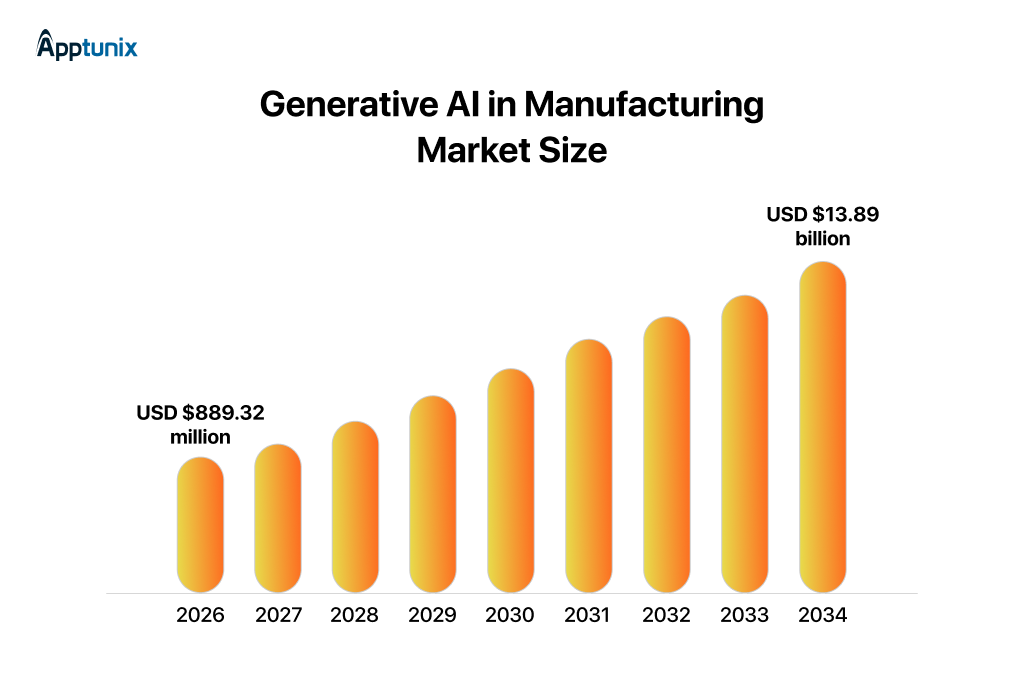
The generative AI in the manufacturing market is already reflecting it. According to recent industrial data, the Generative AI manufacturing market has climbed past $900 million this year and is on track to cross $13 billion by 2034.
The real story is where this impact shows up.
From design to delivery, here are 8 use cases that are changing how manufacturers actually work and grow.
Around 60% of manufacturing and automotive leaders have already put use cases into production, and 86% are seeing at least 6% annual revenue growth. Below are the 8 use cases of AI automation in manufacturing that are showing the clearest business outcomes.
Unplanned downtime is one of the fastest ways to destroy plant efficiency. A single machine failure doesn’t just stop one asset. It slows labor productivity, impacts delivery timelines, and creates cascading delays across the line.
The old model was simple: wait for a breakdown, then fix it. The smarter model is predictive.
With generative AI in manufacturing, machine sensor data, vibration logs, heat signatures, and service history can be analyzed continuously to flag early warning signals. That means maintenance becomes planned instead of reactive.
| Aspect | Old Way | New Way with AI | Business Result |
|---|---|---|---|
| Maintenance approach | Breakdown-based | Predictive alerts | Less downtime |
| Data usage | Historical logs | Live sensor + AI insights | Faster intervention |
| Cost impact | Emergency repair cost | Planned maintenance | Lower maintenance spend |
| Output impact | Production halt | Continuous uptime | Better throughput |
This is one of the most proven enterprise AI solutions for manufacturers.
Quality issues are rarely isolated. One defect trend often repeats across batches before teams catch it. The traditional way relies on manual inspection and post-production checks.
That means defects are often found after the cost has already been incurred. The new model uses computer vision and AI-led pattern recognition.
This helps manufacturers catch micro-level inconsistencies in dimensions, texture, alignment, or assembly quality.
| Aspect | Old Way | New Way with AI | Business Result |
|---|---|---|---|
| Inspection | Manual sampling | Real-time AI inspection | Early defect detection |
| Speed | Slow | Instant | Faster response |
| Waste | High rework | Reduced scrap | Better margins |
| Customer impact | Defect leakage | Consistent quality | Higher retention |
This is a major part of AI deployment in manufacturing workflows.
The market is moving faster than traditional design cycles. The old process involves multiple engineering iterations, design revisions, and physical prototype rounds. That slows innovation.
AI accelerates this by generating multiple optimized design options based on performance, material, and production constraints.
| Aspect | Old Way | New Way with AI | Business Result |
|---|---|---|---|
| Design cycles | Manual iterations | AI-generated options | Faster product launch |
| Prototype cost | High | Reduced | Better R&D efficiency |
| Time to market | Slow | Faster | Competitive edge |
| Customization | Limited | High | Better product fit |
This is where custom generative AI development solutions for factories create strategic value.
Supply chains no longer behave predictably. Historical trend-based forecasting alone is no longer enough.
AI brings dynamic forecasting by combining market demand signals, supplier risks, historical orders, and logistics variability.
This is a strong use case for AI for supply chain optimization in manufacturing.
| Aspect | Old Way | New Way with AI | Business Result |
|---|---|---|---|
| Forecasting basis | Historical trends | Multi-variable AI model | Better accuracy |
| Inventory risk | Overstock/stockout | Optimized inventory | Better cash flow |
| Supplier planning | Manual | Risk-aware AI planning | Reduced disruption |
| Demand response | Delayed | Faster | Better order fulfillment |
A lot of losses happen between machines, not inside them. Line balancing, worker movement, shift efficiency, and idle time all affect throughput. An agentic AI solution studies process flow patterns and recommends optimization points.
| Aspect | Old Way | New Way with AI | Business Result |
|---|---|---|---|
| Workflow planning | Supervisor intuition | AI-assisted insights | Better throughput |
| Bottleneck detection | Reactive | Continuous | Faster resolution |
| Idle time | High | Reduced | Better utilization |
| Labor efficiency | Variable | Optimized | Higher productivity |
This is one of the most practical examples of how generative AI is used in manufacturing.
This is where smart factories are headed. Instead of testing changes on live production lines, teams simulate them first. Digital twins help operators visualize the entire factory in a virtual environment.
| Aspect | Old Way | New Way with AI | Business Result |
|---|---|---|---|
| Testing | On the actual line | Virtual simulation | Lower risk |
| Cost of error | High | Low | Safer experimentation |
| Planning speed | Slow | Fast | Better capacity planning |
| Expansion decisions | Assumption-led | Data-led | Smarter capex |
This is highly valuable for investors evaluating scalability.
This goes deeper than workflow. It focuses on cycle time, sequencing, machine handoff, and material movement. AI identifies process-level inefficiencies that are hard to catch manually.
| Aspect | Old Way | New Way with AI | Business Result |
|---|---|---|---|
| Process review | Manual audits | Continuous AI analysis | Faster optimization |
| Cycle time | Static | Dynamic improvements | More output |
| Material flow | Delayed | Optimized | Less waste |
| Cost efficiency | Lower | Higher | Better margins |
A strong enterprise AI solution for manufacturers from a scale lens.
This is less flashy but extremely useful. Factories spend a huge amount of time on SOPs, maintenance logs, compliance reporting, and audit trails. AI automates documentation generation from operational data.
| Aspect | Old Way | New Way with AI | Business Result |
|---|---|---|---|
| Documentation | Manual | AI-generated | Faster reporting |
| Accuracy | Human-dependent | Data-driven | Better compliance |
| Time spent | High | Low | More productive teams |
| Audit readiness | Slow | Instant | Faster approvals |
This improves operational speed across teams.

Many existing factory tools—like basic predictive maintenance and vision-based inspection—rely on Analytical AI. They simply analyze past data to flag errors or predict failures based on rigid, pre-set rules.
Generative AI goes a step further. Instead of just flagging numbers, it creates new, actionable text, code, or images, acting as an intelligence layer on top of your current automation.
Here is how that shift changes daily operations:
Analytical: A sensor detects a vibration spike and generates a vague error code.
Generative: The system translates that raw data into a plain-language briefing: “Bearing 4 is overheating. Open manual page 14; requires a 12mm wrench.” It can also generate synthetic data to simulate rare machine failures, training your systems before real-world breakdowns happen.
Analytical AI: A camera flags defects based on a historical library of thousands of physical error examples it was manually trained to recognize.
Generative AI: For new or custom product lines where historical error data doesn’t exist, the system creates hyper-realistic, simulated images of hypothetical cracks or flaws. This allows you to train and deploy accurate quality-control cameras before the first physical batch is even produced.
Let’s have a look how you can implement Generative AI for your factory.
Most AI projects in manufacturing don’t fail because the tech is weak. They fail because teams start with the wrong problem.
A lot of companies jump into tools before they’ve decided what business outcome they actually want.
That’s why how to embed AI in the manufacturing industry is less a tech question and more an operations one.
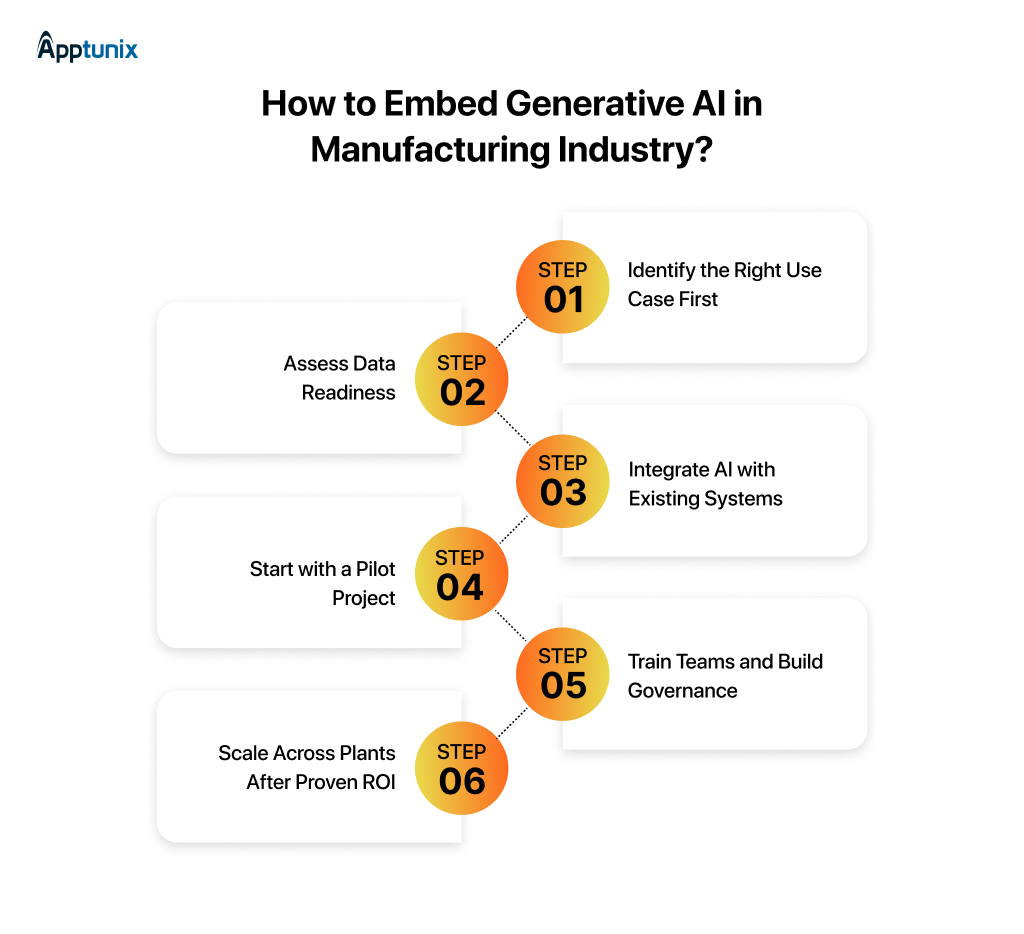
The biggest mistake is starting with “we need AI.” No operator wakes up caring about AI. They care about delayed production, rising costs, missed delivery windows, and quality issues.
The best AI in manufacturing starts with one painful workflow. Downtime prediction. Quality checks. Demand planning. Production scheduling.
That’s where generative AI solutions prove themselves fastest.
A lot of factories still run on scattered spreadsheets, legacy ERPs, machine logs, and undocumented manual processes. Before thinking about deployment, teams need to know whether the data is usable.
This is the part that founders often underestimate when thinking about how to integrate AI in factories. Without reliable operational data, even the best model won’t create meaningful output.
Nobody wants another isolated dashboard. If AI sits outside daily workflows, teams won’t use it.
The real win comes when recommendations show up inside the systems operators already trust: ERP, MES, maintenance software, or line monitoring tools.
That’s what makes AI deployment in manufacturing workflows stick. Adoption follows convenience. If the insight is easy to act on, teams use it. If not, it becomes shelfware.
Smart operators don’t roll out AI plant-wide on day one. They start small. One line, one use case, one measurable KPI. The goal is simple: prove business impact quickly.
This is where AI implementation in manufacturing moves from strategy deck to real business value.
Tech alone doesn’t change operations. People do. Floor teams, supervisors, planners, and leadership all need clarity on how the system supports decisions.
Training matters more than most people think. At the same time, governance needs to be built early.
This is what separates experimentation from real deployment.
Once the pilot shows results, scaling becomes much easier. The key is not copying the system blindly across plants. Every facility has different workflows, teams, and constraints. Scale the playbook, not just the tool.
The companies getting this right aren’t treating AI like innovation theater. They’re treating it like a margin and speed lever across the business.
The investment to embed generative AI in manufacturing ranges from USD $20,000 (pilot projects) to USD $150,000+ (full enterprise deployments), depending on scope and business goals. Here’s the full cost breakdown:
| Generative AI Complexity | Cost in USD | Functionalities |
|---|---|---|
| Proof of Concept (PoC) | $15,000 – $40,000 | Evaluating a single workflow using open-source models |
| Mid-Scale Custom Integration | $40K–$150K | Fine-tuning proprietary data, custom UI, and integrating with localized MES/ERP systems |
| Enterprise Smart Factory Transformation | $150K–$200K+ | Multimodal models across multiple plants with continuous fine-tuning pipelines |
Scaling AI on a real factory floor takes more than just a basic chatbot. It requires a few specific engineering building blocks to handle the heavy lifting:
Instead of just reading text, these models process blueprints, images, and sensor data all at once. A technician can simply point a camera at a machine to get instant, visual repair steps.
Real data on rare machine breakdowns or brand-new parts is hard to find. Generative AI creates hyper-realistic simulations to train and perfect your automation systems safely.
Most plants run on old software that is a nightmare to update. AI quickly rewrites this outdated code, forcing legacy SCADA and PLM platforms to connect smoothly with modern software.
Fast assembly lines can’t wait for data to travel to a cloud server and back. Processing data right on the spot (Edge AI) cuts lag to milliseconds for instant safety shut-offs, while leaving the heavy trend analysis for the cloud.
At the end of the day, manufacturing has always been about one thing: building better systems that help businesses move faster and waste less. The difference now is that generative AI development solutions in manufacturing are giving teams a smarter way to do exactly that, from planning and quality control to downtime reduction and delivery speed.
At Apptunix, we work closely with manufacturing businesses to make this shift practical and outcome-led through:
The opportunity in smart generative AI in manufacturing is no longer theoretical; it’s operational. If you’re exploring where it fits in your business, the next step starts with a conversation below.
Q 1.What is generative AI in manufacturing?
Generative AI in manufacturing creates new content like designs, simulations, and predictions from data patterns. It generates 3D models, digital twins, and optimized processes to enhance efficiency and innovation.
Q 2.How is generative AI used in smart factories?
Generative AI powers smart factories by enabling real-time workflow optimization, predictive maintenance, and quality control through synthetic data and digital twins. It simulates production scenarios, automates defect detection, and adjusts operations dynamically for minimal waste.
Q 3.Can generative AI reduce downtime in manufacturing?
Yes, generative AI reduces downtime via predictive maintenance that forecasts failures using sensor data and historical patterns, cutting unplanned outages by up to 50% or 30% in cases like ACG Capsules. It generates maintenance recommendations and root cause analyses for faster repairs.
Q 4.Is generative AI the future of Industry 4.0?
Generative AI advances Industry 4.0 by driving autonomous ecosystems with IoT integration, turning data into actionable intelligence for design, maintenance, and sustainability. It fosters faster innovation and agile operations, positioning adopters as leaders in smart manufacturing.
Q 5.What are the challenges of implementing generative AI in manufacturing?
Key challenges include data quality issues, high computational costs, and integrating with legacy systems, especially for SMEs. Ethical concerns, workforce upskilling, and cultural resistance also hinder adoption.
Q 6.How much time does it take to implement generative AI in a manufacturing company?
Implementation time varies: pilots or simple tools like chatbots can deploy in 2-4 weeks, as seen with ACG Capsules achieving 40% less downtime in five weeks. Full-scale integration takes 3-9 months or more, depending on data readiness, infrastructure, and scale, with many firms planning within 3-6 months.
Q 7.How do you handle AI "hallucinations" on a high-stakes factory floor?
You never deploy an LLM directly to a machine control switch. Industrial-grade generative AI uses a framework called RAG (Retrieval-Augmented Generation) coupled with strict human-in-the-loop guardrails. The AI acts as a diagnostic assistant, surface-level analyzer, and code modernizer—meaning it provides verified data blueprints to engineers, but final operational approvals always remain with human teams.
Get the weekly updates on the newest brand stories, business models and technology right in your inbox.
With over 20+ years of experience in driving global digital initiatives, Nikhil Bansal is the CEO & Director of Apptunix. He specializes in orchestrating large-scale digital transformations, enterprise-grade software solutions, and high-level business strategies that redefine industry standards. Nikhil is known for his ability to bridge the gap between complex business challenges and innovative technology, helping Fortune 500 companies and startups alike achieve sustainable growth. A visionary leader, he empowers enterprises to navigate the digital landscape with agile, ROI-focused models and future-ready business strategies.
65 Views 8 min August 27, 2026

210 Views 8 min June 24, 2026

249 Views 8 min June 22, 2026
Book your consultation with us.
Book your consultation with us.


One Central, The offices 3, Level 3, DWTC, Sheikh Zayed Road, Dubai
+971 50 782 1690