AI in Saudi Arabia Healthcare: Use Cases & Current Regulatory Landscape
20 Views 13 min July 31, 2026

Reena Bhagat, the CTO and Head of AI at Apptunix, is a seasoned technology strategist with a deep-rooted expertise in emerging technologies. With a focus on AI/ML integration, product engineering, cloud management, she leads the technical vision for high-performance SaaS infrastructures. Reena is recognized for building secure, scalable, and decentralized systems that solve real-world complexities. Her passion lies in leveraging data science and future-tech to create resilient digital products, making her a trusted authority for organizations looking to lead in the age of intelligent automation.
Most enterprises are still managing contracts the same way they did 15 years ago. Someone creates a Word document, sends it over email, waits days for feedback, loses track of the version, and then scrambles when a renewal deadline is missed. The bigger the organization, the worse this problem gets. Legal teams are buried in review queues. Procurement managers are chasing approvals across three departments. Compliance officers have no real-time view of what obligations are active across hundreds of vendor contracts.
And the cost of this chaos is not small. Research consistently shows that poor contract management costs companies between 5% and 40% of deal value. For an enterprise running thousands of contracts annually, that is a serious financial and operational problem.
This is exactly why more organizations are turning to AI contract management software. Not because it is a trendy technology investment, but because manual contract workflows have real, measurable costs that compound over time.
In this blog, we will cover everything that matters in contract management software development for enterprise teams.
At its core, contract management software is a platform for creating, storing, tracking, reviewing, and managing contracts across an entire organization. Of agreements getting lost in emails and shared drives with no clear owner, or tracking everything through set steps with built-in recordkeeping, notifications, and reporting.
For companies, this becomes a much bigger process called contract lifecycle management, or CLM. A good contract lifecycle management platform for companies does not just store papers. It handles every step of a contract’s life, from the draft to the final signature to its end or renewal.
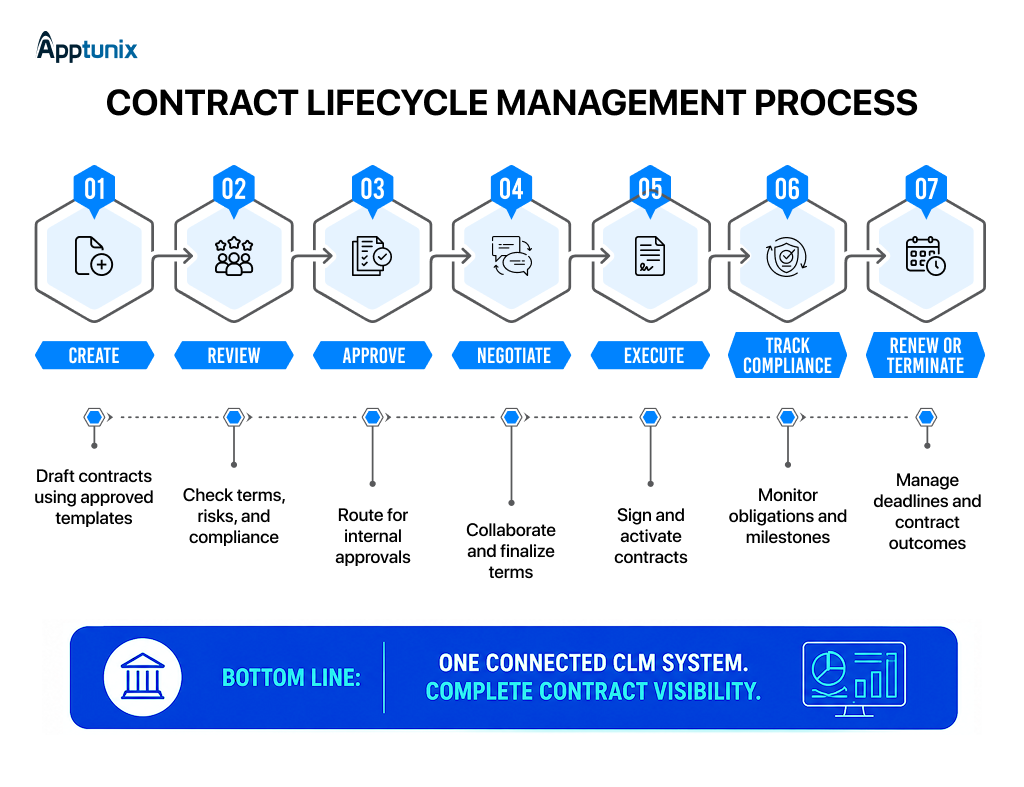
Contract lifecycle management is the process of managing a contract from when someone decides they need one to when it is closed.
Here is what that process actually looks like:
Traditional CLM tools improved on spreadsheets by centralizing storage and adding basic workflow features. But they still required significant manual effort for review, risk assessment, and search.
AI-powered contract management systems are a different category entirely. Here is where the gap shows up:
Traditional systems use static templates. AI-powered systems generate dynamic first drafts using generative AI, pulling in the right clauses based on contract type, jurisdiction, and deal parameters.
Traditional systems require humans to read every clause. AI systems extract, classify, and flag clauses automatically using NLP, surfacing only the items that need human attention.
Traditional systems rely on periodic manual reviews. AI systems score risk in real time as contracts are being drafted and negotiated.
Traditional keyword search means you need to know exactly what you are looking for. NLP-powered semantic search lets you ask questions in plain English and find relevant clauses across thousands of documents.
Traditional systems require someone to manually check obligations. AI systems monitor compliance continuously and alert the right people when action is needed.
Building a production-grade enterprise CLM platform requires a structured process. Here is how responsible development actually works.
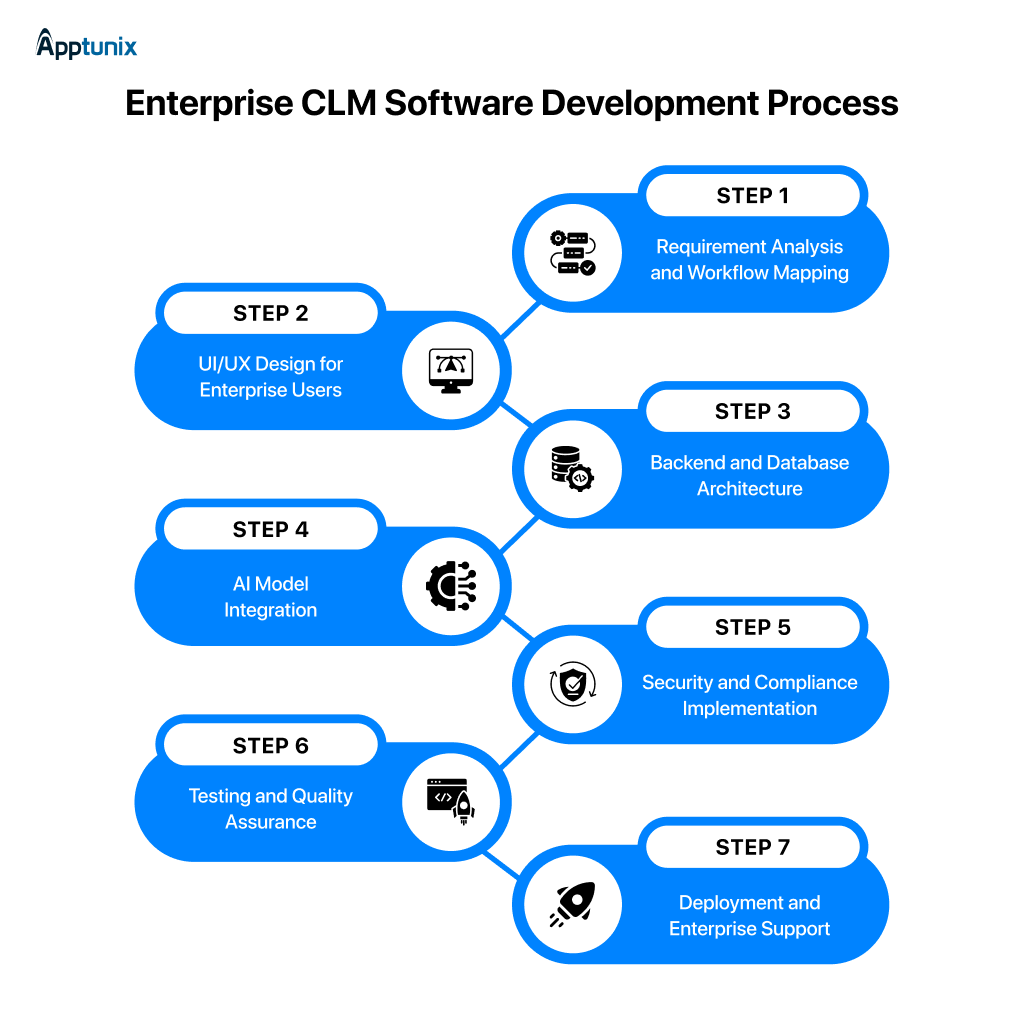
Before writing a single line of code, the team needs to map current contract workflows across legal, procurement, finance, and compliance. This step surfaces the actual bottlenecks, integration requirements, and compliance constraints the platform must address. Skipping this step and jumping straight to development is one of the most common reasons enterprise software projects fail.
Enterprise users are not the same as consumer app users. They need information-dense interfaces, configurable dashboards, and workflows that match how they actually operate. Design decisions made without input from actual legal and procurement personnel create adoption problems that no training program can fully fix.
The backend must handle large document volumes, concurrent users across departments, complex permission structures, and real-time workflow processing. A microservices architecture with a document database for search and storage combined with a relational database for workflow and user data is standard for enterprise CLM platforms. The architecture decisions made at this stage determine how well the system will scale.
NLP models, risk scoring engines, and generative AI components are integrated through an API-based architecture that keeps the AI layer modular. This means AI models can be upgraded or replaced without rebuilding the core platform. Fine-tuning pre-trained legal language models on your specific contract repository significantly improves accuracy compared to generic out-of-the-box models.
Security architecture is defined at the requirements stage and built into the platform from the ground up. This includes data encryption, role-based access control frameworks, audit logging infrastructure, and compliance validation against the specific regulatory frameworks your industry requires.
CLM platforms need both technical testing and domain-specific validation. Functional testing covers all workflow scenarios. AI model accuracy testing validates clause extraction against legal expert review. Security penetration testing is non-negotiable for enterprise deployment. Performance testing under real-world document loads confirms the system will hold up when you move from a pilot to a full enterprise rollout.
Enterprise deployment includes SSO integration, alignment with existing IT infrastructure, user training programs, and a defined post-launch support structure. A phased rollout starting with one department before enterprise-wide deployment significantly reduces the risk of disruption to active contract workflows.
12 Questions Every C-Suite Must Ask Before Signing a Tech Development Contract
The features you build into your platform determine both its value and its cost. Here is a breakdown of the core capabilities a well-built AI contract management software must include.
Smart templates that adapt to the contract type, the jurisdiction, and even the counterparty are basically table stakes for any enterprise CLM platform. Yet AI goes one notch further, like it doesn’t just do the basics.
Auto-fill features pull entity data from your CRM or ERP to pre-populate parties, addresses, payment terms, and those standard commercial bits and pieces. Meanwhile, dynamic clause libraries point you to the right language based on the deal type, risk profile, and what has actually happened before. So a procurement manager building a standard vendor agreement shouldn’t have to ping legal for every routine contract, and honestly that’s kinda the whole point.
Multi-level approval routing is one of the top value features in a contract management system, period. The routing rules should be configurable based on contract value, type, department, and risk level. A low-value NDA shouldn’t follow the same approval chain as a multi-million-dollar supplier agreement.
Real-time notifications over email, Slack, and Teams keep the process moving without that annoying “did you see my message” vibe. Escalation rules also stop things from stalling when approvers are out or just unavailable. In practice, this can cut average approval cycle times by more than half, which is pretty dramatic.
This is where AI-powered contract management systems really show the most direct ROI for legal teams.
Clause comparison quietly checks contract language against approved standard templates and flags deviations. Compliance checks validate the contract against internal policy plus relevant regulatory requirements. Risk scoring then assigns a risk level to the full contract and also to specific clauses, so legal can focus where the attention matters most.
NLP-powered semantic search lets users find what they need by describing it in plain language rather than guessing exact keywords. Search for “contracts with governing law outside the US that include automatic renewal” and get an accurate result in seconds.
A real time dashboard that shows, sort of lets you see every contract’s current stage, plus what deadlines are coming up, and how obligations look right now, is essential for enterprise visibility, you know.
Renewal alerts at 90, 60, and 30 days before expiry give teams enough runway to act before it gets messy. Vendor performance dashboards track SLA compliance and obligation fulfillment by supplier, so procurement teams actually have evidence for those renegotiation conversations, not just opinions.
If a CLM platform sits in isolation, it usually adds more friction than it removes. The right integrations make it function as the hub of your contract operations, instead of another disconnected tool that nobody checks.
CRM integration ties contracts to opportunities and accounts, which helps sales and legal share the same context. ERP integration connects contract data to financial systems to improve spend tracking and payment obligation management, so there’s less guesswork. E-signature support through DocuSign or Adobe Sign brings execution into the same workflow, rather than creating a handoff outside the system.
Contracts hold some of the most sensitive commercial and personal data an organization keeps. Security cannot be treated like an afterthought.
Role-based access control ensures people see only the contracts relevant to their role and department. Immutable audit trails log every action on every document. GDPR, HIPAA, and SOC 2 compliance must be built into data handling architecture from the start, not retrofitted later. AES-256 encryption at rest and TLS 1.3 in transit are the minimum standards for enterprise deployment.
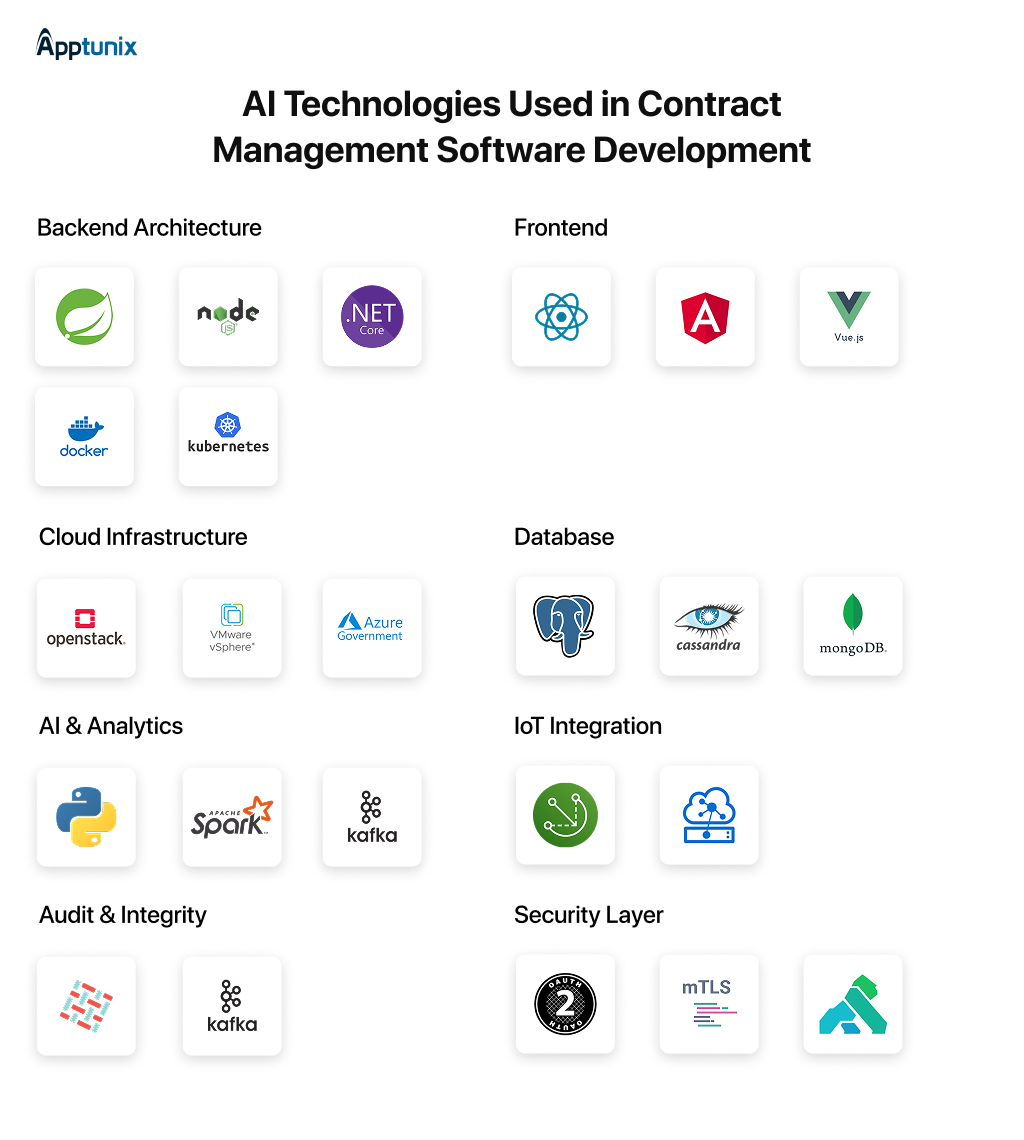
NLP is the core AI technology that makes modern contract management systems intelligent. It enables software to read and extract meaning from legal text, identifying clauses, obligations, parties, dates, and risk signals across large document volumes. Without NLP, AI-powered CLM is not really possible.
Machine learning models train on historical contract data to improve clause classification, risk scoring, and routing recommendations over time. The system gets more accurate and more useful the more contracts it processes, which creates a genuine compounding advantage for enterprises that start building their data asset early.
Large language models make it possible to generate complete contract drafts from a set of input parameters. A procurement manager specifies contract type, vendor, value, and key commercial terms, and the system produces a complete first draft in seconds. This does not replace legal review. It changes what legal reviews from scratch drafts to structured, AI-generated starting points.
Predictive models analyze contract language, counterparty history, deal structure, and market context to forecast risk outcomes before execution. This shifts risk management from reactive, where problems are found after they happen, to proactive, where they are flagged before the contract is signed.
Optical character recognition combined with document understanding models converts legacy paper contracts, scanned PDFs, and image-based files into structured, searchable digital data. For enterprises with large archives of legacy contracts, this is often the first step in a CLM implementation.
Ready-made CLM tools like DocuSign CLM, Ironclad, and Conga work well for organizations with standard workflows, limited IT resources, and straightforward contract operations. They deploy faster and carry lower upfront costs.
Custom CLM software development makes more sense when your workflows are complex and do not fit standard templates, when you need deep integration with existing ERP or CRM systems, when you handle sensitive data that requires specialized security architecture, when you need AI capabilities tuned to your specific contract types and industry terminology, or when you are building for a scale where per-seat subscription costs become financially uncompetitive with a custom build.
For large enterprises with multi-jurisdiction operations and complex approval structures, custom development typically delivers better total ROI over a 3 to 5 year horizon.
The cost to develop contract management software depends on several variables that compound against each other.
The adoption of AI-powered contract management systems is not limited to one sector. It is happening across virtually every industry that deals with regulatory complexity or high contract volumes.
Across all these industries, contract management systems aim to make contract processes faster, improve control over compliance, reduce risks, and make operations more efficient.
AI-assisted clause extraction and risk flagging reduce the time legal teams spend on routine contract review dramatically. Lawyers focus on judgment calls that actually require legal expertise, not on scanning documents for standard deviations.
Automated compliance checks and deviation alerts catch risky clauses before contracts are signed. Catching a problematic indemnification clause during review is a very different problem than catching it after execution.
Centralized obligation tracking means no contractual requirement goes unnoticed. Automated alerts surface upcoming compliance milestones without anyone manually managing a calendar.
Shared contract workspaces eliminate the version confusion and communication gaps between legal, finance, and procurement. Everyone works from the same document with a full, visible change history.
Automated templates and pre-approved clause libraries allow procurement teams to generate standard vendor contracts in minutes. Routine agreements do not need to wait in a legal review queue that was designed for complex, high-risk contracts.
Integrated approval workflows reduce contract cycle times substantially. What previously required weeks of email coordination can move through defined routing paths in days, with complete visibility at every stage.
Real-time contract status visibility lets procurement managers see exactly where a delay is happening. Bottlenecks get identified and escalated immediately rather than discovered after a project deadline is missed.
Centralized contract data enables accurate spend reporting, commitment tracking across all active vendor agreements, and early identification of favorable renegotiation windows. Procurement teams make better decisions when they have complete commercial data in one place.
Contracts hold some of the most sensitive commercial and personal data a company has. Meeting enterprise security requirements while maintaining a usable, performant system is a genuine engineering challenge. GDPR, HIPAA, and SOC 2 compliance simultaneously require data architecture decisions that have to be made before the first line of application code is written.
Most large enterprises run ERP and CRM systems that are years or even decades old. Integrating a modern CLM platform with legacy infrastructure requires custom middleware development and sometimes data migration and cleaning projects that extend timelines and budgets beyond initial estimates.
NLP models trained on general text perform poorly on specialized legal language without domain-specific fine-tuning. A clause misidentified in a legal context is not the same as a search result that is slightly off. It has real business and legal consequences. AI outputs in legal workflows need to be validated by domain experts before going into production, and that validation takes time and money.
The most technically capable CLM platform fails if people do not actually use it consistently. Adoption challenges are especially acute when workflows change significantly from what teams are used to. Change management, training investment, and design quality all directly determine whether the platform delivers its intended ROI or becomes expensive shelfware.
Apptunix builds AI-powered enterprise solutions designed to perform under real production conditions at enterprise scale. The approach includes scalable microservices architecture built for large document volumes, AI model integration with domain-specific fine-tuning for legal language, and custom workflow automation built around how legal and procurement teams actually operate rather than how a product demo assumes they do.
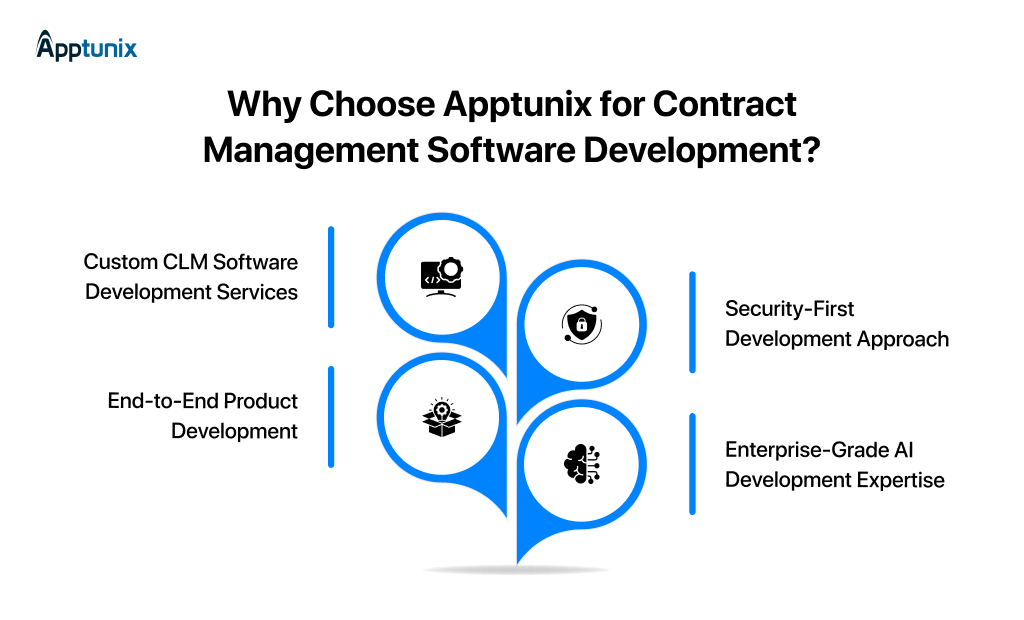
Our custom software development company brings depth across both legal technology and procurement systems. This covers legal workflow automation, including approval routing, clause libraries, and risk scoring. It covers procurement software solutions including vendor management, spend visibility, and contract-to-PO integration. And it covers AI integration across NLP, generative AI, and predictive analytics embedded into core platform workflows.
Security architecture is defined at the requirements stage and built into every layer of the platform. Enterprise compliance standards, including GDPR, HIPAA, and SOC 2, are built into data handling design from the start. Data protection architecture includes encryption, tokenization, and access control frameworks designed for enterprise-scale deployment.
Apptunix covers the full development lifecycle without handoffs to external partners. Strategy and requirements definition happen before any design or development begins. Enterprise UX research drives design decisions. Backend, frontend, API, and AI model development are handled by the same team. Deployment includes enterprise IT integration and SSO configuration. Post-launch support covers ongoing performance monitoring, model retraining as contract data grows, and feature iteration based on real user feedback.
Cross-industry experience spans healthcare, fintech, logistics, real estate, and SaaS contract management. Dedicated development teams are embedded in your project rather than rotating generalist contractors who do not know your business. An agile delivery process with sprint-based milestones keeps stakeholders informed without creating overhead. The focus is on enterprise outcomes, not feature counts.
AI-powered contract management systems are transforming how enterprise legal and procurement teams operate. The ability to automate routine review, flag risk before contracts are signed, track obligations in real time, and give leadership visibility into the entire contract portfolio is not a competitive advantage anymore. For large enterprises operating at scale, it is becoming a baseline operational requirement.
Investing in scalable enterprise CLM solutions built around your specific workflows and integration requirements delivers measurable returns in reduced cycle times, lower legal risk, better compliance outcomes, and stronger procurement performance. Custom contract management software development gives enterprises the flexibility, security, and AI capabilities that off-the-shelf tools cannot match.
If you are ready to move beyond spreadsheets and email chains and build contract management infrastructure that actually serves your enterprise, the right time to start is now. Get in touch with Apptunix to discover what your enterprise CLM platform needs to do and how to build it the right way.
Q 1.What is contract management software development?
Contract management software development is the process of building digital platforms that help enterprises manage the entire contract lifecycle, including drafting, approvals, negotiations, renewals, compliance tracking, and document storage. Modern AI contract management software also includes automation, analytics, and intelligent risk detection.
Q 2.What are enterprise CLM solutions?
Enterprise CLM solutions are advanced contract lifecycle management platforms designed for large organizations. These systems centralize contract operations, automate approvals, improve compliance management, and streamline collaboration between legal and procurement teams.
Q 3.How does AI improve contract lifecycle management?
AI-powered contract management systems improve contract lifecycle management by automating repetitive tasks, extracting contract data using NLP, identifying legal risks, generating summaries, and enabling intelligent document search. AI also accelerates contract review and approval workflows.
Q 4.What features should enterprise contract management software include?
These features improve operational efficiency for enterprise legal and procurement teams. Enterprise contract management software should include:
Q 5.How much does contract management software development cost?
The cost to develop contract management software typically ranges from $50,000 to $300,000+ depending on complexity, AI integrations, security requirements, scalability, and enterprise workflows. AI-powered enterprise CLM software generally requires a larger development investment.
Q 6.Why do enterprises invest in AI contract management software?
Enterprises invest in AI contract management software to reduce manual workload, minimize compliance risks, accelerate approvals, improve procurement operations, and gain centralized visibility into contract data and vendor relationships.
Q 7.What industries use enterprise contract lifecycle management platforms?
Industries using enterprise contract lifecycle management platforms include healthcare, fintech, logistics, real estate, SaaS, manufacturing, retail, and government organizations that manage large volumes of legal and procurement contracts.
Get the weekly updates on the newest brand stories, business models and technology right in your inbox.
Reena Bhagat, the CTO and Head of AI at Apptunix, is a seasoned technology strategist with a deep-rooted expertise in emerging technologies. With a focus on AI/ML integration, product engineering, cloud management, she leads the technical vision for high-performance SaaS infrastructures. Reena is recognized for building secure, scalable, and decentralized systems that solve real-world complexities. Her passion lies in leveraging data science and future-tech to create resilient digital products, making her a trusted authority for organizations looking to lead in the age of intelligent automation.
20 Views 13 min July 31, 2026
53 Views 13 min July 21, 2026
120 Views 13 min July 2, 2026
Book your consultation with us.
Book your consultation with us.


One Central, The offices 3, Level 3, DWTC, Sheikh Zayed Road, Dubai
+971 50 782 1690


Offer Ends Soon
Get a quick expert response in under 5 minutes.