
Compliance-Ready Software Development in Saudi Arabia: Laws, Standards and Best Practices
50 Views 13 min July 15, 2026

With over 20+ years of experience in driving global digital initiatives, Nikhil Bansal is the CEO & Director of Apptunix. He specializes in orchestrating large-scale digital transformations, enterprise-grade software solutions, and high-level business strategies that redefine industry standards. Nikhil is known for his ability to bridge the gap between complex business challenges and innovative technology, helping Fortune 500 companies and startups alike achieve sustainable growth. A visionary leader, he empowers enterprises to navigate the digital landscape with agile, ROI-focused models and future-ready business strategies.
Before committing to a $1M+ tech project, most decisions are made with limited clarity—and that’s where things start to go wrong.
This blog breaks down what C-suite leaders actually need to evaluate before signing a high-value enterprise software development contract. It focuses on reducing risk, improving decision-making, and ensuring your investment delivers long-term value.
Here’s what you’ll take away:
If you’re about to commit significant budget to technology, this guide helps you make that decision with clarity, not assumptions.
Most companies don’t lose millions on bad technology. They lose it on bad decisions made before the technology was ever built.
A $1M+ enterprise software contract isn’t a purchase you make and move on from. It’s a commitment that shapes your operations, your budget, and your competitive position for years.
And yet, most organizations approach it the same way they’d approach buying office equipment. Compare quotes. Pick a vendor. Sign fast.
That’s where things go wrong.
According to research from the Standish Group, nearly 68% of large-scale enterprise tech projects exceed their original budget. A McKinsey study found that IT projects over $15M run an average of 45% over budget.
This guide gives you the 12 questions that separate a great mobile app development company that scale you confidently from companies that spend two years firefighting a project that was broken before it started.
Before you can evaluate risk or ask the right questions, you need a clear picture of what you’re actually committing to. Let’s break it down.

This is the core of the contract—building your platform, application, or system from scratch or significantly enhancing an existing one.
It could include:
Most enterprises don’t start from zero. They already have tools, databases, CRMs, ERPs, or third-party services in place.
Your new system needs to connect with:
This is where complexity increases significantly. Poorly planned integrations often become one of the biggest reasons for delays and unexpected costs.
This part of the contract usually includes:
This layer determines how stable, secure, and scalable your product will be in real-world conditions.
With rising data regulations and cybersecurity threats, this is no longer optional.
A robust contract should account for:
Skipping clarity here can create legal and reputational risks later.
Before your product goes live, it needs to be validated across multiple dimensions:
Without structured QA, bugs and system failures often appear post-launch—when fixing them is far more expensive.
This is one of the most underestimated parts of any enterprise software development contract.
After launch, your system will need:
In many cases, post-launch costs can account for 15–25% of total spending, yet they’re often not clearly defined in the initial agreement.

Most procurement processes are designed for predictable purchases. Smart contract development at this scale aren’t predictable. Here’s what goes wrong when organizations apply standard IT procurement frameworks to a $1M+ build:
By the time you realize what “later” costs, your leverage is gone.
These aren’t generic checklist items. Each one targets a specific failure point that shows up repeatedly in large-scale tech projects. This is the core of what good tech contract due diligence looks like in practice.
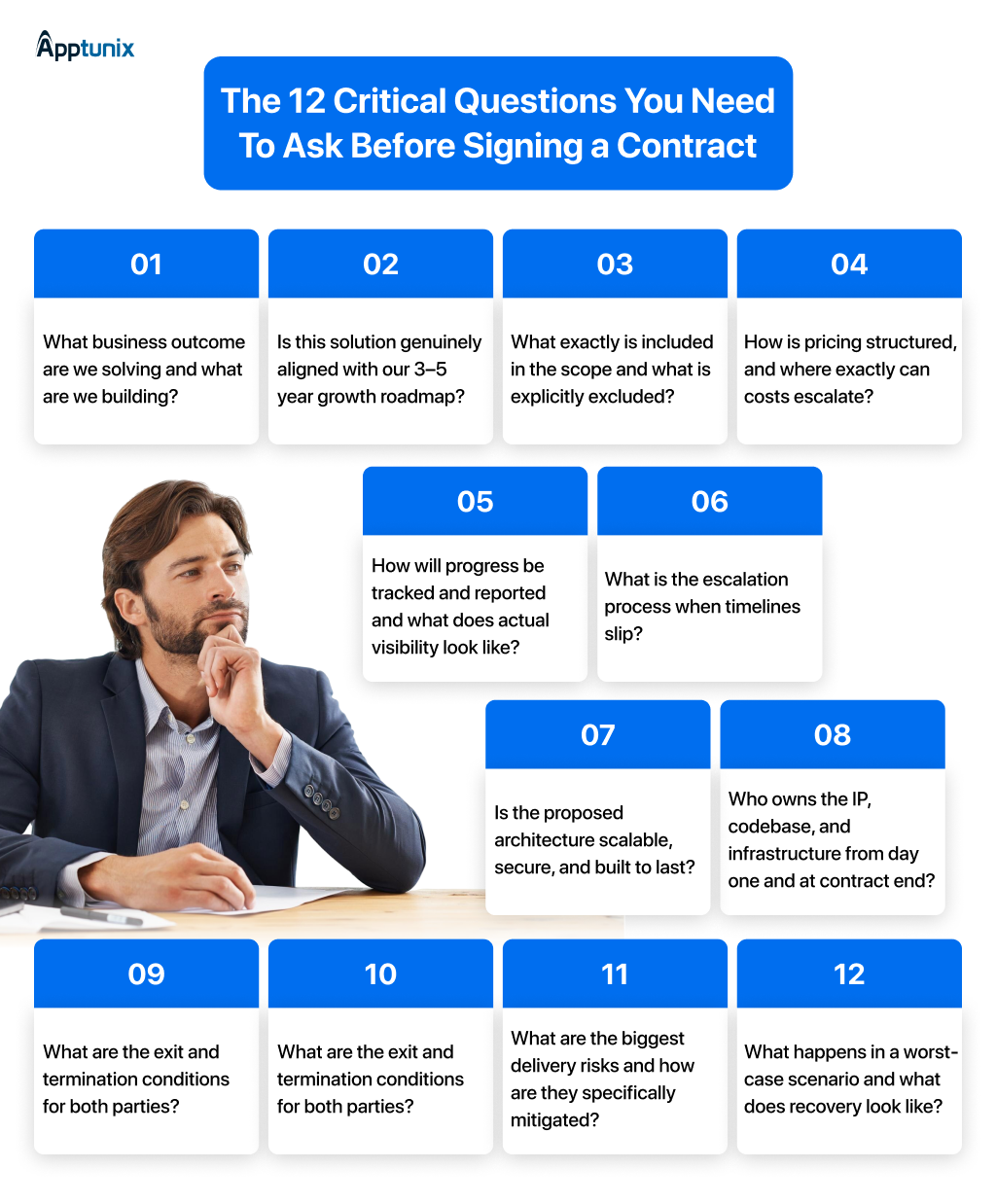
The most crucial question on the list deserves full attention, but people often ignore it. A vendor who can articulate your business problem and explain how their proposed solution addresses that problem, rather than one who just knows how to build what you describe.
The answer becomes obvious when vendors provide vague answers about their services, which include “we’ll help you digitize your operations” and “we’ll improve efficiency”. Vendors who understand the business outcome ask harder questions during scoping, catch requirements that don’t add up, and push back when the scope doesn’t serve the objective.
The technology which resolves present-day issues generates upcoming expenses through required system reconstruction. Before you finalize any enterprise software development contract, map the proposed architecture against where your business is going, not just where it is now.
The question requires an answer which will determine system failures that occur when user numbers reach two times their current level. The question needs to be answered about which systems require reconstruction when we enter new markets. The system needs to show which product lines can be added through the new product line. The answers will tell you whether you’re buying infrastructure or a stopgap.
The exclusions matter as much as the inclusions. Often more. Scope ambiguity is the single most common driver of budget overruns in enterprise tech projects, and it almost always originates in the contract language.
Push for a detailed scope document that names deliverables specifically — not categories, not capabilities, not general outcomes. Ask the vendor to walk you through what happens when a requirement falls in a grey area. The discomfort of that conversation before signing is minor compared to the cost after signing.
Fixed price contracts aren’t as fixed as they appear. Change requests, scope additions, timeline extensions, infrastructure cost increases — there are multiple mechanisms through which a quoted number becomes a significantly larger one.
Ask your vendor to walk you through every scenario where the cost could increase beyond the baseline. Then document those scenarios, cap them where possible, and build contingency accordingly. A vendor who can’t answer this question with specifics is a vendor whose costs will surprise you.
“We’ll send weekly status updates” is not a visibility plan. Real visibility means access to the development environment, meaningful progress metrics, regular demos of working software, and a reporting cadence that surfaces problems early rather than burying them in status theater.
Ask to see examples of how the vendor has reported progress to other enterprise clients. Ask what tools they use and whether you’ll have direct access to them. Vendors with nothing to hide generally don’t hide anything.
Delays happen on almost every complex software project. The question isn’t whether they’ll happen — it’s whether there’s a defined, contractually-backed process for responding when they do.
What triggers escalation? Who gets notified? What remedies are available? What are the vendor’s obligations if a milestone is missed by two weeks? By a month? Get specific answers and get them in writing.
Ask to see the architecture document. Not a diagram in a pitch deck — an actual architecture document that describes the technology choices, the infrastructure decisions, the security model, and the rationale behind all of it.
If there isn’t one at the proposal stage, that’s worth understanding. It might mean the vendor works iteratively and documents as they go — which is legitimate. It might also mean they haven’t actually designed anything yet. Know which one you’re dealing with.
Architectural debt is real, and it’s expensive. Systems built quickly with the wrong tradeoffs create compounding maintenance costs and increasingly painful upgrade cycles.
Ask the vendor directly: What are the constraints of this architecture? What would it take to change the core data model if requirements shift? How is the system designed to accommodate features that don’t exist yet? These aren’t unreasonable questions. Any senior engineer should be able to answer them.
This question is non-negotiable. If IP ownership isn’t explicitly assigned to you in the contract, you do not own it — regardless of what was said in the sales process.
The codebase, the database schemas, the infrastructure configurations, the documentation — all of it needs to be contractually assigned to your organization. If the vendor uses open-source components (which is standard practice), understand which licenses apply and what obligations they create.
The best time to negotiate exit terms is before you need them. Once you’re inside a troubled project, the vendor’s leverage increases significantly and your options narrow.
What triggers the right to terminate? What happens to the codebase if you exit early? Are there penalties? What’s the knowledge transfer process? What access do you retain to infrastructure? Get answers to all of these before you sign.
Any vendor who tells you a project of this scale has no significant risks is either lying or hasn’t thought about it carefully enough. Neither is reassuring.
The best vendors have spent time thinking about where this specific project is likely to be hard — complex integrations, unclear requirements, technical dependencies, team bandwidth — and they have a plan for each one. Ask them to walk you through the three or four things most likely to cause problems, and listen closely to the specificity of the answer.
These aren’t pessimistic questions. They’re professional ones. Every serious vendor has thought about them. The ones who haven’t are the ones you’ll be having these conversations with at the worst possible moment.
Most enterprise tech projects don’t fail overnight. They drift. Slowly, quietly—and often invisibly in the beginning.
The challenge is that these risks don’t look like risks at first. They show up as assumptions, quick decisions, or things teams believe they’ll “figure out later.” But once development starts, these small gaps compound into real problems.
Before the contract is signed, these are the signals that warrant slowing down:
The project scope presents a problem because it lacks direct boundaries. The statement “we will finalize this during development” gives the impression of flexible development, but it shows that the team requires more precise directions.
The project started as a small project because no one understood its boundaries. The project now requires ongoing changes because its requirements keep changing, and the expenses keep increasing.
Vendors should provide detailed explanations about their project management processes. You have entered a visibility gap because the project lacks clear information about tools, reporting, and communication methods.
The absence of transparency results in three major problems because it creates a situation where teams only recognize problems after they have already caused schedule delays.
Fast delivery is attractive, but it needs to be backed by a clear execution plan.
The timelines require examination because they present optimistic projections without showing the specific steps needed for their successful completion. The absence of proper systems leads to two main problems, which result in decreased project quality and missed delivery dates.
People should take their time to discuss ownership issues because they need to be treated with complete clarity.
The business faces long-term risk because no one knows who is responsible for the code, infrastructure, and documentation. The same applies if documentation is treated as optional—it will eventually slow down progress and increase dependency.
If you notice any of the following, pause before moving forward:
These are early warning signs. Ignoring them usually leads to bigger problems later.

Most vendors quote a number. Fewer of them break down where that number comes from. Here’s roughly where costs fall on a large-scale custom software build:
At this level of investment, decisions can’t rely on instinct or surface-level evaluation. You need a structured approach that reduces uncertainty before it turns into cost.
Strong IT procurement risk management isn’t about slowing things down—it’s about making sure you’re moving in the right direction.
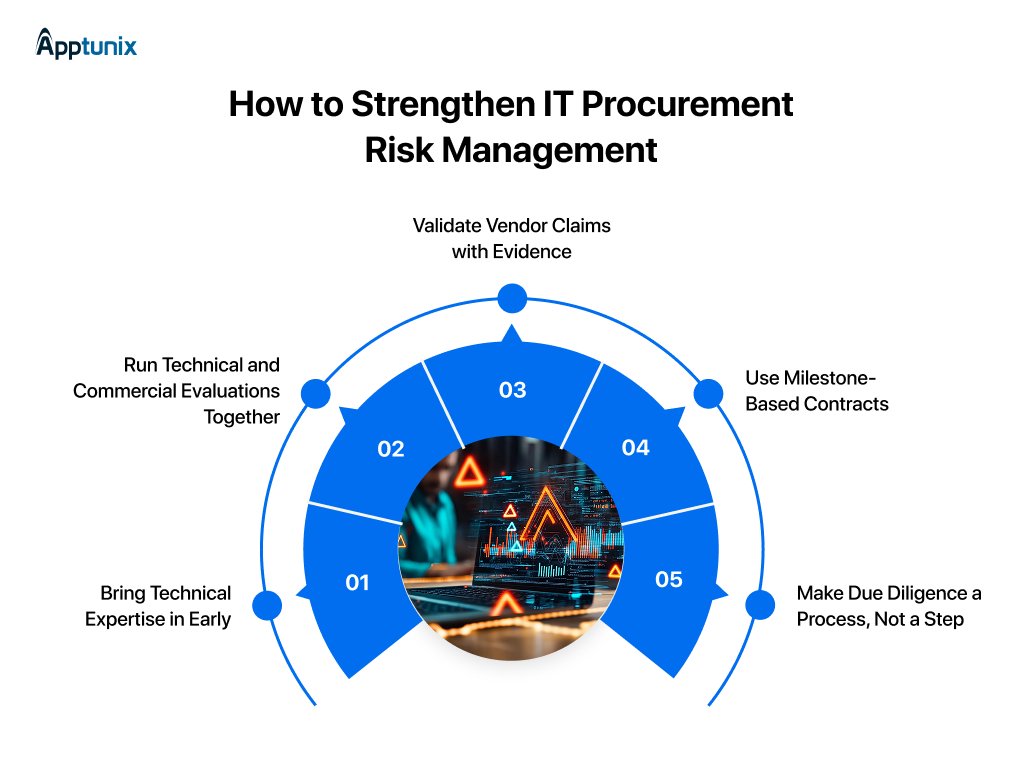
One of the biggest gaps in enterprise decisions is the lack of deep technical validation during the early stages.
Involve your CTO, senior engineers, or even external consultants from the beginning. They can assess architecture choices, identify hidden complexities, and challenge assumptions that may not be obvious to business teams.
This early input often prevents issues that would otherwise surface much later in the project.
Procurement decisions often separate pricing from technical feasibility.
That’s a mistake.
A proposal might look cost-effective on paper, but without understanding how that pricing was derived, it’s difficult to judge its reliability. Running both evaluations in parallel ensures that cost, scope, and technical complexity are aligned from the start.
Case studies and portfolios are useful—but they’re not enough on their own.
Go deeper. Ask for:
This shifts the conversation from what a vendor says they can do to what they have actually done.
Instead of committing the entire budget upfront, structure the contract around milestones.
This approach:
It also aligns incentives, ensuring that both sides stay focused on measurable progress.
Effective tech contract due diligence is not a one-time activity before signing.
It should continue throughout the project lifecycle—validating assumptions, tracking performance, and ensuring alignment at every stage.
This mindset shift alone can significantly improve project outcomes.
This is worth naming directly because it happens at almost every organization that gets this wrong.
Presentation quality gets mistaken for delivery capability. A polished pitch deck says nothing about engineering discipline, project management maturity, or what this vendor does when a project hits trouble.
Evaluate what they’ve shipped, not what they can describe.
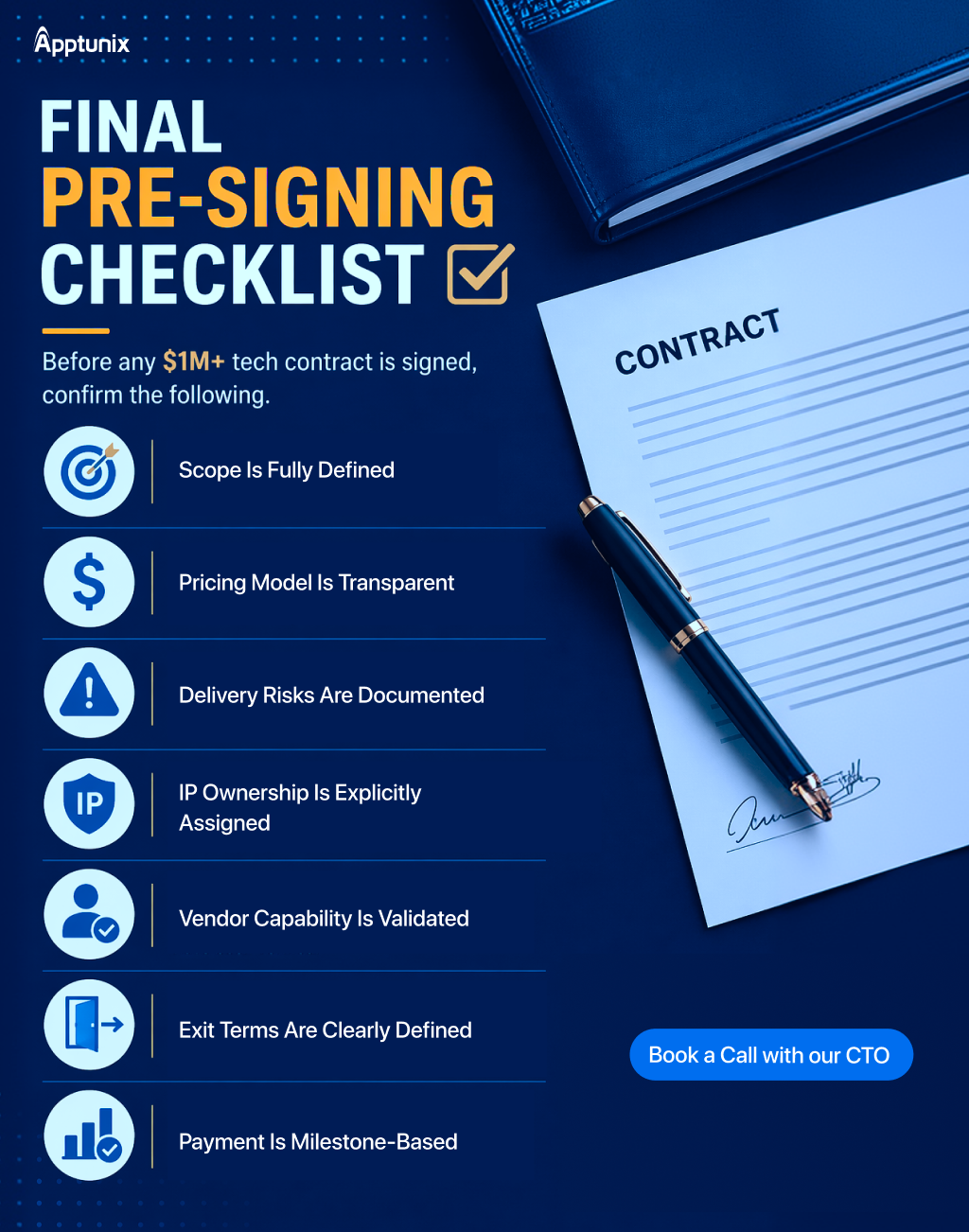
The account team gets evaluated instead of the build team. The people who sell the project are rarely the people who build it. The experienced architects and senior engineers who show up in sales meetings may have minimal involvement in your actual project. Ask to meet the team who will work on your account before you sign.
Communication risk gets underestimated. Time zone gaps, language barriers, unclear escalation paths, and ambiguous ownership of decisions are among the most common and most underestimated sources of project friction.
Let’s look at two common scenarios.
A company is eager to move quickly. They finalize a vendor based on a strong proposal and competitive pricing.
The contract is signed with a loosely defined scope.
In the early stages, everything seems on track. But as development progresses:
Within months, timelines slip, and costs rise. What began as a $1M project starts moving toward $2M, with no clear end in sight.
Another company takes a different approach.
Before signing, they invest time in structured tech contract due diligence. Scope is clearly defined, risks are documented, and milestones are aligned with deliverables.
Throughout the project:
The result is not just timely delivery—but a system that scales with the business.
What This Tells You
The difference between these two outcomes isn’t the vendor alone.
It’s the process behind the decision.
Clarity upfront reduces uncertainty later.
At the scale of a $1M+ investment, what companies need most is not just execution—it’s clarity before execution.
This is where Apptunix positions itself differently. The focus isn’t limited to building software. It starts much earlier, at the decision stage, where most risks are either identified or missed.
Apptunix gets involved from the early stages of an enterprise software development contract, helping businesses define scope with precision. Instead of broad feature discussions, the focus is on detailing what will be built, how it will behave, and where potential gaps may exist.
This reduces ambiguity before development begins, which is where most cost escalations originate.
Rather than treating due diligence as a checklist exercise, Apptunix approaches it as a structured process. This level of tech contract due diligence ensures that decisions are backed by analysis.
This includes:
One of the biggest challenges in large projects is a lack of visibility. Apptunix DPA addresses this by maintaining clear and consistent communication throughout the lifecycle:
This transparency helps businesses stay informed and in control, rather than reacting to issues late.
A system that works today but fails tomorrow creates long-term problems.
Apptunix focuses on building scalable, flexible architectures that align with business growth. This includes planning for increased users, evolving features, and integration expansion—ensuring the system doesn’t need to be rebuilt as the business scales.
The key difference is in approach.
Instead of simply executing requirements, Apptunix challenges assumptions, asks the right questions, and helps refine decisions. This reduces risk not just during development, but throughout the lifecycle of the product.
A $1M contract, by itself, is not risky.
What makes it risky is the lack of clarity behind it.
When decisions are rushed, assumptions go unchecked, and due diligence is treated as a formality, even the best ideas can struggle during execution.
Strong IT procurement risk management and thorough tech contract due diligence don’t eliminate challenges. But they make those challenges manageable, predictable, and far less expensive.
The companies that build technology successfully at this scale aren’t luckier than the ones that don’t. They’re more deliberate. They ask harder questions, they invest in the evaluation process, and they build contracts that protect them not just at signing but through the full lifecycle of the relationship.
In the end, success doesn’t depend only on the software development company you choose. It depends on how well you define the decision before you sign.

Q 1.What is an enterprise software development contract?
An enterprise software development contract is a legally binding agreement between a business and a technology vendor that defines scope, timelines, deliverables, pricing, ownership, and responsibilities for building large-scale software solutions.
Q 2.Why is tech contract due diligence important before signing?
Tech contract due diligence helps identify hidden risks, unclear scope, cost escalation points, and legal gaps before committing to high-value development agreements, reducing the chances of project failure.
Q 3.What should be included in a software vendor contract checklist?
A strong software vendor contract checklist should include scope definition, pricing model, SLAs, IP ownership, delivery timelines, risk clauses, exit terms, and post-launch support details.
Q 4.How does IT procurement risk management apply to tech contracts?
IT procurement risk management ensures that organizations evaluate vendor capability, financial stability, technical feasibility, and contract risks before investing in large-scale technology projects.
Q 5.What are the biggest risks in enterprise software development contracts?
The most common risks include scope ambiguity, vendor lock-in, unclear ownership, cost overruns, weak SLAs, and a lack of structured tech contract due diligence.
Q 6.How can businesses avoid cost overruns in tech contracts?
To avoid overruns, businesses should define scope clearly, use milestone-based payments, follow a detailed software vendor contract checklist, and implement strong IT procurement risk management practices.
Q 7.Who should be involved in tech contract due diligence?
Effective tech contract due diligence requires collaboration between C-suite leaders, CTOs, legal teams, and procurement specialists to ensure both business and technical alignment.
Q 8.What happens if an enterprise software development contract fails?
If an enterprise software development contract fails, businesses may face financial loss, project delays, operational disruption, and the need to rebuild or switch vendors—often at a higher cost.
Q 9.How does Apptunix support tech contract due diligence?
Apptunix helps enterprises strengthen tech contract due diligence by evaluating scope, identifying risks, validating technical architecture, and ensuring contracts align with long-term business goals before development begins.
Q 10.Why choose Apptunix for enterprise software development contracts?
Apptunix combines technical expertise with structured IT procurement risk management and a proven software vendor contract checklist approach, helping businesses reduce risk and execute scalable, high-value technology projects with confidence.
(1 ratings, average: 5.00 out of 5)
Get the weekly updates on the newest brand stories, business models and technology right in your inbox.
With over 20+ years of experience in driving global digital initiatives, Nikhil Bansal is the CEO & Director of Apptunix. He specializes in orchestrating large-scale digital transformations, enterprise-grade software solutions, and high-level business strategies that redefine industry standards. Nikhil is known for his ability to bridge the gap between complex business challenges and innovative technology, helping Fortune 500 companies and startups alike achieve sustainable growth. A visionary leader, he empowers enterprises to navigate the digital landscape with agile, ROI-focused models and future-ready business strategies.
50 Views 13 min July 15, 2026

139 Views 13 min June 26, 2026

262 Views 13 min June 9, 2026
Book your consultation with us.
Book your consultation with us.


One Central, The offices 3, Level 3, DWTC, Sheikh Zayed Road, Dubai
+971 50 782 1690


Offer Ends Soon
Get a quick expert response in under 5 minutes.