How AI Integration in Business Apps Builds Smart Workflows?
20 Views 10 min September 10, 2026

Reena Bhagat, the CTO and Head of AI at Apptunix, is a seasoned technology strategist with a deep-rooted expertise in emerging technologies. With a focus on AI/ML integration, product engineering, cloud management, she leads the technical vision for high-performance SaaS infrastructures. Reena is recognized for building secure, scalable, and decentralized systems that solve real-world complexities. Her passion lies in leveraging data science and future-tech to create resilient digital products, making her a trusted authority for organizations looking to lead in the age of intelligent automation.
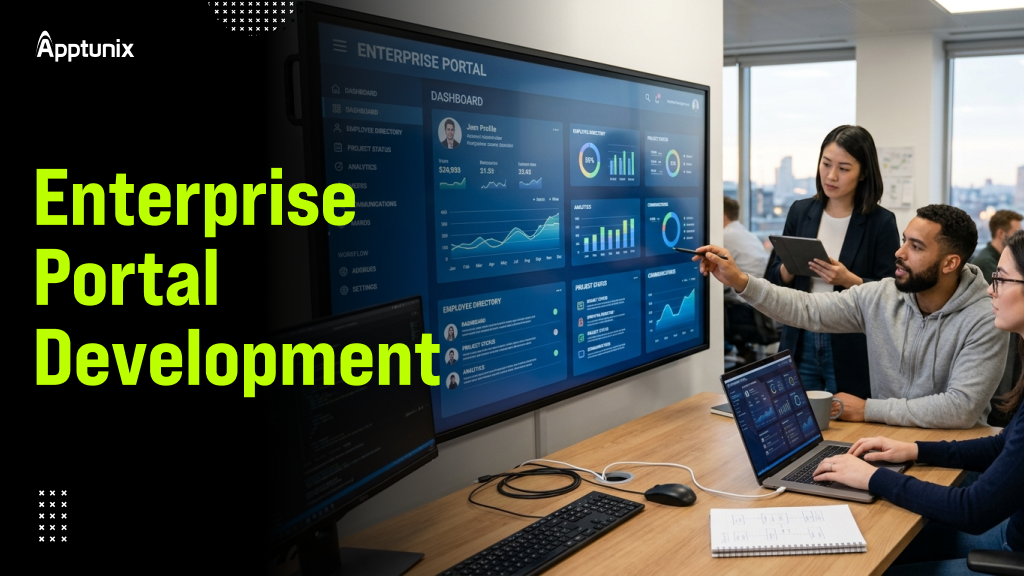
You’ve been here before. Eighteen months of planning. A seven-figure budget. Dozens of stakeholder alignment meetings. And then launch day — met with frustrated employees, broken integrations, and a helpdesk that never stops ringing. But, if you failed once, why should you try it again today? Well, there’s a solid reason to try again.
The Enterprise Portal Market size is anticipated to cross USD 47.24 billion by 2035. Digitalization in the business world is a major factor expected to drive market growth during the forecast period, driven by the growing use of internet services worldwide.
However, despite the market size, the hard truth is that poor technology is not the reason most enterprise portals fail. They were unsuccessful because integration was an add-on, personalization was added after launch, and governance was a Word doc that nobody looked at.
This is for those who want efficient enterprise portal development. Let’s make this one work this time.
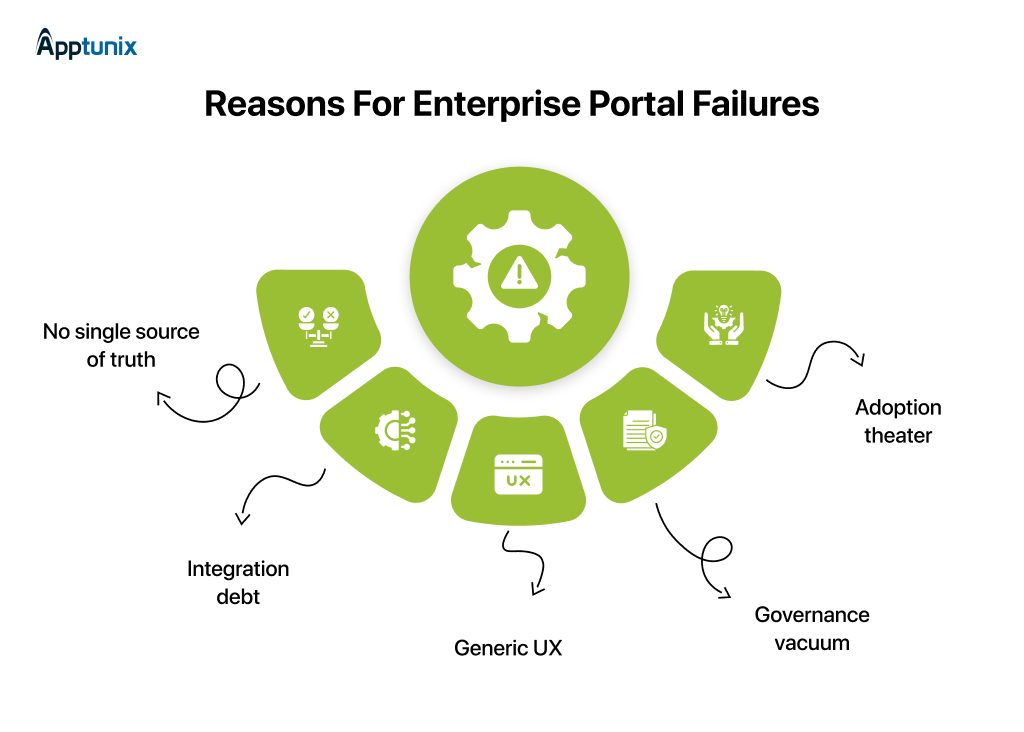
Most post mortams of a failed project identify the same suspects — software vendors are not the culprit.
The most typical failures:
Sound familiar? That’s because enterprise portal development is deceptively complex. Technology is the easy part. The architecture decisions made in the first 60 days determine whether you succeed or repeat history.
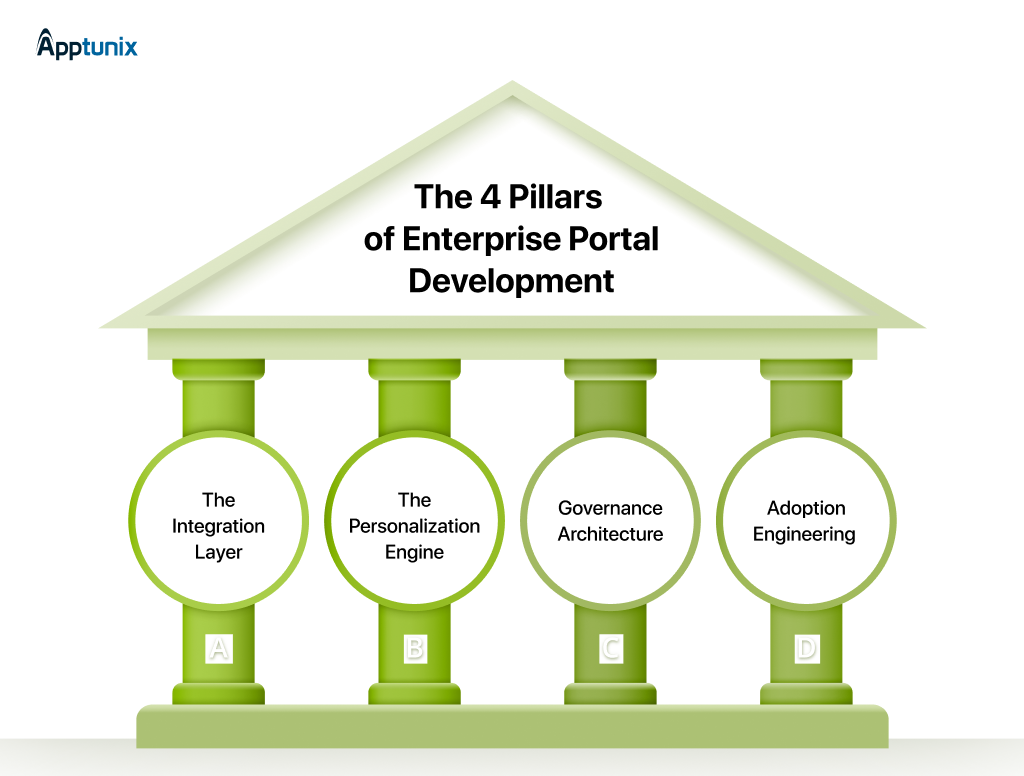 Before you talk to a single enterprise portal development company, you need to internalize what a high-functioning portal actually requires. There are four non-negotiable pillars.
The integration layer is the circulatory system of your portal. If it’s clotted, nothing works.
What a robust integration architecture includes:
Fact: McKinsey highlights APIs and modern integration architectures as key enablers of scalable digital ecosystems and faster technology adoption.
Some questions to ask a service partner for enterprise portal development before signing up:
If their responses are not clear, continue to walk.
A warehouse manager in Ohio should not be on the same portal as a finance analyst in Singapore. Ever.
Add layers of personalization that make a difference:
This is where enterprise portal development services must go beyond template customization. Real personalization requires a rules engine, a user data model, and ongoing iteration — not a one-time configuration.
Content governance is the single most underestimated requirement in enterprise web portal development. Without it, your portal becomes a digital junkyard within six months.
A governance model that holds:
The governance model should be designed before a single wireframe is drawn. It is not a post-launch housekeeping task.
Your portal’s success is measured in daily active users six months post-launch, not in applause on go-live day.
What adoption engineering looks like:
Related Read: Enterprise Web App Development: How Large Organizations Build Scalable Digital Platforms
Before your enterprise web portal development goes into the build phase, confirm every item below is locked.
Architecture & Integration:
Personalization & UX:
Governance:
Adoption:
If more than three items are unchecked, you are not ready to build.
Related Read: How to Choose the Best Enterprise Software Development Firm?
Most enterprise portal projects don’t struggle at the technology layer. They struggle at the process layer — unclear ownership, misaligned expectations, and handoffs that happen without the right documentation. Here’s exactly how a world-class enterprise portal development company like Apptunix moves from concept to launch.
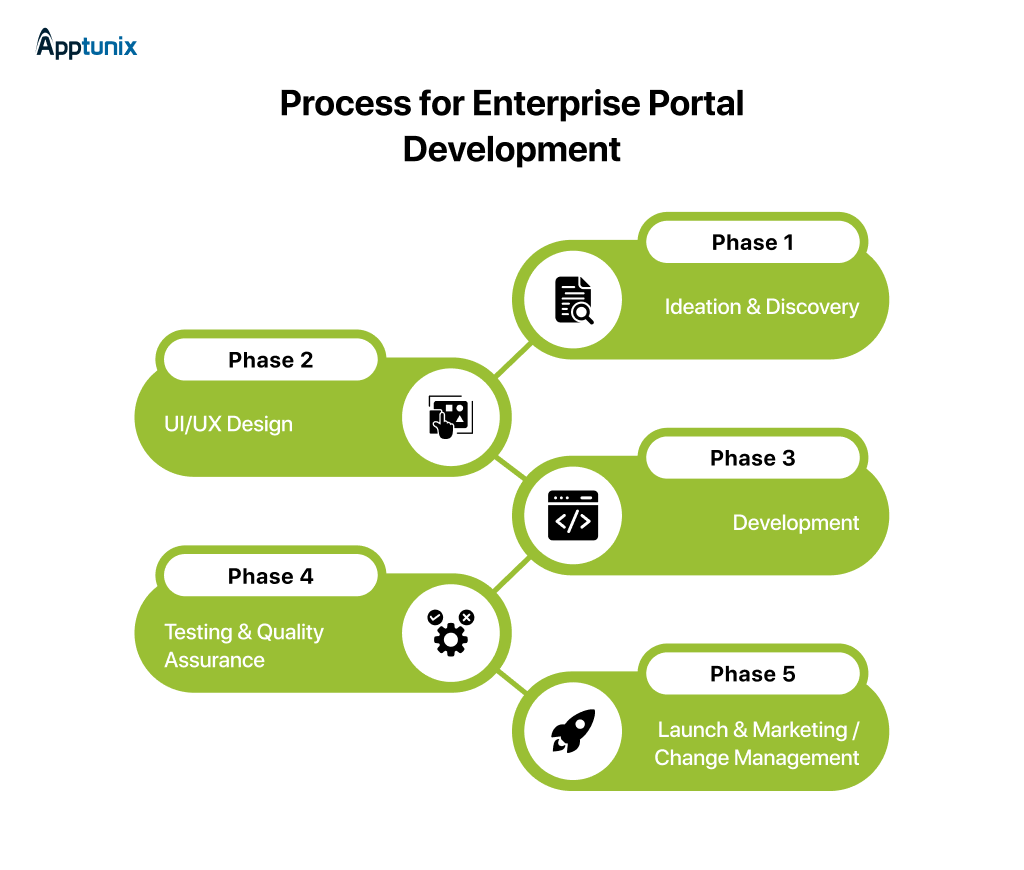
Fact: According to PMI’s Pulse of the Profession report, projects that take a structured, phase-gated approach to delivering projects have success rates nearly two times higher.
Where great portals are born — or quietly doomed.
We start by working closely with your CIO, HR tech leads, and platform owners to brainstorm solutions that align with actual business goals — not IT assumptions. This isn’t a requirements-gathering checklist. It’s a collaborative diagnostic.
What happens in this phase:
It produces a well-defined, signed-off plan that is shared and shared-generative across all teams, both business and technical. No ambiguity. No “we’ll figure it out in development.”
Interfaces built for humans, not for demo videos.
Our enterprise web portal development company’s UI/UX design process centers on your actual users — not on what looks impressive in a boardroom presentation. Every design decision is validated against real employee workflows.
What this phase delivers:
You’re involved in the design process throughout — because a portal that surprises its stakeholders at handoff is a portal that gets redesigned post-launch.
Built with the latest technologies. Maintained by your team for years.
Using the most current and appropriate technology stack for your environment, our developers build your enterprise portal in structured, documented, and tested sprints — with full transparency throughout.
Development principles we don’t compromise on:
Quality isn’t a phase. It’s a discipline woven through every sprint.
Throughout the entire enterprise portal development process, our QA engineers run parallel testing — not as a final gate, but as a continuous quality signal.
Testing coverage includes:
Issues caught in testing cost 10x less to fix than issues caught post-launch. This is where corners don’t get cut.
Go-live is a milestone, not a finish line.
When it’s time to deploy, our enterprise portal development team doesn’t leave you with a deployment script and wave goodbye. We work with your internal comms, HR, and IT teams to create momentum that goes beyond day one.
What a successful launch looks like:
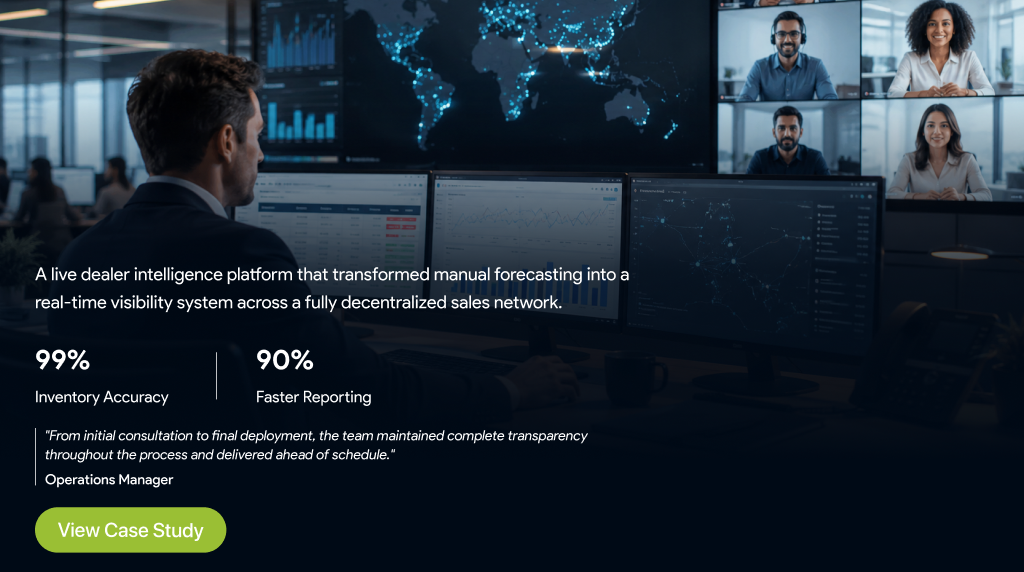
Building on this development, we created a live dealer intelligence platform that automated the forecasting of traditional dealers with a live view of the extended and decentralized automotive sales network. It streamlined and simplified the way inventory was managed, reported to dealers, and analyzed for operations, all into one intelligent system — empowering quick decision making, accurate forecasting, and better collaboration between teams.
Building on this foundation, the next step was to address persistent industry challenges. The platform was designed to remove reporting delays, minimize operational inefficiencies, and deliver real-time business intelligence to leadership at scale. It was delivered quickly and reliably, and readily adopted by the distributed dealer network, from consultation to launch.
Technology has come a long way for enterprise portal solutions development. Here are the characteristics of a best in class today.
Frontend:
Backend:
Infrastructure:
Let’s address the question every CIO asks — and that most vendors dodge with “it depends.”
It does depend. But on knowable things: your integration complexity, your user scale, your security requirements, and how much of the infrastructure you’re building from scratch versus extending. Here’s an honest, no-fluff breakdown.
Often, enterprise portals end up costing way more than the initial estimate because of poor scope in the first month of development. Here’s what moves the needle:
Cost drivers that inflate budgets:
What keeps costs predictable:

This is where most organizations get it wrong. They evaluate enterprise portal development partner on demos, not on delivery methodology.
Related Read: App Development Timeline and 5 Tips to Shorten It
The frustration that plagues even advanced enterprise IT groups:
The more personalized, the more complex in terms of governance.
Each new personalisation rule becomes a new governance responsibility. There are exponentially more content pathways in a portal that brings content to the surface based on role, location, seniority, and behaviour — each pathway needs to be owned.
How to resolve it:
It’s the difference between a capable enterprise portal development agency and a company that will give you a great-looking, broken portal in 18 months.
The organizations that succeed at enterprise portal development are not the ones with the biggest budgets. They’re the ones that treat the architecture phase as seriously as the build phase, that invest in governance before they invest in design, and that measure success in daily active users — not in go-live applause.
You’ve already lived through one failed portal project. You know what it costs — in money, in credibility, in years of organizational momentum.
The next one can be different. But only if you make different decisions from day one.
Q 1.What exactly is enterprise portal development, and how is it different from creating a regular website?
Enterprise portal development establishes a single digital workspace that brings all employees, systems, and data together in an enterprise. It is not like a regular website; it is integrated with ERP, HRIS, and CRM systems, role-based access is enforced, and it can serve thousands of users that are authenticated at the same time without any problem.
Q 2.What's the average timeframe of an enterprise portal project?
The 9–18 month discovery to launch period is typical for most medium to large enterprise portal projects. By not planning discovery, integration architecture, and governance, organizations can find themselves in a three-year, expensive rebuild. The 60-day phase of architecture is a fixed investment.
Q 3.So what is an intranet, and what is an enterprise portal?
The main functions of an intranet are to publish information such as announcements and documents. An enterprise portal is a transactional digital workplace for employees who perform tasks, launch applications, view their personalized data, and connect with integrated systems, all from one location.
Q 4.What are the common technologies in enterprise portal development?
Typical stacks for an enterprise portal are AWS/Azure/GCP cloud platforms, MuleSoft/Azure Integration Services/Boomi integration services, a headless CMS (Contentful, Sitecore), and micro-frontend architecture. The right stack is contingent on your current tech infrastructure and in-house support capabilities.
Q 5.What are the criteria for assessing an enterprise portal development firm?
Evaluate the following: depth of integration, approach of delivery, post-launch SLAs, and change management approach. Never accept client references based on case studies or solely on a vendor’s claims; always ask for references from a client of a similar size and complexity.
Q 6.How much does it cost to develop an enterprise portal?
Smaller companies can expect to pay $30,000 – $60,000+, while larger companies with complex integrations may see costs hit $500,000 – $2M+. A well-constructed portal can provide 5 to 10 times return on investment over time in terms of productivity and the reduction of support costs.
Q 7.Is it possible to create an enterprise portal on Microsoft SharePoint or ServiceNow?
Yes — and in many cases, it’s the perfect fit for organizations. Both are solid platforms, but need a lot of customization. One of the common mistakes made is considering them solutions that can be bought ready-made. When you’re in the Microsoft 365 world, a SharePoint-based portal with custom development can be the best option.
(1 ratings, average: 5.00 out of 5)
Get the weekly updates on the newest brand stories, business models and technology right in your inbox.
Reena Bhagat, the CTO and Head of AI at Apptunix, is a seasoned technology strategist with a deep-rooted expertise in emerging technologies. With a focus on AI/ML integration, product engineering, cloud management, she leads the technical vision for high-performance SaaS infrastructures. Reena is recognized for building secure, scalable, and decentralized systems that solve real-world complexities. Her passion lies in leveraging data science and future-tech to create resilient digital products, making her a trusted authority for organizations looking to lead in the age of intelligent automation.
20 Views 10 min September 10, 2026
64 Views 10 min August 19, 2026
68 Views 10 min August 12, 2026
Book your consultation with us.
Book your consultation with us.


One Central, The offices 3, Level 3, DWTC, Sheikh Zayed Road, Dubai
+971 50 782 1690