Fleet Management Software Development: Cost, Features, Process & AI Guide for Enterprise Fleets
90 Views 10 min June 24, 2026

As the Design Lead (UI/UX) at Apptunix, Sandeep Singh brings a decade of experience in crafting human-centric digital experiences. He specializes in intuitive product design, user psychology, and aesthetic storytelling that elevates brand identity. Sandeep is dedicated to building seamless interfaces that balance form and function, ensuring every digital touchpoint is engaging and accessible. By combining design-thinking with data-driven insights, he helps businesses transform complex workflows into delightful user journeys that drive high retention and market success.

Enterprise software isn’t built the same way as regular software applications, and that’s the plot that most businesses get wrong. The broad perspective of a web app may look simple: a dashboard, some workflows, and some integration, but when this same technology needs to deal with thousands of users, multiple departments, and perform live decision-making, then everything changes.
This is where a trusted enterprise web application development company comes into the picture, as the process going forward becomes less about coding and more about the infrastructure behind it. This plays an important role in the scaling of enterprise web apps, keeping a seamless user experience. Because in enterprise environments, performance issues don’t just frustrate users, they simply slow down operations, impact revenue, and create delays across the organization.
On the other hand, a well-constructed enterprise system acts as the central nervous system for businesses. It links teams, automates workflows, processes data in real-time, and scales without breaking under pressure. That’s why companies investing in enterprise web development today aren’t just building apps, but they’re building a digital framework that supports growth for years.
According to Gartner, by 2026, over 75% of organizations will adopt digital transformation models built on cloud and scalable application architectures—highlighting how modern enterprise web app development is increasingly driven by systems designed for flexibility, performance, and scale.
To understand enterprise web app development, let’s first decode what makes an application “enterprise” in the first place. It’s not just about the size of the project, but it’s more about the complexity, responsibility, and scale.
An enterprise web application is designed to:
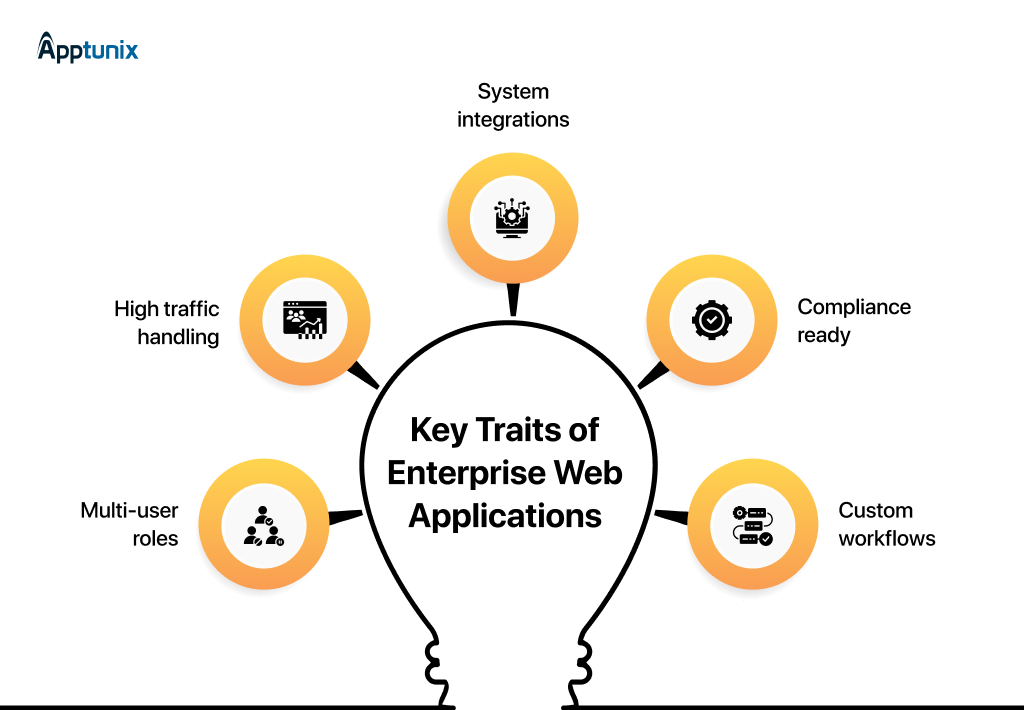
However, above all, it functions in an ecosystem where setback is not an alternative. Unlike the irregular glitches, which are still bearable, enterprise systems affect day-to-day activities within an organization. In case they fail, the team’s output is hampered, decisions get delayed, and revenue gets affected.
That’s why web enterprise software development requires a fundamentally different approach, the one that prioritises:
Another important difference is customization. Two enterprises never operate the same way. Their workflows, approval systems, reporting structures, and operational logic are unique. That’s why enterprise application development services are always customised, not templated.
In the past few years, enterprise applications have seen a drastic evolution, as earlier they were seen as internal tools, considered useful but not strategic. But this doesn’t exist anymore, as today enterprise web applications are a core component in how businesses operate, compete, and scale.
When your sales team tracks leads, your finance team manages transactions, your operations team monitors logistics, and your leadership team analyses performance. This all happens through one system. So you are not just improving efficiency, but you’re creating alignment across the entire organization.
This is the real return of enterprise application development; it removes fragmentation. No need to hop between multiple disconnected tools, as enterprises operate through a unified digital ecosystem, where data flows effortlessly, and choices are based on real-time insights.
This has a direct impact on:
In many ways, enterprise web apps have become the operational backbone of modern organizations.
Most companies don’t start by building enterprise systems. They evolve into needing them.
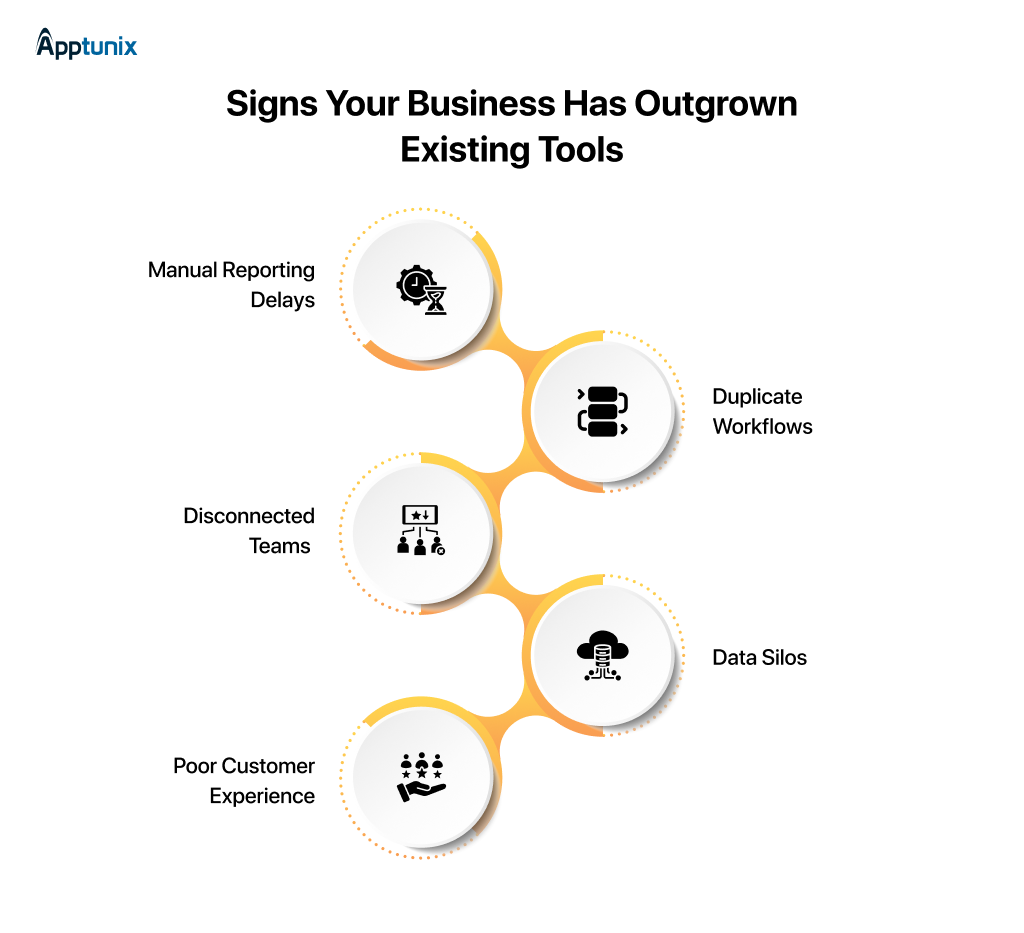
Initially, certain tools, when paired together, perform well, like spreadsheets, CRMs, and standalone apps. But as business grows, it becomes a necessity to acquire an enterprise system. It usually starts subtly, like the data doesn’t match across systems. Teams rely on manual updates or reports that take hours or days to compile.
Processes that once took minutes now require multiple steps and approvals. Then it becomes a problem. Leaders don’t have a clear view of operations. Teams duplicate work, and the customer experience suffers as systems aren’t connected. This is typically the point where most businesses realise they’ve outgrown their existing setup and begin exploring custom enterprise software development solutions. Here onwards, enterprise web app development becomes less of an option and more of a necessity.
Every enterprise application serves a different purpose. In fact, most organizations use a combination of systems, each of which serves a different operational challenge. What’s important to understand is how these systems operate within a bigger ecosystem.
For instance, ERP systems are designed to provide structure in internal processes. It is used to manage and integrate core business processes such as: Human resources, manufacturing, supply chain, and procurement into a single unified portal.
CRM platforms, on the other hand, focus outwards. These help in handling customer relations by tracking interactions, upgrading sales processes, and personalising communication. Then comes supply chain systems, which operate in the backend but are important for businesses that deal with inventory, logistics, and vendor management. Their absence can cause chaos in operations.
Business intelligence platforms go one step ahead by turning raw data into actionable insights. They just don’t provide analytics, but define why it’s happening and assist with the next move. Investing in collaborating platforms or tools that link teams, streamline communication, and improve output across departments is capital-efficient for enterprises.
Before jumping straight into development, the bigger question is not what to build, but how to build it right. Enterprise systems influence operations for years, so early decisions must support growth, efficiency, and long-term adaptability.
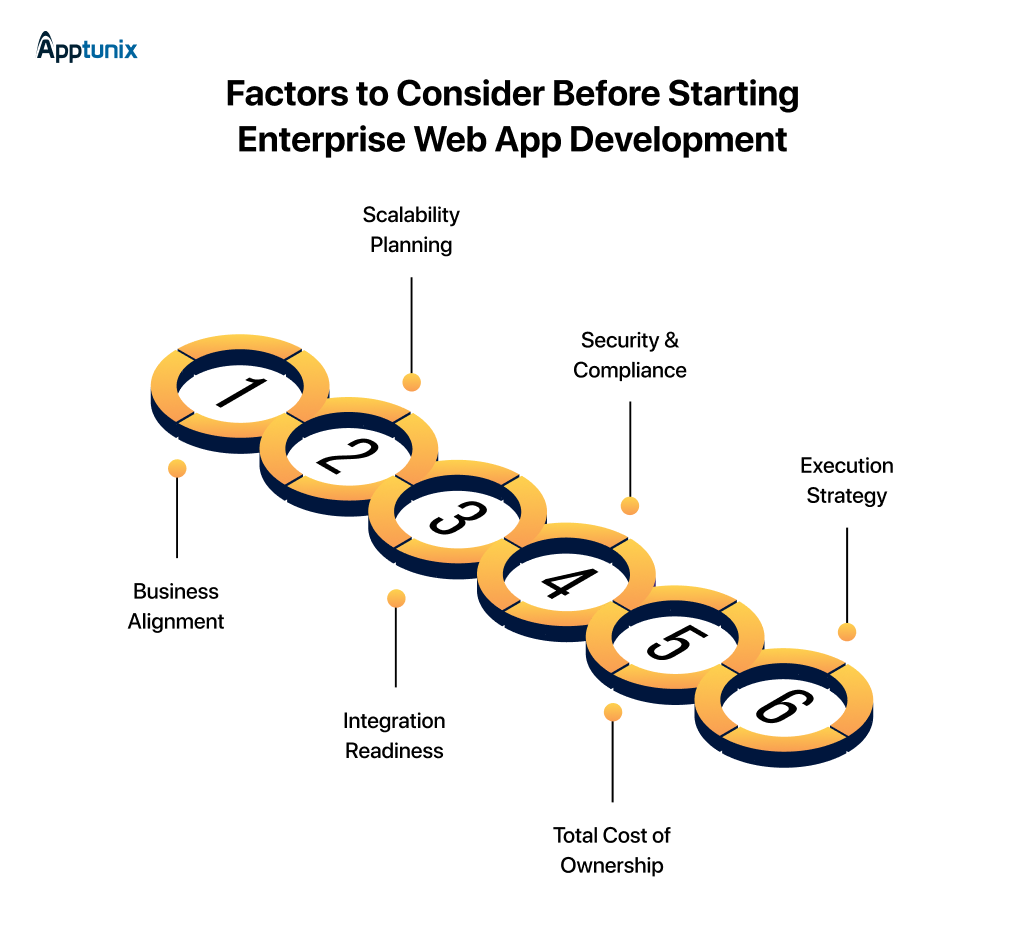
1: Business AlignmentThe platform should solve real operational challenges, not simply replicate the existing process. Start by identifying where delays, inefficiencies, or disconnected workflows exist, then build around measurable business outcomes.
2: Scalability PlanningEnterprise web apps should support future expansion, not just current demand. Whether it’s more users, new markets, or larger data volumes, the architecture must grow without performance issues or expensive rebuilds later.
3: Integration ReadinessMost organisations already rely on CRMs, ERPs, accounting software, and internal tools. A new system should integrate smoothly with this existing ecosystem, otherwise it risks becoming another isolated platform.
4: Security & ComplianceFor enterprises handling customer, financial, or operational data, security cannot be an afterthought. Role-based access, data encryption, audit logs, and compliance requirements should be planned from day one.
5: Total Cost of OwnershipThe real investment goes beyond development. Businesses should evaluate maintenance, infrastructure, upgrades, support, and scaling costs to understand the complete long-term picture.
6: Execution StrategyWhether development happens in-house or through a specialised partner, success depends on strong planning, clear communication, and technical expertise. The right execution model helps deliver faster while avoiding unnecessary technical debt.
Building an enterprise application is not a one-time task. It is a structured process that evolves with business needs. Each stage plays an important role in creating a system that performs reliably today and scales smoothly in the future.
Stage 1: Discovery & Requirement Planning
Every successful project starts with understanding the business clearly. This stage focuses on identifying goals, current challenges, user needs, and workflow gaps. It helps define what the platform should achieve before development begins.
Stage 2: Architecture & Experience Design
Once the requirements are clear, the next step is planning how the system will function. This includes deciding the platform structure, user journeys, dashboards, and overall experience. Strong planning here prevents costly issues later.
Stage 3: Frontend & Backend Development
This is where the actual product starts taking shape. The frontend handles what users interact with, while the backend manages data, logic, and system operations. Both sides must work together seamlessly for smooth performance.
Stage 4: Integrations with Existing Tools
Most enterprises already use CRMs, ERPs, payment systems, or internal software. During this stage, the new application is connected with existing tools to create a unified digital ecosystem.
Stage 5: Testing & Quality Assurance
Testing runs throughout the project to ensure everything works as expected. This includes checking usability, speed, security, and system stability. Enterprise platforms must be reliable before going live.
Stage 6: Deployment & Launch
After approvals, the application is launched in the live environment. This includes server setup, cloud deployment, and final checks to ensure the transition is smooth with minimal disruption.
Stage 7: Post-Launch Support & Optimisation
Launch is only the beginning. As teams use the system, improvements, updates, new features, and performance enhancements become necessary. Continuous support helps the platform stay efficient as the business grows.
Stage 8: Scaling for Future Growth
As the organisation expands, the application should grow with it. This stage focuses on handling more users, new workflows, larger data volumes, and evolving business goals without rebuilding the system.
When applications are built for enterprise-scale operations, features are no longer optional add-ons—they become essential for security, efficiency, and long-term performance. The right feature set helps businesses run more smoothly, make faster decisions, and scale with confidence.
Single Sign-On (SSO) & Multi-Factor Authentication (MFA): Secure login systems help protect sensitive business data while making access easier for employees. Users can sign in quickly without compromising security.
Role-Based Access Control: Not every user should see or manage everything. Role-based permissions ensure employees only access the data and tools relevant to their responsibilities.
Real-Time Dashboards & Analytics: Live dashboards give leadership teams clear visibility into operations, sales, productivity, or performance metrics. This supports faster and smarter decision-making.
Audit Logs & Compliance Reporting: For regulated industries, tracking user activity is essential. Audit logs create transparency, while reporting tools help meet compliance and governance requirements.
Workflow Automation: Repetitive manual tasks such as approvals, notifications, and updates can be automated. This improves efficiency, reduces delays, and lowers operational errors.
Advanced Search & Smart Filters: As enterprise data grows, users need to find information quickly. Smart search and filtering improve productivity by reducing the time spent locating records or reports.
Multilingual & Multi-Region Support: For global organisations, supporting multiple languages, currencies, and regional settings helps teams work consistently across locations.
Seamless Third-Party Integrations: Enterprise platforms often need to connect with CRMs, ERPs, HR tools, payment systems, or other internal software. Smooth integrations keep data flowing across departments.
Offline Access & Syncing: For field teams or low-connectivity environments, offline functionality ensures work continues without interruption and syncs automatically once reconnected.
Scalability & Performance Monitoring: As usage grows, the system should continue performing efficiently. Monitoring tools help track speed, uptime, and overall platform health.

Using the right tech stack is important, as there is no universal tech stack specified for enterprise web software development. Frontend technologies like React, Angular, or Vue are chosen based on how complex the interface needs to be. Backend systems vary depending on performance and scalability requirements, like Node.js for real-time applications, Java, or .NET for enterprise-grade systems.
Databases are selected based on data structure and load, with caching layers added for performance optimization. Cloud platforms like AWS, Azure, or GCP provide the infrastructure needed to scale dynamically, especially for businesses planning SaaS-based enterprise platforms. DevOps tools ensure continuous integration and deployment, allowing systems to evolve without downtime.
The objective is not the “best” technology, but choosing the most appropriate combination.
Enterprise development is a significant investment. The cost to build an enterprise web application varies from $40,000 to $600,000 and takes up to 3 months to over a year to build.
These costs and timelines are driven by:
But what matters more is ROI. A well-built enterprise system reduces inefficiencies, improves productivity, and supports long-term growth, making it a strategic investment rather than an expense.
Some of the most successful enterprise platforms demonstrate what growth looks like in real life. Here are some game changers in enterprise apps:
Salesforce: Restructured the process of managing customer relationships for businesses by centralising data and automating workflows.
SAP: Built ERP systems that power operations for some of the world’s largest organizations.
Shopify Plus: Enables high-volume businesses to manage complex e-commerce operations seamlessly.
Slack: Effortless internal communication, making team collaborations faster and more efficient.
These platforms lead because they solve real problems at scale, and similar challenges exist across mid-market businesses today.
Enterprise systems are becoming more adaptive and intelligent over time. Merging AI into workflows brings predictive insights and automation. This reduces manual effort while improving speed and accuracy across teams. At the same time, modular architectures are making enterprise platforms more flexible, allowing businesses to update or scale particular components without disrupting the entire system.
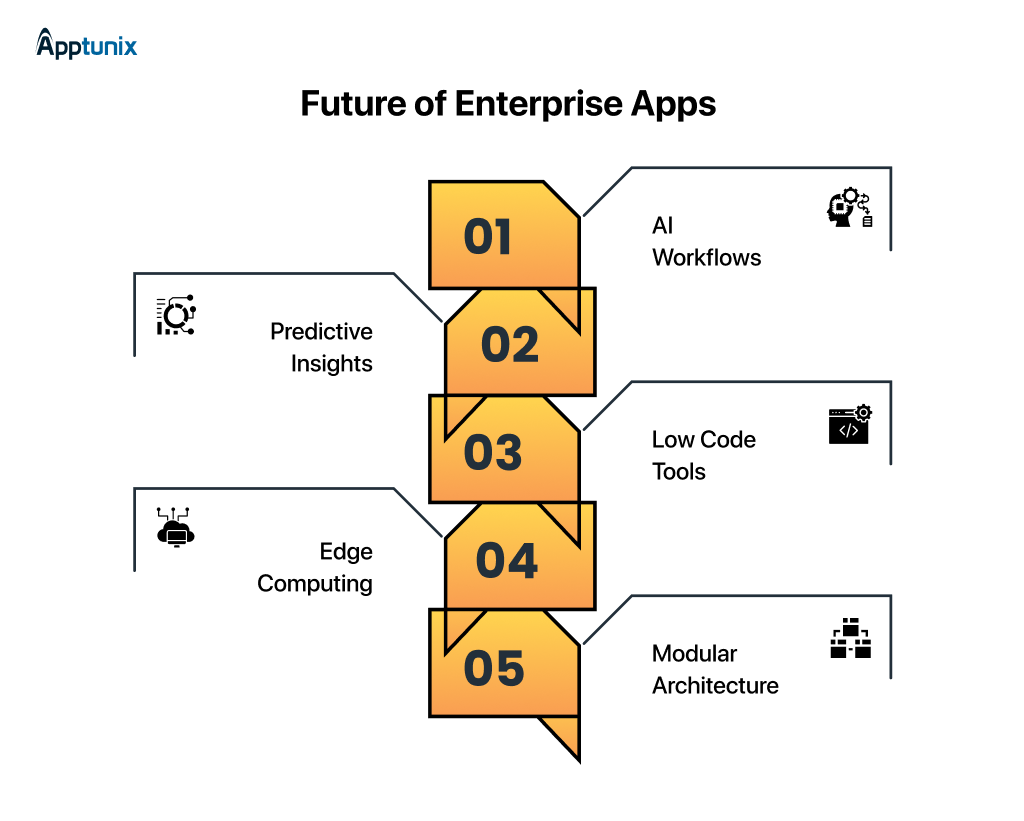
Low-code development empowers non-technical teams to customize workflows and dashboards, reducing dependency on developers. Meanwhile, edge computing has also become a game-changer in terms of increasing efficiency among globally dispersed users.
Apptunix approaches enterprise web application development with a focus on long-term scalability, not just immediate delivery.
With experience across 3000+ projects, the team emphasises:
Their work with global brands reflects an ability to build systems that don’t just function but thrive reliably. If you are evaluating partners for enterprise application development services, understanding Apptunix’s broader experience in high-performance software delivery can help shape the right decision.
Building an enterprise web application is more of a strategic rather than a technical decision. As organizations grow, the limitations of disconnected tools, manual processes, and rigid systems become increasingly visible. What starts as a minor unavailability eventually leads to operational delays, data silos, and missed opportunities.
This is exactly where enterprise web application development creates long-term value. It brings structure to complexity, connects systems, and enables businesses to operate with clarity and speed. But more importantly, it lays the foundation for scalability. As in enterprise ecosystems, the goal is bigger than just to solve everyday challenges; it’s about building systems that can adapt to changing business needs.
From architecture and technology choices to integrations and user experience, each decision made during development directly influences how well the system performs under pressure. That’s why taking a structured, well-planned approach is critical–not just for a successful launch, but for sustained performance over time.
As enterprise applications continue to become more intelligent, modular, and data-driven, businesses that invest in the right systems today will be better positioned to adapt, scale, and compete tomorrow.
If you’re evaluating your next move in enterprise web development, the focus shouldn’t just be on building an application, but it should be on building a platform that supports growth without becoming a limitation.

Q 1.What is enterprise web application development?
It is the process of building scalable, secure, and high-performance web-based systems designed to support complex business operations. These applications handle large user bases, integrate multiple systems, and ensure seamless workflows across departments within an organization.
Q 2.What is the difference between a web app and an enterprise web app?
A standard web app typically serves a specific function for a limited audience, whereas an enterprise web app is built for scale. It supports multiple user roles, complex workflows, system integrations, and strict security and compliance requirements across large organizations.
Q 3.How long does it take to build an enterprise web application?
The development timeline usually ranges from 3 to 12+ months, depending on the application’s complexity. Factors like feature scope, system integrations, architecture decisions, and testing requirements significantly influence how long it takes to build and deploy the platform.
Q 4.How much does enterprise web app development cost?
Enterprise web application development costs typically range from $40,000 to $300,000+ in the US market. The final cost depends on factors such as system complexity, integrations, scalability requirements, development team, and long-term maintenance planning.
Q 5.What technologies are used in enterprise web development?
Enterprise web development uses a combination of modern technologies across layers. Common choices include React or Angular for frontend, Node.js, Java, or .NET for backend, and cloud platforms like AWS or Azure for scalability and infrastructure management.
Q 6.What are examples of enterprise web applications?
Popular enterprise web applications include platforms like Salesforce, SAP, Shopify Plus, and Slack. These systems manage large-scale operations, from customer relationships and supply chains to internal communication and business analytics.
Q 7.Should I build or buy an enterprise web application?
The decision depends on your business needs. Off-the-shelf solutions work for standard workflows, but if your processes are unique or rapidly evolving, custom enterprise application development offers better flexibility, scalability, and long-term control over your system.
Q 8.What security features should an enterprise web app have?
An enterprise web application should include robust security measures such as data encryption, role-based access control (RBAC), multi-factor authentication (MFA), and secure APIs. It should also comply with industry standards like GDPR, HIPAA, or other relevant regulations.
Get the weekly updates on the newest brand stories, business models and technology right in your inbox.
As the Design Lead (UI/UX) at Apptunix, Sandeep Singh brings a decade of experience in crafting human-centric digital experiences. He specializes in intuitive product design, user psychology, and aesthetic storytelling that elevates brand identity. Sandeep is dedicated to building seamless interfaces that balance form and function, ensuring every digital touchpoint is engaging and accessible. By combining design-thinking with data-driven insights, he helps businesses transform complex workflows into delightful user journeys that drive high retention and market success.
90 Views 10 min June 24, 2026

95 Views 10 min June 22, 2026

105 Views 10 min June 19, 2026
Book your consultation with us.
Book your consultation with us.


One Central, The offices 3, Level 3, DWTC, Sheikh Zayed Road, Dubai
+971 50 782 1690


Offer Ends Soon
Get a quick expert response in under 5 minutes.