How to Create a Weight Loss App Like Noom?
14 Views 15 min August 10, 2026

Arohi Singh is a technology content strategist at Apptunix, where she writes about software and app development across industries, from on-demand and logistics to fintech, healthcare, and applied AI. With over 5 years of experience, she works closely with Apptunix’s engineers, product managers, and solution architects to turn real project insights into clear, decision-ready guidance for founders and business leaders. Her writing focuses on what matters before you build: market context, feature trade-offs, realistic costs, and compliance considerations
Planning to build a food delivery app in the UAE, Saudi Arabia, or Kuwait?
Here is what the investment actually looks like — based on real GCC-region project data, not textbook estimates. At Apptunix, we have delivered food delivery platforms for clients across Dubai, Riyadh, and Kuwait City. The cost range we consistently see: $15,000 for a lean MVP to $150,000+ for a full-featured, multi-panel platform.
This guide breaks that down by country, complexity tier, development panel, and timeline. So you can budget accurately before a single line of code is written.
If you already know your market and want to talk specifics, our food delivery app development team can map out a project scope for you in one call. Otherwise, read on.
The global and Middle Eastern food delivery sectors are expanding rapidly. All thanks to increased smartphone adoption and convenient lifestyle patterns. These factors make the region a top destination for launching custom food delivery platforms.
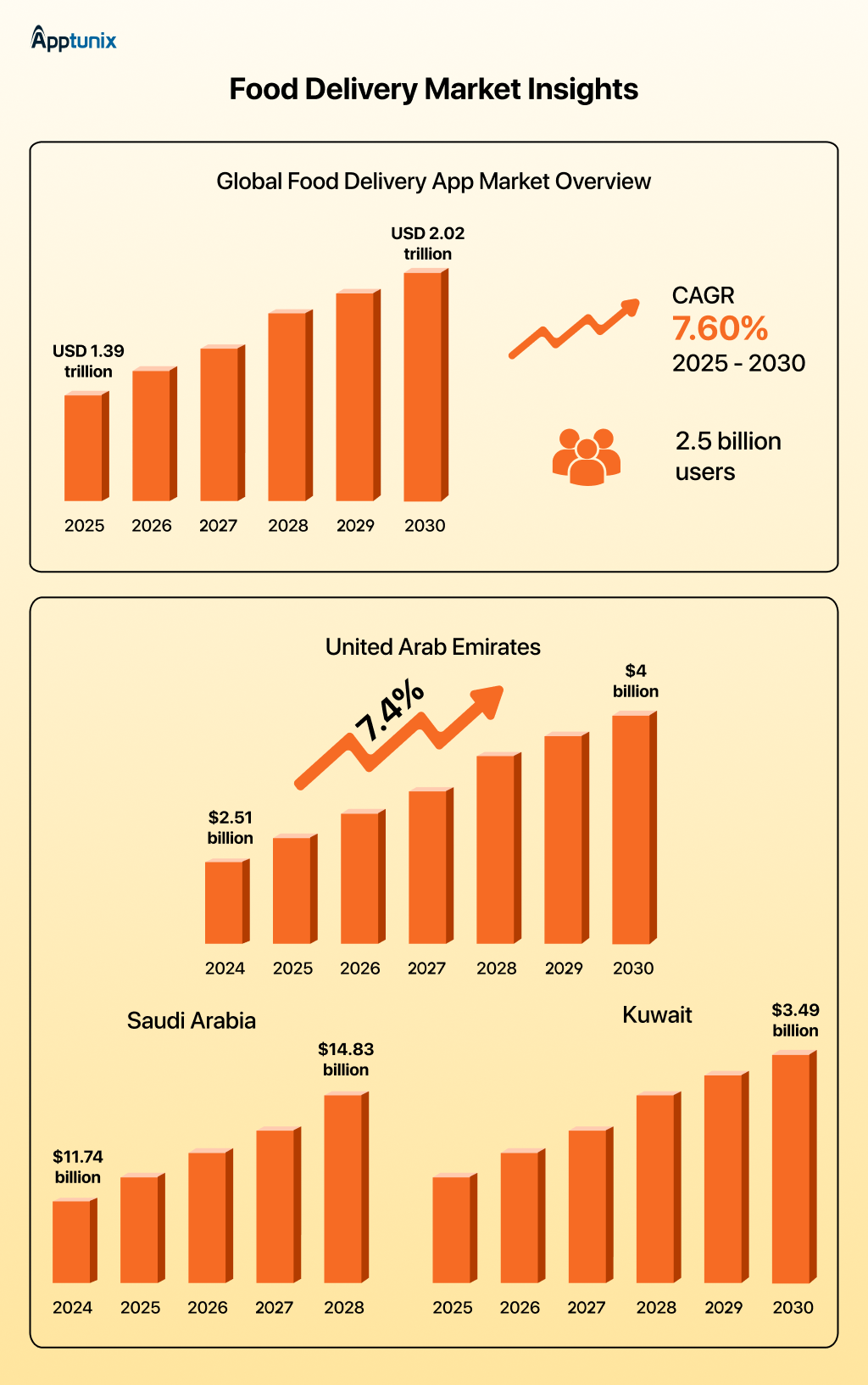
These numbers clearly reflect demand for innovation, advanced UX, and multi-platform support.
This shows why food delivery app development cost in Kuwait is more optimized for targeted, agile builds that deliver performance without over-investment.
The Middle East’s food delivery market is a goldmine, and the UAE, Saudi Arabia, and Qatar are its crown jewels. With booming markets and tech-savvy foodies, the restaurant delivery app development in Middle East offers a feast of opportunities.
Here’s why launching your app in these countries is a recipe for success.
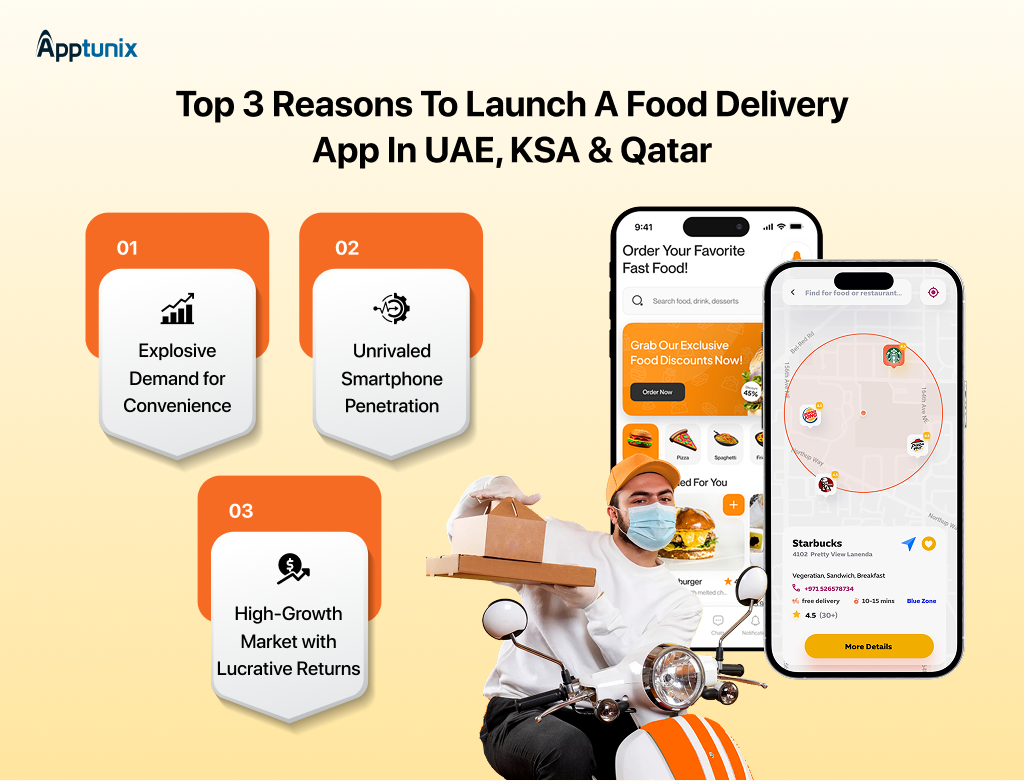
1: Explosive Demand for ConvenienceNever have the consumers in the UAE, Saudi Arabia, and Kuwait responded as well to fast, hassle-free food delivery than right now. In Saudi Arabia alone, the online food delivery market is projected to hit $2.79 billion by 2026. People wish to have meals at their doorstep: quick and steaming with a mere tap only. A food delivery app answers this rising need for convenience, making it a necessity, not a luxury.
2: Unrivaled Smartphone PenetrationSmartphones are everywhere in the Middle East market. The UAE boasts nearly 99% internet penetration, with users highly comfortable ordering via mobile apps. Saudi Arabia and Kuwait see similar mobile-first behavior. In Kuwait, food delivery apps have already reached over 1.6 million users with a penetration rate of 29–34%.
People here don’t just browse, they order, track, and repeat. If your app isn’t in their hands, or on their home screen, you’re missing the game.
3: High‑Growth Market with Lucrative ReturnsMiddle East nations are investing in digital transformation. Saudi Arabia, under Vision 2030, has attracted global players like Meituan’s Keeta into the Riyadh market, backed by a $266 million investment and a plan to capture 80% market share by 2026.
The UAE supports digital ventures through initiatives and startups like Instashop, which launched in Dubai and quickly expanded across categories, including food and groceries.
In Kuwait, Talabat remains a dominant local success story, worthy of attention by any serious investor.
Now that we’ve seen why launching in the Gulf is a golden opportunity, let’s break down what it actually costs to develop a food delivery app across UAE, Saudi Arabia, and Kuwait.
To enter the fast-growing food delivery space in the Middle East, understanding the development price is of utmost importance. But it’s not just about numbers, it’s about smart investment. A well-built app can come up with massive potential, while a rushed one can cost you your reputation. Depending on your goals, whether it’s a basic MVP or a full-fledged app, your food delivery app development cost will vary.
The table below will help you compare and give you a budget estimate depending on the complexity of the apps and the rates of development in the region.
Note: Conversion is based on approximate values — $1 ≈ 3.67 AED, 3.75 SAR, and 0.31 KWD. Prices may vary based on vendor, tech stack, and timelines.
Now, let’s quickly dive deeper into the key factors that actually shape those numbers.
The plan of investing in a food delivery app in the Middle East, and more specifically, the UAE, Saudi Arabia, and Kuwait, is a very promising step. But to be able to survive in the market, it is necessary to be familiar with the factors that affect the cost of food delivery app development in these regions.
Let’s break down the main cost-driving factors in this regard.
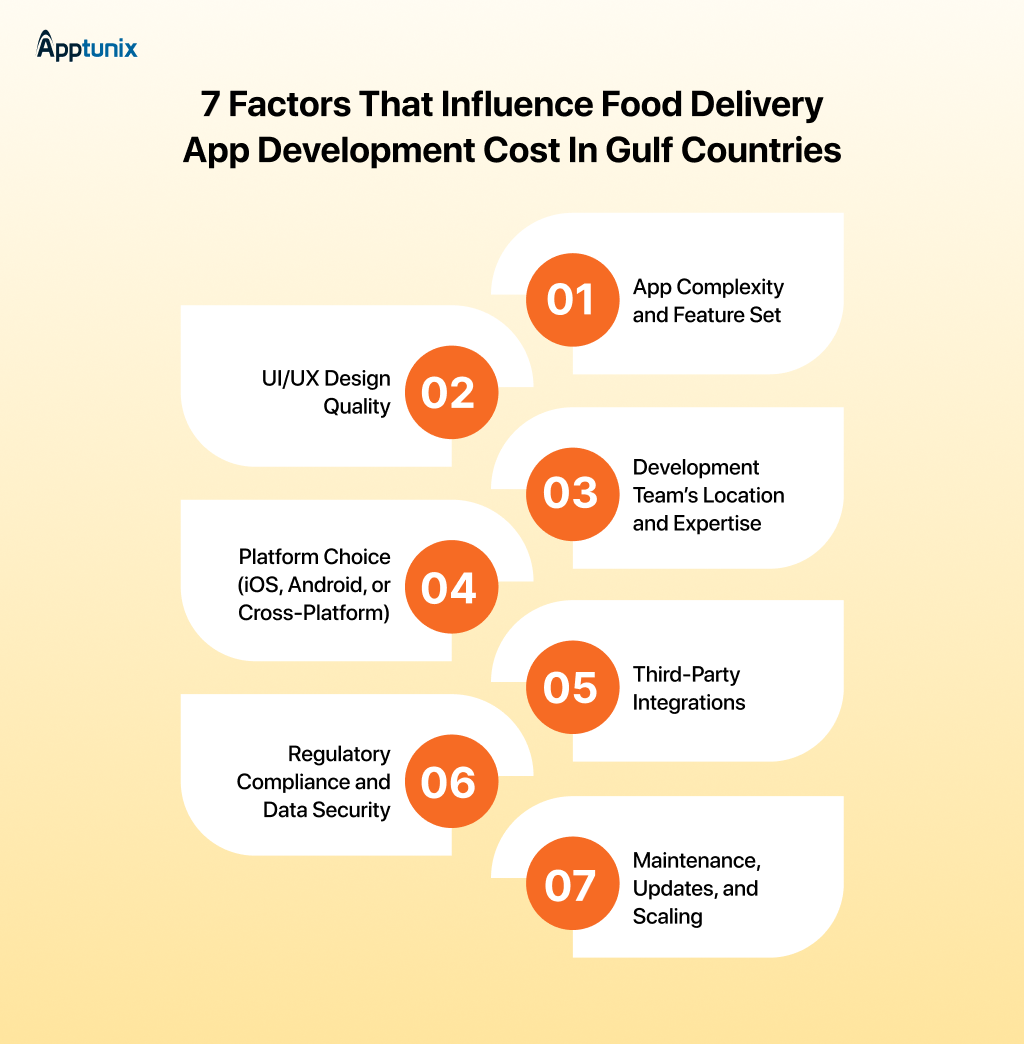
1: App Complexity and Feature SetKeep in mind that your app’s complexity directly correlates with its development cost.
Customers in these markets, like the UAE, Saudi Arabia, and Kuwait, are accustomed to highly refined experiences. They demand easy-to-use interfaces, multi-lingual communication, AI-based recommendations, and delivery tracking in real-time. These aspects are outside the simple scope and need a strong backend, bigger development channels, and a huge build time.
For instance, a basic app with login, menu navigation, and checkout might cost $20,000–$30,000. But an advanced, full-featured platform can push the budget upwards of $100,000.
2: UI/UX Design QualityIn the Middle East, the visual aspect of the product and its usability have a massive implication on how people consume it. The app design could end up either breaking the app or making it awesome.
Tailored designs catering to Arab cultures such as RTL (right-to-left) interface layouts, culturally relevant visuals, and region-specific color schemes, demand a specialist. Businesses that serve both locals and expats also need to create seamless, inclusive experiences.
Premium UI/UX offerings, mainly from experienced organizations, can cost anywhere between $5,000 to $25,000, depending on the wide variety of app monitors and degree of customization.
3: Development Team’s Location and ExpertiseThe price of hiring a development team differs tremendously by location. There are local agencies in the UAE or KSA where costs are higher, usually $50–$150 per hour due to overheads and high operational costs. On the other end, offshore development in India, Eastern Europe, or Southeast Asia provides lower prices ($20–$50 hourly) and access to world-class talent.
The majority of startups in Kuwait and the UAE opt for a hybrid model, i.e., strategic planning handled locally and technical execution outsourced. The localization, compliance, and regional scalability are met through hiring an experienced Middle East-focused development company.
4: Platform Choice (iOS, Android, or Cross-Platform)Platform selection is similar to picking a recipe. Native apps (Swift and iOS, Kotlin and Android) deliver the highest performance. But it is double the price for two platforms. Cross-platform alternatives such as Flutter or React Native, employed by Talabat, reduce cost by 30–40%. But here you have to compromise on complicated features such as real-time GPS.
In the Middle East, with 91–99% smartphone penetration, cross-platform is popular, keeping the food delivery app development cost in UAE or Saudi Arabia manageable.
5: Third-Party IntegrationsFood delivery apps require multiple third-party integrations to function efficiently. Each adds to the development cost, like Payment gateways, Maps & Geolocation, SMS & Email APIs, and Chat support.
Each integration involves licensing fees and additional development hours. In the Middle East, integration with local payment and delivery services is often mandatory, which increases complexity.
6: Regulatory Compliance and Data SecurityMiddle East data protection laws become even more stringent within the region, especially in the UAE (Dubai Data Law) and Saudi Arabia (PDPL – Personal Data Protection Law).
If your app processes or saves personal data, particularly location and payment data, you have to follow local data hosting policies, consent collection, encryption, and privacy guidelines. These introduce security and legal advice costs into the development pipeline.
Non-compliance would lead to substantial penalties or app store rejection, meaning spending money on legal and compliance features upfront during development is non-negotiable.
7: Maintenance, Updates, and ScalingLaunching the app is just the beginning. The continual updating, bug fixing, performance tracking, and scaling with additional users incur ongoing costs.
For example:
Kuwait and Saudi companies are increasingly shifting to cloud-based scalable services in businesses such as AWS, Azure, or local cloud providers.
Now that we know what drives the cost, let’s break it down panel by panel.
An effective food delivery application is never meant to be a single interface. To win the struggle in competitive Middle East markets in such countries as the UAE, Saudi Arabia, and Kuwait, five panels need to be integrated into your platform, and each of them needs to cater to a major user group. We should deconstruct them and investigate what the usual cost of construction is:
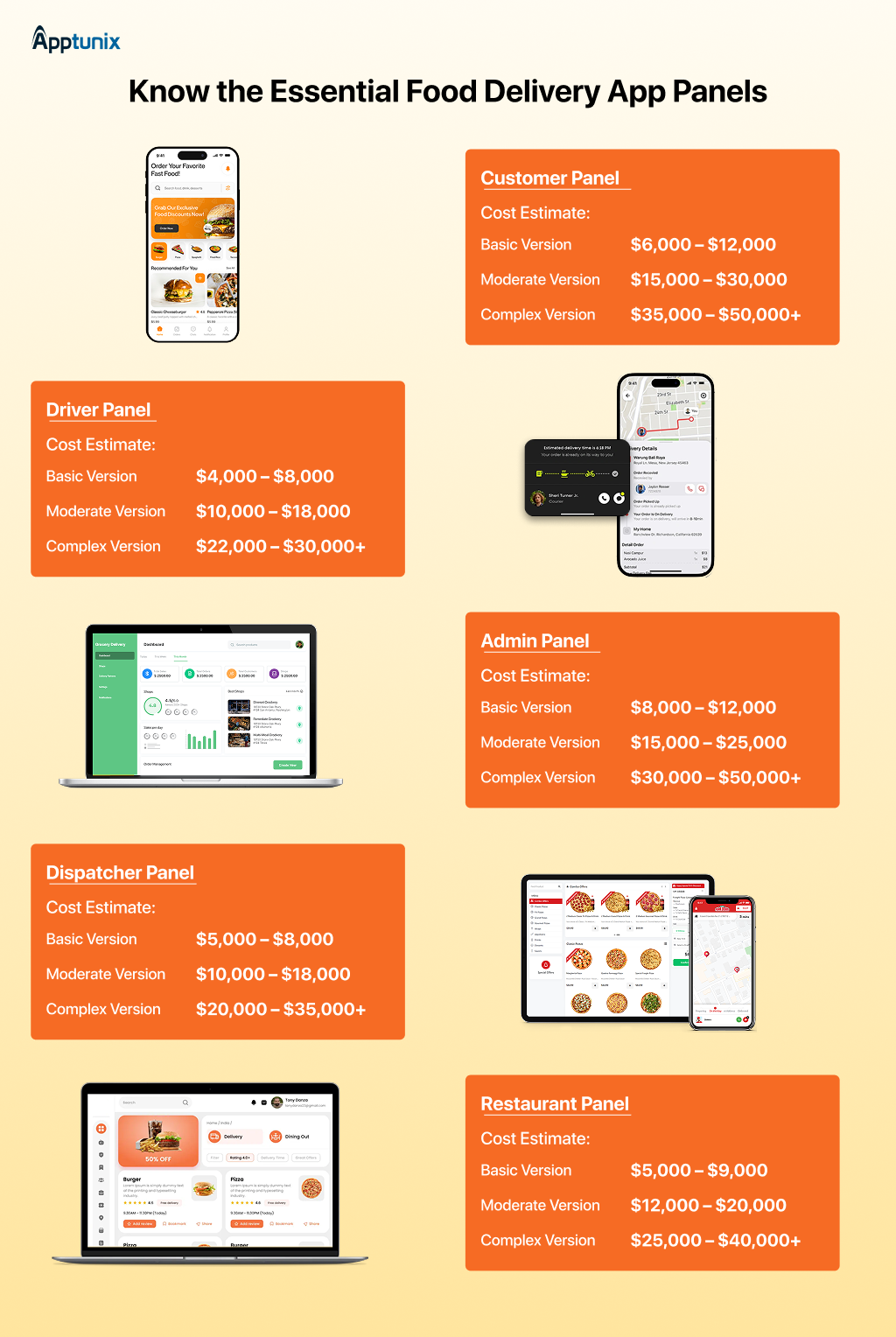
1: Customer PanelIt is the core of the user experience. From looking at restaurants to ordering and payment, this panel determines how your customers interact with your business on a day-to-day basis. It needs to be quick, user-friendly, and very responsive.
2: Driver PanelThe logistics backbone of your service. This panel allows tracking deliveries in real-time, optimizing routes, and communicating with customers or dispatchers. Since punctuality is significant in fast-paced cities in the Middle East, this panel will have to be well integrated with GPS and an easy UI.
3: Admin PanelThis is your mission control. Both in the case of launching in Abu Dhabi or expanding across the Gulf, the admin panel provides you with complete control and insights. It is where you monitor your platform health, user metrics, vendor data, and revenue performance. It will give complete control over the scalability, compliance, and profitability.
4: Dispatcher PanelThe operational nerve center. This panel manages real-time order dispatch, zone-wise delivery mapping, and efficient driver assignment. In high-demand areas like Jeddah or Kuwait City, a robust dispatcher panel is essential for reducing delays and increasing delivery throughput.
5: Restaurant PanelThe partner interface. Restaurants and food outlets use this panel to manage their online storefronts, menus, orders, and business performance. A smooth, intuitive merchant panel can greatly boost restaurant satisfaction and long-term partnerships in your ecosystem.
With a clear picture of what each panel will cost, the next big question is, how long does it take to bring your food delivery app to life in the Middle East?
When considering the cost and time frame of developing a food delivery application in the Middle East, it is crucial to know both the average construction time and the budget. No matter whether you’re planning to launch in Dubai, Riyadh, or Kuwait City, the delivery window directly impacts your market entry and ROI.
So, how long does it take to develop a food delivery app?
Well, it all depends on where and what you are developing.
Here’s a detailed look at timelines based on regions like the UAE, Saudi Arabia, and Kuwait, which are currently hotbeds for on-demand food tech innovation.
Estimated Timeline: 3 to 6 Months
If you are looking to know how long it takes to develop a food delivery app in the UAE, it usually takes from 10 weeks for MVPs to 6 months for complete apps. The food delivery app development cost in UAE comes with the advantage of quicker go-to-market with the help of an ample local talent pool and a highly developed digital infrastructure.
Entrepreneurs building a Zomato-like app in UAE or planning custom food delivery app development in the Gulf countries often choose the UAE because of its mature tech environment.
Why it’s faster in UAE:
If you’re willing to launch a food app like Talabat in Dubai, with the right team, your development time frame cannot be more than 3 months.
Estimated Timeline: 4 to 7 Months
The food delivery app development cost in Saudi Arabia is competitive, but development often takes longer due to:
For businesses exploring how much it costs to develop a food delivery app in Riyadh, it is necessary to consider additional time. Designing a bilingual interface, national data storage policies, and supporting local logistics APIs demands time.
Startups planning to build a food app like Jahez should budget around 4 to 6 months. Because more complex features, such as real-time tracking or AI-based suggestion offers, will require more time.
Estimated Timeline: 5 to 9 Months
The food delivery app development cost in Kuwait tends to be on the low side, particularly when a startup is aiming at the MVP model. However, slower delivery is often the trade-off due to a limited pool of full-stack agencies and technical consultants.
If you’re launching with a tight budget, Kuwait is a smart choice. The Middle East food delivery startup cost can be minimized by outsourcing development or partnering with offshore teams experienced in restaurant delivery app development in the Middle East.
Developing a custom food delivery app in Kuwait with all necessary and progressive characteristics may require 9 months or more in case it is done from scratch.
The duration to accomplish your journey could be dramatically reduced as you pursue seasoned programmers who are conversant with the market, payment gateways, and compliance models in the GCC region.
While timelines and costs vary by region, one thing’s certain: with smart strategies, you cut costs without cutting corners.

The idea of building a food delivery app in the Middle East can be a profitable undertaking, though it’s also a significant investment. The positive aspect?
There are smart, strategic ways to reduce food delivery app development cost in UAE, Saudi Arabia, and Kuwait without compromising on quality.
And now, it is time to look into the practical strategies that help you cut costs and still deliver a scalable, high-performing app.
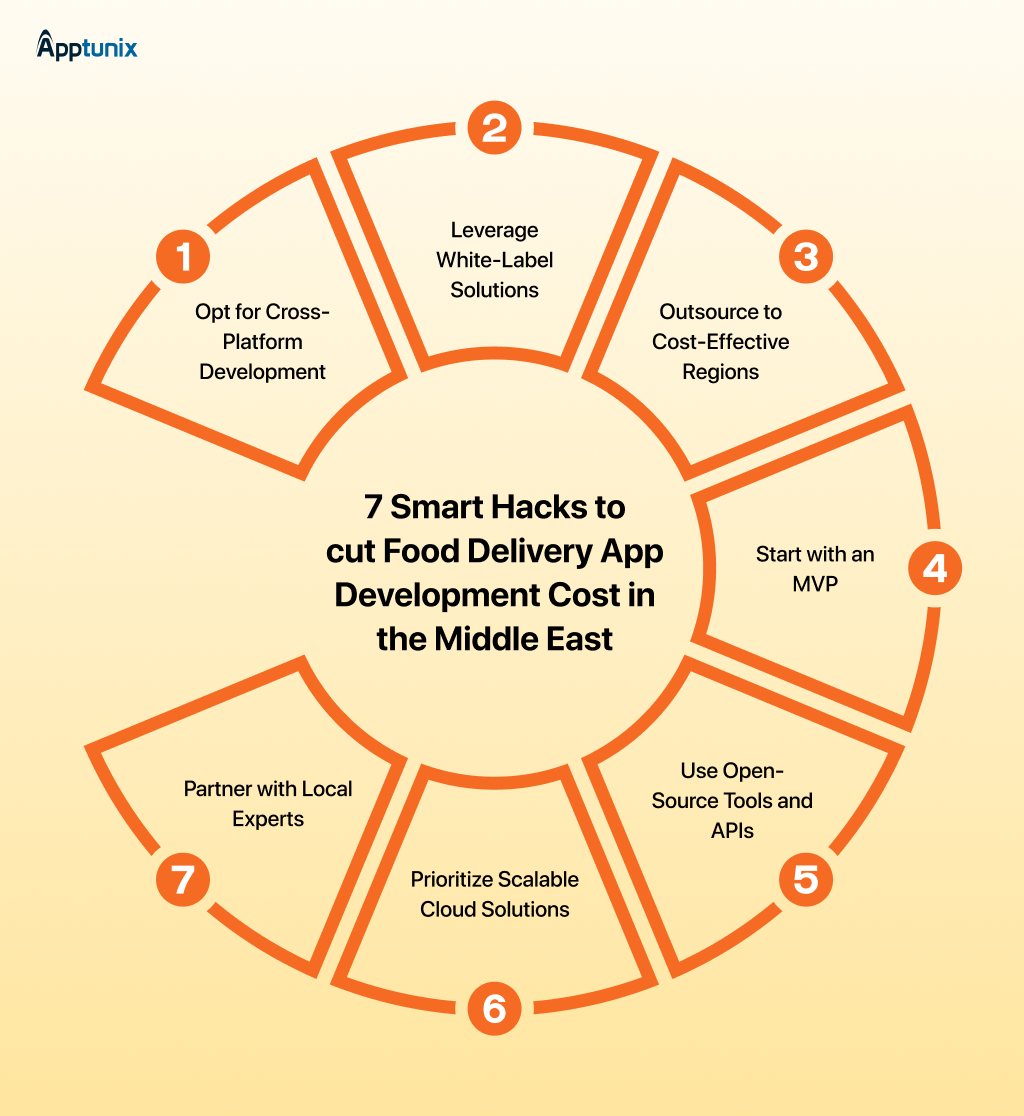
1: Opt for Cross-Platform DevelopmentWhy build separate iOS and Android apps when you can use Flutter or React Native to cover both?
The usage of cross-platform frameworks cut development time by 30–40%, saving $10,000–$30,000. Apps like Noon Food use Flutter for seamless performance across the UAE’s 91% smartphone penetration. This approach ensures your app reaches foodies in Dubai and Kuwait without doubling the food delivery app development cost in UAE or Kuwait.
2: Leverage White-Label SolutionsWhite-label app templates are pre-built, customizable, and minimize time to market much more effectively. This model helps businesses that want to create a food delivery app like Talabat or Jahez without having to spend a lot on its creation. It’s perfect for entrepreneurs seeking a lower Middle East food delivery startup cost, offering robust functionality at a fraction of the custom development cost.
3: Outsource to Cost-Effective RegionsDeveloper charges in the UAE ($100–$200/hour) and Saudi Arabia ($50–$150/hour) can inflate budgets.
Outsourcing to India or Southeast Asia ($20–$50/hour) can save 40–60%, as seen with KFC’s Middle East apps, which achieved a 22% conversion boost. This keeps the cost to develop a food delivery app in Riyadh or Kuwait competitive without compromising quality.
4: Start with an MVPLaunching with just the essential features allows for faster rollout and lower investment. It’s the smartest approach for startups to test the market. Once the MVP proves successful, you can reinvest in scaling and advanced features, minimizing financial risk.
5: Use Open-Source Tools and APIsIntegrating open-source libraries and third-party APIs (for payment gateways, maps, chat, etc.) can save thousands in development hours. This approach directly lowers on-demand food delivery app pricing in UAE while maintaining a rich user experience. Popular services like Stripe, Google Maps, and Firebase cut both costs and implementation time for Gulf-based apps.
6: Prioritize Scalable Cloud SolutionsThe overall cost of the backend is lowered by 20% as Cloud services such as AWS or Google Cloud provide pay-as-you-go opportunities. For Saudi Arabia’s 520,000 daily orders, scalable servers handle peak Ramadan traffic without upfront investments, optimizing the app development cost for food delivery in the Middle East.
7: Partner with Local ExpertsCollaborating with region-specific consultants or agencies that are familiar with the culture of the Gulf market, its laws, and understanding the consumer behaviour will avoid costly mistakes. These experts guide localization, compliance, and integrations more efficiently. Their expertise reduces costly revisions, saving 10–15% on the Zomato-like app cost in UAE or Saudi Arabia while ensuring cultural fit.
By blending these strategies, you can launch a game-changing app without breaking the bank.
Strategist Tip: Don’t compromise your security to save a quick buck. If you want a platform built to withstand peak order volume during Ramadan while staying completely compliant with Gulf digital laws, explore our core Custom Food Delivery App Development Services to see how we blend cost-efficiency with premium, market-ready execution.
Now it’s the perfect time to explore how you can turn every delivery into a revenue opportunity.
Developing a food delivery app is only half the battle. Maintaining and scaling revenue is where the real challenge begins. Here’s how leading food apps in the Middle East, like Talabat, Jahez, and Careem NOW, and what you can do to optimize your profit, as well.
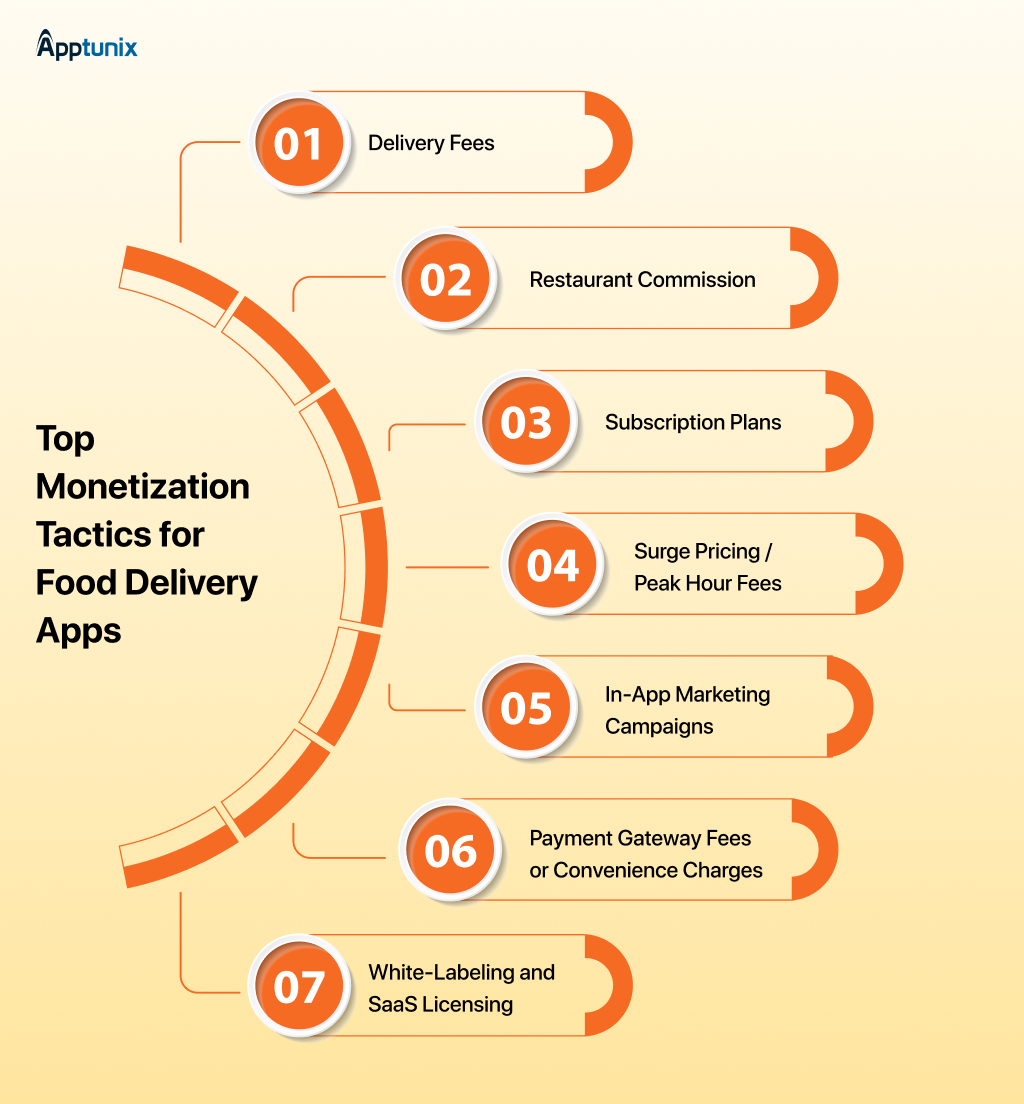
1: Delivery FeesOne of the most straightforward sources of revenue is imposing a delivery fee on customers. These fees can be fixed, distance-based, or surge-based, depending on traffic and order volume.
In high-demand cities like Dubai and Riyadh, the variable pricing models of delivery definitely serve the purpose. It augments the logistics expenditures and amplifies profitability without directly impacting the on-demand food delivery app pricing in UAE.
2: Restaurant CommissionThe majority of food delivery services charge a fee (commission) on every order a customer makes with the help of the app. It is usually between 15% and 35 %.
For businesses considering restaurant delivery app development in the Middle East, this model aligns well with both premium and budget restaurant chains looking for broader market access.
3: Subscription PlansInspired by models like Zomato Gold and Talabat Pro, subscription-based monetization offers customers free deliveries, discounts, and priority support for a monthly or annual fee. It’s a smart move for startups aiming to reduce churn and balance Middle East food delivery startup costs with recurring revenue.
4: Surge Pricing / Peak Hour FeesAn additional fee imposed on customers at peak hours or times of high demand will assist in maximizing profits. And this especially works in urban centers such as Dubai or Jeddah, in which food delivery can be considered time-sensitive. Surge prices are not only good for increasing margins but also lead to increased revenue during rush hours. Through which the cost of food delivery app development in the UAE can be covered.
5: In-App Marketing CampaignsAllowing restaurants or third-party brands to rent promotion space in the app with special offers, coupons or banners allows them to market to the users directly. This feature adds a dynamic income stream without altering the custom food delivery app development in Gulf countries, making it cost-efficient and easy to maintain.
6: Payment Gateway Fees or Convenience ChargesCharging users a small processing fee for online payments or fast checkouts may seem minimal, but it adds up at scale. For platforms keeping close watch on the app development cost for food delivery in the Middle East, this fee structure creates consistent passive income with little operational friction.
7: White-Labeling and SaaS LicensingSome successful platforms expand into B2B by offering their food delivery tech stack as a white-label or SaaS solution to restaurants or aggregators. This strategy offsets high Zomato-like app cost in the UAE by licensing out proven architecture to others, turning technology into a revenue driver.
Now that you know how to earn, let’s explore who can help you do it best.
In a region bursting with digital innovation, rising consumer demand, and fierce competition, building a profitable food delivery app goes beyond just code. It requires strategic insight, regional expertise, and a product built to scale. Whether you’re planning to enter Saudi Arabia with a restaurant delivery app or exploring custom food delivery app development in Gulf countries, partnering with the right tech ally makes all the difference.
And Apptunix is that ally.
With over 11 years of experience and 2500+ solutions delivered across the globe, Apptunix specializes in food delivery app development tailored for the Middle East market. Our team understands the peculiarities of cities such as Dubai, Riyadh, and Kuwait City in terms of challenges and user expectations.
We’ve assisted startups in building apps like Talabat and Jahez, offering white-label, custom, and SaaS-based solutions. It will strike the right balance between cost-efficiency and user-centric design. Whether your goal is to minimize the Middle East food delivery startup cost with an MVP or to launch a Zomato-like app, we offer flexible models to fit your budget and timeline.
Want to see the kind of apps we have built? Browse our food delivery portfolio to explore completed projects across the region.

Q 1.How to develop a food delivery app in the Middle East?
The most essential step to building a food delivery app in the Middle East is:
Q 2.What is the average food delivery app development cost in the UAE?
The average cost to build a food delivery app in the UAE varies; it is based on numerous factors. A basic, functional app (MVP) might cost AED 73,500 – AED 183,750 (~$20,000 – $50,000 USD). For a more feature-rich or Zomato-like app, you could expect to invest AED 330,750 – AED 551,250+ (~$90,000 – $150,000+ USD), again depending on the complexity or functions.
Q 3.How long does it take to build a complex food delivery app in Dubai?
A feature-rich app can take 4 to 6 months in Dubai. MVPs may take just 5–10 weeks. Timelines depend on scope, design complexity, and integration requirements like maps, payments, and admin dashboards.
Q 4.What are the key challenges in food delivery app development in the Middle East?
Some unique challenges in the Middle East market include:
Q 5.What are the key features that influence the food delivery app development cost the most?
Cost-driving features in a food delivery app include:
The more complex the feature, the higher the development time and budget required.
Q 6.What are the primary monetization strategies for a food delivery app in the Middle East?
Delivery fees, restaurant commissions, premium subscriptions, sponsor listings, and surge prices are the most frequently used ways of revenue acquisition by most apps. Ad placements and loyalty-based upselling are common throughout the Gulf states.
Q 7.How do local payment gateways like KNET (Kuwait) or SADAD (Saudi Arabia) affect development?
Implementing local gateways guarantees compliance and customer trust, but can add a bit to development expense because of local API specifications and additional testing. Still, they are critical to conversion and retention.
Q 8.How can Apptunix help my business launch a successful food delivery app in the Middle East?
Apptunix, with over a decade of experience, helps businesses launch successful food delivery apps in the Middle East by offering end-to-end development. We specialize in understanding local market needs, building tailored features, ensuring robust security, and optimizing your food delivery app development cost, from initial planning to post-launch support.
Q 9.Has Apptunix ever built a food delivery app in the Middle East market?
Yes, Apptunix has successfully built and launched food delivery apps in the Middle East market. From geo-fenced solutions in Dubai to region-specific platforms in Saudi Arabia and Kuwait, we’ve delivered apps tailored to local needs. With experience in integrating payment systems like SADAD and KNET, we know what it takes to thrive in the Gulf.
(4 ratings, average: 4.50 out of 5)
Get the weekly updates on the newest brand stories, business models and technology right in your inbox.
Arohi Singh is a technology content strategist at Apptunix, where she writes about software and app development across industries, from on-demand and logistics to fintech, healthcare, and applied AI. With over 5 years of experience, she works closely with Apptunix’s engineers, product managers, and solution architects to turn real project insights into clear, decision-ready guidance for founders and business leaders. Her writing focuses on what matters before you build: market context, feature trade-offs, realistic costs, and compliance considerations
Book your consultation with us.
Book your consultation with us.


One Central, The offices 3, Level 3, DWTC, Sheikh Zayed Road, Dubai
+971 50 782 1690