
Cost to Build an App Like Eventbrite: Complete Development & Pricing Guide (2026)
20 Views 24 min September 16, 2026


Australia’s taxi industry is rapidly shifting toward fully digital, app-driven booking systems.
User expectations now demand real-time tracking, instant payments, smart dispatch, and seamless UX.
AI-powered dispatch and route optimization are becoming competitive differentiators, not optional upgrades.
EV integration and sustainability readiness are shaping the future of mobility platforms.
Regulatory compliance across Australian states must be factored into architecture planning from day one.
Revenue models extend beyond ride commissions to subscriptions, surge pricing, fleet partnerships, and B2B contracts.
Scalable backend infrastructure determines whether a taxi app survives city expansion.
Building a taxi booking app in Australia requires both technical depth and strategic market clarity.
The opportunity lies in serving underserved niches — regional cities, corporate mobility, airport transfers, and EV fleets.
Success depends less on copying global ride-hailing giants and more on solving localized Australian market gaps.
Urban mobility rarely stands still. In the past, if you wanted to book a cab, you would call a dispatch line and hope that a taxi would arrive on time, if at all. Now people can use their smartphones to book a taxi, see their taxi’s real-time location, and pay for their ride in the app.
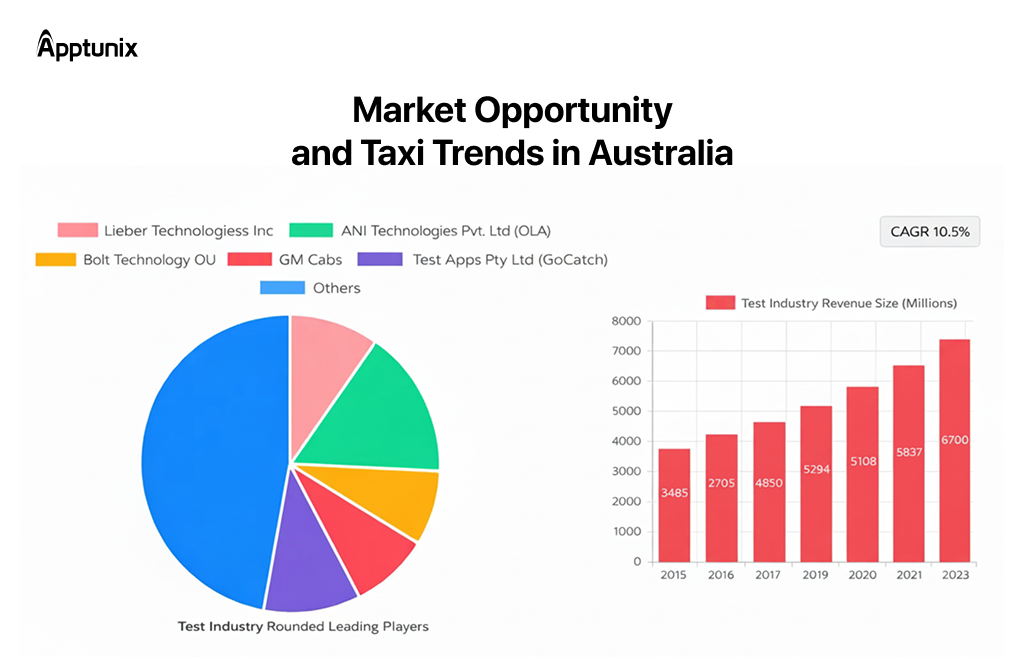
App-based cab bookings now represent over 63% of the Australian taxi industry and the percentage keeps increasing every day.
Meanwhile, ride-hailing revenue alone is projected to hit about $1.86 billion in the country, growing toward roughly $2.10 billion by 2030 with millions of active users expected on platforms. That trajectory explains why founders, transport operators, and regional fleet owners keep asking how to build a taxi booking app in Australia that actually competes in today’s market.
This guide covers the practical aspects of on-demand taxi app development in Australia.
The Australian transportation sector is undergoing a major transformation that is reshaping its operational structure. Identifying the industry’s future direction will help determine whether now is the appropriate time to build new transportation infrastructure.
The global situation is escalating further due to this issue. The ride-hailing industry will achieve global revenue of more than $428 billion by 2030, with annual growth exceeding 12.6%. The APAC Region which includes Australia, will emerge as the fastest expanding area for ride-hailing services throughout the next decade because of rising vehicle ownership costs and greater smartphone usage among former public transport users who now live in urban areas.
Uber and DiDi dominate the headline numbers in major metro markets, but the picture beyond Sydney and Melbourne tells a different story. Ola exited Australia entirely after competitive and regulatory pressures made the economics unworkable at their scale. That exit left real gaps in driver supply and regional coverage that a focused operator can genuinely address.
When an established player withdraws, they don’t take the demand with them. The riders and drivers are still there waiting for a better option.
✔Electric Vehicle Integration
Australia’s EV adoption is accelerating rapidly. EV sales grew by 117%, and federal government incentives continue pushing fleet electrification. Businesses who want to build a taxi booking app in Australia integrate electric vehicle (EV) fleet management, charging route optimization, and emission reporting into their ride-hailing platforms are better positioned than those who are retrofitting these capabilities later because they build in these capabilities from the outset.
✔AI-Driven Operations
Artificial intelligence (AI)-based dispatch systems are moving from being a competitive advantage to becoming a baseline expectation for taxi dispatch systems. Companies using AI-powered dispatch, predictive demand forecasting, and dynamic pricing optimization achieve up to 30% higher efficiency than traditional rule-based competitors. The majority of mobility platforms worldwide are expected to offer AI-driven dispatch capabilities by 2027.
✔Autonomous Vehicle Readiness
Waymo is currently offering commercial robotaxi services in the United States, providing millions of rides per month. Regulatory frameworks for autonomous vehicles in Australia are still developing, with trials underway in various states. Developers of mobility platforms that design their systems to integrate autonomous vehicles will be increasingly well positioned as regulations allow large-scale autonomous vehicle operation.
✔Accessibility and NDIS Transport
According to sources, 4.4 million Australians live with a disability, meaning that there is a continual demand for transport funding through the National Disability Insurance (NDIS). Currently, no major mobility platform provider effectively serves the transportation needs of these individuals, creating a significant opportunity for mobility system developers to build user-friendly taxi booking apps.
✔Increased Shared E-Bike Use
As consumers seek flexible options for short-distance travel, shared e-bike use has increased across Melbourne, Sydney, and Brisbane. Platforms that have adopted a forward-looking strategy are now integrating micro-mobility into their overall offering, creating a single app experience that covers everything from 1 km e-bike trips to 30 km airport transfers.
✔B2B Transport
Currently, the corporate mobility space in Australia is very fragmented. Organisations looking to manage employee transport, facilitate client transfer and manage executive travel want/need platform-based solutions with integrated invoicing features, compliance reporting, fleet visibility etc. The corporate market also has higher average transaction and customer lifetime values than observed in the consumer ride-hailing sector.
The process of starting a transport company today differs significantly from the procedures that existed fifteen years ago. Your organization requires equal resources for both its technology infrastructure and its vehicle fleet. Let’s proceed with the analysis in an organized manner.
A.Define Your Niche Before You Build AnythingEstablished competitors maintain an advantage over their rivals because most businesses use copying methods to compete against them. Uber and DiDi have already established themselves as leaders in the ride-hailing sector in most major metropolitan centres. Australian company Ingogo developed its sustainable business model through partnerships with taxi operators and corporate clients.
Opportunities in the Australian marketplace exist as follows:
B.Determine Your Revenue Structure EarlyYou should lock in your monetization strategy before you build a taxi booking app in Australia since your monetization strategy will have a direct impact on back-end workflows and analytics requirements, as well as the overall scope of taxi-hailing software development. You do not want to have to make significant architectural changes mid-way through the development of your software program.
Typical sources of the revenue generated in Australia are:
C.Licensing, Compliance, and Operational SetupThis is where many founders lose significant time. Australia doesn’t operate under a single national framework; ride-hailing regulation is administered at the state level, and requirements differ significantly across jurisdictions.
General requirements across most states include:
Evaluating legal requirements for ride-sharing apps in Australia should happen before a single line of code is written. Operators who treat compliance as an afterthought routinely face launch delays of six to twelve months sometimes longer in states with stricter frameworks like Victoria.
D.Fleet Ownership vs. Aggregator ModelThis structural decision has the single largest impact on technology scope and the cost to build a taxi booking app in Australia.
| Fleet Ownership | Aggregator Marketplace | |
|---|---|---|
| How it works | You manage vehicles and drivers directly | You connect independent drivers to riders |
| Capital requirement | Significantly higher | Lower |
| Operational control | High | Moderate |
| Platform dependency | Lower | Higher |
| Tech complexity | Vehicle management + dispatch | Driver onboarding + marketplace logic |
| Best suited for | Regional operators, premium services | Scalable city-wide platforms |
E.Think Beyond Launch DayMany founders obsess over initial development budgets. Yes, upfront numbers matter. But long term positioning matters more.
If you rush into development without strategic planning, you may underestimate infrastructure scaling needs, compliance updates, or feature expansion requirements. That oversight increases future costs far beyond initial savings.
When evaluating how to start a taxi business in Australia, focus on sustainability. Ask yourself:
A well planned foundation makes expansion easier. Poor planning locks you into expensive rebuild cycles.
In the end, launching a taxi platform is not just about building software. It is about building a system that connects technology, compliance, operations, and market demand into one coherent ecosystem. When those pieces align, growth becomes far more predictable.
Most founders approach taxi booking app development in Australia the wrong way: they start with features rather than operations. The result is a bloated, expensive product that looks functional in demos but underperforms in the real world.
The founders who get this right treat every development decision as an operational decision. Here’s how that plays out in practice.
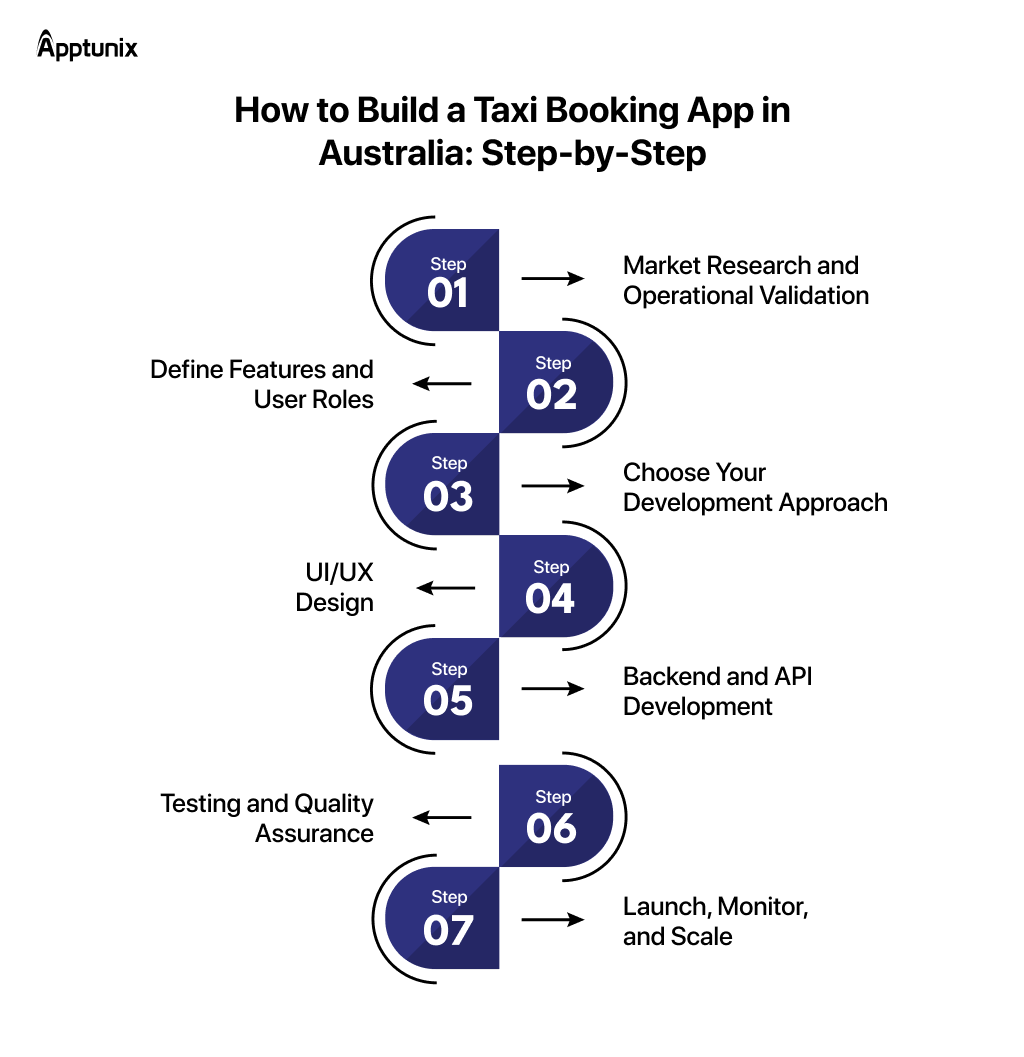
Step 1:Market Research and Operational ValidationDon’t build before you understand the market you’re entering. Talk to actual drivers and fleet operators. The demand-side is obvious. The supply-side (driver availability, shift patterns, vehicle types, pain points with existing platforms) is where most founders are blind.
Strong validation answers three questions:
When DiDi entered Australia in 2018, they didn’t just copy their China playbook. They spent months studying Australian commuter behavior and driver economics before launch and undercut Uber on commission to accelerate driver supply. Market research drove their go-to-market, not assumptions.
This stage also provides the clearest basis for estimating taxi software development costs in Australia before committing engineering resources.
Step 2:Define Features and User RolesThe Rider app, Driver app, and Admin dashboard each have distinct logic, users, and design requirements. Founders who treat them as “one app with different views” create scope creep, cost overruns, and under-built driver-side experiences.
The driver app is almost always under-scoped in early builds. Yet driver experience directly determines service quality, retention, and ultimately rider satisfaction. If drivers hate using your platform, your rider experience suffers regardless of how polished your passenger app looks.
Scoping all three independently from the start makes cost estimation more accurate and collaboration with taxi app development services in Australia significantly smoother.
Step 3:Choose Your Development ApproachThree main options exist, each with real trade-offs:
| Approach | Best For | Watch Out For |
|---|---|---|
| Native (separate iOS + Android) | Performance-critical platforms | Higher build and maintenance cost |
| Cross-platform (Flutter, React Native) | MVP stage, cost efficiency | Minor platform-specific limitations |
| Hybrid | Simple apps | Not recommended for real-time GPS platforms |
Three main options exist, each with real trade-offs:Cross-platform is the most common choice for founders building a taxi booking app in Australia at MVP stage, which balances speed, cost, and performance well enough for most early-stage use cases.
Build real-time infrastructure from day one. Real-time ride matching, live GPS, and push notifications are foundational. Retrofitting real-time capability into an existing codebase is one of the most common and expensive reasons early platforms require full rebuilds.
Step 4:UI/UX DesignUsers decide within seconds. Drivers decide within days. Uber’s early driver app was notorious for poor UX. It contributed to early driver churn in several markets. A poor driver app is a supply problem that directly throttles your rider experience.
Strong design reduces support volume, improves trip completion rates, and is one of the highest-ROI investments in the entire build.
Rider-facing design priorities:
Driver-facing design priorities:
Step 5:Backend and API DevelopmentThis is where the platform actually lives or dies. The backend determines whether your on-demand taxi app development in Australia performs under real-world conditions or collapses under load. Engineers build infrastructure for real-time matching, payment processing, notification delivery, and data coordination.
Key integrations every Australian taxi platform needs:
| Integration | Purpose |
|---|---|
| Google Maps or HERE | Routing, ETA, live tracking |
| Stripe or Braintree | PCI-DSS compliant payment processing |
| Push notification infrastructure | Real-time rider and driver alerts |
| AI-powered taxi dispatch system | Automated, intelligent trip allocation |
The AI-powered taxi dispatch system deserves serious investment at this stage. Static rule-based dispatch breaks down fast at scale. AI dispatch uses historical demand data, real-time driver locations, traffic conditions, and driver performance scores to allocate trips to reduce wait times while maximizing driver utilization.
Platforms using AI dispatch report 15–30% improvements in trip efficiency compared to manual or rule-based allocation.
Step 6:Testing and Quality AssuranceA bad launch is harder to recover from than a delayed one. To build a taxi booking app in Australia that handles 50 concurrent users comfortably will often fail at 500. And a public failure booking loops, payment errors, GPS dropouts destroys driver and rider trust in ways that take months to repair.
Testing must cover:
Step 7:Launch, Monitor, and ScaleLaunch is the beginning of the product. The weeks immediately after release generate more useful operational data than any planning phase can produce. How you respond to that data determines whether the platform grows or stalls.
Feed this data directly back into ongoing taxi booking software development. Every feature optimization at this stage should be driven by real usage patterns.
Platforms built on extensible architecture can enter new cities, add vehicle categories, and integrate new revenue streams without rebuilding. That flexibility is only possible if the earlier steps were executed with scale in mind. It’s the difference between a platform that grows and one that gets replaced.

The first thing you need to learn in constructing a taxi booking system for Australian markets is to understand the legal requirements for ride-sharing platforms which operate within Australian borders. You must maintain compliance throughout your entire project instead of treating it as a task which requires completion during the launch phase. Building an Australian taxi booking application requires you to establish all system components because compliance requirements determine driver recruitment processes and payment systems and application development expenses.
Founders who treat regulatory requirements as product requirements from day one build faster and spend less. Businesses that fail to comply with regulations will experience higher costs for redesigning their products and longer delays for product launches.
Every on-demand taxi app development in Australia collects sensitive data continuously location history, payment records, user identities, and ride patterns. The Australian Privacy Principles (APPs) under the Privacy Act 1988 govern how all of this is handled.
Platform obligations:
Why it matters for development:
Data governance decisions made during taxi-booking software development determine the cost of compliance at scale. The implementation of encryption and audit logging and access control systems should start at the program architecture stage because this process will require costly rework when organizations treat privacy issues as secondary. established taxi app development companies in Australia will treat privacy protection as their most important task from the beginning of their product development process.
What it covers: Any platform processing card transactions must comply with the Payment Card Industry Data Security Standard (PCI-DSS). This applies to every taxi booking software development project handling digital payments, which is effectively all of them.
Key implementation requirements:
| Requirement | What It Means in Practice |
|---|---|
| Secure gateway integration | Never store raw card data on your servers |
| Tokenized payment storage | Replace card details with encrypted tokens |
| Transaction monitoring | Automated fraud detection across all payments |
| Dispute and refund workflows | Clear, structured chargeback handling processes |
Recommended gateways: Stripe and Braintree are the most widely used for Australian taxi platforms both are PCI-DSS compliant by design and handle the majority of security requirements at infrastructure level. Getting this right early reduces both the cost to build a taxi booking app in Australia and the ongoing compliance burden post-launch.
What it covers: A structured approach to screening drivers is an essential compliance requirement for Australia taxi & ride sharing apps. All Australian states have driver screening requirements that are administered at the state level, but share similar baseline criteria across all jurisdictions.
An example of the typical onboarding compliance checklist:
Development consideration: When building a taxi or rideshare mobile app, driver onboarding has a narrow scope. A good driver onboarding process should support the collection of documents from drivers, tracking the verification status of those documents, and managing compliance records. Building a proper onboarding flow from the beginning will save time and reduce costs compared to retrofitting it later, and it will also lower the overall cost of building a taxi booking app in Australia.
What it covers: Dispatching based on manual methods is no longer operationally viable for growing ride share apps. An AI-based taxi dispatch system is used to automatically allocate trips to drivers based on live driver location, current demand for trips, current traffic conditions, and driver performance score, but must comply with privacy and data handling laws.
| Area | Requirement |
|---|---|
| Data inputs | Location and behavioural data must be collected under valid consent |
| Algorithmic decisions | Dispatch logic must not discriminate on protected characteristics |
| Data retention | Ride and location history retention must comply with APP guidelines |
| Driver transparency | Drivers must understand how allocation decisions are made |
Platforms using a compliant AI-powered taxi dispatch system consistently report 15–30% improvements in trip efficiency. The key is building the system with both performance and compliance in mind from the start, something any reputable taxi app development agency in Australia should be able to demonstrate experience with.
What it covers: The Disability Discrimination Act 1992 places enforceable obligations on transport providers, with state authorities progressively tightening these requirements for on-demand taxi app development in Australia.
Features required for taxi booking app accessibility and safety compliance:
| Area | Implementation |
|---|---|
| Vehicle accessibility | Wheelchair-accessible options within fleet or network |
| App accessibility | WCAG compliance for visual and motor impairments |
| Passenger safety | Emergency contact and live ride-sharing transparency |
| Incident reporting | Accessible, in-app reporting and escalation channels |
Don’t rely on informal policy interpretation. Transport regulation is state-administered, and requirements shift regularly as governments update licensing frameworks.
| Body | Jurisdiction | What They Cover |
|---|---|---|
| OAIC | Federal | Data privacy and APP compliance |
| Transport for NSW | New South Wales | Driver accreditation, operator licensing |
| VicRoads | Victoria | Commercial passenger vehicle licensing |
| TMR Queensland | Queensland | Booked transport operator requirements |
| Australian Government | Federal | Transport and infrastructure policy |
Convenience wins. A well-built passenger experience removes friction at every step and reduces the number of decisions a rider has to make.
Riders should be able to book a ride or schedule one for later in under a minute. Strong scheduling tools matter especially for airport transfers and corporate commuters two of the highest-value segments in the Australian market. If you’re working through how to build a taxi booking app in Australia, this is where the experience either hooks users or loses them permanently.
Watching a vehicle move toward you on a map reduces anxiety, improves perceived wait times, and makes riders feel safer during trips. Any on-demand taxi app development in Australia should treat map integration as foundational infrastructure. Live tracking is one of the non-negotiable features required for a taxi booking app at any scale.
Card processing, digital wallets, and automated receipts are standard expectations in 2026. What’s less obvious is that payment implementation must align with PCI-DSS standards and the broader legal requirements for ride-sharing apps in Australia something that should be baked
Riders want to know what they’re paying before they commit. Transparent upfront pricing reduces booking abandonment and eliminates post-trip disputes. Hidden or surprise fares are one of the fastest ways to lose rider trust permanently.
Two-way ratings create accountability on both sides of the marketplace. Passengers share experiences, platforms monitor service quality, and underperforming drivers get flagged before they become a reputation problem. This feedback loop is what keeps service standards from drifting as the platform scales.
Drivers are the supply side of your marketplace. Their experience directly determines service quality, availability, and retention. Yet the driver app is consistently the most under-invested interface in early-stage taxi booking app development in Australia and it shows in driver churn rates.
Drivers accept requests, track pickups, and manage trip status through a fast, low-distraction interface. Every unnecessary tap adds friction and friction at scale means lower acceptance rates and slower response times for riders.
A clear breakdown of completed trips, bonuses, surge earnings, and payout timelines builds the kind of trust that keeps drivers on your platform. Platforms that obscure earnings data consistently struggle with supply stability and a thin driver supply means longer wait times, which drives riders away too.
Real-time routing, traffic awareness, and turn-by-turn directions built directly into the driver app reduces context-switching and improves trip efficiency. Most Australian platforms integrate the Google Maps API at this layer to ensure accuracy and reliability across metro and regional coverage areas.
Drivers need to control when they work without friction. A clean availability toggle, shift scheduling, and break management tools give drivers autonomy which directly improves platform supply during peak demand windows.
Masked calling and in-app messaging enable drivers to coordinate with riders without exposing their personal phone numbers. It reduces no-shows, resolves pickup confusion quickly, and keeps all communication within the platform to ensure safety and compliance.
The admin panel is where long-term scalability lives. It’s also where an experienced taxi app development agency in Australia tends to add the most architectural value because a poorly designed backend creates operational bottlenecks that get more expensive to fix as the platform grows.
Live visibility across the entire driver network helps operators balance availability across zones, identify service gaps, and respond to demand shifts before they affect rider experience. This is the operational control room to build a taxi booking app in Australia.
Granular data on ride volume, revenue patterns, user behavior, and regional demand turns operational guesswork into informed decision-making. Platforms that don’t instrument their data early find themselves flying blind exactly when growth decisions matter most.
Operators need to adjust surge zones, pricing multipliers, and incentive structures in real time without engineering involvement. This flexibility is often the difference between a platform that responds to market conditions effectively and one that misses demand windows entirely.
Document collection, verification status tracking, accreditation expiry alerts, and compliance record management all need to live in one place. This is a direct legal requirement for ride-sharing apps in Australia, where driver accreditation standards are enforced at the state level.
Operators should be able to adjust driver commission rates, platform fees, promotional discounts, and referral structures independently. Hardcoding these into the backend creates expensive engineering dependencies every time the business model needs to evolve.
Simple proximity-based dispatch worked when platforms were small. As volume grows, it breaks down creating longer wait times, inefficient driver routing, and demand imbalances that frustrate both riders and drivers. The AI-powered taxi dispatch system has become the most influential operational differentiator in modern ride-hailing, and it’s increasingly a baseline expectation rather than a competitive advantage.
Here’s what it actually does.
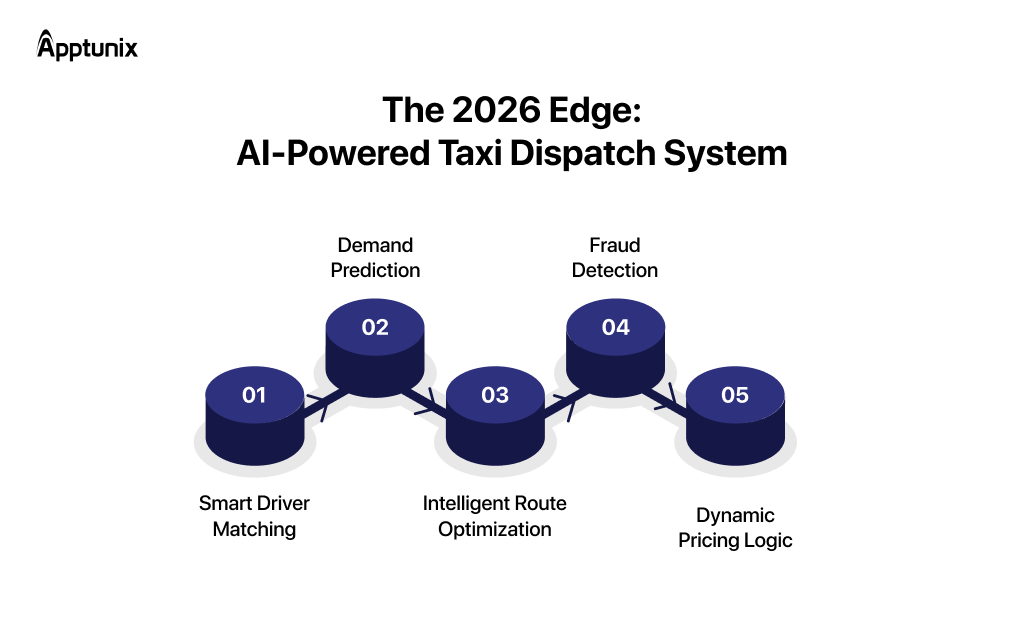
Traditional dispatch assigns the nearest available driver. AI dispatch goes further evaluating traffic conditions, driver history, route patterns, demand density, and trip completion likelihood before making an assignment.
The result is faster pickups, reduced driver idle time, and higher overall trip completion rates. For founders evaluating the cost to build a taxi booking app in Australia, intelligent dispatch increases initial development investment but the operational efficiency gains at scale make it one of the highest-ROI architectural decisions you can make.
AI models learn from historical booking data, seasonal patterns, weather behavior, and local event calendars. They forecast demand spikes before they happen giving operators time to pre-position drivers, adjust incentives, and prevent the supply shortages that damage platform reputation.
This is particularly valuable for taxi booking software development targeting Australian urban markets, where demand can shift sharply around sporting events, public holidays, and peak commute windows.
AI routing analyzes real-time congestion, road closures, and historical travel patterns to recommend the most efficient path. This improves fuel efficiency, arrival accuracy, and rider satisfaction simultaneously.
For drivers, smarter routing means more trips per shift and lower operating costs. For the platform, it means better asset utilization and fewer negative reviews tied to slow or inefficient routing.
Pattern recognition identifies suspicious booking behavior and payment anomalies before they become revenue problems. Systems monitor account irregularities, transaction inconsistencies, and behavioral deviations flagging issues for review without disrupting legitimate users.
This layer also supports alignment with the legal requirements for ride-sharing apps in Australia, where platforms are expected to maintain data integrity and user protection standards at scale.
AI adjusts pricing in real time based on demand intensity, driver availability, and time sensitivity. Riders see transparent pricing that reflects actual market conditions. Drivers receive surge incentives that make it worth their time to come online during busy periods.
Founders exploring how to build a taxi booking app in Australia increasingly treat dynamic pricing as a growth lever. When implemented well, it benefits all three sides of the marketplace: riders gain availability, drivers earn more, and the platform maintains its margin.
Investment planning always comes up early in conversations. Founders want clarity on budget expectations before committing resources. The cost to build a taxi booking app in Australia varies widely depending on scope, technology depth, and scaling goals.
Rather than viewing development as a single price tag, it helps to think in tiers.
| Development Level | Scope Description | Estimated Investment (AUD) | Estimated Timeline |
|---|---|---|---|
| MVP Build | Core booking features required for taxi booking app functionality | AUD 20,000 – 40,000 | 3 – 5 Weeks |
| Mid Scale Platform | Advanced tracking, analytics, scalable backend | AUD 40,000 – 80,000 | 3 – 5 Months |
| Enterprise Solution | Multi city support, automation, intelligent dispatch | AUD 100,000+ | 5 – 12+ Months |
Understanding taxi app development cost in Australia means understanding the variables that move the number up or down.
The single biggest cost driver. An MVP tests viability with minimal engineering. A full-scale platform targeting multi-city expansion requires significantly more architecture, testing, and integration work. Define your scope clearly before engaging any taxi app development services in Australia.
Native development costs more than cross-platform frameworks like Flutter or React Native. The right choice depends on your performance requirements and long-term maintenance budget.
Platforms implementing an AI-powered taxi dispatch system or predictive demand analytics require additional engineering investment upfront. That investment typically pays back in operational efficiency, driver utilization, and margin improvement.
Google Maps, Stripe or Braintree for payments, push notification infrastructure, and compliance tooling all add cost both upfront and as recurring operational expenses. These are non-negotiable for any serious on-demand taxi app development in Australia, so build them into your budget from the start.
Software doesn’t stand still. Bug fixes, OS updates, feature iterations, and infrastructure scaling form a continuous cost after launch. A realistic budget for taxi booking software development includes 15–20% of the initial build cost annually for maintenance and improvements.
The most expensive mistake founders make isn’t overspending on development — it’s underspending on architecture and rebuilding from scratch eighteen months later. Choosing the right taxi app development services in Australia from the beginning is a cost decision, not just a quality one.
Launching an app is only half the story. Revenue planning decides whether your platform grows into a sustainable business or struggles to cover operational costs. When founders explore how to build a taxi booking app in Australia, features dominate early conversations. But smart operators think about monetization just as early, because your revenue model shapes your backend architecture, your driver relationships, and your long-term competitive positioning.
Here’s a breakdown of the models that consistently work in the Australian market:
Most operators start here because it scales naturally and aligns platform incentives with driver success. You charge drivers a percentage on each completed ride typically between 15 and 30 percent depending on market competition, driver supply, and incentive structures.
This model fits cleanly into taxi booking software development because commission tracking, ride logs, and automated settlement tools integrate directly into the backend payment architecture.
A platform processing 5,000 rides per week at an average fare of AUD $20 with a 20% commission generates $200,000 in monthly gross revenue without charging riders a single extra dollar. Commission scales with volume, which makes it one of the most natural growth models in on-demand taxi app development in Australia.
Demand fluctuates constantly. Rainstorms, peak commute windows, major sporting events, and public holidays shift supply and demand instantly. Dynamic pricing allows your platform to respond in real time.
When implemented well, surge pricing benefits all three sides of the marketplace. Riders get availability when they need it most. Drivers receive financial incentives to come online during busy periods. The platform maintains supply-demand balance without manual intervention.
Modern on-demand taxi app development in Australia typically combines surge logic with an AI-powered taxi dispatch system using real-time traffic data, historical demand patterns, and driver availability.
Subscription packages give drivers and fleet operators predictable pricing while giving the platform a revenue stream that doesn’t fluctuate with ride volume.
Common subscription tiers include weekly or monthly driver memberships with reduced commission rates, premium placement in ride queues during high-demand windows, access to advanced earnings analytics and performance dashboards, and dedicated support channels for fleet operators managing multiple vehicles.
An experienced taxi app development agency will design tier logic that makes the jump from free to paid feel like a natural progression.
Subscription revenue is particularly powerful because it’s predictable. Commission revenue tells you how the platform performed last week. Subscription revenue tells you what next month looks like before it arrives.
Advertising rarely drives core revenue in the early stages, but it strengthens margins meaningfully once the platform reaches scale. The key to build a taxi booking app in Australia is that advertising only works when you have the user data and segmentation capabilities to make it relevant.
Opportunities in the Australian market include local business promotions targeted by rider location and trip history, sponsored pickup points at high-traffic venues like stadiums, airports, and shopping centers, in-app partner discounts and co-marketing arrangements with hotels, restaurants, and event operators, and fleet partnership deals with vehicle suppliers or fuel networks.
In practice, the most successful Australian taxi platforms don’t rely on a single monetization model. They layer multiple streams deliberately, with each one serving a different strategic purpose.
Commission ensures baseline revenue that scales with trip volume. Surge pricing optimizes supply-demand balance and captures peak-period upside. Subscriptions stabilize cash flow and build driver loyalty. Advertising adds incremental margin without affecting the core rider or driver experience.
Choosing the right mobile app development services in Australia shapes everything that follows — strategy, scalability, compliance, user experience, and long-term cost control. Many founders exploring how to start a taxi business in Australia reach a point where building internally feels unrealistic, timelines get tight, and the technical complexity of on-demand taxi app development in Australia becomes clear. That’s where an experienced partner changes the outcome.

Who Are We?
Apptunix is the most trusted & highly rated app development company in Australia with over a decade of experience building on-demand platforms across Australia, the Middle East, North America, and Southeast Asia. We’ve delivered more than 10 ride-hailing and mobility platforms globally, reaching millions of users across competitive urban markets.
Our team of 250+ engineers, designers, and product strategists has worked across the full spectrum of taxi booking app development in Australia from lean MVPs built for regional operators to enterprise-grade platforms handling hundreds of thousands of monthly trips. We understand what it takes to build a taxi booking app in Australia because we’ve seen it happen.
Australian transport regulation varies significantly by state, and overlooking licensing requirements creates operational friction that’s expensive to fix post-launch. We align taxi booking software development with local frameworks including CPVV standards in Victoria, Point to Point transport rules in NSW, and TMR requirements in Queensland.
That means driver onboarding flows, verification processes, and documentation modules are structured with compliance in mind before engineering begins. Our clients avoid the costly rebuilds that follow from treating legal requirements for ride-sharing apps in Australia as an afterthought.
Navigation habits vary between Sydney, Melbourne, and regional centres. Booking behavior differs between corporate users and casual riders.We design taxi booking app development solutions in Australia that reflect these realities, integrating PayID support, EFTPOS compatibility, region-specific mapping behavior, and accessibility options that meet Australian standards.
Successful platforms require more than a rider interface. We architect every engagement around three tightly integrated components because a weakness in any one of them creates problems across the others.
Budget uncertainty delays good decisions. We remove ambiguity by providing a structured taxi app development cost Australia breakdown before any development commitment is made.
Every engagement starts with a clear MVP cost projection based on your specific feature scope, a phased scaling estimate that shows how costs evolve as the platform grows, and infrastructure planning guidance.
This transparency helps founders evaluate the realistic cost to build a taxi booking app in Australia and align investment with actual business goals, rather than working from industry averages that may have nothing to do with what they’re actually building.
The founders who make the best technology decisions aren’t necessarily the most technical ones. They’re the ones who ask the right questions early and work with partners who answer them honestly. That’s the standard we hold ourselves to on every engagement.
Australia’s ride-hailing market isn’t saturated. It’s selectively served. Regional gaps, accessibility needs, corporate transport, and premium segments all represent real, underserved demand for operators who enter thoughtfully.
This guide covered everything that matters to build a taxi booking app in Australia, legal requirements for ride-sharing apps, platform architecture, features, costs, monetization, and the AI-powered taxi dispatch system capabilities that modern platforms run on
Each piece connects. Skip one and you’ll pay for it later usually at the worst possible moment. The founders who win in this space validate first, build smart, and partner with people who’ve done it before. The ones who struggle start with features and figure out everything else as they go.
You don’t need a perfect plan to start. You need the right conversation.
Apptunix has launched 100+ mobility platforms globally. We know what works in the Australian market, what the legal and technical landmines look like, and how to move from idea to live platform without the costly detours most first-time operators encounter.
The opportunity won’t wait foreve but rushing into the wrong build is worse than waiting. One strategy session can save you months of guesswork.

Q 1.How much does it cost to build a taxi booking app in Australia?
The cost to build a taxi booking app in Australia generally ranges from $40,000 to $60,000 for a standard MVP (Minimum Viable Product). For a more advanced platform with custom features, you can expect the taxi app development cost to scale between $100,000 and $250,000+, depending on the complexity of the integrations.
Q 2.Do I need to comply with Australian transport regulations?
Yes. To build a taxi booking app in Australia, you must adhere to state-specific laws like the Point to Point Transport regulations in NSW or Victoria’s Commercial Passenger Vehicles rules. Compliance includes driver accreditation, vehicle safety checks, and mandatory GST registration for all taxi travel services.
Q 3.How can I monetize a taxi booking app in Australia?
Most operators use a commission-based model, taking 15% to 25% per ride. Other effective strategies include surge pricing during peak Melbourne or Sydney hours, corporate account subscriptions, and in-app advertising for local Australian businesses.
Q 4.How long does it take to develop a taxi booking app in Australia?
A standard on-demand taxi app development in Australia project typically takes 4 to 6 months from discovery to launch. If you choose a white-label car rental app solution or a pre-built taxi framework, you can often go live in as little as a few weeks.
Q 5.How much investment is needed to launch a taxi booking app in Australia?
Beyond the initial taxi app development cost, you should budget for driver onboarding, marketing, and legal fees. A total initial investment of $80,000 to $150,000 is usually recommended to ensure a smooth launch in competitive markets like Brisbane or Perth.
Q 6.What essential features should a taxi booking app include?
Key features required for taxi booking app success include real-time GPS tracking, automated fare estimation, multiple secure payment gateways (Apple Pay/Google Pay), and a dedicated SOS button. A robust AI-powered taxi dispatch system is also critical for reducing wait times.
Q 7.What technology stack is used to build a taxi booking app?
Most taxi app development services utilize a modern stack: Flutter or React Native for cross-platform mobile apps, Node.js or Python for the backend, and AWS or Google Cloud for hosting. We also integrate Google Maps Platform for precise Australian geocoding.
Q 8.How can AI improve taxi dispatch and fleet management?
An AI-powered taxi dispatch system uses machine learning to predict high-demand “heat zones,” optimizes driver routes to save fuel, and automates smart-matching based on the driver’s proximity and performance history.
Q 9.How does Apptunix support taxi platform development?
As a leading taxi app development company, Apptunix provides end-to-end support—from UI/UX design to custom coding and post-launch maintenance. We focus on how to build a taxi booking app in Australia that is scalable, secure, and fully compliant with local transport authorities.
Q 10.Does Apptunix offer cost planning before development begins?
Yes! We provide detailed taxi booking software development cost planning during our initial discovery phase. This ensures your project stays on budget while prioritizing the high-impact features your specific market needs.
(1 ratings, average: 1.00 out of 5)
Get the weekly updates on the newest brand stories, business models and technology right in your inbox.
20 Views 24 min September 16, 2026

11 Views 24 min September 14, 2026

30 Views 24 min September 8, 2026
Book your consultation with us.
Book your consultation with us.


One Central, The offices 3, Level 3, DWTC, Sheikh Zayed Road, Dubai
+971 50 782 1690