How to Develop an Enterprise AI Chatbot: A Complete Step-by-Step Guide
39 Views 12 min July 21, 2026

Reena Bhagat, the CTO and Head of AI at Apptunix, is a seasoned technology strategist with a deep-rooted expertise in emerging technologies. With a focus on AI/ML integration, product engineering, cloud management, she leads the technical vision for high-performance SaaS infrastructures. Reena is recognized for building secure, scalable, and decentralized systems that solve real-world complexities. Her passion lies in leveraging data science and future-tech to create resilient digital products, making her a trusted authority for organizations looking to lead in the age of intelligent automation.
One unexpected demand spike can empty shelves within hours. One slow-moving product line can lock cash into inventory for months. Yet many businesses still rely on spreadsheets, static reports, and historical averages to make supply chain decisions in markets where customer behaviour changes faster than planning cycles can keep up.
The result is overstocked warehouses, stockouts during peak demand, delayed production, and strained supplier relationships. Industry benchmarks show that inventory carrying costs typically run 20 to 30 percent of inventory value per year. According to McKinsey’s research on AI in supply chain operations, improving forecast accuracy through AI can reduce inventory levels by 20 to 30 percent, which translates directly into that overhead being cut, not just managed.
This is where AI-powered demand forecasting changes the equation. Instead of relying only on past sales data, AI analyzes live inventory, demand shifts, supplier lead times, weather patterns, and market signals in real time to generate faster, more accurate predictions.
The real question for enterprises is no longer whether to use AI for forecasting, but whether to adopt a generic platform or build a custom solution trained around how their business actually operates.
AI demand forecasting uses artificial intelligence and machine learning to predict future customer demand with greater accuracy. It analyzes historical sales data alongside real-time business and market signals like inventory, pricing, seasonality, and supply chain trends.
Unlike traditional forecasting methods, AI continuously learns and updates predictions as new data enters the system. This helps businesses reduce stockouts, avoid overstocking, and improve supply chain planning. The result is faster, data-driven decision-making with more accurate demand visibility.
Earlier, demand forecasting was considered a back-office process. But today it is a competitive differentiator. The gap between businesses that get it right and those that do not is broadening fast.
E-commerce has been the biggest catalyst of this shift. As global e-commerce has grown over a decade from around 5 per cent of total retail sales to over 20 per cent now, this brings a level of demand volatility that traditional forecasting methods were never equipped to handle. Consumer behaviour changes faster, channels multiply, and seasonal patterns that once held steady now shift year to year.
While there are many ready-made demand planning tools available. Platforms like o9, Kinaxis, and SAP IBP are well-built products that serve a broad market. But the real question is – are they adaptable to your business requirements?
Comparing custom AI to off-the-shelf solutions is vague, as most off-the-shelf forecasting software is built for general use. It operates on broad market data and standard forecasting logic. That may work for businesses with simple operations, limited SKUs, or predictable demand.
But for growing businesses, demand is rarely that simple. It deals with multiple challenges, like:
Ordinary tools usually miss these patterns, which leads to poor forecasts, excess inventory, stockouts, and planning mistakes across procurement, production, and logistics.
That’s why many companies now choose custom AI demand planning software development services. As a custom solution is trained on your own historical data, your seasonal trends, your promotions, and your supply chain behaviour. It becomes more accurate over time because it keeps learning from your business, not from someone else’s data.
Businesses investing in enterprise demand forecasting software development should scope these capabilities from the architecture stage itself, not treat them as future upgrades.
One observation to make in this list is that every feature above needs to be scoped into the system architecture before development begins. Retrofitting any of them after the initial launch is significantly more expensive than designing for them from the start. If a development proposal does not address all seven of these, push back before the architecture is locked.
Usually, the explanations of AI in forecasting either skip the details entirely or go straight into ML terminologies that’s not for everyone. Neither is useful for a business evaluating whether to commission a build.
Here is what actually happens inside a custom-built AI demand forecasting platform designed for real-time supply chain planning, explained in easy language.
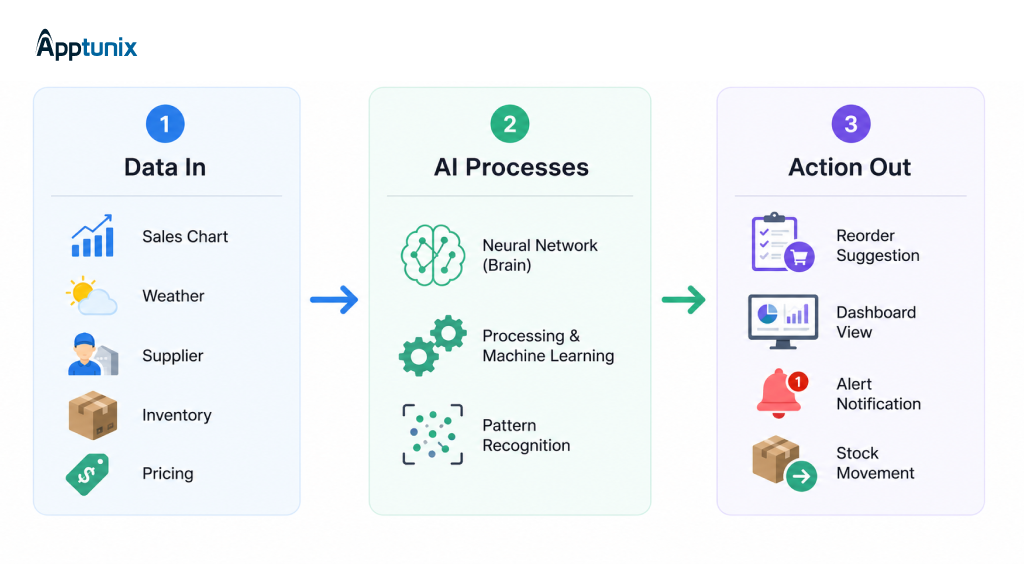
Traditionally, forecasting runs primarily on historical sales data. What sold last month, last quarter, last year? AI based demand forecasting starts with that same historical data and then adds everything else that influences what customers buy.
That includes live inventory levels, current pricing, upcoming promotions, supplier lead times, seasonal calendars, economic indicators, weather forecasts for relevant regions and, in some cases, competitor pricing signals and social trend data.
The more demand indicators the system can see, the more accurately it can predict what will happen next, especially for products with volatile or externally driven demand.
The forecasting model looks across all of this data simultaneously and identifies patterns that no human planning team could detect at the same scale and speed.
Not just what sold last November, but why it sold, and what combination of conditions at the time drove that outcome. Not just that demand spikes in Q4, but which specific SKUs spike by how much in which regions, under what pricing and promotional conditions, and how supplier lead time variability affected fulfillment in previous years.
The system learns these relationships continuously. As new data flows in, the model updates its understanding of your demand patterns and adjusts its predictions accordingly. Understanding how AI models are built and trained helps explain why this continuous learning is possible, and why the architecture decisions made during development directly affect how well a system adapts in production.
A supply disruption in a key region, a competitor going out of stock in a category, an unexpected shift in consumer behaviour following a news event, the model factors these in automatically, rather than waiting for the next planning cycle to catch up.
This is where demand forecasting AI is most commonly misunderstood. The output of a well-built system is not a spreadsheet of predicted numbers for the planning team to interpret and act on manually.
It is a set of recommended actions.
Reorder this SKU by Thursday to avoid a stockout in the northeast region over the next three weeks. Increase safety stock in this warehouse ahead of the Q4 promotional window based on last year’s uplift pattern. Move excess inventory from distribution centre A to B, where the model is predicting a higher draw over the next six weeks.
The recommendations are specific, timely, and actionable. The goal of a well-built demand and supply planning software system is not to produce a better forecast for someone to read. It is to shorten the distance between data and decision to the point where the right action is surfaced to the right person at the moment they can still act on it.
That is the difference between a forecasting tool and a planning system.
The businesses that see the strongest returns from custom demand planning artificial intelligence software share one common characteristic. Their demand is complex, volatile, or consequential enough that generic platform limitations show up directly in operational and financial performance.
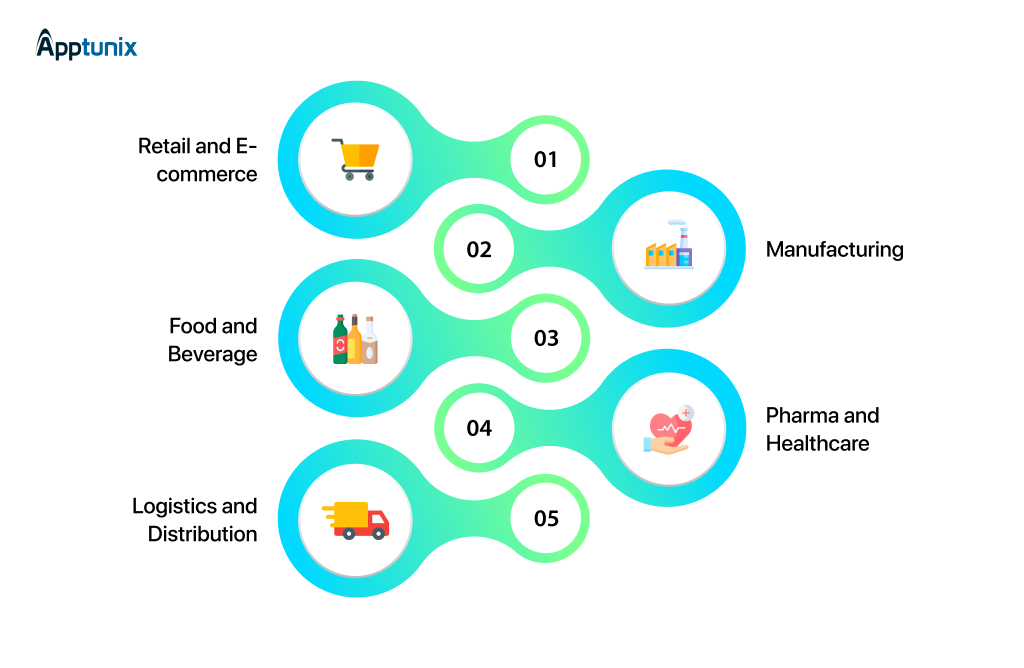
-> Retail and e-commerceRetail demand does not follow a straight line. Promotions spike up volumes overnight, and seasonal patterns vary by product, region, and year. Moreover, competitor pricing influences purchasing decisions in real time.
Off-the-shelf demand planning tools handle the predictable parts of retail forecasting well enough. Where they fall short is at the intersections. That is when a promotional uplift coincides with a supply constraint during peak season in a specific region.
Custom AI demand planning software handles these intersections because the model was trained on your promotional history, your regional demand patterns, and your supplier performance data. Not on industry averages from retailers with entirely different products and customers. That distinction is at the core of how AI in ecommerce transforms businesses. Not as a generic tool, but as something built around how your operation actually works.

-> ManufacturingFor manufacturers, a forecast error is not just an inventory problem. It is a production problem.
A miscalculation means a production line running at the wrong capacity, raw materials arriving at the wrong time, and procurement commitments built on incorrect assumptions. The downstream effects ripple across operations before anyone realises the forecast was off.
Custom AI-based demand forecasting built for manufacturing that connects demand signals directly to production planning workflows. When the forecast shifts, the downstream operational decisions shift with it automatically.
-> Food and beverageFood and beverage forecasting has a variable that most other industries do not have to account for. Perishability.
Overestimating demand for a perishable product line does not just create excess inventory. It creates a spoilage problem, a margin problem, and a waste management problem at the same time.
Custom demand forecasting AI for food and beverage accounts for expiry windows, supplier lead time variability, and regional consumption differences as core planning variables, not edge cases that generic tools were not designed to prioritize.
-> Pharma and healthcareDrug availability forecasting operates under constraints that no generic platform was designed to handle as a primary use case.
Regulatory requirements restrict how and where certain products can be stored and distributed. Patient population trends drive demand in ways that standard retail demand signals do not capture.
Temperature-controlled logistics add supply chain complexity that affects what can be promised to which location and when.
For pharmaceutical businesses, forecast accuracy is not just a supply chain efficiency metric. It is a patient outcome variable. Custom demand planning tools built for pharma incorporate these constraints into the forecasting model from the architecture stage.
-> Logistics and distributionLogistics businesses use improving supply chain forecasting to make decisions across their entire network simultaneously. Fleet routing, warehouse staffing levels, inventory positioning across distribution centres, and carrier capacity commitments all depend on accurate demand signals arriving early enough to act on.
A custom system built for a logistics operation connects demand forecasts directly to network planning workflows, so that when demand shifts in one region, the system flags the downstream implications for staffing, routing, and inventory positioning across the whole network before the shift becomes a service problem.
Most platforms hide pricing behind a sales call or publish licensing ranges that do not reflect the full cost of implementation, integration, and ongoing maintenance. No competitor page gives honest development figures for custom AI demand forecasting software development.
Here is what a realistic build actually costs.
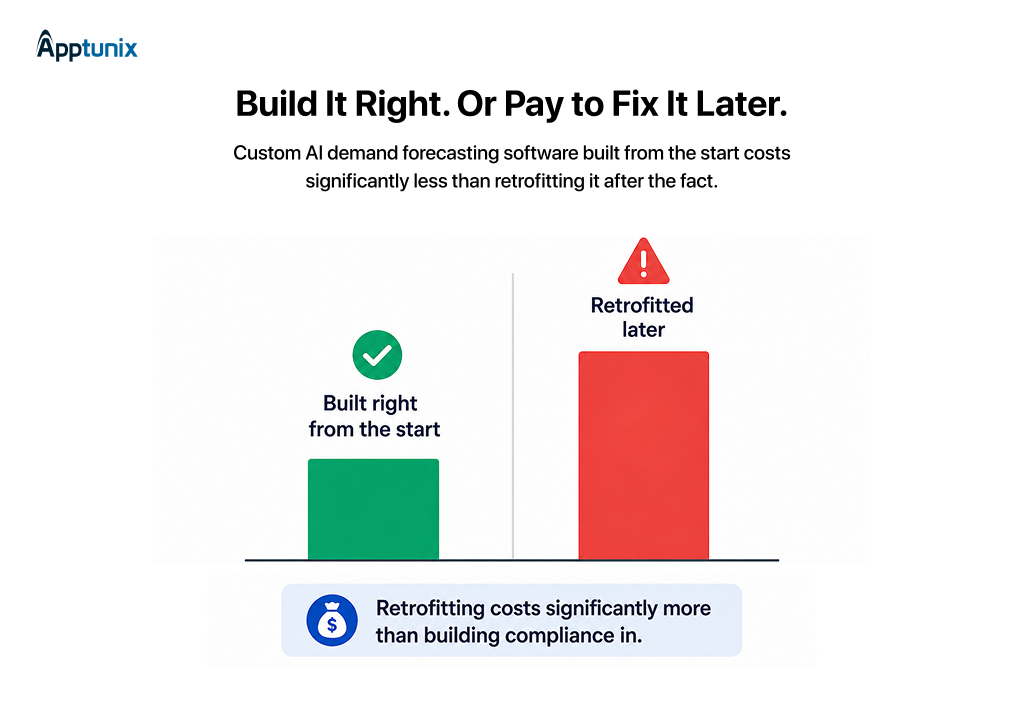
Custom AI demand forecasting software development typically ranges from $80,000 for a foundational single-category system to $250,000 or more for a full enterprise-grade build. The gap between those two numbers is not arbitrary. It is driven by a specific set of variables that determine how complex your build actually needs to be.
A production AI demand planning software system is not a one-time investment. Based on published industry benchmarks, ongoing maintenance typically runs 15 to 20 percent of the initial build cost annually.
This includes retraining the model as market conditions change, maintaining infrastructure, updating integrations when your ERP or WMS changes, and monitoring performance to catch accuracy drops before they affect planning decisions.
What this means in practice
These are starting reference points. The actual figure for your build depends on your data maturity, your existing technology stack, the number of integrations required, and the forecast accuracy your operations need to hit.
That scoping conversation is where every Apptunix engagement starts — before any architecture decisions are made and before any numbers are committed to. If you want to understand what a build would realistically cost for your specific supply chain context, that is exactly the conversation we have first.
Most development partners start a forecasting project by recommending a tech stack. The actual business problem gets addressed somewhere in the middle.
We do it the other way around.
No ongoing licensing dependency, no vendor lock-in, no risk that a platform pricing change affects your access to a capability your operations depend on.
We work regularly across retail, manufacturing, logistics, pharma, and food and beverage. These are industries where demand complexity is high enough that off-the-shelf demand planning tools consistently fall short of what a custom build delivers.
If you are evaluating whether custom AI demand forecasting software development is the right move for your business, the conversation starts with your data and the specific problem you are trying to solve.
Let us talk!
Wrong forecasts do not just create inventory problems. They create cash flow problems, supplier problems, and customer problems, all at the same time.
AI demand forecasting software development gives businesses a way out of that cycle. Not by adding another tool to the stack, but by building a system that learns from your specific data, connects to how your operations actually run, and gets more accurate over time.
The businesses that get this right do not treat forecasting as a back-office function. They treat it as a competitive advantage.
If your supply chain has outgrown generic demand planning tools, the next step is a conversation about what a system built specifically for your business would look like.
Apptunix is ready when you are.
Q 1.What is AI demand forecasting software?
AI demand forecasting software uses machine learning to predict future customer demand by analysing historical sales, real-time signals, and external data. This helps businesses make smarter inventory, production, and supply chain decisions continuously.
Q 2.Why build custom instead of using off-the-shelf demand planning tools?
Generic demand planning tools use models trained on industry-wide data, not yours. A custom AI demand planning software system is trained on your specific patterns, integrates with your existing stack, and is owned entirely by your business with no ongoing licensing cost.
Q 3.Which industries benefit most from custom AI demand planning software?
Retail, manufacturing, food and beverage, pharma, and logistics see the strongest results. In these industries, where demand complexity makes generic demand planning artificial intelligence software consistently inadequate for real operational accuracy.
Q 4.How much does building AI demand forecasting software cost?
Custom AI demand forecasting software development typically ranges from $80,000 for a foundational system to $250,000 or more for an enterprise-grade build. Ongoing maintenance runs 15 to 20 percent of the initial build annually.
Q 5.What data do you need to build AI demand forecasting software?
At minimum, two to three years of clean historical sales data by SKU, alongside inventory records, pricing history, and promotional calendars. External signals like weather and economic indicators improve accuracy further for volatile demand categories.
Q 6.How long does AI demand forecasting software development take?
A well-scoped build typically runs six months to nine months, or even a year, from data audit to live deployment. Data preparation takes the largest share of that timeline. Rushing it is the most common reason for poor model accuracy after launch.
(1 ratings, average: 5.00 out of 5)
Get the weekly updates on the newest brand stories, business models and technology right in your inbox.
Reena Bhagat, the CTO and Head of AI at Apptunix, is a seasoned technology strategist with a deep-rooted expertise in emerging technologies. With a focus on AI/ML integration, product engineering, cloud management, she leads the technical vision for high-performance SaaS infrastructures. Reena is recognized for building secure, scalable, and decentralized systems that solve real-world complexities. Her passion lies in leveraging data science and future-tech to create resilient digital products, making her a trusted authority for organizations looking to lead in the age of intelligent automation.
39 Views 12 min July 21, 2026
90 Views 12 min July 2, 2026
119 Views 12 min June 26, 2026
Book your consultation with us.
Book your consultation with us.


One Central, The offices 3, Level 3, DWTC, Sheikh Zayed Road, Dubai
+971 50 782 1690


Offer Ends Soon
Get a quick expert response in under 5 minutes.