
How Much Does It Cost to Build an Ecommerce App in Saudi Arabia?
19 Views 8 min October 6, 2026

Pallavi Nautiyal is a seasoned Tech Consultant at Apptunix, specializing in the intersection of global finance and decentralized technology. With a deep-rooted expertise in banking infrastructure, digital payment gateways, and Web3 ecosystems, she guides businesses through the complexities of modern financial engineering. Pallavi is recognized for her ability to architect secure, compliant, and scalable solutions—ranging from smart contracts and crypto-wallets to robust digital banking platforms. Her strategic insights help organizations navigate regulatory landscapes while leveraging the power of Blockchain to ensure transparency and seamless user experiences in every transaction.
The global NLP market is growing from $45.74B (2026) to $193.4B (2034). Enterprise NLP solutions use named entity recognition, sentiment analysis, and semantic search integrated with AI models. Natural language processing software development costs range from $10K-$25K for proof of concepts to $150K-$500K+ for full enterprise solutions. Custom NLP offers superior accuracy and data privacy with timelines of 4-8 weeks for prototypes.
Think about the sheer volume of unstructured text floating around your company right now. We’re talking about endless threads of customer emails, messy PDFs, Slack histories, call transcripts, and legal briefs.
In fact, up to 80% of your company’s valuable data is completely locked away inside these formats. Historically, trying to extract actual business value from this mountain of text meant hiring massive data science teams and spending months manually labeling data.
But things have shifted fast.
Large enterprises aren’t sitting on the sidelines either—they command more than 71% of this entire market share.
This massive growth is happening because traditional text processing has officially collided with generative AI solutions and Large Language Model (LLM) architectures.
Enterprise spending on generative AI models has grown by a staggering 80.8%. Forward-thinking companies are moving away from generic, public AI tools. Instead, they are putting their budgets into custom, highly secure, domain-specific systems.
Investing in NLP software development isn’t a tech experiment anymore. It’s an operational baseline you need to automate workflows, scale your operations, and unlock the intelligence already sitting in your files.
At its core, NLP software development is all about building software that helps computers understand, interpret, and generate human language.
But when we talk about enterprise software development, the stakes are much higher than a consumer app. Your systems need to process massive amounts of text with pinpoint accuracy, ironclad security, and zero downtime.
Modern corporate systems rely on a few foundational pillars to make sense of language:
Today, enterprise software engineering focuses heavily on blending traditional text parsing with LLMs using an architecture called Retrieval-Augmented Generation (RAG). This allows your software to look through millions of internal company documents and provide accurate answers to complex user questions without making things up or “hallucinating.”
Nobody invests in advanced software just because it sounds cool. You do it to fix real, costly operational bottlenecks. Let’s look at how specialized language applications are changing the game across key industries.
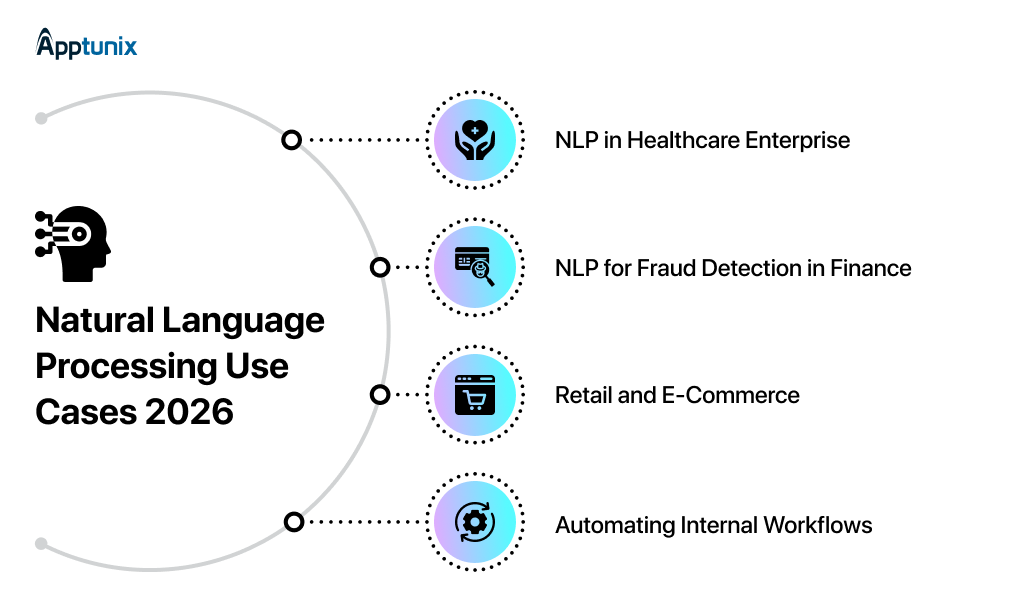
Healthcare has become one of the fastest-growing sectors for custom language applications. Incorporating NLP in healthcare enterprise environments directly tackles administrative burnout and improves patient care.
In banking, financial services, and insurance, specialized text processing acts as a shield for corporate margins and compliance protocols.
Operational speed matters. Specialized language tools take the manual labor out of daily internal workflows.
When laying out your language tech strategy, you’ll hit a classic crossroads: do you want to buy an off-the-shelf platform or build your own software?
The big cloud providers offer incredibly powerful, pre-trained language APIs. Here is how they generally stack up against a custom build:
While public cloud APIs are fantastic for generic text, they often stumble over niche industry jargon, unique company acronyms, and strict data privacy mandates.
Choosing bespoke NLP solutions for business ensures your models train on your actual data. This gets rid of third-party dependencies, maximizes accuracy, and keeps data security locked down from day one.
Building a reliable, enterprise-grade language application is a step-by-step journey. Cutting corners on data prep or validation almost always leads to high computing costs or inaccurate outputs later on.
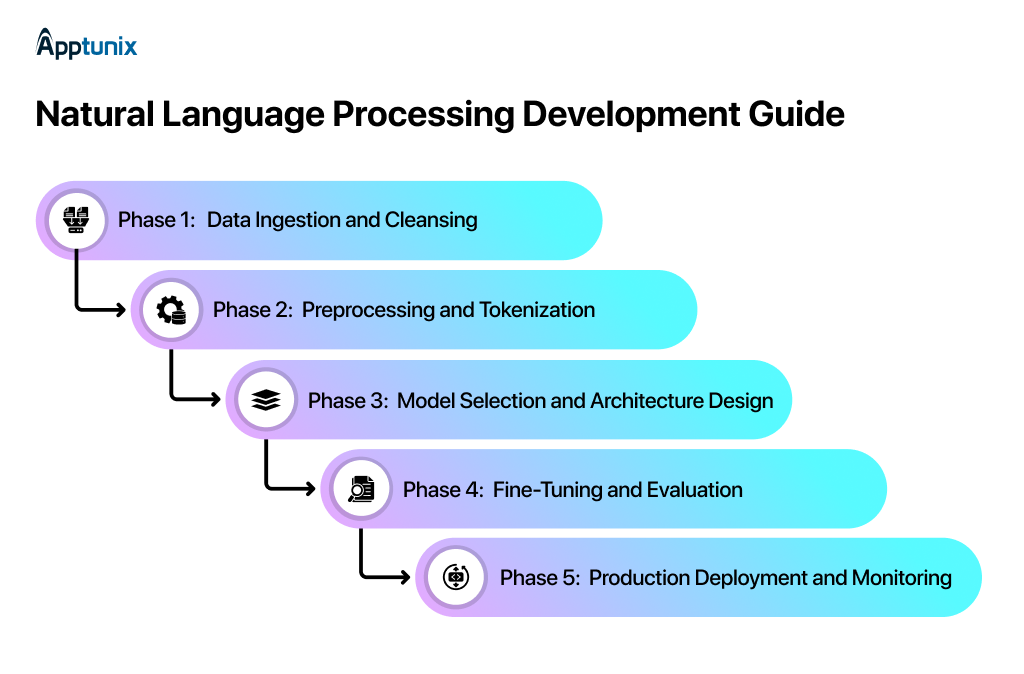
Bring together text from all your scattered sources—PDFs, database rows, legacy emails, and audio files.
Clean up the raw text by stripping out broken formatting, tracking scripts, and HTML tags.
Set up strict pipelines to scrub out sensitive personal information (PII) before anything touches your models.
Break down long text blocks into smaller pieces (tokens) that the algorithms can actually read.
Standardize words to their root forms so your software recognizes variations of the same concept.
Strip out empty words that add zero contextual meaning to your analytics.
Decide whether to use standard statistical approaches, open-source models (like Llama or Mistral), or commercial APIs.
Create mathematical embeddings to translate human language into numbers your system can calculate.
Integrate high-performance vector databases (such as Pinecone or Milvus) to enable lightning-fast semantic searches.
Fine-tune your chosen model on your company’s proprietary data using efficient techniques like LoRA.
Put model outputs through rigorous testing scenarios using industry benchmarks.
Keep humans in the loop to review data samples, catch hallucinations, and calibrate accuracy.
Ship your software into secure cloud, hybrid, or on-premises setups.
Wrap your models in clean, secure APIs that your existing corporate applications can talk to easily.
Monitor live dashboards to track accuracy, server response times, and token costs in real time.
A successful NLP solution depends on more than just choosing the right language model. Enterprise-grade platforms combine multiple technologies that work together to process data, retrieve information, maintain security, and deliver accurate results at scale.
Understanding the technology stack behind modern NLP systems helps organizations make informed decisions about performance, scalability, and long-term ROI.
The success of an enterprise NLP solution depends heavily on the technology stack behind it. Now, let’s see how much it can cost to build NLP software for your organization.
The cost of NLP software development varies significantly depending on model complexity, data quality, compliance requirements, and deployment architecture.
A proof of concept (PoC) typically costs between $10,000 and $25,000. It helps validate the idea before committing to a larger investment.
Enterprise NLP platforms are significantly more complex and can cost over USD $500,000. Solutions powered by Generative AI, RAG, and domain-specific language models often require investments of $150,000 or more due to integration, security, and scalability requirements.
NLP development costs can vary significantly from one project to another. Understanding these cost drivers to create NLP software early helps businesses plan budgets more accurately and avoid unexpected expenses during development.
Enterprise NLP adoption is expanding across industries that manage large volumes of unstructured data and customer interactions. From healthcare and banking to retail and manufacturing, organizations are using NLP to automate processes, improve decision-making, and extract insights.
The following industries are leading NLP adoption in 2026 due to their growing need for efficiency, compliance, and AI-driven intelligence.
Building custom text processing tools means balancing complex math with practical business rules and strict local regulations. Partnering with established NLP software companies, like Apptunix, gives you a major advantage:
Want to tap into the value hidden in your company’s documents? Reach out to Apptunix today, and let’s talk about how our custom software development services can automate your workflows and save you valuable time.
Q 1.What is the difference between traditional NLP and Generative AI?
Traditional NLP is all about analyzing, categorizing, and extracting data from text that already exists. Generative AI in manufacturing, finance, or healthcare is built to create entirely new text from scratch. Modern enterprise apps usually blend both: traditional tools structure the messy data, and generative models turn those findings into easy-to-read human summaries.
Q 2.How do custom NLP solutions protect sensitive enterprise data?
Custom applications can be hosted completely inside your private cloud or on-premise infrastructure. This means your sensitive business data stays inside your corporate firewall and is never used to train public, third-party AI models.
Q 3.How long does it take to build and deploy a custom NLP application?
A focused Proof of Concept (PoC) to solve a single problem usually takes about 4 to 8 weeks to build and validate. Moving from that prototype to a fully integrated, production-ready enterprise tool typically takes anywhere from 4 to 9 months, depending on how complex your data and systems are.
Q 4.Can custom NLP software handle multiple languages and regional dialects?
Yes. Modern language applications use multilingual foundation models that can easily handle processing, translation, and sentiment tracking across dozens of global languages and localized business dialects.
Q 5.How do you measure the accuracy and success of an NLP deployment?
We track model performance using clear metrics like precision, recall, and F1-scores for data accuracy. For overall business impact, we look at tangible operational metrics, like a drop in support ticket handling times, faster document processing, and human hours saved.
Get the weekly updates on the newest brand stories, business models and technology right in your inbox.
Pallavi Nautiyal is a seasoned Tech Consultant at Apptunix, specializing in the intersection of global finance and decentralized technology. With a deep-rooted expertise in banking infrastructure, digital payment gateways, and Web3 ecosystems, she guides businesses through the complexities of modern financial engineering. Pallavi is recognized for her ability to architect secure, compliant, and scalable solutions—ranging from smart contracts and crypto-wallets to robust digital banking platforms. Her strategic insights help organizations navigate regulatory landscapes while leveraging the power of Blockchain to ensure transparency and seamless user experiences in every transaction.
19 Views 8 min October 6, 2026
18 Views 8 min October 6, 2026

17 Views 8 min October 5, 2026
Book your consultation with us.
Book your consultation with us.


One Central, The offices 3, Level 3, DWTC, Sheikh Zayed Road, Dubai
+971 50 782 1690