Compliance-Ready Software Development in Saudi Arabia: Laws, Standards and Best Practices
39 Views 20 min July 15, 2026

With over 20+ years of experience in driving global digital initiatives, Nikhil Bansal is the CEO & Director of Apptunix. He specializes in orchestrating large-scale digital transformations, enterprise-grade software solutions, and high-level business strategies that redefine industry standards. Nikhil is known for his ability to bridge the gap between complex business challenges and innovative technology, helping Fortune 500 companies and startups alike achieve sustainable growth. A visionary leader, he empowers enterprises to navigate the digital landscape with agile, ROI-focused models and future-ready business strategies.
Legacy system modernization is the process of updating or replacing outdated enterprise software, infrastructure, and applications so they can meet current business demands including cloud scalability, security compliance, and AI integration.
Enterprises spend up to 70% of IT budgets maintaining old systems leaving less than 30% for growth and innovation. Legacy infrastructure actively blocks AI adoption — modern AI tools need real-time, API-accessible data that most legacy systems cannot provide
Biggest mistakes companies make:
The cost of modernizing is fixed and manageable. The cost of staying on legacy systems compounds every year. Mid-market companies that modernize today build the operational foundation to compete in an AI-driven market. Those that delay face rising maintenance costs, growing security exposure, and an increasing gap between what their systems can do and what their business needs.
Read below to learn about the legacy system modernization cost and how to get the most ROI in the initial days!
Mid-market companies are caught in a painful position right now. They are large enough to have built serious infrastructure over the years. But they are also under the same competitive pressure as large enterprises to move faster, integrate AI, serve customers in real time, and cut operational costs.
The pressure is showing up in quarterly numbers.
IT teams spend more time keeping old systems alive than building anything new. Sales teams export CRM data into spreadsheets because the system cannot produce the reports they need. Security teams lose sleep over software that stopped receiving patches two years ago.
And when leadership asks about AI development services, the honest answer is usually: “not until we fix the foundation.”
This guide covers everything mid-market leaders need to understand about legacy system modernization — what it actually costs to delay, how to approach the transition, where companies go wrong, and what the landscape looks like.
The word “legacy” gets thrown around loosely. In practice, a legacy system is any technology that creates more operational drag than value.
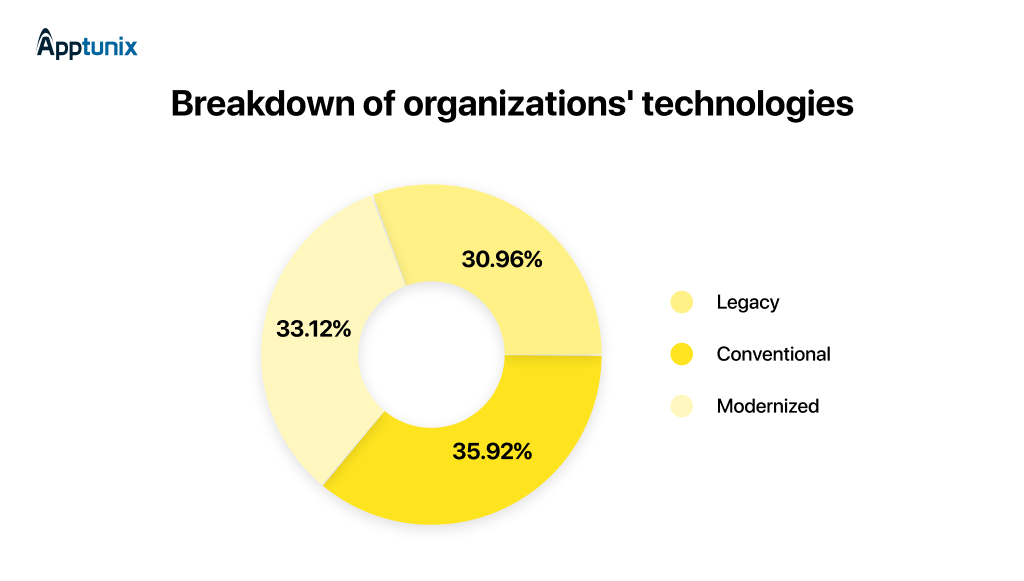
Concretely, this includes:
Staying on legacy systems is rarely laziness. There are real reasons it happens, and most of them come down to risk perception and short-term cost math.
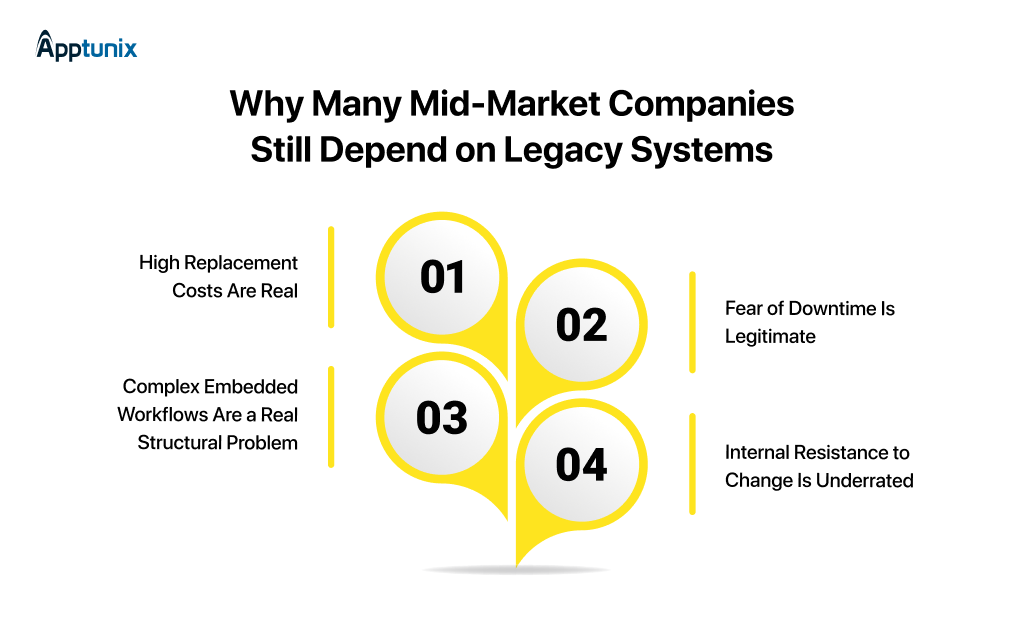
The sticker shock is legitimate. ERP implementation costs average $450,000 according to Panorama Consulting’s 2025 benchmark study, and that is before you account for what most companies miss in their initial budgets.
A realistic mid-market ERP project adds up fast: implementation services alone can run $129,000 or more, covering 500+ consultant hours across configuration, integrations, testing, and project management. Migration and integrations together add another $66,000 during large-scale legacy system upgrade services projects. Training costs an additional $35,000. And licensing — at roughly $150/month per user for 175 people — adds $315,000 just for the software. Year-one totals can hit $545,000.
Most companies underestimate ERP implementation costs by 30 to 50%, and the gap is not random. Budget overruns typically stem from underestimating project staffing (38% of cases), expanding initial scope (35%), and technical or data issues (34%).
None of this makes legacy software modernization unaffordable — it makes poor planning unaffordable. The companies that get blindsided are the ones who budgeted for the software and forgot about everything else.
51% of companies experience operational disruptions when going live with a new ERP system, and 50% of ERP implementations fail on their first attempt. These numbers are real, and they explain why operations teams resist pulling the trigger.
But here is what that argument misses: legacy systems are not stable. They fail too, just more quietly, and in ways that get normalized over time.
A logistics delivery platform with legacy system modernization saw performance during peak delivery windows improve by 30%, field team user satisfaction increased by 40%, and customer retention held at 97% through the transition. The disruption of modernization was planned and temporary. The disruption of staying on the old system was ongoing and growing.
This is the most technically honest reason mid-market companies delay modernization, and it deserves a direct response rather than dismissal.
Decades of business logic get quietly embedded in legacy systems — custom pricing rules, exception-handling processes, regulatory compliance calculations — and none of it gets documented. Support personnel with legacy system expertise can name their price, and they know it. When your entire business depends on someone who understands a 20-year-old system, you are paying for their monopoly on institutional knowledge.
Many experts with legacy program and application knowledge are retiring, creating a shortage of professionals capable of maintaining legacy system modernization. The workflow complexity argument for staying put becomes riskier as AI in legacy modernization accelerates. The person who understands how the system actually works is not going to be there in three years.
A US-based legal case management provider runs phased legacy application migration services. Rather than being paralyzed by workflow complexity, the modernization approach focused on transitioning the codebase to modern technologies without disrupting the critical system, which serves the government and legal sectors.
Gartner’s research found that 55–75% of ERP projects that fail to meet objectives had insufficient training investment. The failure mode is not the technology. It is the people who have built years of muscle memory around working with or around the old system.
Studies show 67% of organizations would gladly replace their core platforms when planning legacy software modernization initiatives, 70% still want to squeeze more value from them, and 50% admit they want both at the same time. That contradiction — wanting to modernize without losing what they have — is what keeps organizations stuck. The impulse is understandable. The execution consequence is a delayed decision that gets harder every year.
Industry benchmarks consistently show 10–20% productivity drops during system transitions as employees learn new processes. That is a real short-term cost, and managers who get measured on quarterly productivity numbers feel it directly. The answer is to build that productivity drop into the project plan, something an experienced enterprise software modernization company should account for.
AI-powered workflows are a live competitive advantage. Companies are using AI to automate invoice processing, generate first-draft proposals, route customer service inquiries, flag supply chain anomalies, and score leads in real time. These capabilities require clean data pipelines and modern application architectures. They do not work on top of legacy monoliths.
Intelligent automation using large language models and robotic process automation is actively reducing headcount requirements for repetitive knowledge work. Companies with legacy system modernization capture this productivity. Companies that do not pay full headcount costs for processes that competitors are automating.
Scalability expectations have changed permanently. The ability to provision additional compute in minutes, scale down to zero during off-peak hours, and deploy globally without capital expenditure is now table stakes for any growing business.
Hybrid work demands have made location-independent access a requirement, not a preference. A system that requires VPN access and a thick client is a productivity bottleneck for a distributed workforce.
Real-time services have set a baseline that customers now bring to every interaction. Amazon delivering in two hours, Uber giving live tracking, and banking apps approving instant transfers have reset expectations for what “fast” means.
Personalization at scale is impossible without a unified data layer that connects customer behavior, transaction history, and interaction data. Legacy CRM systems operating in silos cannot support this.
Faster go-to-market is the most direct competitive consequence. A company that can deploy a new product feature in two weeks beats the company that needs a change request, a testing cycle, and a deployment window that takes eight weeks.
Reduced costs through automation creates margin advantages that competitors on legacy infrastructure cannot match. If a competitor is processing the same volume of work at 40% lower cost because they have automated it, that is a structural competitive disadvantage for businesses operating outdated digital transformation legacy systems.
Not every legacy system requires the same treatment. The right approach depends on the system’s criticality, the complexity of the underlying code, the available budget, and the business’s timeline.
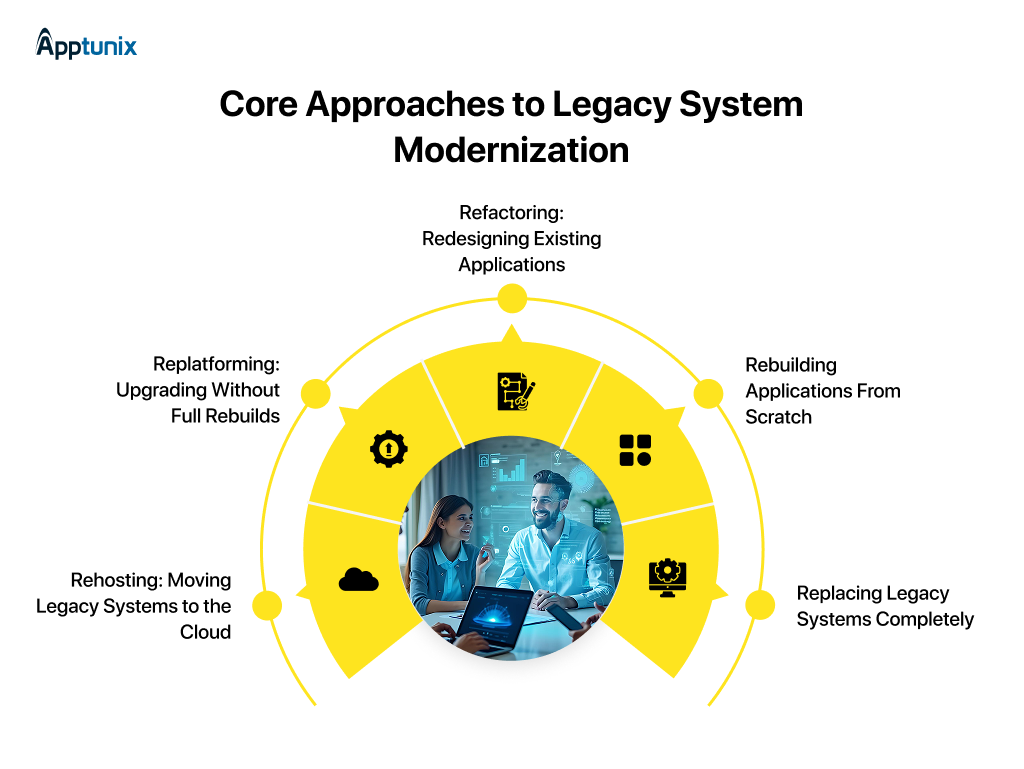
The lift-and-shift approach moves an existing application from on-premise servers to cloud infrastructure without changing the application code or architecture. The application continues to work exactly as before, but now runs on cloud infrastructure through legacy application migration services.
This approach makes sense when the primary problem is infrastructure cost, reliability, and scalability. It is the fastest migration path with the lowest short-term risk.
The limitation is that rehosting does not solve architectural problems. A monolithic application that is difficult to update and cannot be scaled component-by-component remains those things after a lift-and-shift. It simply costs less to run.
Replatforming makes targeted infrastructure and framework updates, moving a database from Oracle to PostgreSQL, updating a web framework from an unsupported version to a modern one, or containerizing application components.
This approach captures meaningful performance, cost, and manageability without the disruption associated with full-scale legacy system upgrade services. It is the right choice when the core application logic is sound, but the underlying platform is creating friction.
Refactoring involves restructuring existing code into a microservices architecture breaking a monolithic application into independent, separately deployable services that communicate via APIs. This is the most technically demanding approach short of a full rebuild, but it produces the most flexible and scalable result.
An API-first system built on microservices allows individual components to be updated, replaced, or scaled independently. A performance problem in the reporting module does not require redeploying the entire application. A new integration only needs to connect to the relevant API, not the entire system.
Cloud-native application development from scratch is warranted when the existing codebase is so tightly coupled, so poorly documented, or so deeply tied to obsolete technology that refactoring costs as much as rebuilding.
This is the highest-risk, highest-reward option. Done well, it produces a modern, flexible, maintainable system built for current and future legacy software modernization requirements. Done poorly, it is an enormously expensive project that takes three times as long as planned and delivers half of what was promised.
The risk is managed through phased delivery, replacing components incrementally, often supported by specialized legacy modernization services.
Sometimes, the commercially available modern alternatives are sufficiently mature that building custom software does not make sense. When modernization costs exceed replacement value when the cost of refactoring or rebuilding is higher than the cost of migrating to a modern commercial platform.
This typically applies to commoditized functions like HR systems, basic accounting, and standard CRM use cases, where modern SaaS platforms have largely solved the problem and customization requirements are limited.
One of the biggest misconceptions around legacy system modernization is that every project requires a multi-million-dollar transformation. In reality, legacy system maintenance cost vary significantly depending on the modernization approach, infrastructure complexity, integration requirements, data migration volume, and business continuity expectations.
For most mid-market companies, the real financial risk is not modernization itself, but delaying it until outdated infrastructure creates operational, security, or scalability failures that force emergency replacement under pressure.
The framing most organizations use is wrong when evaluating digital transformation legacy systems. They compare the cost of modernization against the cost of doing nothing. But doing nothing has real, compounding costs that rarely appear on a single line item.
Technical debt is the accumulated cost of shortcuts. Every year a system runs past its useful life, the cost of eventually replacing it increases.
Slower operations show up as lost revenue and missed opportunities, especially as businesses push for AI in legacy modernization.
A sales team that takes two days to generate a quote that a competitor generates in two hours is losing deals.
Rising maintenance costs are the clearest signal. Industry research consistently shows that companies running legacy infrastructure spend 60-80% of their IT budgets on maintenance rather than innovation. That ratio inverts the purpose of an IT function.
The four barriers above — cost, downtime, complexity, and resistance — are all solvable with the right legacy modernization services.
The application layer is only half the problem. The infrastructure that applications run on requires legacy system modernization.
Monolithic architectures package all application functions into a single deployable unit. This simplifies initial development but creates compounding problems at scale. Updating one component requires deploying the entire application. Scaling one function requires scaling all of them. A failure in one module can bring down the entire system.
Each service has a single responsibility, communicates through well-defined interfaces, and can be updated, scaled, or replaced without touching any other service.
APIs have become the connective tissue of modern enterprise systems. Rather than building direct integrations between every pair of systems, which creates a web of brittle, expensive-to-maintain connections through standardized interfaces.
This dramatically reduces integration costs, accelerates the adoption of new tools, and makes the enterprise technology stack composable, able to be reconfigured as business needs change without rebuilding from scratch.
Pure public cloud is not the right answer for every workload. Regulatory requirements, latency constraints, data residency requirements, and existing infrastructure investments often justify hybrid architectures where some workloads run on public cloud, some on private cloud, and some remain on-premise.
Multi-cloud enterprise legacy modernization services allow businesses to use the best suited cloud for each workload. The operational overhead is real but manageable with the right enterprise software modernization company.
Continuous Integration and Continuous Delivery (CI/CD) pipelines automate the process of building, testing, and deploying software changes. When combined with DevOps practices that align development and operations teams, these pipelines enable software changes to be deployed reliably within hours or days rather than weeks or months.
This is a business agility capability. The speed at which legacy software modernization can be safely deployed determines how quickly the business can respond to market changes.
Infrastructure-as-Code tools like Terraform and Ansible allow infrastructure to be provisioned, configured, and managed through version-controlled code rather than manual processes. This makes infrastructure changes repeatable, auditable, and reversible, and dramatically reduces the risk of human error in production environments.
Automated monitoring and observability tools provide real-time visibility into system health, performance, and anomalies. Problems are detected before they become outages rather than after.
Before making any technology decisions, the organization needs an accurate picture of what it actually runs. This means cataloging every application and system, documenting the business processes they support, mapping the integrations between them, and assessing the technical health of each.
This audit is frequently unpleasant for organizations, which discover they have more systems than they realized, many of which are undocumented, and several of which run critical processes nobody knows are running.
Not all legacy systems carry the same risk. The audit should distinguish between systems that are a maintenance burden and systems that are an active risk — those running unsupported software, those containing sensitive data without adequate security controls, and those where failure would materially impact operations.
High-risk systems should be prioritized regardless of their strategic importance. A system can be relatively minor in functionality and still pose an unacceptable security risk.
After security risks, the modernization roadmap should prioritize workflows that directly affect revenue, customer experience, or operational efficiency. These are the areas where modernization delivers the fastest measurable return.
Internal administrative processes can often wait. Customer-facing systems and core operational platforms typically cannot.
The most common failure mode in modernization programs is treating the technology change as the goal rather than the business outcome. The goal is not to migrate to the cloud — it is to reduce infrastructure costs by 30%, enable real-time reporting, or support a new product that requires API-based integration.
Defined KPIs create accountability and allow the organization to assess whether the investment is delivering value. They also help prevent scope creep from derailing timelines and budgets.
Legacy system modernization projects consistently run over budget and behind schedule when the scope is not carefully bounded. The solution is phased delivery with clearly defined scope boundaries for each phase.
Phase one delivers the highest-priority outcomes with the most bounded scope. Subsequent phases expand on that foundation. This approach produces faster time-to-value, allows the organization to learn from early phases before committing to later ones, and limits the blast radius if a phase encounters unexpected complexity.
Technology change fails because of people, not technology, more often than the reverse. The teams that have to use new systems need to understand why the change is happening, be involved in decisions that affect their workflows, and receive adequate training before being expected to operate effectively on new platforms.
Change management is a core project workstream with a budget, timeline, and accountable owners.
The modernization process itself has been transformed by AI tools. Projects that previously required months of manual effort now take significantly less time.
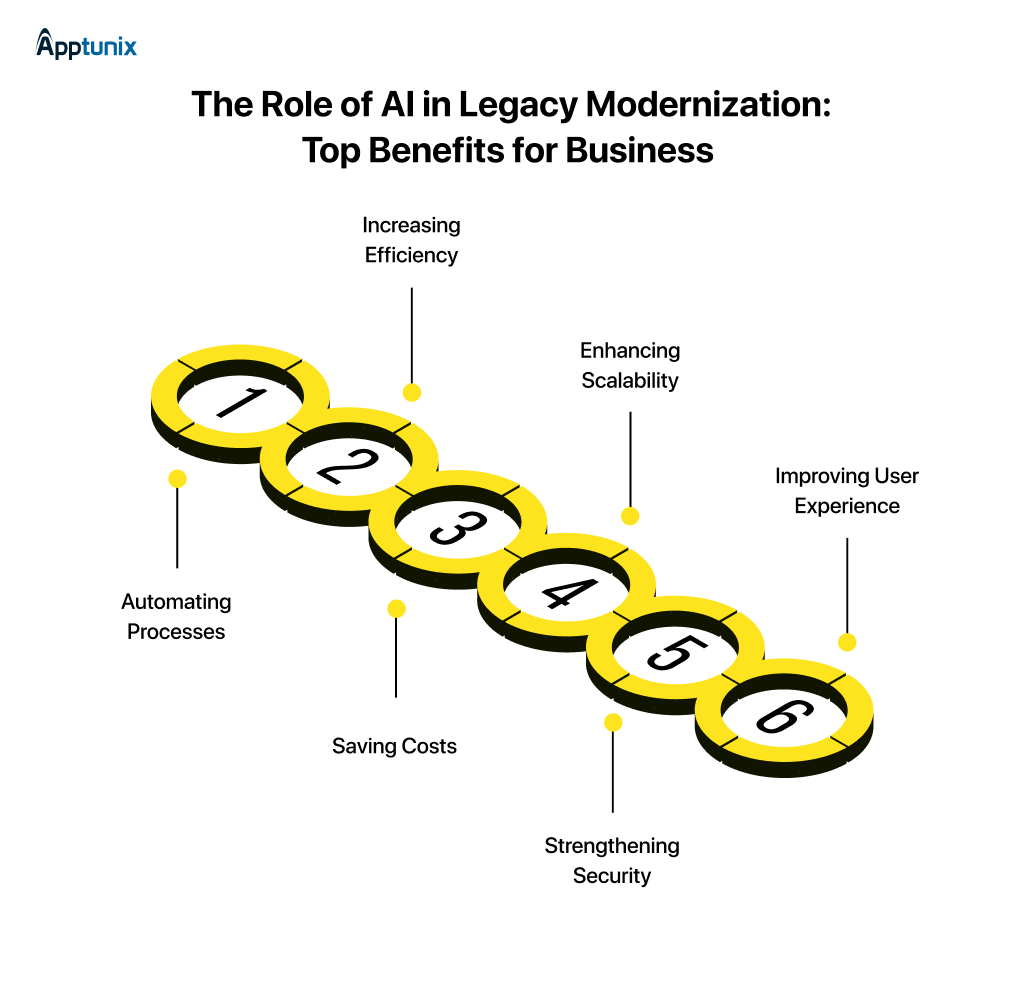
Automated code analysis tools can scan millions of lines of legacy code, map dependencies, identify dead code, flag security vulnerabilities, and produce documentation in hours. This replaces what used to be a labor-intensive discovery phase that ate significant budget before any actual modernization work began.
Intelligent documentation tools can infer the purpose of undocumented code by analyzing patterns, execution flows, and data structures. This solves one of the most common blockers in modernization projects: nobody knows what the system actually does.
AI-assisted testing dramatically reduces the effort required to build comprehensive test suites. Tools can analyze existing code to generate test cases, identify edge cases that human testers miss, and maintain test coverage as code changes. Smart migration planning uses AI to analyze the dependency graph of legacy system modernization and recommend a sequenced migration path that minimizes risk and maximizes continuity. Rather than relying on manual assessment, AI in legacy modernization can process the full complexity of a large legacy system and surface insights that would take a team months to develop.
When legacy system modernization is scoped and executed as an IT project rather than a business transformation, it optimizes for the wrong outcomes. IT teams focus on technical completeness; the business needs to focus on operational outcomes. Without business ownership, modernization projects deliver technically correct solutions that do not actually change how work gets done.
A modern system that teams do not know how to use, or do not trust, will not deliver its potential value. Organizations that skip or underinvest in training and change management consistently report disappointment with modernization outcomes even when the technology is objectively superior.
Data migration is the most technically complex and most frequently underestimated component of legacy modernization. Decades of accumulated data carry decades of inconsistencies, duplicates, missing values, and structural problems that must be resolved during migration rather than carried forward into the new system.
Underinvesting in data migration is one of the most reliable ways to blow a modernization budget.
The pressure to show quick wins sometimes leads organizations toward solutions that relieve immediate pain without addressing the underlying architecture. These band-aids create their own technical debt and often make the eventual proper modernization more complex.
The right question is not “what is the cheapest way to solve this problem today” but “what is the most cost-effective solution over a five-year horizon.”
Public cloud — AWS, Azure, Google Cloud — is the right default for most workloads. It offers the best cost structure, the widest range of services, and the fastest path to modern capabilities.
Private cloud makes sense for workloads with specific regulatory requirements, extreme latency sensitivity, or data that genuinely cannot leave specific infrastructure for legal reasons.
Hybrid cloud is a deliberate architecture that puts each workload in the environment best suited to it. The overhead is real, but for mid-market companies with complex regulatory environments or significant existing infrastructure investments, it is often the most practical path.
Industries with complex operations, large-scale data dependencies, and rising customer expectations are accelerating investments in legacy system modernization. From healthcare and banking to retail and manufacturing, businesses are prioritizing enterprise legacy modernization with AI adoption.
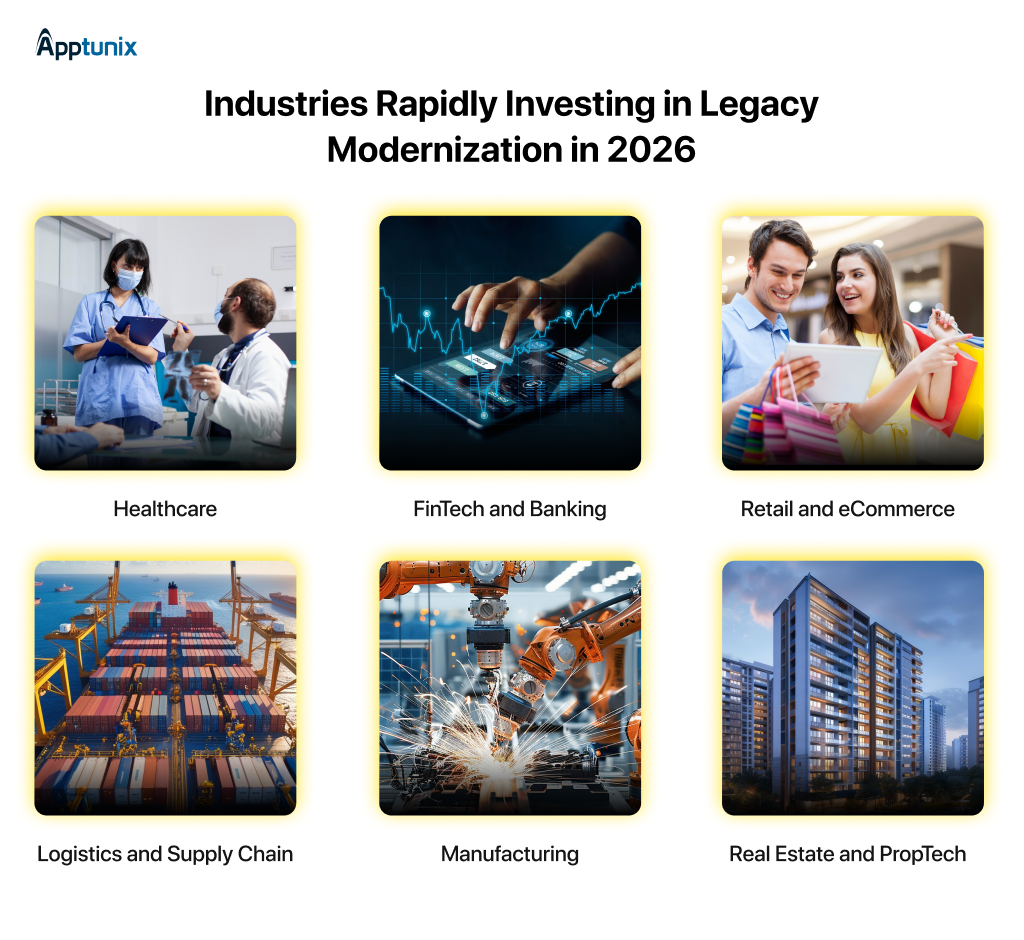
Healthcare organizations face a specific combination of pressures: aging clinical systems that cannot integrate with modern telehealth and patient experience platforms, regulatory requirements around data privacy and interoperability, and the potential of AI-assisted diagnostics and care coordination that requires modern data infrastructure. The ONC’s interoperability rules have created a regulatory deadline around modernization that many healthcare organizations are now working against.
Banking core systems built on COBOL in the 1970s and 1980s still process a significant fraction of global financial transactions. The cost of running these systems is enormous. More critically, they cannot support the real-time, API-accessible services that fintech competitors offer natively. Banks that do not modernize their core systems lose ground to neobanks and embedded finance providers every quarter.
Retail has been transformed by the expectation of real-time inventory visibility, personalized recommendations, and seamless omnichannel experiences. Legacy retail systems built for in-store operations cannot support these capabilities without significant modernization. The retailers that have modernized their technology stacks are outperforming those that have not on virtually every operating metric.
Supply chain disruptions of the past few years have underscored the value of real-time visibility and rapid replanning capabilities. Legacy system modernization provides batch-updated, siloed views of inventory and shipments, which cannot support the kind of dynamic supply chain management.
Industrial IoT and AI-powered predictive maintenance are transforming manufacturing economics. Capturing this value requires connecting the operational technology layer — factory floor systems, PLCs, SCADA — to modern data and analytics infrastructure. This integration is only possible when the enterprise systems that manufacturing operations connect to have been modernized.
Property management, lease administration, and transaction processing platforms built on decade-old software are being rapidly displaced by cloud-native PropTech platforms. Companies that do not modernize their technology stacks face increasing operational disadvantages against competitors using modern platforms and accelerating investor expectations for technology-enabled efficiency.
Enterprise application modernization is no longer just an IT upgrade initiative. It directly impacts operational efficiency, scalability, customer experience, and long-term competitiveness. Through strategic legacy software modernization, businesses can reduce operational friction and build systems designed for faster growth.
Modern systems automate the integration steps that manual processes currently perform. Approval workflows, data synchronization, report generation, and exception handling that currently require human coordination happen automatically, faster, and with fewer errors.
A modernized system gives leadership real-time visibility into operational metrics that previously required days of manual data assembly. This changes the quality and speed of operational decisions.
Modern infrastructure supports current security standards — encryption at rest and in transit, fine-grained access controls, audit logging, and timely security patching. These capabilities are table stakes for meeting current regulatory requirements and managing cyber risk.
When systems share data through APIs rather than requiring manual coordination, cross-functional workflows become faster and more reliable. Finance, operations, sales, and service teams work from the same underlying data, and changes in one function propagate automatically to others that depend on them.
Cloud migration typically reduces infrastructure costs for mid-market companies — both the direct cost of hardware, maintenance, and power, and the indirect cost of the IT staff time required to manage on-premise environments. Gartner research consistently shows that cloud-optimized workloads run at 30-50% lower total cost of ownership than equivalent on-premise deployments.
The ability to scale infrastructure up or down in response to business demand rather than planning to peak capacity and running excess capacity. New products, new markets, and seasonal demand spikes no longer require legacy system modernization investments months in advance.
Perhaps most importantly for competitive positioning, modern infrastructure is the foundation on which AI and automation capabilities are built. Companies that modernize today are positioning themselves to deploy the next generation of AI capabilities as they become available, rather than spending that future budget on infrastructure catch-up.
Apptunix operates as a full-spectrum enterprise digital transformation partner — covering the application layer, infrastructure transformation, cloud migration, and enterprise integration under a single accountable engagement.

The scope of what Apptunix delivers includes application modernization from legacy refactoring through cloud-native rebuilds, infrastructure transformation across hybrid and multi-cloud environments, enterprise integrations via API-driven architectures, and the full migration lifecycle from audit through stabilization.
This end-to-end capability matters because fragmented modernization — where different vendors handle different layers without unified accountability — is a primary source of cost overruns and quality failures in enterprise transformation projects.
Apptunix applies AI to both the modernization process and the post-modernization environment. On the process side, AI-assisted code analysis, documentation, and testing compress the timeline and reduce the cost of discovery and migration. On the outcome side, modernized systems are designed with the data architecture and integration patterns required to support intelligent automation and AI-powered workflows.
The modernization roadmap Apptunix develops for each client reflects the specific business context — the industry, the regulatory environment, the competitive pressures, and the organization’s appetite for risk. There is no template that fits every situation, and the engagements are designed to reflect that.
The technical depth spans cloud-native development on AWS, Azure, and GCP; microservices architecture and containerization; API design and integration; DevOps tooling and CI/CD pipeline implementation; and the full range of modern frameworks and languages required for enterprise application development.
The execution model is designed around business continuity. Agile delivery with short feedback cycles allows scope to be adjusted based on real-world learning. Secure migration processes ensure data integrity and compliance throughout the transition. Phased deployment planning allows the organization to capture value incrementally while managing risk.
The argument for delaying modernization gets weaker every year. The cost of maintaining legacy systems is rising. The security and compliance risks are intensifying. The competitive disadvantage relative to companies on modern platforms is widening. And the opportunity cost of not adopting AI and automation is increasing with each quarter.
The companies that will lead in their markets in 2028 and 2030 are making modernization investments today.
Legacy system modernization done right is not a one-time project. It is a transition to a way of operating that is continuously capable of adopting new capabilities rather than perpetually catching up.
Build secure, scalable, and future-ready enterprise systems with an enterprise software development partner who understands both the technical complexity and the business context of enterprise transformation. Apptunix delivers end-to-end legacy modernization services for mid-market enterprises from initial audit and strategy through cloud migration, application modernization, AI integration, and ongoing optimization.
If your organization is ready to move from maintaining aging infrastructure to building the foundation for the next decade of growth, the right time to start that conversation is now.
Q 1.How much does legacy system modernization cost for a mid-market company?
Most mid-market modernization projects land between $150,000 and $450,000 in year one. That covers licensing, implementation, data migration, integrations, and training. More than half of organizations underestimate the final cost by 30–50%.
Q 2.What is the difference between rehosting, replatforming, and refactoring?
Rehosting moves your app to the cloud without changing the code. Fast, but fixes nothing architecturally. Replatforming makes targeted upgrades — new database, containerization, framework update — without redesigning the whole system. Refactoring restructures the codebase into microservices so components can scale and update independently.
Q 3.How long does a legacy modernization project take?
Rehosting: 3–6 months
Replatforming: 6–12 months
Refactoring into microservices: 12–24 months
Full rebuild: 18–36 months
Timelines extend most often because of undiscovered complexity — companies assume 40 integration points and find 140. A proper system audit before locking scope prevents most overruns.
Q 4.What happens to business data during migration?
Data gets extracted, cleaned, transformed, and loaded into the new system. The tricky part is that decades of legacy data carry years of inconsistencies — duplicate records, broken field relationships, missing values. This needs to be resolved before migration, not after. You can migrate everything or migrate active data and archive history.
Q 5.How is AI connected to legacy modernization?
Two ways. First, AI tools now accelerate the modernization process itself — automated code analysis, dependency mapping, and test generation compress timelines that used to take months. Second, legacy systems block AI adoption entirely because AI needs clean, real-time, API-accessible data, which most legacy architectures cannot provide.
Q 6.What are the biggest risks of not modernizing legacy systems?
Four compound over time: security exposure from unpatched software, rising maintenance costs (legacy systems cost 15–25% more to maintain each year), inability to scale without proportional infrastructure investment, and competitive disadvantage as peers automate processes you are still running manually.
Get the weekly updates on the newest brand stories, business models and technology right in your inbox.
With over 20+ years of experience in driving global digital initiatives, Nikhil Bansal is the CEO & Director of Apptunix. He specializes in orchestrating large-scale digital transformations, enterprise-grade software solutions, and high-level business strategies that redefine industry standards. Nikhil is known for his ability to bridge the gap between complex business challenges and innovative technology, helping Fortune 500 companies and startups alike achieve sustainable growth. A visionary leader, he empowers enterprises to navigate the digital landscape with agile, ROI-focused models and future-ready business strategies.
39 Views 20 min July 15, 2026

133 Views 20 min June 26, 2026

256 Views 20 min June 9, 2026
Book your consultation with us.
Book your consultation with us.


One Central, The offices 3, Level 3, DWTC, Sheikh Zayed Road, Dubai
+971 50 782 1690


Offer Ends Soon
Get a quick expert response in under 5 minutes.