The global mHealth apps market is projected to grow rapidly, reaching around USD 154.12 billion by 2034, with an annual growth rate of 15.20% from 2025 to 2034.
How to Develop a mHealth App in 2026?

Pallavi Nautiyal is a seasoned Tech Consultant at Apptunix, specializing in the intersection of global finance and decentralized technology. With a deep-rooted expertise in banking infrastructure, digital payment gateways, and Web3 ecosystems, she guides businesses through the complexities of modern financial engineering. Pallavi is recognized for her ability to architect secure, compliant, and scalable solutions—ranging from smart contracts and crypto-wallets to robust digital banking platforms. Her strategic insights help organizations navigate regulatory landscapes while leveraging the power of Blockchain to ensure transparency and seamless user experiences in every transaction.
1388 Views|
10 mins |
April 15, 2026
Read Time: 10 mins |
April 15, 2026
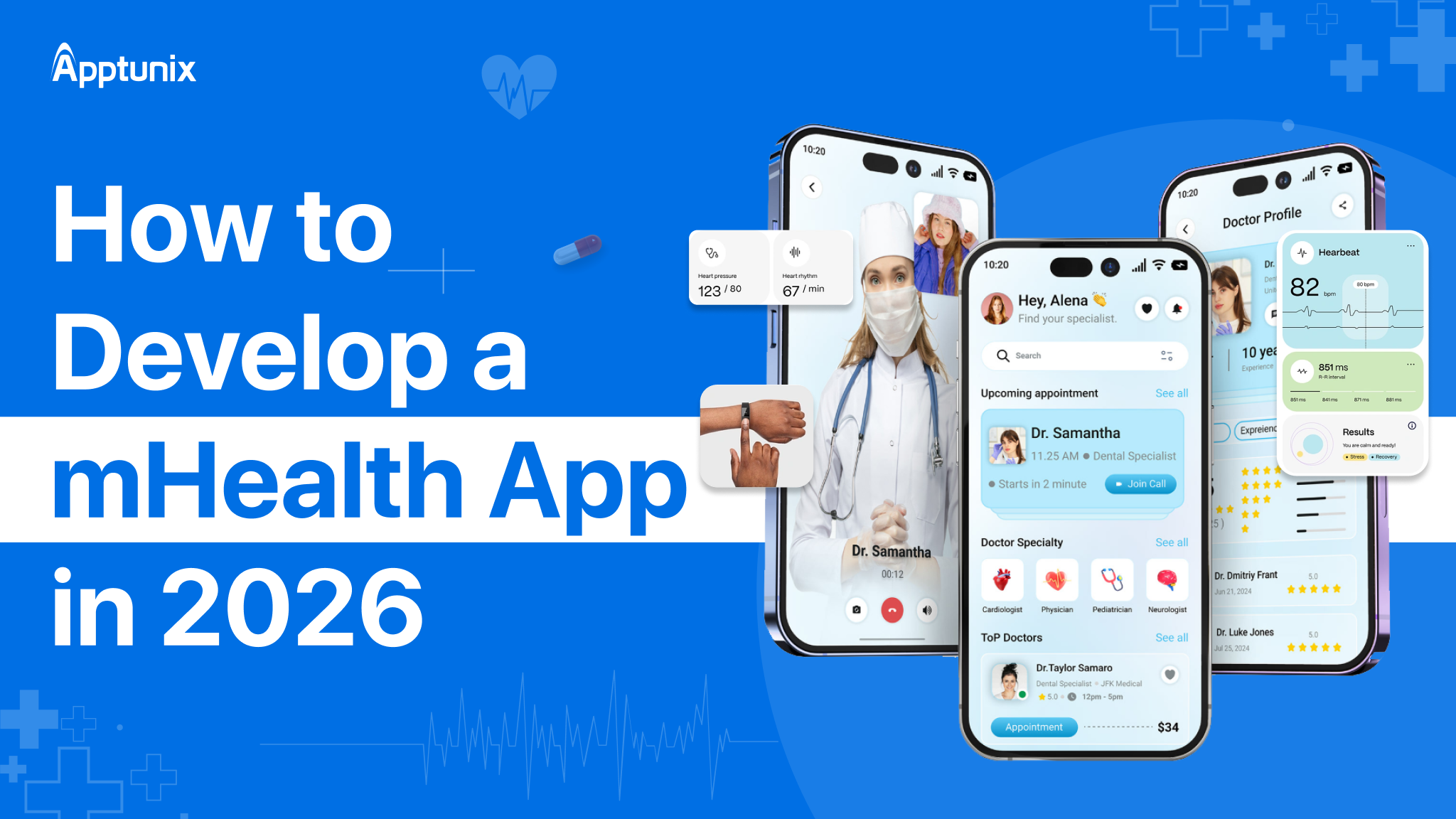
Imagine a world where patients can seamlessly manage their health, connect with providers, and access personalized treatment plans – all from the convenience of their mobile devices. The future of healthcare is in the palm of your hand, and in 2026, the rise of mHealth apps will transform how we deliver and experience medical care.
Let’s take a look at numbers –
In this blog post, we’ll guide you through the essential steps to develop a cutting-edge mHealth app that will revolutionize your practice and empower your patients.
From understanding the latest industry trends to incorporating innovative features and ensuring robust security, you’ll learn everything you need to create a mobile solution that sets you apart in the rapidly evolving healthcare landscape. Whether you’re a healthcare provider, a tech-savvy entrepreneur, or simply someone passionate about the future of medicine, this guide will equip you with the knowledge and insights to unlock mHealth’s full potential in 2026.
Let’s get started!
Understanding mHealth Apps
mHealth, or mobile health apps, are digital healthcare solutions that enable users to manage health-related tasks on mobile devices.
It is designed to assist patients and healthcare providers in offering various services. Whether it’s booking a doctor’s appointment, tracking fitness goals, or getting medication reminders, these apps make healthcare more convenient and accessible.
With innovative features such as real-time health tracking, encrypted chat, and AI-powered analytics, mHealth apps are transforming the healthcare industry. They help patients stay on top of their health and enable doctors to provide better, personalized care – anytime, anywhere.
Bonus Read: Top 26 Innovative Healthcare Startup Ideas to Launch!
3 Reasons to Invest in mHealth App Development?
Following, we’ve discussed top reasons why you should consider investing in mHealth app development:
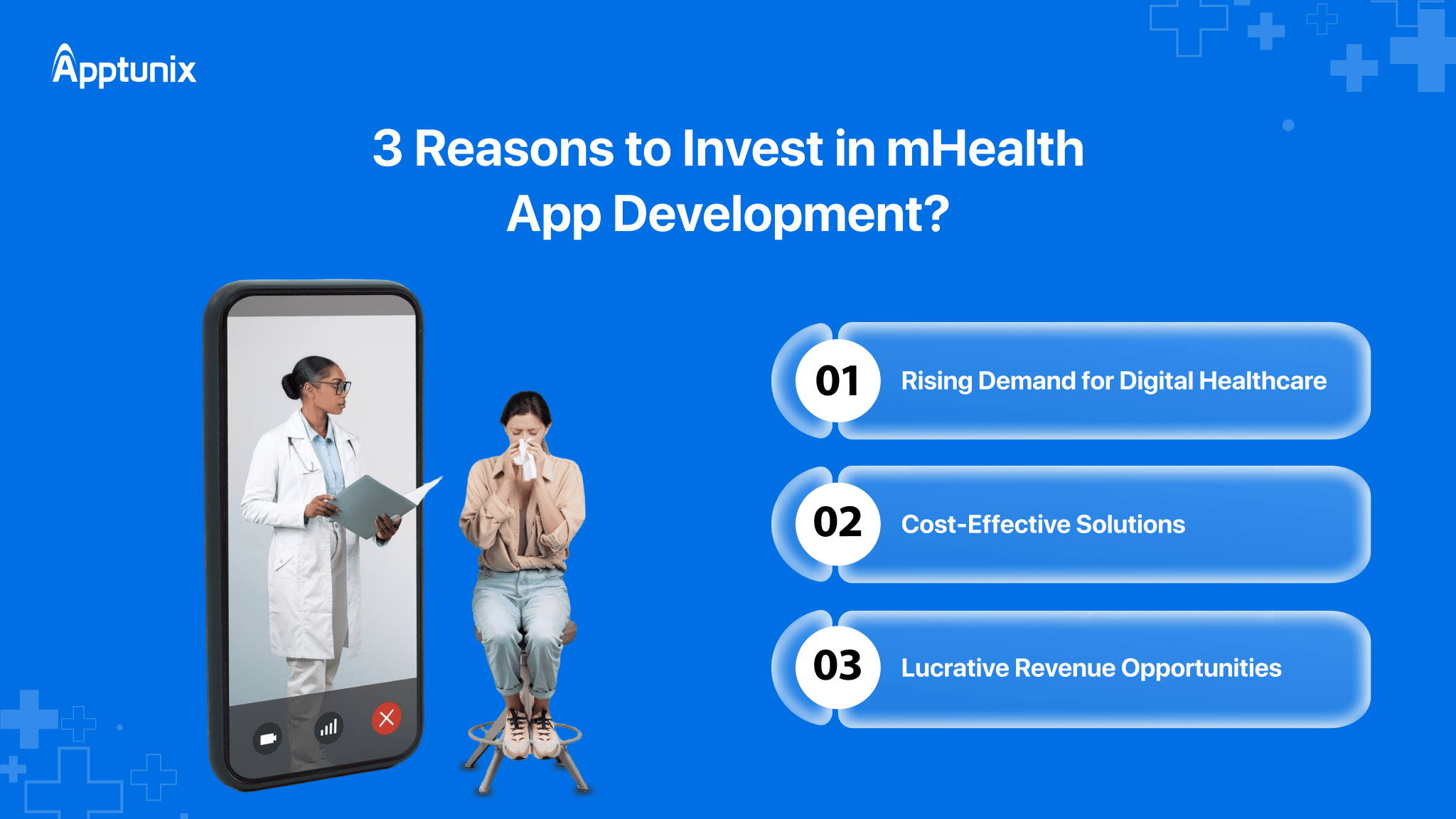
1. Rising Demand for Digital Healthcare
Convenience is now highly prioritized by consumers across all industries, including the healthcare sector.
Patients are increasingly choosing to manage their health digitally these days. They want to be able to use their smartphones to track their health, make appointments, and swiftly and conveniently access medical services. The global mHealth market is projected to grow to $268.46 billion by 2032, driven by the increasing adoption of smartphones, wearables, and remote healthcare services. Investing now allows businesses to tap into this growing demand and offer innovative solutions that improve patient care and engagement.
2. Cost-Effective Solutions
mHealth apps offers cost-effective, scalable, and high-demand solutions. These solutions reduces hospital visits, enhance remote monitoring, and administrative burdens.
With the global mHealth market projected to surpass $300 billion by 2030, entrepreneurs have a lucrative opportunity to invest in a tech-driven, AI-powered, and data-centric industry. As digital health adoption accelerates, now is the perfect time to invest in mHealth apps and capitalize on a rapidly growing, impact-driven market.
Read More: How to Patent an App Idea in Detail!
3. Lucrative Revenue Opportunities
The Medical Apps segment is projected to be the top revenue generator, with an estimated growth of $110.7 billion from 2022 to 2032.
Investing in custom healthcare app development offers a variety of revenue streams, including subscription plans, in-app purchases, strategic partnerships, and more. With the right monetization strategy, businesses can generate a steady income while providing essential healthcare services. As the healthcare industry continues its digital transformation, mHealth apps offers a profitable and scalable investment opportunity.

Types of mHealth Apps
The mHealth (mobile health) industry is transforming the way healthcare services are delivered. From remote consultations to fitness tracking, these apps enhance accessibility, improve patient engagement, and streamline medical processes.
Different Types of mHealth Apps
Here’s a breakdown of the top mHealth app types:
| mHealth Types | Description | Examples |
|---|---|---|
| Telemedicine Apps | Telemedicine apps allow patients to consult doctors remotely through video calls, chats, or voice calls. These apps eliminate the need for in-person visits, making healthcare accessible anytime, anywhere. | Teladoc Health, MD Live |
| RPM (Remote Patient Monitoring) Apps | RPM apps collect and transmit real-time health data such as blood pressure, glucose levels, and heart rate to healthcare providers. This ensures early detection of potential health risks and better chronic disease management. | MyChart, Dexcom |
| Fitness & Wellness Apps | These apps help users monitor their daily workouts, calorie intake, sleep patterns, and mental well-being. They often include personalized fitness plans and goal tracking to encourage a balanced lifestyle. | MyFitnessPal, Fitbit |
| Medication Reminder Apps | Managing multiple medications can be overwhelming. These apps send reminders, track dosages, and alert users about refills, ensuring adherence to prescribed treatments. | Medisafe, Pill Reminder |
| Chronic Disease Management Apps | Designed for individuals with chronic illnesses like diabetes, asthma, and hypertension, these apps help monitor symptoms, log medical readings, and offer personalized health recommendations. | Glucose Buddy, BlueLoop |
| Mental Health & Therapy Apps | Mental health apps offer meditation guides, stress management techniques, and access to licensed therapists via chat or video calls. These platforms help users cope with anxiety, depression, and stress effectively. | Calm, BetterHelp |
| Women Health & Pregnancy Apps | From period tracking to pregnancy milestones, these apps assist women in managing their reproductive health. They provide insights into fertility, pregnancy progress, and postpartum care. | Flo, Clue |
| Emergency & First Aid Apps | These apps provide step-by-step first aid guidance, CPR instructions, and emergency medical contacts. They can be crucial in handling accidents, burns, and sudden illnesses. | Red Cross First Aid, Medscape |
| Hospital Management Apps | Hospitals use these apps to manage patient records, doctor schedules, appointment bookings, and billing systems. They improve workflow efficiency and reduce administrative burdens. | Epic, Kareo |
| Medical Reference & Education Apps | Designed for doctors, nurses, and medical students, these apps provide access to drug databases, medical research, and diagnosis tools, ensuring informed decision-making. | Medscape, UpToDate |
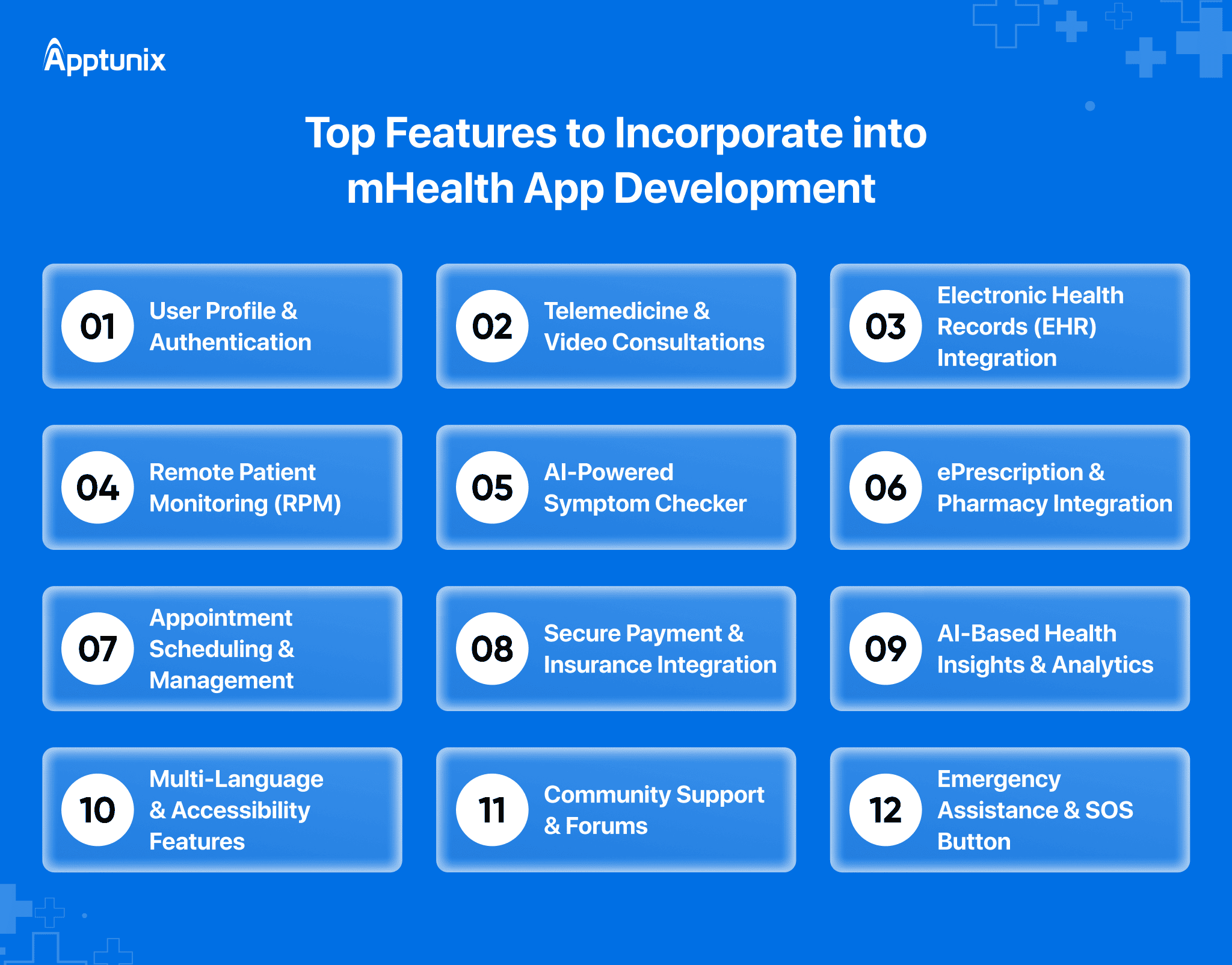
Top Features to Incorporate into mHealth App Development
Below, we’ve listed top features that you can include in your mHealth application. Let’s check:
| Feature | Description |
|---|---|
| User Profile & Authentication | Secure login with multi-factor authentication (MFA) and compliance with HIPAA/GDPR for data protection. |
| Telemedicine & Video Consultations | Real-time video calls, secure messaging, and AI-powered chatbots for virtual healthcare. |
| Electronic Health Records (EHR) Integration | Cloud-based medical history storage, easy access for patients and providers, and hospital interoperability. |
| Remote Patient Monitoring (RPM) | Wearable and IoT integration for real-time health tracking, AI-driven alerts, and predictive analytics. |
| AI-Powered Symptom Checker | Instant self-diagnosis, AI-generated health recommendations, and 24/7 chatbot support. |
| ePrescription & Pharmacy Integration | Digital prescriptions, automated medication reminders, and drug interaction alerts. |
| Appointment Scheduling & Management | Easy booking, calendar integration, push notifications, and virtual queue management. |
| Secure Payment & Insurance Integration | Multiple payment methods, healthcare insurance integration, and transparent billing. |
| AI-Based Health Insights & Analytics | Personalized health tracking, disease prevention insights, and fitness/nutrition monitoring. |
| Multi-Language & Accessibility Features | Voice commands, text-to-speech, and support for multiple languages for inclusivity. |
| Community Support & Forums | Patient discussion groups, chronic disease peer support, and doctor Q&A sessions. |
| Emergency Assistance & SOS Button | One-tap emergency calls, GPS tracking for ambulances, and auto-sharing of medical records. |
mHealth App Development Guide: Step-by-Step Process
Below, we’ve outlined the step-by-step process of mHealth app development, giving you a clear and comprehensive understanding of how it works:
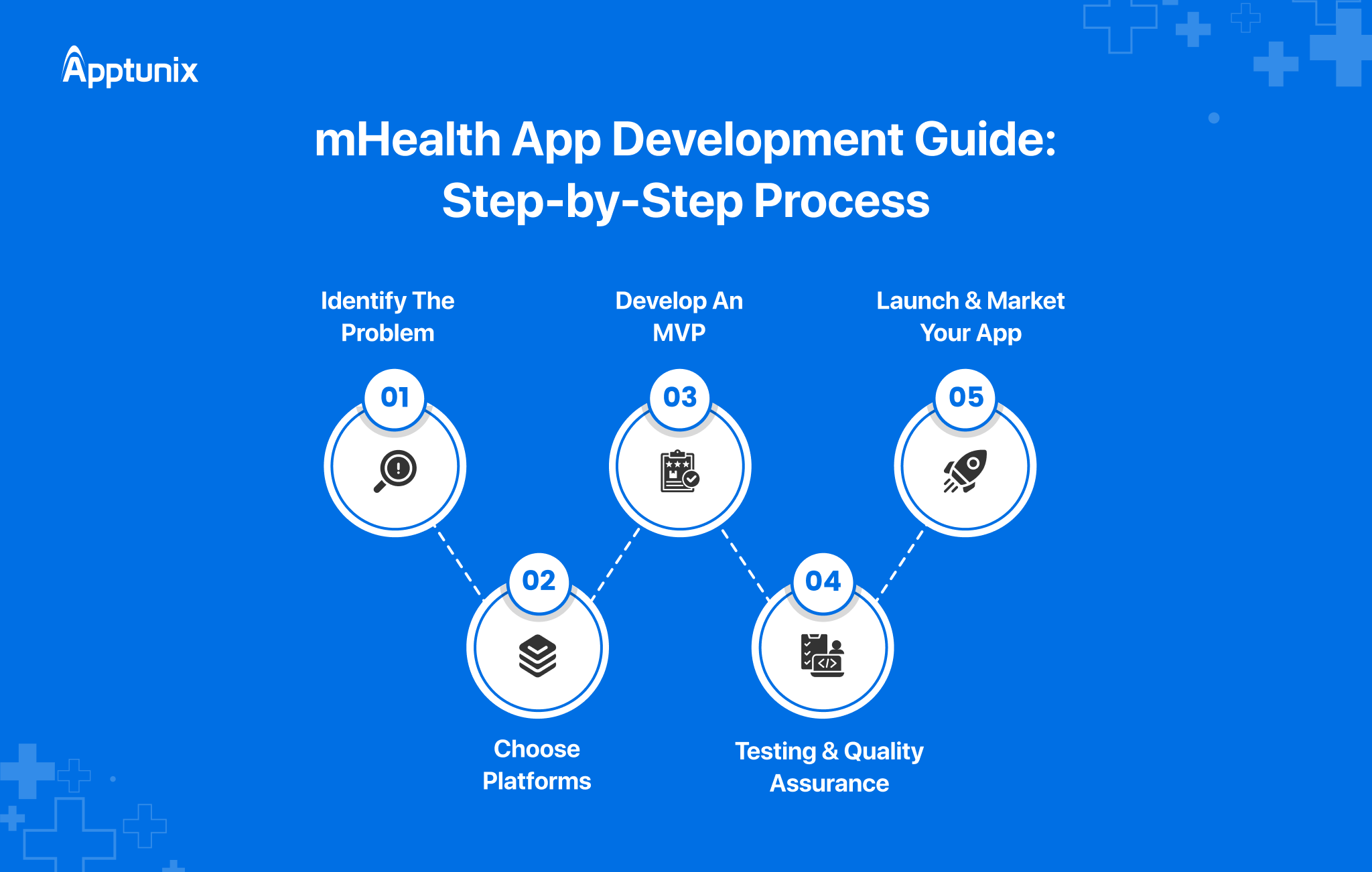
Step 1: Identify the Problem
Before jumping into development, it’s crucial to define the healthcare challenge your app will solve. Conduct thorough market research to identify gaps in existing solutions.
Key Actions:
- Analyze user needs (patients, doctors, or healthcare providers).
- Research competitors and study their strengths/weaknesses.
- Consult healthcare professionals to ensure real-world applicability.
- Validate your idea with surveys and focus groups.
Step 2: Choose Platforms
Your app’s success depends on choosing the right platform—iOS, Android, or both. The decision should be based on your target audience, budget, and technical requirements.
Key Considerations:
- iOS vs. Android: iOS users tend to spend more, while Android has a broader market.
- Cross-platform vs. Native: Native apps (Swift/Kotlin) offer better performance, while cross-platform (Flutter/React Native) reduces costs.
- Device Compatibility: Ensure support for smartphones, tablets, and wearables.
Step 3: Develop an MVP (Minimum Viable Product)
An MVP is a simplified version of your app with essential features to test the market and gather user feedback before full-scale development.
MVP Features to Include:
- Secure user authentication (HIPAA/GDPR compliance).
- Core healthcare service (telemedicine, health tracking, etc.).
- User-friendly UI/UX for seamless navigation.
- Integration with APIs for real-time health monitoring.
Read More: How to Develop a Health and Fitness App [Detailed Guide + Cost]
Step 4: Testing & Quality Assurance
Rigorous testing ensures your mHealth app is secure, reliable, and free from critical issues before launch. Healthcare apps must pass strict compliance and usability tests.
Types of Testing:
- Functionality Testing: Ensure all features work as intended.
- Security Testing: Protect sensitive patient data from breaches.
- Usability Testing: Check if the app is user-friendly and accessible.
- Compliance Testing: Ensure adherence to HIPAA, GDPR, and other health regulations.
Step 5: Launch & Market Your App
A great app won’t succeed without proper marketing and a strong launch strategy. Focus on acquiring early adopters and establishing credibility.
Launch Strategies:
- Submit your app to Google Play Store & Apple App Store with proper ASO (App Store Optimization).
- Create a marketing website with SEO-friendly content.
- Leverage social media, influencer marketing, and paid ads.
- Partner with hospitals, clinics, and healthcare professionals to drive adoption.
- Encourage user reviews and ratings for credibility.
How Much Does it Cost for mHeatlh App Development?
Although, there is no fixed cost of development for mHealth applications. It is mainly because mobile app development cost depends on several factors, including:
- Project complexity;
- Features;
- Platform (iOS, Android, or both);
- Tech Stack;
- Development Team and more.
Below, we’ve discussed in detail about estimated cost breakdown based on different level of complexity:
mHealth App Development Cost Breakdown:
| App Complexity | Estimated Cost (USD) | Development Time | Key Features |
|---|---|---|---|
| Basic mHealth App Development | $15,000 – $30,000 | 3-6 months | User registration, doctor profiles, basic health tracking, appointment booking |
| Medium mHealth App Development | $30,000 – $100,000 | 6-9 months | Telemedicine, EHR integration, wearable devices, payment gateways |
| Advanced mHealth App Development | $100,000 or above | 9-18 months | AI-based diagnostics, IoT-integration, real-time monitoring, HIPAA compliance |
Factors Impacting mHealth App Development Cost
| Factors | Details |
|---|---|
| Features & Functionalities | Integrating advanced features like AI, real-time tracking, & integration increases costs. |
| UX/UI Design | A high-quality UI/UX design impacts cost but improves user engagement. |
| Compliance & Security | Regulations like HIPAA, GDPR require additional security measures, adding more to overall costs. |
| Platform Choice | Developing for iOS & Android separately costs more than a cross-platform solution. |
| Development Team Location | US/Canada: $100 – $200/hour Europe: $50 – $100/hour India: $30 – $50/hour |
Most Recommended: How Much Does it Cost to Build a Mobile App?
MVP Approach: Build mHealth App at a Low Cost
If you’re looking for a cost-effective solution to create an mHealth application, our MVP approach is exactly what you need.
Here, our top mHealth developers will help you develop your mHealth app with basic or limited features & functionalities and will launch it into the market.
Once you’ve tested your healthcare application in market and improved it based on real-user feedback – you can gradually scale and integrate advanced features by reaching out to investors.
Our MVP approach ensures a faster time-to-market, reduced development costs, and a data-driven strategy for future improvements.
With our expert custom healthcare app development team, you’ll launch a functional, high-quality mHealth app at minimal cost—allowing you to validate your idea, attract investors, and stay ahead in the growing digital healthcare market.
Benefits of mHealth Apps for Healthcare Professionals & Patients
Following, we’ve listed top advantages of mHealth apps for healthcare professionals & patients.
Let’s discuss:
| Benefit | Description |
|---|---|
| Accessibility & Convenience | Patients can consult doctors remotely, schedule appointments, and access health records anytime, reducing hospital visits. |
| Patient Engagement & Compliance | Medication reminders, personalized health insights, and remote monitoring help patients stay on track with treatment plans. |
| Efficient Workflow for Healthcare Professionals | Automates administrative tasks like appointment scheduling, digital prescriptions, and patient record management, freeing up more time for patient care. |
| Real-Time Health Monitoring | Wearable integration and AI-powered analytics enable continuous tracking of vitals, allowing early detection of health issues. |
| Cost Reduction | Reduces unnecessary hospital visits, minimizes operational costs, and optimizes healthcare resource allocation for improved efficiency. |
Market Trends and Future of mHealth Apps
Let’s discuss market trends and future of mhealth applications:
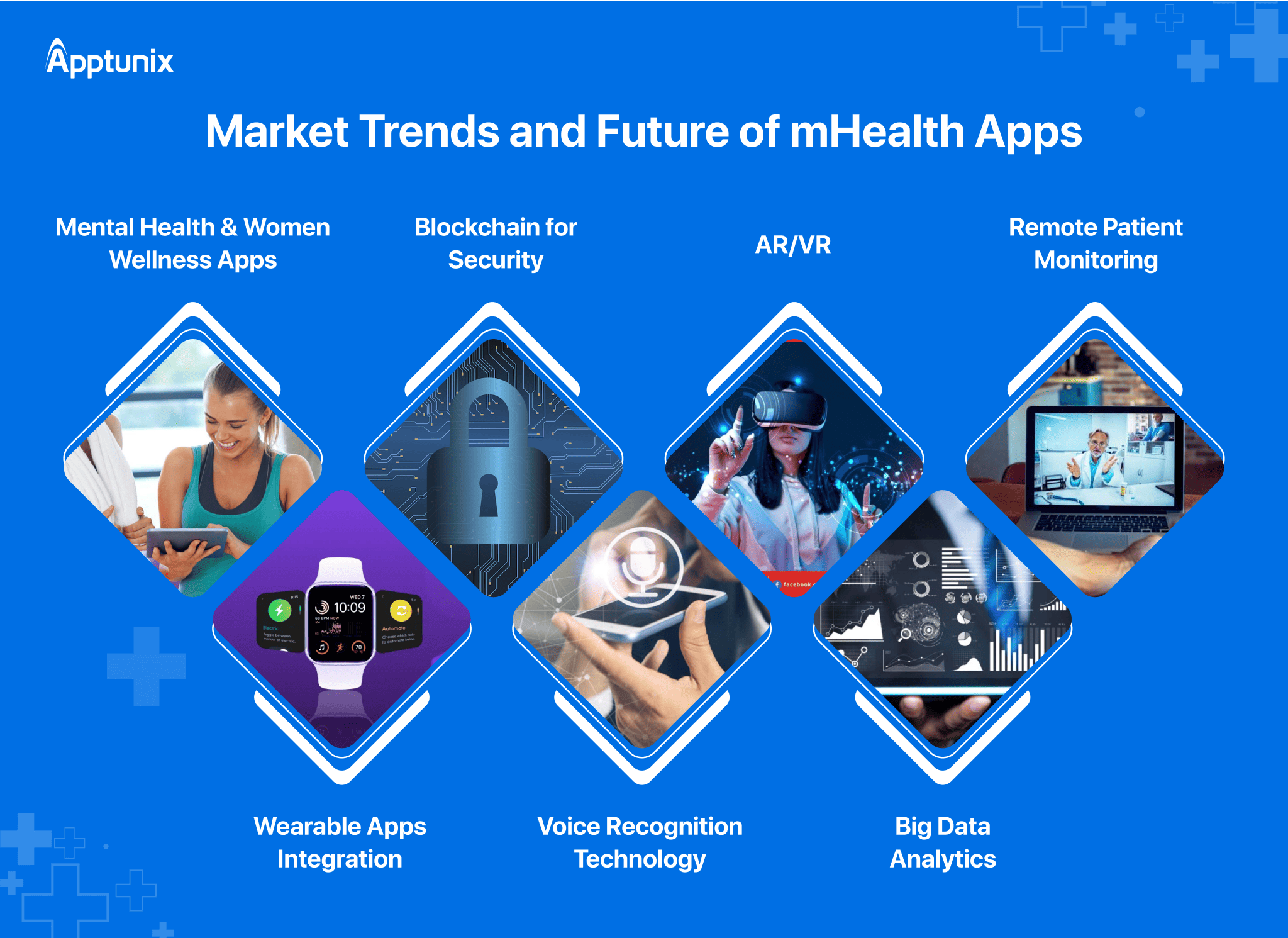
1. Mental Health & Women Wellness Apps
The global mental health apps market was valued at $7.38 billion in 2024. It is expected to grow to $8.50 billion in 2025 and reach $17.52 billion by 2033.
With 1 in 5 women experiencing mental health disorders like depression or anxiety—compared to 1 in 8 men—the demand for mental health and wellness apps is on the rise.
This growing market is driven by the need for self-care, therapy, period tracking, and maternal health solutions, making mental health apps more essential than ever.
2. Wearable Apps Integration
About 35% of US adults are using wearable healthcare devices. Wearable devices collects health-specific patient data such as sleep patterns, heart rate, and activity levels.
When wearable app devices are integrated with mHealth apps – it assists in detailed health analysis and personalized health recommendations.
Read More: Wearable App Development Guide: Cost & Development Process
3. Blockchain for Security
mHealth apps handle highly sensitive patient information, including medical records and personal data. Ensuring top-tier security and encryption is essential to protect this data from breaches.
Blockchain mobile app technology enhances security by providing decentralized, tamper-proof storage, ensuring data integrity, transparency, and confidentiality while preventing unauthorized access.
4. Voice Recognition Technology
Voice-enabled features allow medical professionals and patients to interact with mHealth apps hands-free, improving accessibility and efficiency.
This technology helps reduce administrative workload, enhances dictation accuracy for medical records, and enables faster data entry, making healthcare processes more seamless.
5. AR/VR
The global AR/VR market in healthcare will grow by 3.5 times by 2028.
AR/VR are transforming healthcare via immersive virtual consultations, pain management therapies, and surgical simulations.
These technology enhance telemedicine experiences, assist in rehabilitation, and provide realistic medical training, improving patient care and medical education.
6. Big Data Analytics
Big Data plays a crucial role in predicting disease outbreaks, optimizing hospital operations, and personalizing treatments.
By analyzing vast amounts of medical data, healthcare providers can identify trends, improve patient care, and enhance decision-making for more accurate diagnoses and efficient resource management.
7. Remote Patient Monitoring
RPM allows real-time tracking of patients’ vital signs, chronic disease management, and post-surgery recovery.
Using wearable devices and IoT integration, doctors can monitor patients remotely, reducing hospital visits, improving preventive care, and ensuring timely medical interventions.
Develop a Robust mHealth App With Apptunix Experts
The future of healthcare is digital, and Apptunix, a leading healthcare app development company is here to help you build a cutting-edge mHealth app that stands out!
Whether you’re a startup looking to innovate or an established healthcare provider aiming for digital transformation, our expert team delivers secure, scalable, and feature-rich mHealth solutions
Why Choose Apptunix for mHealth App Development?
- Tailor-Made Solutions – We create customized mHealth apps that meet your unique business needs.
- HIPAA & GDPR Compliance – Ensuring top-notch security and data protection.
- AI & IoT Integration – Smart features for real-time health monitoring and patient engagement.
- Seamless UX/UI – User-friendly design to enhance patient-doctor interaction.
- End-to-End Support – From ideation to deployment, we’ve got you covered!
The global mHealth market is booming – don’t miss your chance to lead the digital healthcare revolution! Partner with Apptunix today and turn your vision into reality.
Frequently Asked Questions(FAQs)
Q 1.How much does it cost to create mHealth app?
The cost of developing an mHealth app ranges from $15,000 to $300,000, depending on factors like features, platform (iOS, Android, or both), complexity, and compliance with healthcare regulations. Advanced AI-driven or telemedicine apps tend to be on the higher end.
Q 2.What are the examples of mHealth app?
- MyFitnessPal (Fitness & Nutrition)
- Teladoc Health (Telemedicine)
- Medisafe (Medication Management)
- Calm (Mental Health & Meditation)
- Glucose Buddy (Chronic Disease Management)
Q 3.How long does it take to create mHealth app?
On average, mHealth app development takes 3 to 12 months, depending on the app’s complexity. A simple fitness tracker can be built in a few months, while a fully functional telemedicine app may take a year or more.
Q 4.Is mHealth similar to telehealth?
mHealth (mobile health) and telehealth are related but not identical.
- mHealth focuses on mobile-based health tracking, fitness, and wellness apps.
- Telehealth covers a broader spectrum, including remote doctor consultations, diagnostics, and virtual care services beyond mobile devices.
Q 5.What are the challenges in mHealth app development?
- Data Security & Privacy – Compliance with HIPAA, GDPR, and other regulations.
- Integration Issues – Syncing with wearables, EHRs, and hospital systems.
- User Adoption – Encouraging patients and doctors to use the app.
- Regulatory Compliance – Meeting legal requirements in different regions.
Q 6.What are the regulatory and compliance requirements for mHealth applications?
Compliance varies by region, but the most critical regulations include:
- HIPAA (USA) – Protects patient health data.
- GDPR (Europe) – Ensures data privacy for EU citizens.
- FDA (USA) – Regulates medical devices and software.
- PIPEDA (Canada) – Governs personal health information.
- MHRA (UK) – Regulates medical apps as medical devices.
Rate this article!
Join 60,000+ Subscribers
Get the weekly updates on the newest brand stories, business models and technology right in your inbox.
Pallavi Nautiyal is a seasoned Tech Consultant at Apptunix, specializing in the intersection of global finance and decentralized technology. With a deep-rooted expertise in banking infrastructure, digital payment gateways, and Web3 ecosystems, she guides businesses through the complexities of modern financial engineering. Pallavi is recognized for her ability to architect secure, compliant, and scalable solutions—ranging from smart contracts and crypto-wallets to robust digital banking platforms. Her strategic insights help organizations navigate regulatory landscapes while leveraging the power of Blockchain to ensure transparency and seamless user experiences in every transaction.
Related Posts

Generative AI Software Development: Benefits, Possibilities, and Cost Involved
1246 Views 10 min February 18, 2026
How to Build a Grubhub Clone App? Readymade vs Custom Solutions
990 Views 10 min November 19, 2025

Comprehensive Guide to Develop an Enterprise Software in 2026
1822 Views 10 min November 13, 2025
Partner with tech catalysts who transform ideas into impact.
Book your consultation with us.
Let’s Talk!
Partner with tech catalysts who transform ideas into impact.
Book your consultation with us.
Let’s Talk!
Speak With Our Experts


UNITED ARAB EMIRATES
One Central, The offices 3, Level 3, DWTC, Sheikh Zayed Road, Dubai
+971 50 782 1690