How to Build a Travel Platform Like Expedia?
11 Views 7 min July 31, 2026

Reena Bhagat, the CTO and Head of AI at Apptunix, is a seasoned technology strategist with a deep-rooted expertise in emerging technologies. With a focus on AI/ML integration, product engineering, cloud management, she leads the technical vision for high-performance SaaS infrastructures. Reena is recognized for building secure, scalable, and decentralized systems that solve real-world complexities. Her passion lies in leveraging data science and future-tech to create resilient digital products, making her a trusted authority for organizations looking to lead in the age of intelligent automation.
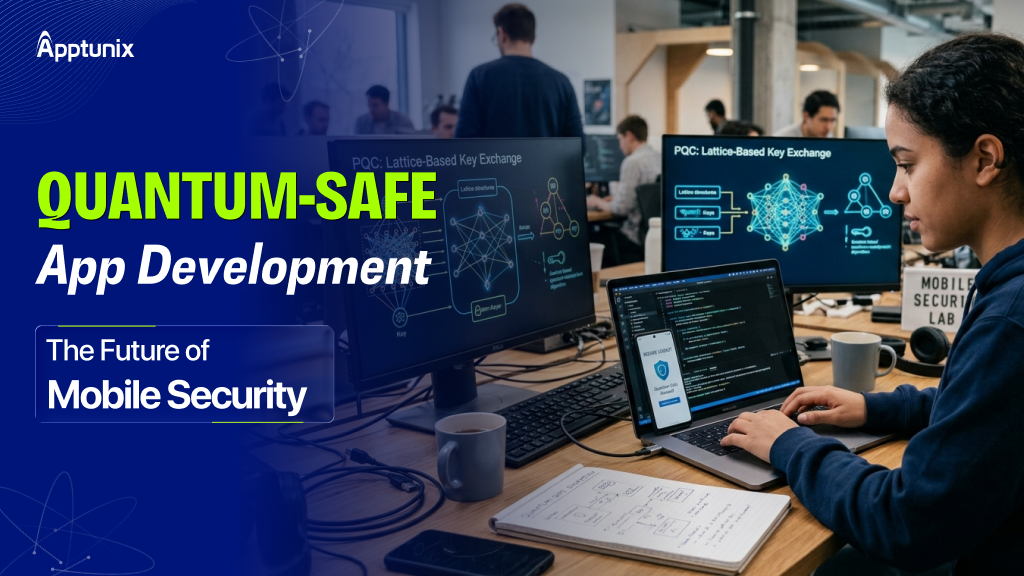
Picture this. A SaaS founder walks into a Series B board meeting. An investor leans forward and asks one question. “What happens to your customer data when quantum computers break RSA (Rivest–Shamir–Adleman)?” The room goes silent. That moment is coming for thousands of founders this year.
The fix already exists. It’s called quantum app development. NIST finalized the standards in 2024. Cloud giants started shipping support in 2025. The play is simple. Build new apps using post-quantum cryptography. Migrate existing ones in phases. Either way, the work starts now. Waiting until 2030 will already be too late.
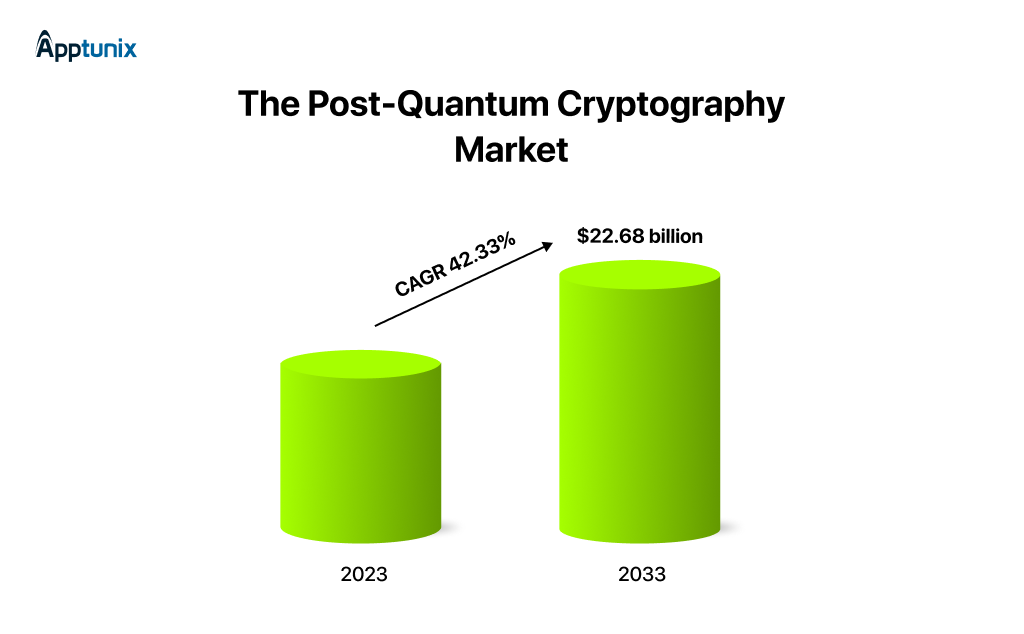
This isn’t a fringe concern anymore. The post-quantum cryptography market is projected to hit $22.68 billion by 2033. That’s a CAGR of 42.33% across the decade. Over 60% of defense, finance, and telecom firms are upgrading right now.
Regulation is moving fast, too. The EU now requires all 27 member states to start migration by the end of 2026. Canada wants federal migration plans submitted by April 2026. The U.S. NSA mandates full transition by 2035.
So how do you actually build for this? Let’s break down quantum app development.
Quantum app development means building apps that resist quantum-computer attacks. It uses cryptographic algorithms that even quantum machines can’t crack.
Today’s encryption relies on math that classical computers find hard. Quantum machines running Shor’s algorithm solve those problems quickly. That breaks RSA. It breaks ECC. It breaks most of the TLS securing the web today.
Post-quantum cryptography app development swaps those algorithms for stronger ones. These math problems hold up against quantum machines.
The work touches everything. Login flows. API authentication. Stored data. Software signing. Backups. It isn’t a feature. It’s a foundation upgrade.
Quantum-safe app development applies the same logic to backend systems. Quantum-resistant encryption for web and mobile apps extends that protection to every client device.
Now let’s look at how to build a quantum app.
A real quantum app development roadmap follows six phases. Skipping any step creates blind spots later.
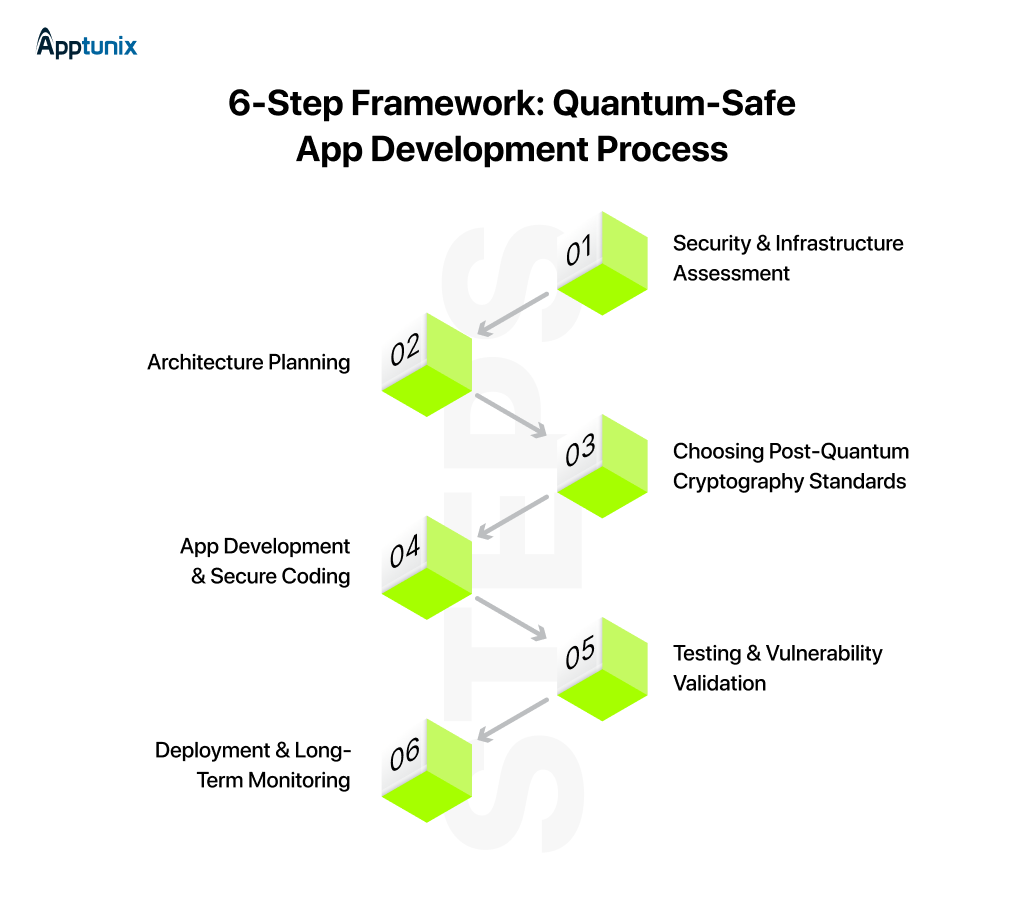
Start with a full crypto inventory. Map every place your app uses encryption today. That includes third-party libraries, APIs, and SDKs. Most teams find hundreds of touchpoints they didn’t know existed.
This step usually takes 2 to 3 weeks. Skipping it means migrating blindly.
Next, design for crypto-agility. That means building systems where algorithms swap easily. Most apps today hardcode RSA inside auth libraries. Pull those out into modular interfaces instead.
This is also where you choose hybrid vs. PQC-native paths.
Pick from NIST’s finalized standards. FIPS 203 (ML-KEM) handles key exchange, FIPS 204 (ML-DSA) handles digital signatures, and FIPS 205 (SLH-DSA) is the hash-based backup. HQC was added in March 2025 as a code-based fallback.
You can read full algorithm details on the NIST PQC project page. Most teams use ML-KEM and ML-DSA for the majority of workloads.
Now the engineering team builds. Quantum-resistant mobile app development needs careful optimization. Key sizes grow. Signatures grow. Compute load rises by 2 to 3 times.
Quantum-safe web application development is easier in some ways. Most TLS work happens at the cloud provider layer today.
Run real penetration tests. Check for side-channel leaks. Validate against NIST test vectors. Hybrid setups need both classical and PQC paths tested in parallel.
This is where most rushed projects fall apart.
Roll out gradually. Start with internal services. Move to external APIs. Watch for performance regressions.
Build dashboards for cryptographic health. Algorithms evolve. Your monitoring should too.
That’s how to build a quantum-safe app the right way. Now let’s look at what these apps actually contain.
Every quantum-safe application includes seven core building blocks. Miss one, and the whole stack weakens.
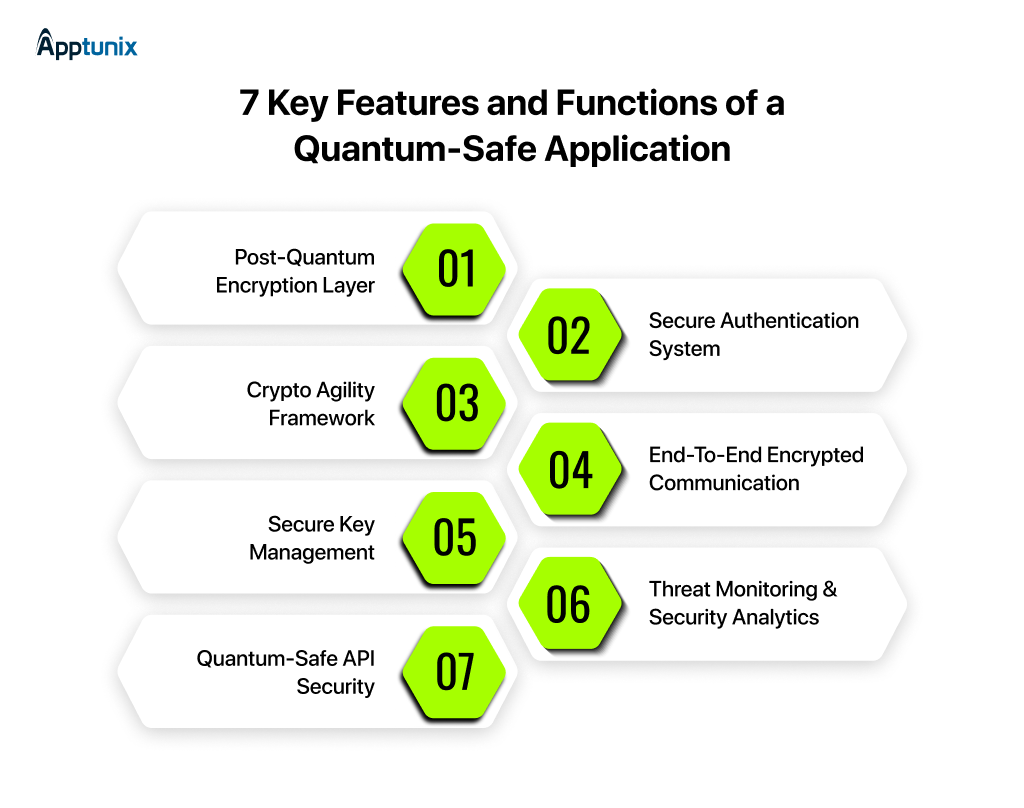
This is the heart of the system. It uses NIST-approved algorithms for data in motion and at rest. Every byte gets touched by it.
Tokens, sessions, and identity flows all need PQC support. ML-DSA replaces RSA and ECDSA here. Single sign-on and OAuth flows get reworked, too.
The system supports swapping algorithms without code rewrites. New standards drop in like plugins. This is the single most important long-term feature.
User-to-user and user-to-server channels use post-quantum keys. Messages stay safe even from harvest-now-decrypt-later attacks.
Keys are generated, rotated, and stored inside PQC-protected systems. HSMs and KMS layers need PQC upgrades, too.
Real-time monitoring catches anomalies fast. AI-driven analytics surface attacks before damage spreads. This is where AI and cybersecurity finally converge.
APIs are the new primary attack surface. Every endpoint needs PQC authentication and encryption headers.

These seven features form the standard quantum-safe app development framework. Most quantum-secure app development services are built to this baseline today. Now let’s talk numbers.
Well, it depends on the complexity and the technology you choose for a Quantum-safe app. The estimated range to develop a quantum-secure app is from USD $30,000 to $350,000+. Here’s the full cost breakdown.
These ranges reflect 2026 market rates to create quantum-safe app consulting. Costs vary by region, team experience, and timeline pressure.
Several factors push your final budget up or down. Here are the main ones, whether you are finding MVP development solutions or enterprise development services.
Most founders underestimate planning and testing. Together, they eat 30% of the budget. Cutting corners here causes 80% of post-launch issues.
Now, let’s address why this matters specifically for your business.
The “harvest now, decrypt later” threat is already live. Adversaries record encrypted traffic today. They plan to decrypt it once quantum hardware matures.
Customer data. Payment records. Investor communications. Source code. All of it sits exposed if you delay.
Three forces are tightening the timeline:
If your product handles long-lived sensitive data, this is already on someone’s risk register. Migrate apps to quantum-safe cryptography before regulators force you to. The best practice is simple. Start your crypto inventory this quarter.
Here’s where the next three years are heading in Quantum-safe apps.
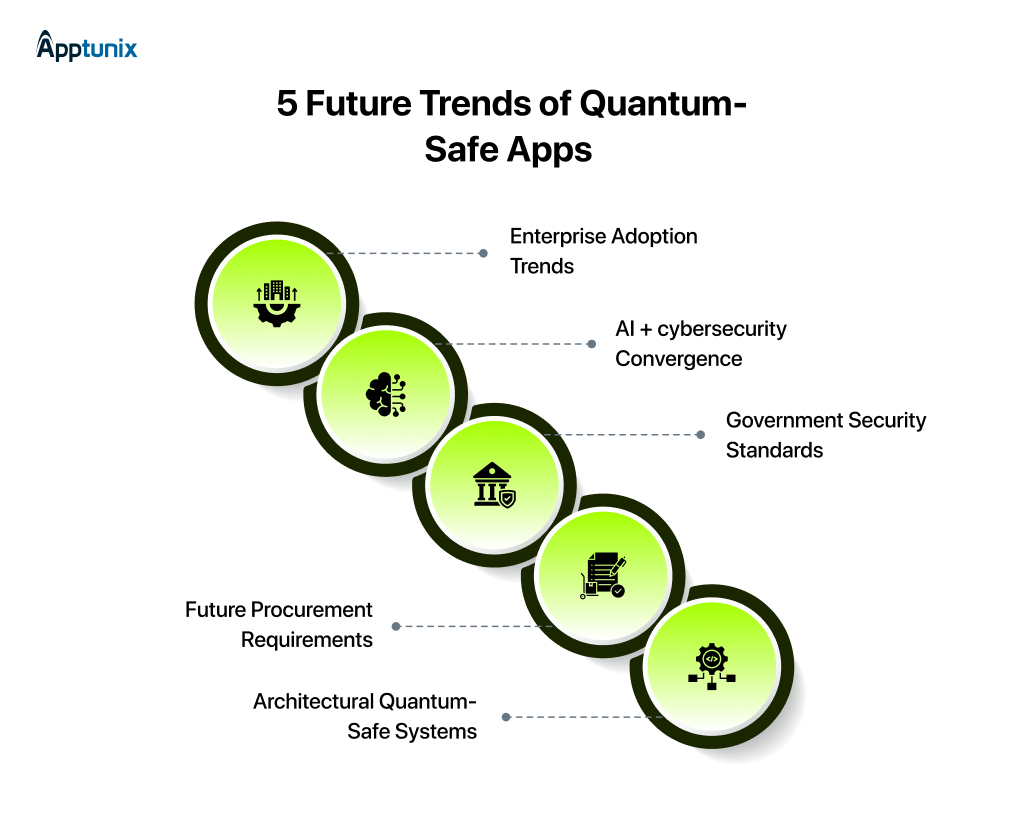
Cloudflare, AWS, Google, and Microsoft are already shipping PQC. More than half of human traffic on Cloudflare already uses post-quantum key agreement. Mid-market SaaS firms follow next. Expect mass adoption by 2027.
AI-powered threat detection layers on top of PQC. Anomalies surface in seconds instead of weeks. Behavioral AI agent development is a key integration that catches leaks faster than rule-based tools.
NSA CNSA 2.0 sets the federal baseline. NIST keeps adding algorithms over time. HQC went official in 2025. More are coming through 2027.
Federal, defense, and BFSI contracts will require PQC compliance by 2027-2028. Private buyers follow shortly after.
New apps will ship PQC out of the box by 2028. Legacy apps will retire fast.
For deeper ecosystem tracking, The Quantum Insider covers the vendor and standards landscape week by week.
This is the shape of quantum-ready application development going forward. Founders who build now own the early-mover advantage.
The quantum threat is real. The standards are set. The largest cloud providers are shipping today.
The only real question left is timing. Founders who start in 2026 roll out smoothly. Founders who wait until 2029 will scramble under regulatory pressure.
You don’t have to build all of this in-house. Specialized teams handle the hard parts faster and cheaper.
That’s where Apptunix fits in. We offer the best mobile app development solutions that help founders, enterprises, and product teams plan and ship quantum-safe end-to-end.
Our work covers crypto inventory, architecture design, hybrid deployment, mobile and web parity, and full cloud integration. Whether you need a 3-month sprint or a 12-month migration, we build for what’s next.
Start the conversation early. Build before the market forces you to. Your customers, regulators, and acquirers will thank you for it.
Q 1.What is quantum app development?
Quantum app development is the practice of building apps that resist attacks from quantum computers. It uses NIST-approved algorithms like ML-KEM and ML-DSA. These replace RSA and ECC at every layer. The goal is to protect data even after quantum machines mature enough to break classical encryption.
Q 2.Why is post-quantum cryptography important for mobile apps?
Mobile apps handle huge amounts of personal data daily. That data flows through TLS connections every second. Quantum computers will eventually break those connections. Post-quantum cryptography blocks that future risk early. It also protects against harvest-now-decrypt-later attacks happening today.
Q 3.When should businesses migrate to quantum-safe cryptography?
The honest answer is right now. NIST standards have been final since 2024. The EU mandates migration by the end of 2026. Most experts agree that 2030 will be too late. Starting your crypto inventory this quarter is the safest move.
Q 4.How much does quantum app development cost?
Basic projects start around $30,000 to $80,000. Mid-range builds with web and mobile parity run from $80,000 to $200,000. Enterprise migrations with full compliance can reach $350,000 or more. Final cost depends on complexity, integrations, and team experience.
Q 5.Which industries need quantum-resistant applications most?
BFSI, defense, healthcare, government, and legaltech sit at the top. Any industry handling data with a 10+ year sensitivity is exposed. Fintech and SaaS firms selling to enterprises come right after. Consumer apps handling payments or identity should plan now.
Q 6.Can existing apps migrate to post-quantum cryptography?
Yes, and most should. Migration usually runs in three phases. Crypto inventory comes first. Hybrid deployment runs classical and PQC side by side. Full PQC-native is the final step. The full process takes 8 to 12 months for most production apps.
Q 7.What are the biggest challenges in post-quantum app development?
Most teams hit four main roadblocks during migration. The first is crypto inventory. Mapping every place your app uses encryption takes longer than expected. Hidden third-party SDKs make it worse.
The second is performance. ML-KEM and ML-DSA produce bigger keys and signatures. The compute load goes up 2 to 3 times. Mobile apps feel this most on low-end devices.
The third is integration complexity. Around 42% of organizations globally cite this as their top blocker. Cloud providers handle PQC differently. Legacy systems often need partial rewrites.
The fourth is talent. Few engineers have shipped production PQC code. Senior PQC engineers charge premium rates today. Most teams rely on quantum-secure app development services for the heavy lifting.
Compliance overlap adds another layer. HIPAA development, SOC2, and FedRAMP audits all touch the migration scope.
Q 8.How long does it take to build a quantum-safe application?
Most projects run 8 to 12 months end-to-end.
Small SaaS apps can finish in 4 to 5 months. Mid-range builds with web and mobile parity take 6 to 8 months. Enterprise migrations with compliance needs hit the full 12 months.
Crypto inventory takes up the first 1 to 2 months. Testing and hybrid rollout cover the final 3 to 4.
Get the weekly updates on the newest brand stories, business models and technology right in your inbox.
Reena Bhagat, the CTO and Head of AI at Apptunix, is a seasoned technology strategist with a deep-rooted expertise in emerging technologies. With a focus on AI/ML integration, product engineering, cloud management, she leads the technical vision for high-performance SaaS infrastructures. Reena is recognized for building secure, scalable, and decentralized systems that solve real-world complexities. Her passion lies in leveraging data science and future-tech to create resilient digital products, making her a trusted authority for organizations looking to lead in the age of intelligent automation.
Book your consultation with us.
Book your consultation with us.


One Central, The offices 3, Level 3, DWTC, Sheikh Zayed Road, Dubai
+971 50 782 1690


Offer Ends Soon
Get a quick expert response in under 5 minutes.