Build a Podcast Hosting & Analytics Platform with Full Audience Data Ownership
31 Views 15 min July 30, 2026

Pallavi Nautiyal is a seasoned Tech Consultant at Apptunix, specializing in the intersection of global finance and decentralized technology. With a deep-rooted expertise in banking infrastructure, digital payment gateways, and Web3 ecosystems, she guides businesses through the complexities of modern financial engineering. Pallavi is recognized for her ability to architect secure, compliant, and scalable solutions—ranging from smart contracts and crypto-wallets to robust digital banking platforms. Her strategic insights help organizations navigate regulatory landscapes while leveraging the power of Blockchain to ensure transparency and seamless user experiences in every transaction.
Have you noticed how trading has suddenly become everyone’s favorite investment activity? From experienced brokers to young investors using mobile apps, the global stock market is witnessing an incredible digital shift.
According to Research and Markets, the stock trading and investing applications market has grown to $63.62 billion in 2025 and is projected to reach $129.38 billion by 2029, registering a CAGR of 19.4%.
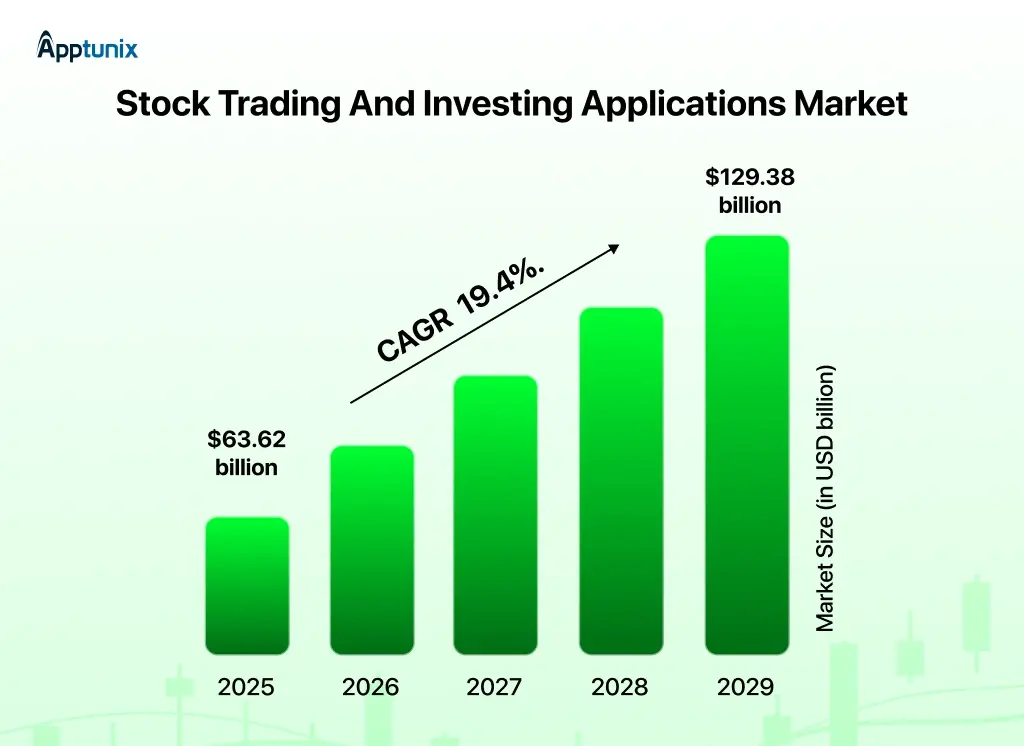
That’s a massive leap, proving how millions of people now rely on mobile trading platforms to buy and sell stocks anytime, anywhere. Well, this boom has made stock trading app development one of the most lucrative opportunities in the fintech industry.
Businesses of all sizes, ranging from startups to global financial firms, want to create trading apps that give users secure, seamless, and real-time access to the stock market.
However, developing a robust and compliant trading platform is not as simple as it looks. Many companies plan to build a stock trading app but struggle to identify what features users expect, how much the project will cost, and how to ensure data security and smooth performance.
Well, if you are planning to develop a stock trading app but are stuck with questions like:
✔ How do trading apps make money?
✔ What are the must-have features of a stock market platform?
✔ What is the actual cost to develop a stock trading app in 2026?
✔ How is AI transforming modern trading solutions?
✔ How to build a stock trading app that stands out?
✔ How can I choose the right stock trading app development company for my project?
Then this guide is built exactly for you.
In short, this guide walks you through everything you need to know about AI stock trading app development. Ranging from the entire trading app development process to feature planning, cost structure, AI integration, and the trends shaping the industry in 2026 and beyond.
This blog is designed as a complete, easy-to-understand roadmap for anyone planning to create their own trading app or scale an existing one. You will discover:
By the end, you’ll know exactly how to plan your app, estimate its cost, and choose the perfect stock trading app development company that can turn your idea into a scalable and profitable fintech product.
Let’s begin!
Modern investors no longer rely on phone calls or desktop terminals to trade. Everything happens on smartphones, where a tap can execute a buy or sell order in seconds. These fast and AI-powered platforms have made stock trading app development one of the hottest trends in fintech.
Now, as the demand for real-time trading grows, every financial firm and startup wants to create a trading app that captures this digital shift.
Coming to the main question, what is a stock trading app?
In simple words, a stock trading app lets users buy, sell, and manage stocks through an interactive digital platform. It connects to stock exchanges and brokerage APIs. This offers instant trading, live market data, and analytics in one place. Furthermore, trading app development is about building a secure, scalable, and regulation-ready platform that enables seamless stock transactions.
Unlike simple investment apps that focus on long-term portfolios, a trading app executes real-time orders, displays market charts, and delivers AI insights that help users make faster, smarter decisions.
When planning to create a trading app, understanding its model helps define the scope, complexity, and cost. Each app type serves a unique purpose and target audience:
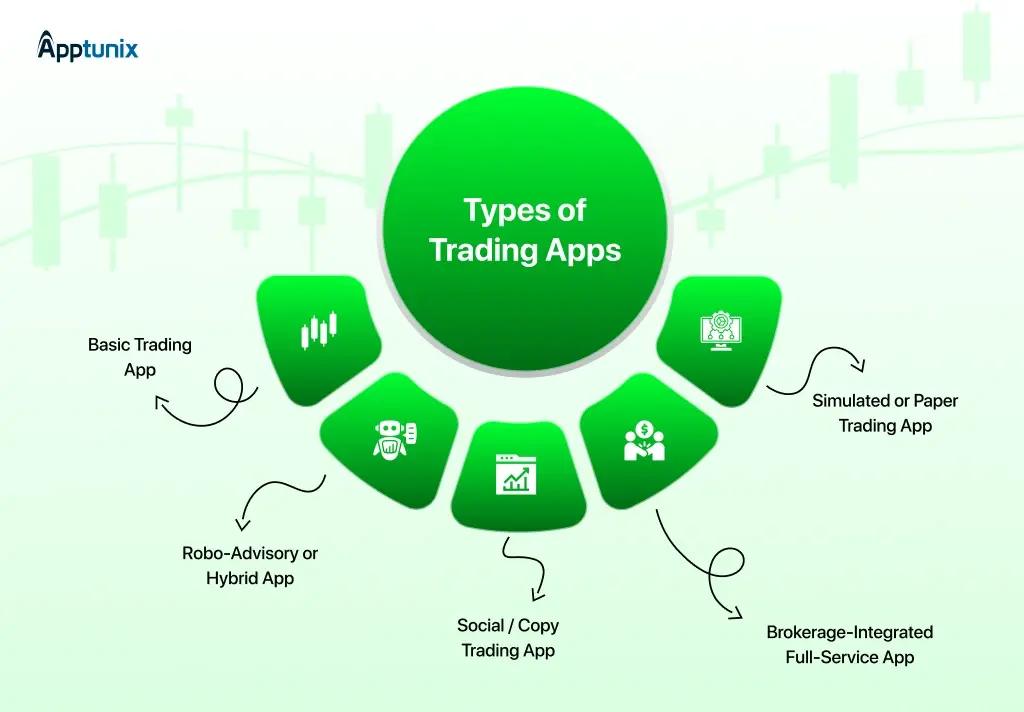
Focuses on essential features like market watch, buy/sell orders, and basic analytics. It is ideal for beginners or startups entering the trading space.
Combines AI algorithms with human expertise to offer automated investment advice and portfolio management. A growing choice for AI stock trading app development projects.
Enables users to follow and replicate the trades of top-performing investors, encouraging community-based trading and collective growth.
The most advanced model; integrating end-to-end brokerage functions like real-time trading, fund management, margin trading, and compliance modules.
Designed for practice and education, these allow users to test strategies using virtual funds before entering the live market.
Each model offers unique scalability options when businesses build trading apps tailored to different user bases, ranging from novice investors to professional traders.
From a business standpoint, trading app development offers high ROI potential because of its diverse monetization channels. Most successful platforms operate on multiple revenue streams that ensure consistent growth while enhancing user value.
Here are the primary ways stock trading apps make money:
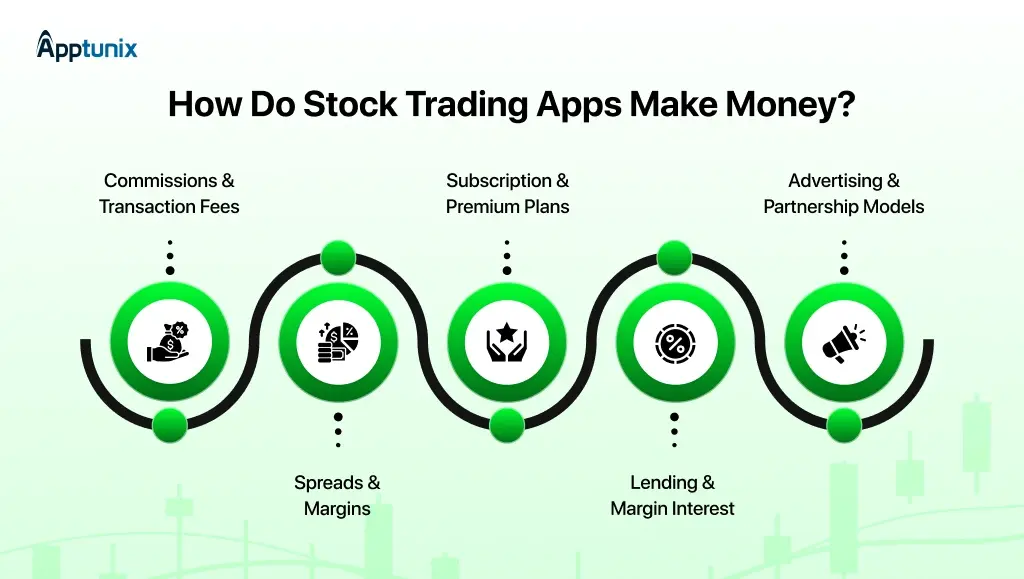
Every executed trade can generate a small commission, especially for brokerage-integrated platforms. Even fractional percentages across thousands of users create significant profits.
Apps earn through the difference between buying and selling prices (the spread), a common model in Forex and stock trading.
Advanced features such as AI insights, market predictions, or zero-commission trading can be offered through monthly or annual subscriptions.
Some platforms generate interest by lending funds for margin trading, thus offering users leveraged trading options.
Cross-promotions and in-app financial product recommendations (like insurance or funds) add non-intrusive monetization streams.
For fintech founders, integrating such models early helps design a sustainable business framework. As an AI-powered app development company, we build trading platforms that seamlessly support these revenue channels, ensuring they are not just user-friendly but also profit-driven.

Building a powerful stock trading app goes far beyond coding. It’s a structured process that transforms an idea into a fully functional, secure, and scalable trading ecosystem. Once you understand what a trading app is and why it matters, the next step is knowing how to create a trading app that actually meets user needs, regulatory standards, and business goals.
Here’s a complete roadmap that every leading stock trading app development company follows.
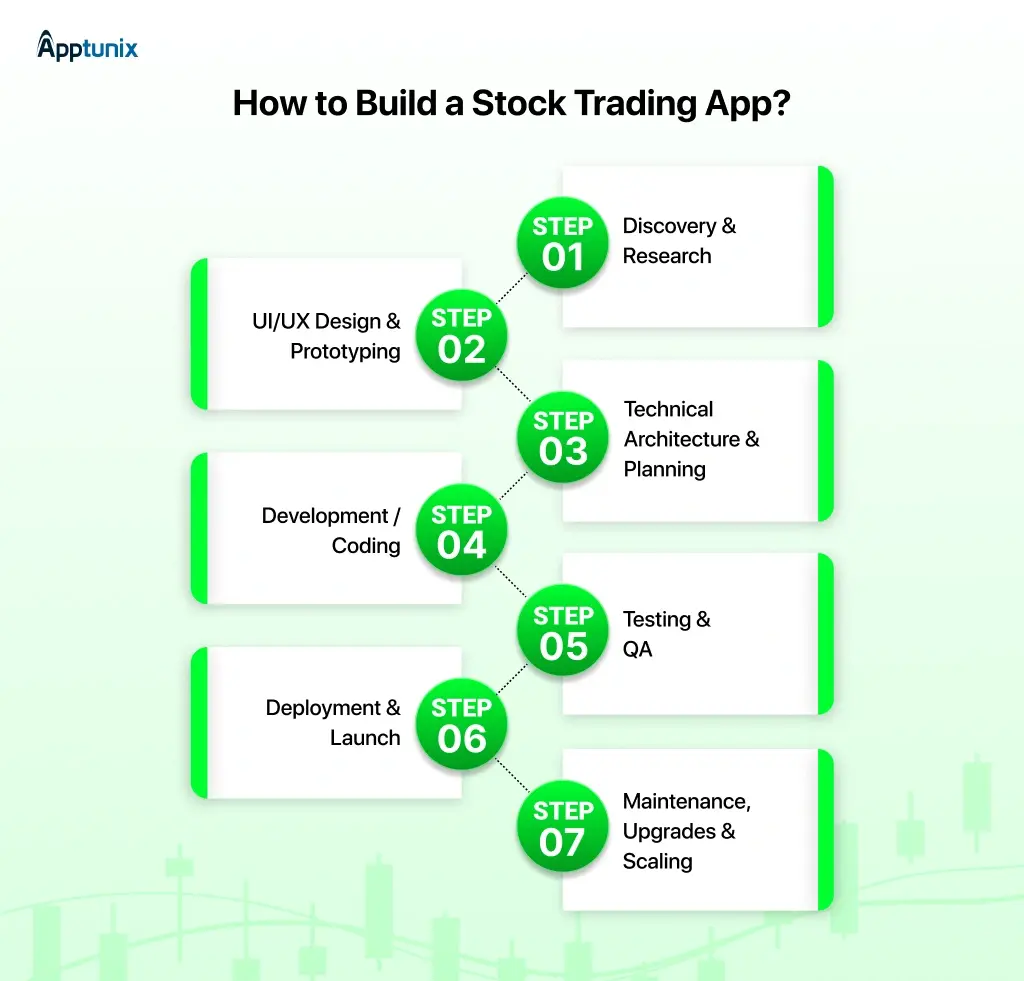
Every successful project starts with deep research. Teams begin by studying the market, analyzing competitors, and defining target user personas. This helps identify gaps and opportunities. During this stage, app developers gather requirements and shortlist must-have features to build a trading app that matches your unique vision and target market.
The design phase focuses on creating intuitive interfaces and smooth user journeys. Wireframes, mockups, and clickable prototypes define how users interact with charts, portfolios, and trades. Usability tests ensure that the final app feels simple yet professional. A vital factor in trading app development success.
Next comes setting up the technical foundation. Developers define data models, APIs, and modules while focusing on security, scalability, and modular design. This stage ensures your system can handle high trading volumes. And yes, focus is laid on integrating AI-driven features that are essential in AI stock trading app development.
This is where your idea comes to life. Front-end developers create responsive interfaces, while backend developers handle order execution, market data streaming, and brokerage integrations. Agile sprints keep progress transparent and measurable. This ensures your team stays aligned to build a stock trading app that performs flawlessly under pressure.
Quality assurance is critical in stock trading app development. QA engineers conduct functional, performance, and security testing to eliminate bugs and vulnerabilities. Penetration testing ensures that transactions, APIs, and data remain safe from potential breaches.
Once approved, the trading app is deployed to live environments. Teams handle app store submissions, backend hosting, and infrastructure setup. Continuous monitoring tools track performance, latency, and order accuracy post-launch. A vital step for any stock trading app development company.
After launch, your Android or iOS app requires regular maintenance in the form of bug fixes, feature improvements, and compliance updates. As your user base grows, scaling infrastructure and adding AI-powered tools become key priorities. Ongoing trading app development ensures long-term stability and market competitiveness.
Bonus Read: AI App Development: A Guide for Entrepreneurs & Businesses
Creating a successful stock trading app is all about balancing user convenience with system intelligence. From intuitive dashboards to secure back-end controls, every feature plays a critical role in performance and user retention. When planning stock trading software development, you must think beyond basic trading functions and focus on a scalable and insight-driven architecture.
Below is a complete overview of must-have modules for both users and administrators.
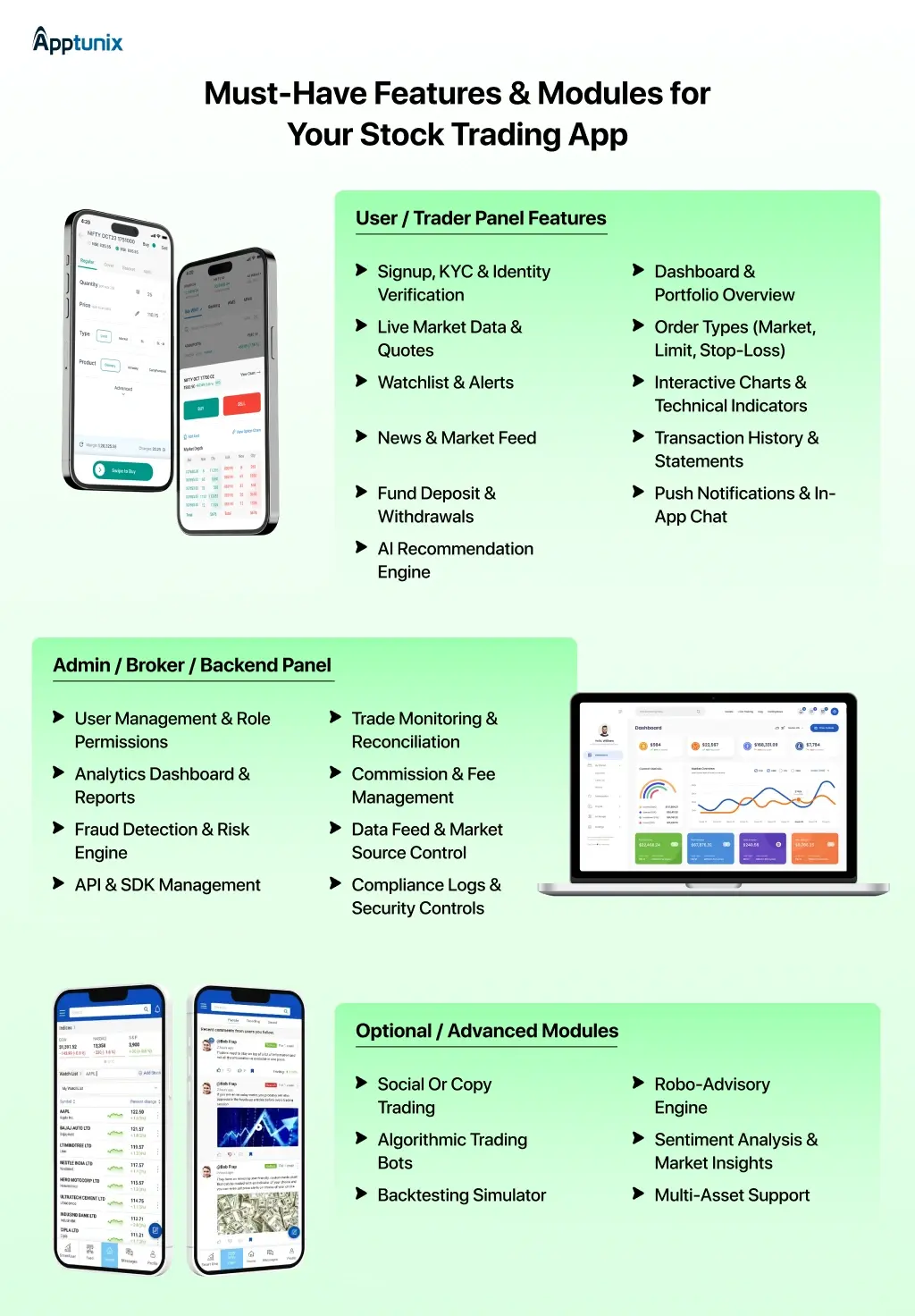
The user interface defines the success of any trading app development project. It must be fast, responsive, and secure to keep traders engaged and confident in every transaction.
Core user-side features include:
The admin panel powers smooth operations and ensures full control across the trading ecosystem. It’s a key part of stock trading software development and helps brokers and platform owners manage users, trades, and compliance efficiently.
A strong backend ensures the entire trading app development process runs securely and efficiently. This allows you to operate with full control, accuracy, and confidence.
Advanced modules can redefine user experience, especially for platforms that aim to stand out:
Integrating these smart capabilities during stock trading software development helps you build a trading app that stays competitive, adaptive, and ready for the future of fintech.
Also Read: How to Develop a Fintech App Like STC Pay
When you are looking to build a stock trading app, it’s vital to understand the main cost buckets. And for stock trading app development, these include:
In addition, ongoing costs arise after launch, which many overlook:
These contribute significantly when you plan to create your own trading app or partner with a stock trading app development firm..
Here’s how cost scales as you go from an MVP to a full-featured platform:
Stock Trading App Development Cost Table (USD)
| Tier | Estimated Cost (USD) | Notes |
|---|---|---|
| Basic MVP | US$30,000 – US$50,000 | Simple core features, one region |
| Mid-tier | US$50,000 – US$150,000 | Advanced UI/UX, multiple integrations |
| Advanced | US$150,000+ | AI modules, multi-asset support, global reach |
Bonus Read: Your Ultimate Guide to Fintech App Development Cost
If you are specifically looking for an AI stock trading app development, there’s an extra investment layer. These include:
Hence, the cost to develop AI stock trading app will often be significantly higher than the standard stock trading app development cost. Trading platforms with AI/ML may fall into the US$80,000 – 300,000+ range.
While knowing the approximate cost to develop stock trading app is useful, the final figure always depends on multiple variables. From feature complexity to compliance standards, each aspect affects both your timeline and total investment.
Let’s now break down the primary factors influencing the price of trading app development. This will help you plan your budget strategically and understand why partnering with a professional stock trading app development company like Apptunix can save both time and money.
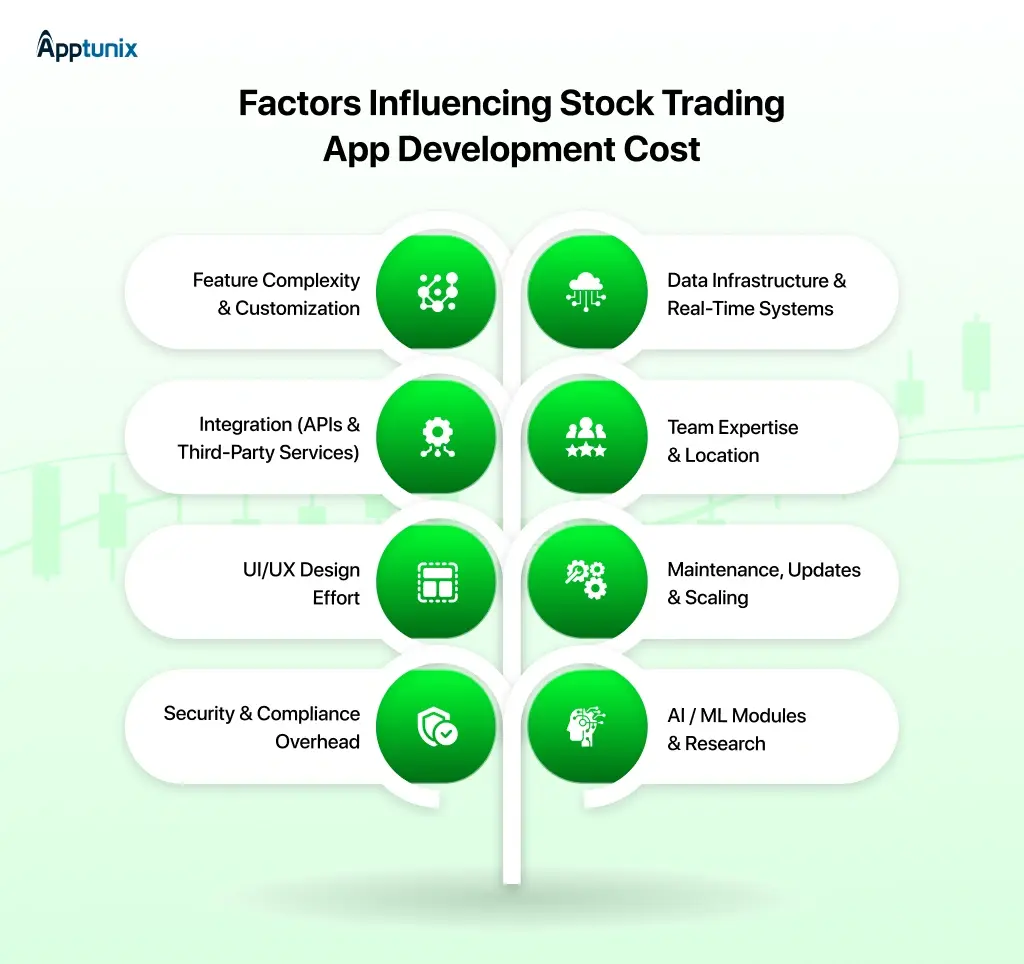
1.Feature Complexity & CustomizationThe number and sophistication of features directly impact the cost to build a stock trading app. Basic trading, watchlists, and portfolios are relatively inexpensive. However, advanced modules such as algorithmic trading, robo-advisory, and AI-driven insights add layers of coding, testing, and backend logic. Working with an experienced trading app development company ensures that customization aligns with your business goals while controlling unnecessary expenses.
2.Integration (APIs & Third-Party Services)Integrations with brokerage APIs, payment gateways, KYC verification systems, and live market data feeds contribute significantly to the overall stock trading app development cost. The more external APIs you connect, the higher the complexity. A reliable stock trading app development service provider manages integrations seamlessly and ensures that API performance remains secure, scalable, and compliant with exchange standards.
3.UI/UX Design EffortA well-crafted interface not only attracts traders but also enhances usability. Sophisticated UI/UX designs with custom dashboards, real-time graphs, and interactive charts require additional design hours. This raises the trading app development cost. Professional designers from a top stock trading app development company employ proven frameworks and design systems that balance aesthetics with performance, thus avoiding cost overruns.
4.Security & Compliance OverheadSecurity is non-negotiable in financial applications. Implementing encryption, KYC/AML protocols, and compliance with global regulations like GDPR or SEBI guidelines adds extra development layers. This increases both effort and cost. However, partnering with a certified fintech app development company minimizes risks and ensures your trading app development process meets legal and audit standards from day one.
5.Data Infrastructure & Real-Time SystemsStock trading relies on real-time market data, order execution, and latency-free operations. Building such architecture demands advanced servers, caching systems, and streaming APIs. The major cost drivers for any stock trading app development project. A seasoned stock trading software development company optimizes your data pipeline for cost efficiency without compromising performance.
6.Team Expertise & LocationThe cost to develop a trading app varies depending on the development team’s location and experience level. Developers in India or Southeast Asia typically charge less compared to teams in the US or Western Europe. Still, expertise plays a key role. Hiring skilled professionals through a reputable stock trading app development company in India offers the best of both worlds: high quality at a competitive price.
7.Maintenance, Updates & ScalingOnce your app is live, continuous monitoring, bug fixes, security updates, and version upgrades become recurring costs. Apps that grow rapidly may also require database optimization, user-load scaling, and periodic audits. Choosing a trading app development partner that provides long-term support and maintenance packages helps keep your stock trading app development cost predictable over time.
8.AI / ML Modules & ResearchIncorporating AI-based trading bots, market prediction engines, or sentiment analysis features can elevate user experience but also raise prices substantially. AI modules require model training, data labeling, and cloud infrastructure. All of this increases the AI stock trading app development cost. Collaborating with an experienced AI app development company ensures efficient integration of AI/ML without unnecessary resource spending.
The stock trading app development industry is evolving faster than ever. From AI-driven automation to blockchain-based trading and community-led investing, the innovation wave is reshaping how both individuals and institutions trade.
As global investments pour into trading app development, the next few years will bring smarter, faster, and more inclusive digital ecosystems. Here’s a look at the most transformative trends redefining the future of trading, and how a forward-thinking stock trading app development company like ours builds solutions ready for 2026 and beyond.
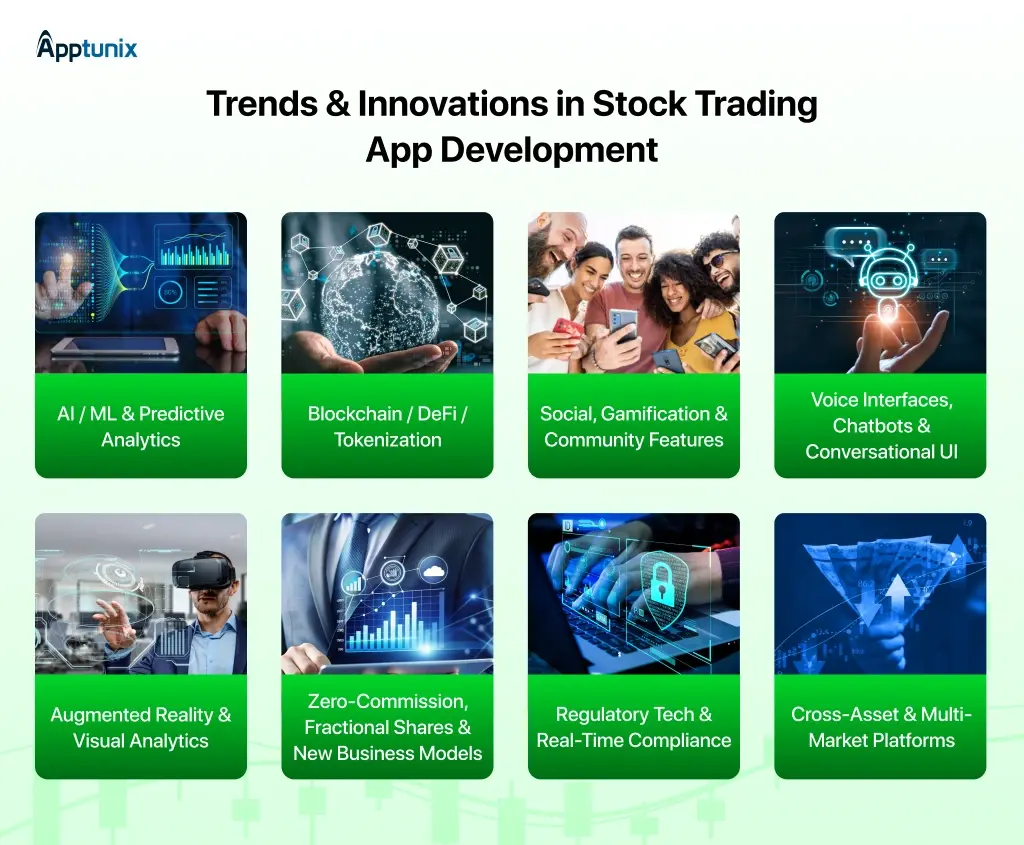
1.AI / ML & Predictive AnalyticsArtificial Intelligence remained the heartbeat of AI stock trading app development in 2025. Modern stock trading software development now integrates predictive analytics and machine learning algorithms that forecast price trends, identify market anomalies, and automate decision-making. According to Grand View Research, the AI trading platform market is projected to grow at a CAGR of 20% between 2025 and 2030. A clear indicator of its accelerating adoption.
So by choosing the right stock trading app development company, you can create a trading app capable of executing real-time analysis, generating AI personalized insights, and automating trades with human-like precision. Our team specializes in building AI-powered trading apps that help investors act faster and smarter while optimizing ROI.
2.Blockchain / DeFi / TokenizationThe fusion of blockchain and DeFi (Decentralized Finance) is revolutionizing how people trade, own, and verify digital assets. Blockchain-backed stock market app development ensures transaction transparency, instant settlements, and tokenized assets. Businesses looking to build a stock trading app that supports cross-border trading or tokenized securities are increasingly turning to decentralized solutions for trustless operations and reduced brokerage costs.
By integrating blockchain into trading app development, our company helps financial innovators create their own trading apps that support asset tokenization, crypto-to-stock conversions, and smart contract-based automation.
For more information, read: AI in Blockchain: Powering Next-Gen Solutions
3.Social, Gamification & Community FeaturesIn 2026, trading will no longer be an isolated experience. Leading apps like eToro and Public will further popularize social and copy trading. This will allow users to follow experts and mirror their strategies. Gamification elements such as leaderboards, streak rewards, and achievements increase engagement, especially among Gen Z investors.
We help brands build trading apps that merge learning, community, and profit, thus making stock trading social, interactive, and growth-driven. Whether you aim to create a stock market app with social feeds or add gamified learning paths, our stock market app developers can bring these ideas to life, and that too within your budget.
4.Voice Interfaces, Chatbots & Conversational UIVoice-enabled Flutter trading apps and React Native trading apps are transforming how users interact with markets. Traders can now execute orders or check portfolios through voice commands or chat-based assistants. Smart chatbots also provide 24/7 customer support and trade suggestions, thus reducing friction across the user journey.
Our team uses advanced NLP and AI technologies to build a trading app that supports multi-lingual voice assistants and conversational analytics. This helps users make trades faster and with greater confidence.
5.Augmented Reality & Visual AnalyticsAR and visual analytics are bridging the gap between raw market data and intuitive decision-making. Imagine pointing your phone camera at a company logo to instantly view live stock performance. That’s the future of stock trading app development. These tools allow traders to visualize patterns and insights in real time, thus making data interaction more engaging.
Our experts integrate AR-powered dashboards to build stock trading apps that provide innovation with user experience. thus setting new benchmarks in digital investing.
6.Zero-Commission, Fractional Shares & New Business ModelsAs competition intensifies, the best stock trading app development strategies are moving toward affordability and accessibility. Zero-commission trading and fractional investing have become industry norms, enabling micro-investors to participate easily. Modern investment app development also introduces subscription models and premium AI analytics to diversify revenue streams.
Our stock trading app development company builds platforms that support these evolving models. This lets us help clients explore how trading apps make money through sustainable and user-centric monetization.
7.Regulatory Tech & Real-Time ComplianceIn 2026, building a stock trading platform that’s compliant in real time is no longer optional. RegTech solutions now automate identity verification, anti-money laundering (AML) checks, and suspicious trade alerts. This ensures traders remain protected while platforms adhere to strict financial laws.
Our trading app development solutions minimize regulatory overhead and enhance investor trust by using compliance automation tools. This keeps your platform safe, legal, and scalable by using compliance automation tools.
8.Cross-Asset & Multi-Market PlatformsInvestors no longer limit themselves to equities. They trade crypto, ETFs, bonds, and commodities all from one app. This multi-asset approach is redefining stock trading software development as businesses aim to create all-in-one trading apps that serve global markets.
Our Android and iOS app developers specialize in creating cross-asset trading platforms that handle diverse instruments with unified analytics. Thus making it easier for investors to trade seamlessly across borders.
The next generation of stock trading app development combines AI, blockchain, and data-driven personalization. Whether you want to build a trading app with AI intelligence, create your own stock market app, or integrate social and DeFi features, working with an experienced stock trading app development company like Apptunix ensures your idea is future-ready, cost-efficient, and globally scalable.
Our team helps you make a trading app that not only adapts to today’s trends but leads tomorrow’s innovation. From AI stock trading app development to investment app development, our fintech app development company brings the expertise, technology, and strategy you need to outperform competitors in this fast-changing market.
Recommended Read: Why Your Next App Should Be Built With Apptunix?

Q 1.How much does it cost to build a stock trading app?
The cost to build stock trading app typically ranges from $30,000 to $150,000+, depending on the app’s features, design complexity, and technology stack. A basic trading app with core functions like market data and portfolio tracking costs less. While AI-powered or multi-asset platforms require bigger investments. Partnering with an experienced stock trading app development agency ensures cost optimization and faster time to market.
Q 2.Can I create my own trading app without a finance background?
Yes, you can create your own trading app even without a finance background. The key lies in partnering with a skilled trading app development team that understands both fintech regulations and user experience. They handle the technical, compliance, and integration parts while you focus on your business goals.
Q 3.What features must every trading app have?
Every stock trading app development project should include features like secure login, KYC verification, real-time stock data, advanced charts, multiple order types, watchlists, and instant trade execution. To stand out, consider AI-powered recommendations, social trading, and robo-advisory tools that enhance engagement and retention.
Q 4.How do trading apps make money?
Trading apps generate revenue through commissions, spreads, subscription plans, premium analytics, or zero-commission trading with payment for order flow. Many apps also earn from margin lending, advertisements, and affiliate partnerships. A strong stock trading software development strategy aligns monetization with user trust and long-term scalability.
Q 5.Is AI stock trading app development worth the investment?
Absolutely. AI stock trading app development helps investors make data-driven decisions, automate trades, and analyze massive datasets in real time. It boosts accuracy, reduces human error, and gives apps a competitive edge in today’s fast-moving financial market. Businesses investing in AI-powered trading app development often see higher engagement and better ROI.
Q 6.How long does trading app development take?
A typical trading app development timeline ranges between 3 to 9 months, depending on complexity and features. A basic MVP can go live in 10 – 12 weeks, while advanced platforms with AI modules, real-time analytics, and cross-platform support require longer development cycles.
Q 7.Which is better: Flutter trading app or React Native trading app?
Both are excellent frameworks. A Flutter trading app offers smooth performance, faster rendering, and a unified UI across platforms. A React Native trading app is preferred for flexibility, large community support, and easy integration with third-party APIs. The best choice depends on your scalability goals and design preferences. Expert stock market app developers can guide you based on your project’s needs.
Q 8.What’s the future of stock trading app development?
The future of stock trading app development revolves around AI, blockchain, voice trading, and cross-asset support. Expect deeper personalization, real-time analytics, and zero-commission business models. Companies that build trading apps leveraging these innovations will dominate the next era of digital investing.
(1 ratings, average: 4.00 out of 5)
Get the weekly updates on the newest brand stories, business models and technology right in your inbox.
Pallavi Nautiyal is a seasoned Tech Consultant at Apptunix, specializing in the intersection of global finance and decentralized technology. With a deep-rooted expertise in banking infrastructure, digital payment gateways, and Web3 ecosystems, she guides businesses through the complexities of modern financial engineering. Pallavi is recognized for her ability to architect secure, compliant, and scalable solutions—ranging from smart contracts and crypto-wallets to robust digital banking platforms. Her strategic insights help organizations navigate regulatory landscapes while leveraging the power of Blockchain to ensure transparency and seamless user experiences in every transaction.
31 Views 15 min July 30, 2026

701 Views 15 min December 26, 2025

725 Views 15 min December 23, 2025
Book your consultation with us.
Book your consultation with us.


One Central, The offices 3, Level 3, DWTC, Sheikh Zayed Road, Dubai
+971 50 782 1690


Offer Ends Soon
Get a quick expert response in under 5 minutes.