
Fleet Management Software Development: Cost, Features, Process & AI Guide for Enterprise Fleets
91 Views 15 min June 24, 2026

With over 20+ years of experience in driving global digital initiatives, Nikhil Bansal is the CEO & Director of Apptunix. He specializes in orchestrating large-scale digital transformations, enterprise-grade software solutions, and high-level business strategies that redefine industry standards. Nikhil is known for his ability to bridge the gap between complex business challenges and innovative technology, helping Fortune 500 companies and startups alike achieve sustainable growth. A visionary leader, he empowers enterprises to navigate the digital landscape with agile, ROI-focused models and future-ready business strategies.
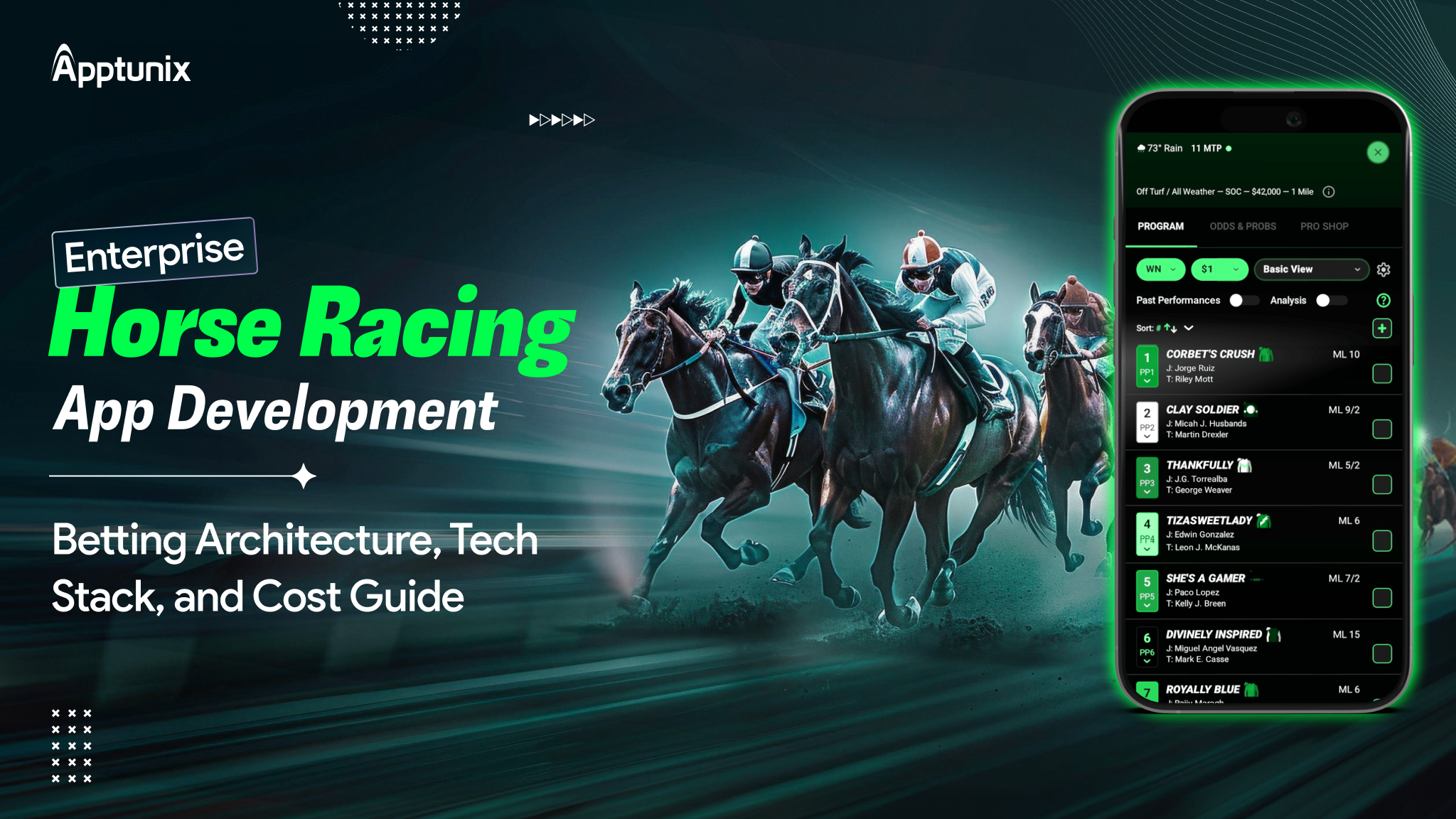
The online betting industry is moving quickly, but horse racing app development is one of the least developed and most profitable areas of sports technology.
According to data from Business Research Insights , the global horse racing wagering handle reached USD 1072.56 billion by 2035.
But a profitable horse racing betting app isn’t just about getting an odds feed.
You need:
Building a modern horse racing platform requires balancing sub-second odds updates, multi-jurisdictional compliance, and high-throughput betting engines. This guide breaks down the core architecture, data engineering pipelines, and realistic budgets required to launch an enterprise-grade horse racing application in 2026.
Horse racing app development involves designing, creating, and releasing a mobile or web-based application for horse racing bettors, fans, traders, and operators.
A horse racing betting app goes far beyond an odds display. At its core, it is a real-time financial transaction system layered on top of a live sports data engine: wrapped in a consumer-grade UX designed to retain users through long periods between race events.
This is why horse racing app development is harder and more valuable than most generic sports betting app development projects. It requires skills in real-time systems, payment processing, regulatory adherence, and AI-driven personalization all in one.
There are around 6 categories into which a horse racing app can be divided:
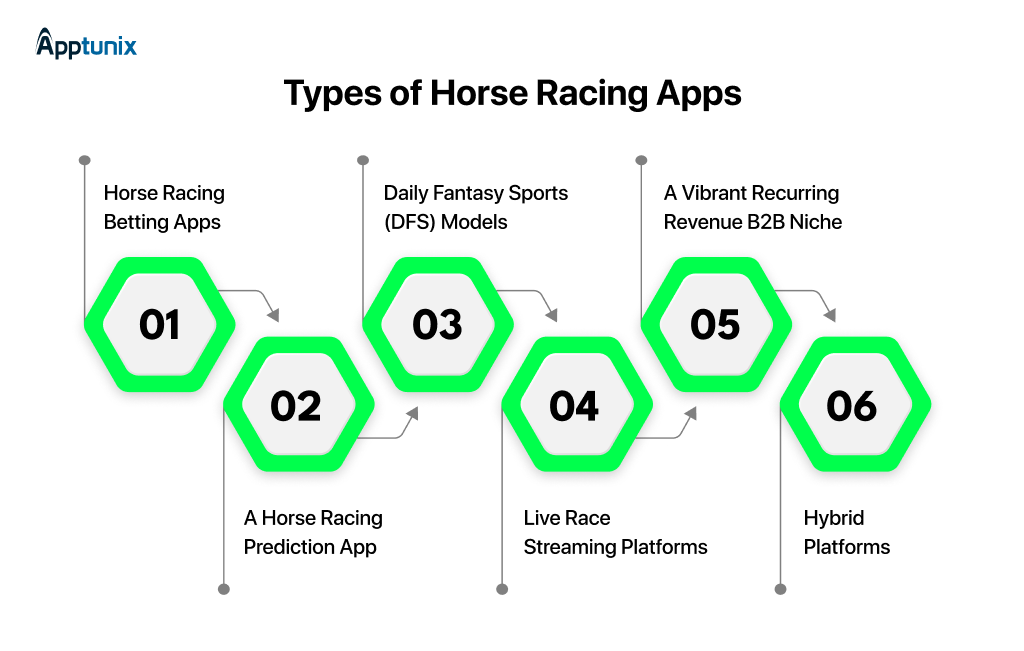
Now let’s dive into the system architecture that powers the horse racing app.
Odds on a horse racing market can change dozens of times per minute. A user seeing stale odds places a bet at the wrong price. The operator either absorbs the loss or faces a dispute. Trust evaporates.
Your entire architecture must be designed around this constraint: every client must receive odds updates within 200ms of the feed publishing them.
The betting engine is the most complex component in any horse racing platform. At a minimum, it must handle:
For live race video, the production-grade architecture uses:
Also read: The 2026 Sports Betting App Development Guide: How to Compete with FanDuel & DraftKings
Horse racing app development demands far more than odds feeds and a bet slip. A structured framework covering compliance, live data, scalability, and post-launch optimization is what separates platforms punters trust from those they abandon. Here is what a professional Enterprise app development firm must execute:
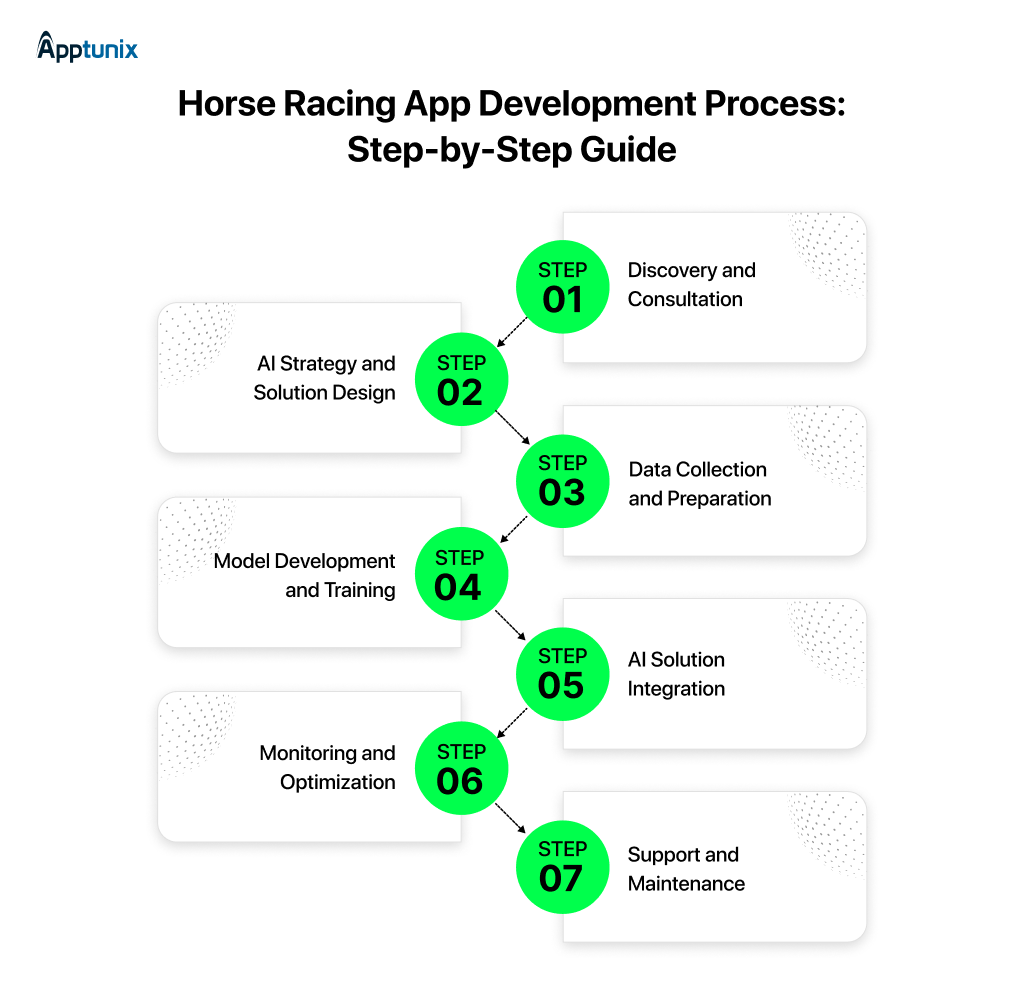
Set your target races, your user personae, your betting categories, and your monetization model before you write a line of code. Outline the licensing journey, compare on-device, cloud, and hybrid architecture, and set clear privacy and compliance boundaries from the early stages. This discovery phase aligns engineering capabilities with market demand to map exact system dependencies before writing code.
Key focus areas:
Create an AI solution blueprint aligned with specific racing outcomes rather than a generic roadmap for AI. Choose pre-trained models and establish fine-tuning criteria using the historical race data, and design fallback actions when predictions cannot be made. The prediction feature is built by a knowledgeable horse racing app development partner like Apptunix as a means of generating revenue, rather than an afterthought that’s tacked onto the betting engine.
Key focus areas:
Gather, retrieve, and collate race data from a number of sources: historical race results, live feed providers, weather APIs, and form databases. Real-device testing and prototype validation should not be done sequentially. Platform design must prioritize low-friction onboarding, enabling users to place wagers within three taps of launching the app.
Key focus areas:
Build and refine prediction models on curated racing datasets, monitoring accuracy, loss, and generalization across different race types and geographies. Set up SDK integration, API design, error handling, and CI/CD pipelines from the beginning: not as post-development additions. Predictive algorithms must be treated as living systems, continuously ingesting historical variables like track moisture, jockey changes, and weather adjustments.
Key focus areas:
Align model deployment with operational betting workflows. On-device model updates must be coordinated with app release cycles; cloud model updates can be pushed independently through continuous deployment pipelines. A reliable horse racing app development partner implements dynamic model downloading and feature flags: enabling precise rollouts by user segment, device type, or geography without forcing full app updates.
Key focus areas:
Build continuous monitoring across latency, prediction accuracy, error rates, device impact, and cloud inference costs from day one of production. The horse racing prediction app design features and development process do not end at launch: optimization must begin the moment real race-day traffic hits the system. A committed horse racing app development company treats post-launch performance tuning as a core deliverable, not a support ticket.
Key focus areas:
Establish long-term support infrastructure before scaling user acquisition. Cost management, device heterogeneity handling, and smart inference routing between on-device and cloud must all be resolved early. An accountable horse racing app developer remains your long-term partner through this phase: ensuring the prediction engine, betting logic, and compliance frameworks evolve alongside your business, rather than stagnating after the initial release.
Key focus areas:
Following are the features that define an efficient horse betting app:
Today’s horse racing betting apps are not restricted to simple betting functions. The top apps of leverage artificial intelligence, real-time analytics, social interaction and rich betting experiences to boost user retention, betting volume, and overall platform revenue.
The enhanced functionalities are now emerging as a major differentiator for operators seeking to create sustainable and future-proof horse racing ecosystems.
Training horse racing prediction models — typically gradient boosting or neural networks — on key variables: past finishing positions, speed figures, going preference, class ratings, draw bias, trainer and jockey performance records, and live odds movement. Together, these inputs give the model a complete view of every runner before the race. Modern AI systems like RaceHP.ai’s URIN model process 144 features per race across 15.8 million training samples: achieving measurable accuracy improvements over traditional handicapping.
Accept bets during a live race, utilising the in-play, or in-running, data. Needs feed latency of less than 100ms, and a risk management system that has the ability to price and accept bets quickly enough for the race to follow. In-running betting is the single highest-margin product in horse racing.
Wagering, tipping contests, social following of the top handicappers, and sharing a bet on social media. These features have a huge impact on increasing DAU/MAU by offering community gravity that draws users back between race days.
This involves a group betting bet where all members share a stake and share the return. Popular in Australia and the UK: boosts average bet and session engagement by a significant margin.
24/7 Virtual Racing with real money wagering, not tied to a live racing schedule. Forecasting the virtual sports betting market, it is estimated that it will be worth $12.68 billion in 2024 and $44.52 billion in 2032 with a CAGR of 17%.
AI-powered home screen that displays the upcoming races based on the user’s preference, monitors previous races, and places bets. This helps to reduce the time between the first bet and the next, and can be a key factor in engagement and retention.
All bets placed and settled are recorded on an immutable blockchain ledger, making the bet audit trail transparent and much more reliable. It meets the requirements of regulators in well-established markets, and it is a great asset in new ones where regulators are just beginning to develop.
Also Read: Fantasy Sports App Development To Grow Your Business Online
This is the highest-stakes section of any horse racing app development project, and the most consistently underprepared.
The UK alone has over 120 licensed operators and an estimated $150 million invested in platform development and upgrades annually, which tells you both the opportunity size and the competitive bar.
Apple App Store and Google Play both require proof of a valid gambling license for the territories where your app will be available. The review process for gambling apps takes 2–4 weeks longer than standard apps. Build this into your launch timeline.
Rule: Engage a gambling law specialist in each target jurisdiction before a single line of code is written.
The investment needed for a horse racing app varies quite a bit. It depends on complexity and features, along with the markets you want to reach. Starting with something small to test the idea makes sense for some, while others build bigger from the start. Understanding the breakdown for development and operations helps with decisions, I think.
The following figures are estimates from benchmarks, and they factor in design development, third-party integrations, and post-launch costs.
The Most Important Cost Insight Most Founders Miss: Operational costs:- data feeds, infrastructure, compliance: often exceed development costs within 18 months of launch. Model these into your financial plan before you build.
Also Read: Cost to Build a Sports Fantasy App: A Detailed Analysis!
The best horse racing app doesn’t rely on one type of revenue, the best apps are stacking several revenue models to harvest the most money from the various types of users. Every stream has a different set of wagers and margins, as well as different data licenses and tiers of subscription. Knowing the individual and the combined working of these models is the difference between successful platforms that continue to run and those that crash as soon as they are launched.
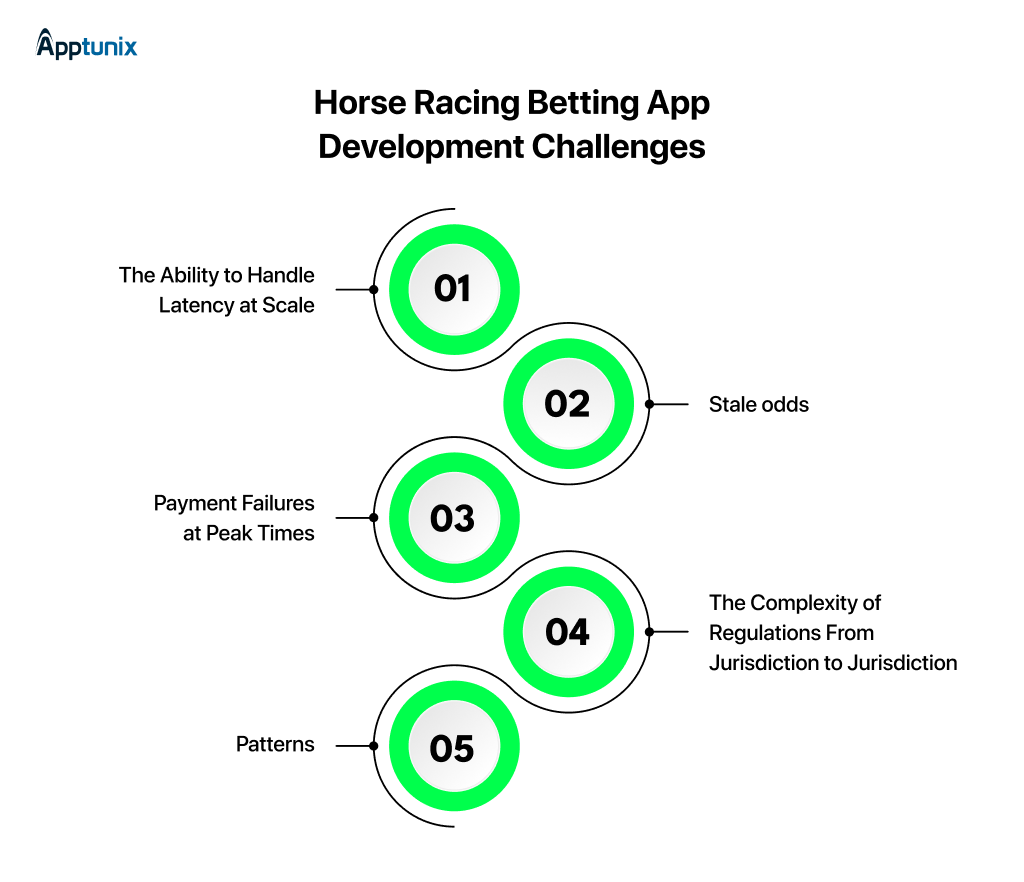
The journey of Horse Racing Betting App Development is never smooth sailing. There are going to be some hurdles that you may encounter during the development. The common challenges include:
AI That Explains Its Reasoning: The next-generation of horse racing prediction apps won’t simply provide a probability score. They’ll tell you why: “We are very impressed with this horse, as he has won 4 of his last 5 races on soft going, and today’s track is soft-to-heavy.” One of the earliest signs of the direction of the market comes from the Daily Racing Form team’s collaboration with Horseshoe Indianapolis to launch ‘A.I. Alan’—a virtual AI handicapper—for the first time.
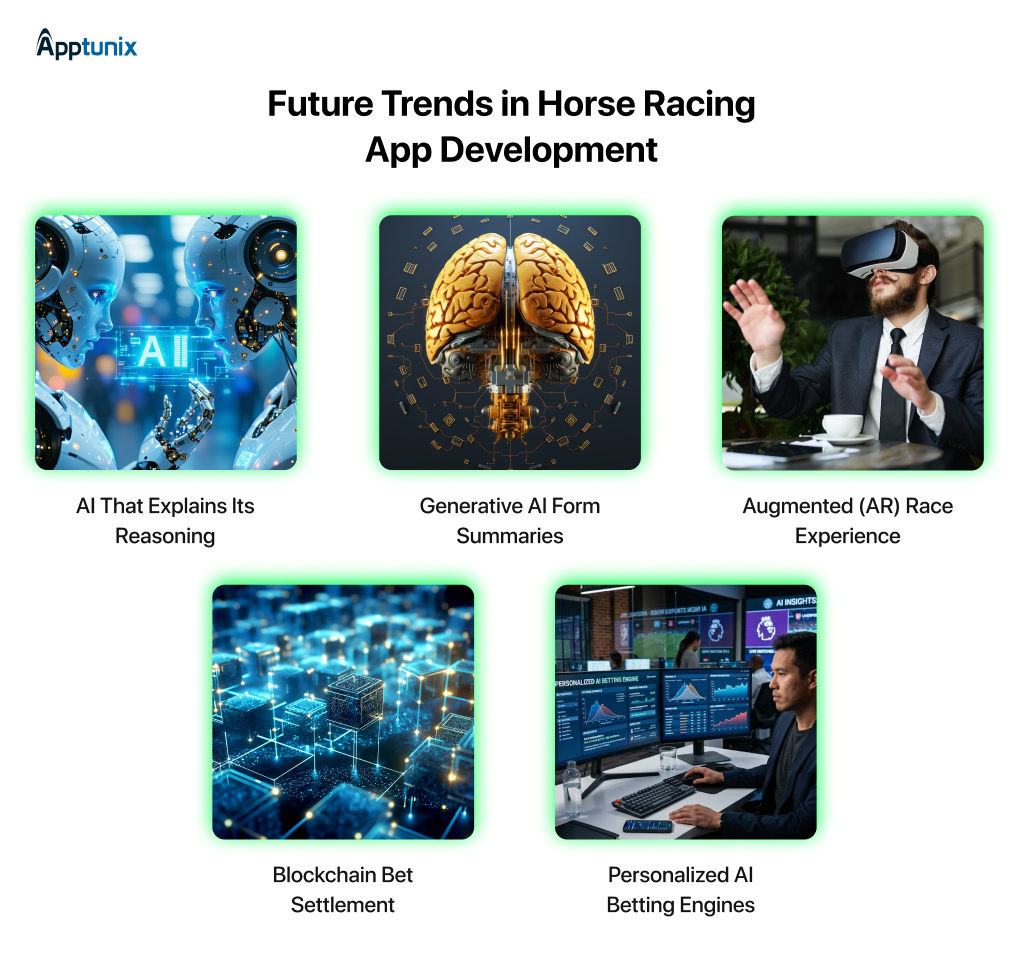
Generative AI Form Summaries: LLMs converting raw form strings into natural-language race previews. Instead of reading “1-2-4-3-1”, a user sees a written summary in plain English.
Augmented (AR) Race Experience: A new concept that displays horse position, live odds, and running commentary over the live stream.
Blockchain Bet Settlement: On-chain records of bet placement and settlement are immutable, enhancing transparency and mitigating disputes in markets where regulatory trust is lower.
Personalized AI Betting Engines: Apps that adapt to specific betting preferences and recommend races that are relevant to each player, instead of them having to find them.
A successful horse racing app development in 2026 involves juggling six different areas at once: Real-time systems engineering, financial transaction architecture, sports data integration, AI and machine learning, regulatory compliance, and consumer UX.
The platforms that succeed are not the ones that start moving the fastest, but those that start the right way: By getting the infrastructure right from the beginning; by building it to scale and be reliable; and by working hard to engage and monetize it. The horse racing apps users keep coming back to aren’t just wagering tools. They’re daily companions that deliver race previews in the morning, prediction insights before post time, and results and replays in the evening.
The market opportunity is real. The execution bar is high. The operators who get both rights will dominate their markets for years.
Q 1.How long does it take to build a horse racing app?
An MVP can be developed in 4-6 months. For a full-featured platform, featuring AI predictions, live streaming, compliance architecture, and support for multiple markets, it can take anywhere from 12 to 18 months to build.
Q 2.Do I need a gambling license to launch?
Yes, for any product that involves a real money bet. It is illegal for any business not to be licensed in all key regulated markets. Get legal advice prior to development.
Q 3.What is the horse racing prediction app design and development process?
It includes data sourcing, historical race results, jockey/trainer data, feature engineering, model selection (gradient boosting or neural networks), training and backtesting, developing a prediction API, and designing the interface to present predictions without overwhelming users. 2-3 model iterations until acceptable production accuracy is achieved.
Q 4.What APIs do I need for a horse racing betting app?
There are certain APIs that are required for a horse betting app. The crucial ones include: Payment gateway, KYC/identity verification (Jumio, Onfido), racing data API (SportRadar, video streaming (AWS MediaLive), BetFair Exchange, or Racing API), push notifications (Firebase), and geolocation verification.
Q 5.Can I build a horse racing app without a betting license?
Yes, it is possible to develop a Horse Racing App without a betting license, provided no real money is involved. If you plan to develop an application that allows users to place real-money bets, you must meet the specific legal authorization, licensing, and platform compliance requirements.
Q 6.What are the biggest technical risks in horse racing app development?
Real-time odds sync under load, duplication of bets due to reordering of network, settlement correctness for high volumes, detection of fraud, including multi-accounting, bonus abuse, etc.
Q 7.How do I handle responsible gambling compliance?
Use deposit limits, session limits, loss limits and self-exclusion, including integration with national self-exclusion registers (GamStop in UK). Develop ML models for identification of problem gambling behavioral patterns. These are mandatory in the UK and Australia, and most of the EU markets.
Q 8.What is the difference between fixed-odds and pari-mutuel betting?
In contrast to fixed-odds betting, where the payoff is decided upon at the time of the wager, parimutuel betting does not determine the final payout until the pool is closed. In many locations where gambling is otherwise prohibited, parimutuel gaming is available under governmental regulation.
Get the weekly updates on the newest brand stories, business models and technology right in your inbox.
With over 20+ years of experience in driving global digital initiatives, Nikhil Bansal is the CEO & Director of Apptunix. He specializes in orchestrating large-scale digital transformations, enterprise-grade software solutions, and high-level business strategies that redefine industry standards. Nikhil is known for his ability to bridge the gap between complex business challenges and innovative technology, helping Fortune 500 companies and startups alike achieve sustainable growth. A visionary leader, he empowers enterprises to navigate the digital landscape with agile, ROI-focused models and future-ready business strategies.
91 Views 15 min June 24, 2026

96 Views 15 min June 22, 2026

106 Views 15 min June 19, 2026
Book your consultation with us.
Book your consultation with us.


One Central, The offices 3, Level 3, DWTC, Sheikh Zayed Road, Dubai
+971 50 782 1690


Offer Ends Soon
Get a quick expert response in under 5 minutes.