
10 Best Construction Project Management Software & How To Build Your Own?
32 Views 12 min August 27, 2026

Pallavi Nautiyal is a seasoned Tech Consultant at Apptunix, specializing in the intersection of global finance and decentralized technology. With a deep-rooted expertise in banking infrastructure, digital payment gateways, and Web3 ecosystems, she guides businesses through the complexities of modern financial engineering. Pallavi is recognized for her ability to architect secure, compliant, and scalable solutions—ranging from smart contracts and crypto-wallets to robust digital banking platforms. Her strategic insights help organizations navigate regulatory landscapes while leveraging the power of Blockchain to ensure transparency and seamless user experiences in every transaction.
Building a health insurance app sounds easy on paper until you realize you’re trying to digitize one of the most complex, regulated, and emotionally sensitive industries in the world.
And yet, companies like Oscar Health have shown it can be done.
They built a mobile-first insurance experience where users don’t just buy a policy, but also understand coverage, track claims in real-time, and access care in a single app. That product-led approach helped them scale to over 1 million members in a market dominated by legacy insurers.
Meanwhile, Lemonade took things even further. Instead of making users wait days or weeks for claims, it introduced AI-driven automation that can approve some claims in under 3 seconds. That is a complete rewrite of how insurance works.
So, what’s the pattern here?
These companies didn’t succeed because they offered better insurance. They succeeded because they invested in reliable health insurance mobile app development services that refined their entire journey.
And that’s exactly where the opportunity sits for founders today.
Because while user expectations have moved toward real-time, app-based experiences, much of the insurance industry still runs on fragmented systems, manual processes, and outdated workflows. Here’s the scope for your app in the market:
In this blog, we will break down exactly how health insurance apps work in practice. We will talk about everything from cost structure and features to architecture, roadmap, and monetization, so you can understand what it really takes to build and scale in this industry.
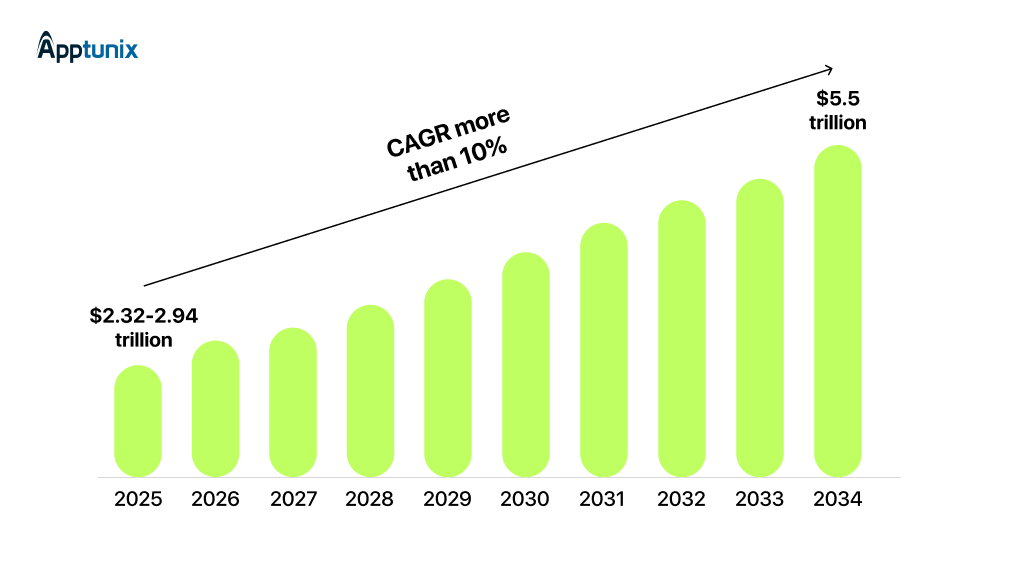
Timing matters more than ideas. And right now? The timing for insurance software development couldn’t be better. The global health insurance market was valued at approximately USD 2.32-2.94 trillion in 2025, and it is projected to grow and reach over USD 5.5 trillion by 2034 with a CAGR exceeding 10%.
Meanwhile, your average insurance customer still logs into three different websites to manage their policies, claims, and provider networks. And, now, this is an opportunity.
Here’s what’s shifted in the last 24 months:
In simple terms: the winners aren’t just building apps, they’re building ecosystems.
Now, let’s flip the perspective because market size does not equal opportunity. Why do users actually want a health insurance app?
Because they’re tired of:
What they want is simple transparency, speed, and control, and if your app delivers these three things, you’re already ahead of 80% of the market.
The opportunity is clear. But before you jump in, let’s address the most practical question founders ask early on: what does it actually cost to build this?
Let’s address the question every founder eventually asks: how much does it cost to build a health insurance app? Here’s a realistic breakdown:
But here’s the truth most blogs won’t tell you: The real cost isn’t development, it’s everything around it. These numbers give you a rough idea. But in reality, your final cost depends heavily on a few key decisions you make early on.

Cost structures in this space are often benchmarked against complex healthcare platforms. To better understand realistic development costs, it helps to look at examples like the cost to build a healthcare app like Patient Access, where enterprise-level features significantly impact overall budgeting.
Key factors include:
Working with an experienced insurance app development company can save you from expensive rework later. The next step is deciding what you’re actually building, because features are where your product truly starts taking shape.
This is where your product actually wins or loses. Let’s talk about the essential features of your app from both the user and business perspectives:
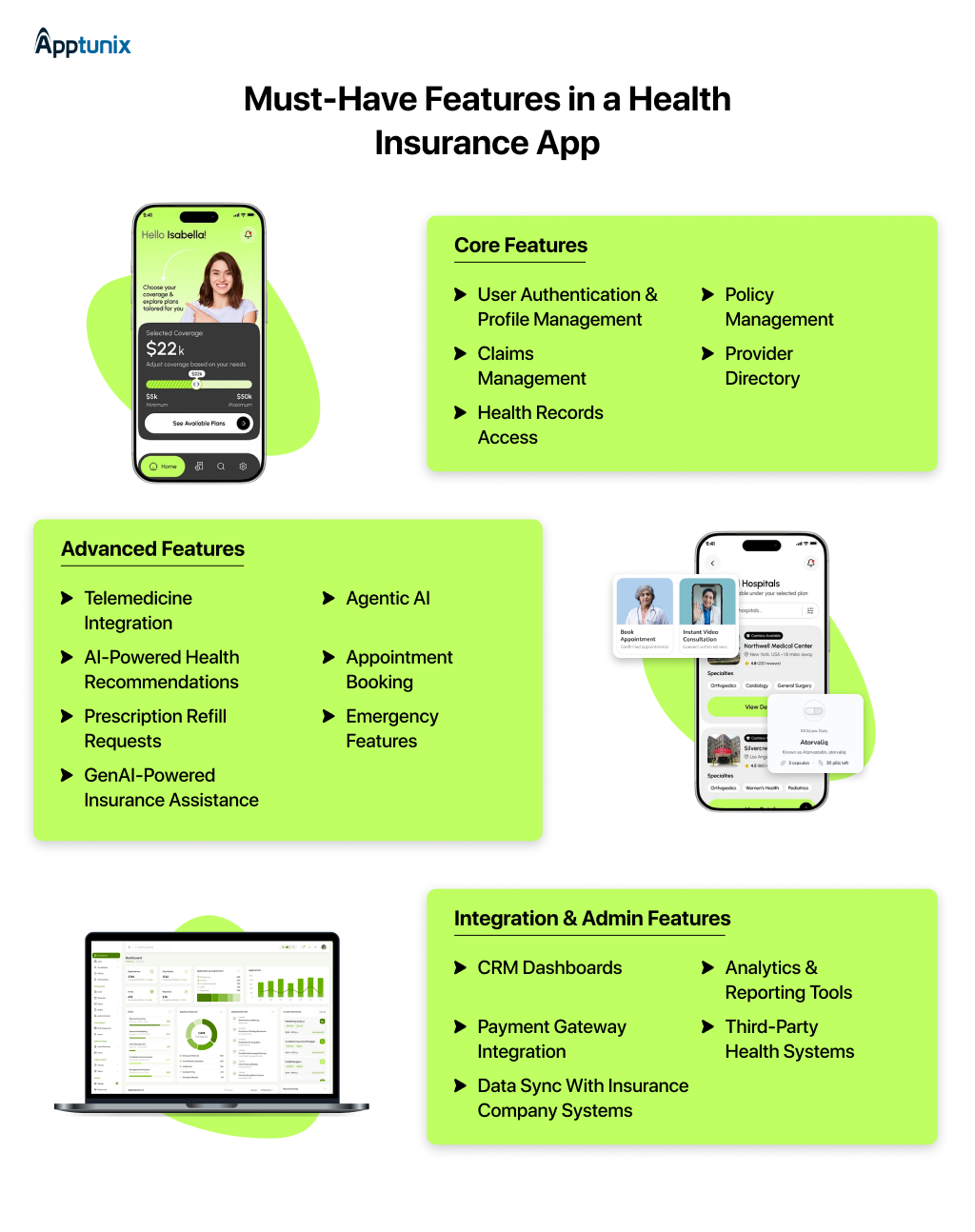
1: Core FeaturesLet’s break down the core features that form the foundation of a reliable health insurance app.
-> User Authentication & Profile ManagementThis seems basic, but it’s actually not. In healthcare, authentication is where security actually matters. Multi-factor authentication, biometric authentication (face ID, fingerprint), is what users consider the bare minimum.
You also need to handle profile data carefully. Emergency contacts, family member access, and dependent management should be kept confidential. Some people manage insurance for parents, spouses, and kids. Build that flexibility in.
-> Policy ManagementYour app should make policies understandable. It must clearly show:
Clarity here reduces support tickets massively. Use plain language and show a single coverage overview that answers these three questions users actually have:
One feature that drives a lot of engagement is policy comparison. Users love seeing these types of insights.
-> Claims ManagementThis is the heart of your app. Show exactly where a claim is in the process. Real-time notifications drive massive engagement. It is also important to tell users why a claim was denied, not just that it was. This prevents about 60% of follow-up calls.
-> Provider DirectoryUsers need to search for doctors, hospitals, and specialists and see: name, location, specialties, whether they’re in-network, ratings and reviews, appointment availability (if you can integrate with booking systems).
Location-based search is critical. Users often search for terms like “orthopedist near me” or “hospital within 10 miles.” You could also add a premium feature of telehealth availability filters and show who offers video visits.
-> Health Records AccessUsers want to see their medical history, prescriptions, lab results, and vaccination records all in one place. This requires integration with your state’s health information exchange (HIE) or direct connections with healthcare providers. It’s complex, but it’s what differentiates a mediocre insurance app from one that people actually open every week.
2: Advanced FeaturesIf you want to stand out, these are what turn casual users into daily users:
These features define modern healthcare app development services.
3: Integration & Admin FeaturesYour backend is just as important as your frontend.
With features in place, the next logical step is execution. How do you actually get a health insurance app built without wasting time or money? Let’s get into that
Let’s break this into actual phases to give you a realistic timeline:
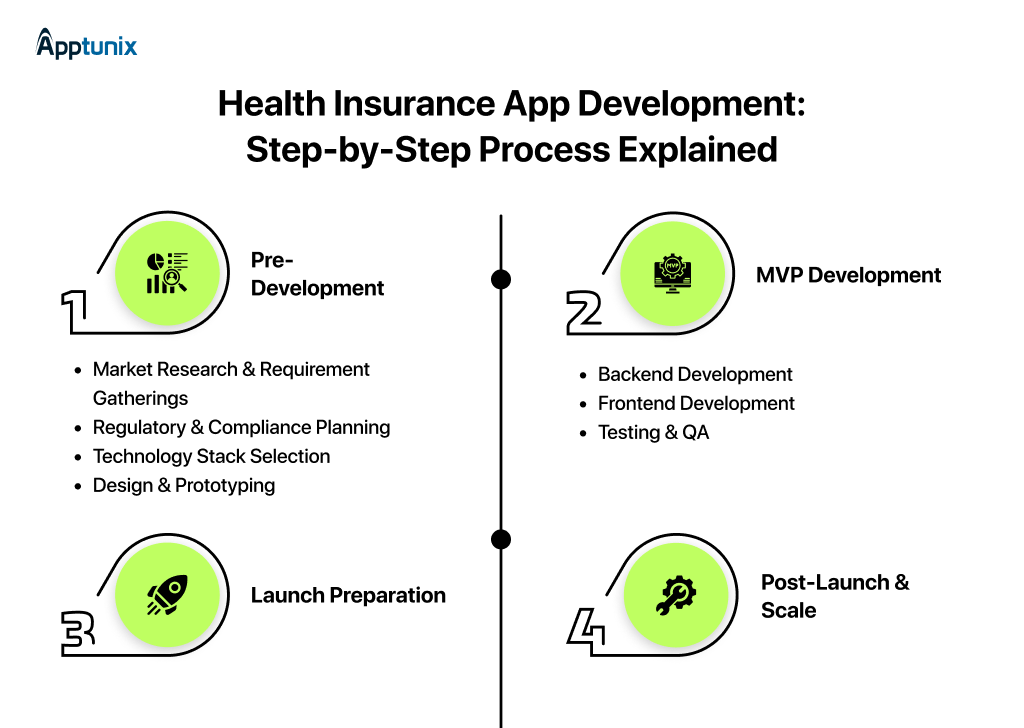
1: Pre-development (4-6 weeks)This is where most founders tend
-> Market Research and Requirements GatheringSpend around 2 weeks talking to actual insurance customers. We are talking about real people currently using health insurance. Figure out where they are facing problems, what features they use the most, and how they currently find providers.
Most new founders overestimate the importance of social features and underestimate transparency. Interview at least 20 users and get into the specifics to define your core features.
-> Regulatory & Compliance PlanningInsurance is heavily regulated. Make sure to hire a healthcare compliance consultant for 1-2 weeks for due diligence. Have them assess:
-> Technology Stack SelectionChoose wisely:
Backend: Node.js with Express (fast iteration), Python with Django (good for data processing), or Java (if you need the enterprise credibility). Pick based on your team’s strength.
Frontend: React Native or Flutter for mobile. Native Swift/Kotlin if you need maximum performance.
Database: PostgreSQL for structured insurance data. Add Redis for caching and Elasticsearch if you’re doing large-scale claims search.
Cloud: AWS or Azure if insurers insist on specific compliance.
Infrastructure as Code: Docker and Kubernetes are good options.
-> Design and PrototypingSpend some time creating high-fidelity prototypes. Use Figma and get sign-off from your insurance partner early. Show those prototypes to actual users. You’ll catch major assumptions that would have cost a lot to fix in code.
Focus on three core flows: login, checking coverage, and submitting a claim. It is important that you get these right before you write even a single line of code. This saves months of rework later.
2: MVP Development (2-3 months)This is where you actually start building something after all that planning.
-> Backend DevelopmentThe main concern is to build something maintainable and scalable. It is not the time to cut corners on code quality. Follow the steps below:
-> Frontend DevelopmentGet the core flows like signup experience, policy view, claims submission, etc., perfect. These are the functions that are visible to users. Include offline functionality from day one because your users should not have to lose access to their policy info if they lose signal.
-> Testing & QATesting and QA take longer in healthcare than in normal software. So, budget 25-30% of dev time here. Make sure to perform:
Never rush this phase because if you skip any of these, you’ll have to fix a ton of bugs later after launch.
3: Launch Preparation (2-4 weeks)This stage required final bug fixes and app store submissions. iOS takes 24-48 hours, typically, and Android, on the other hand, takes a few hours. Create help documentation and set up customer support infrastructure.
This sounds quick, but it takes longer because app stores tend to reject health apps at a higher rate. You might need 2-3 review cycles before your app can be downloaded by users from the app stores.
4: Post-Launch & ScaleThis is where real work begins. Monitor performance obsessively for the first few weeks. Users will find bugs you never even imagined. Set up real-time alerting for failures. Have an on-call rotation and try responding to issues within hours, not days.
Track management metrics religiously, like daily active users, session length, claims submission rate, and support ticket volume. You are looking for patterns that will tell you what to build next.
By now, you have a clear picture of the build process. But behind all of this sits a technical foundation that determines whether your app succeeds or struggles.
Before you start building, it’s critical to understand the technical foundations that will determine your app’s performance, security, and scalability.
1: ScalabilityYour app should handle growth without breaking.
Because success should not crash your app, your app should have the capacity to handle 10x users tomorrow.
2: SecurityWhen you are handling health data, this is non-negotiable. The fines for breaches are enormous. Plus, the reputational damage is worse.
3: Integration ChallengesInsurance systems are often outdated. It is the biggest technical headache to connect to insurance company systems. Most insurers have APIs that were built a decade ago. They might have rate limits that don’t match your needs.
Plan for integration taking 2x longer than you think. Build retry logic, fallback mechanisms, and graceful degradation. If the insurance API is down, your app shouldn’t crash; it should just show cached data with a notice that live data is unavailable.
A skilled insurance app development company can help bridge this gap.
This is the question every founder asks: How do you make money with a health insurance app?
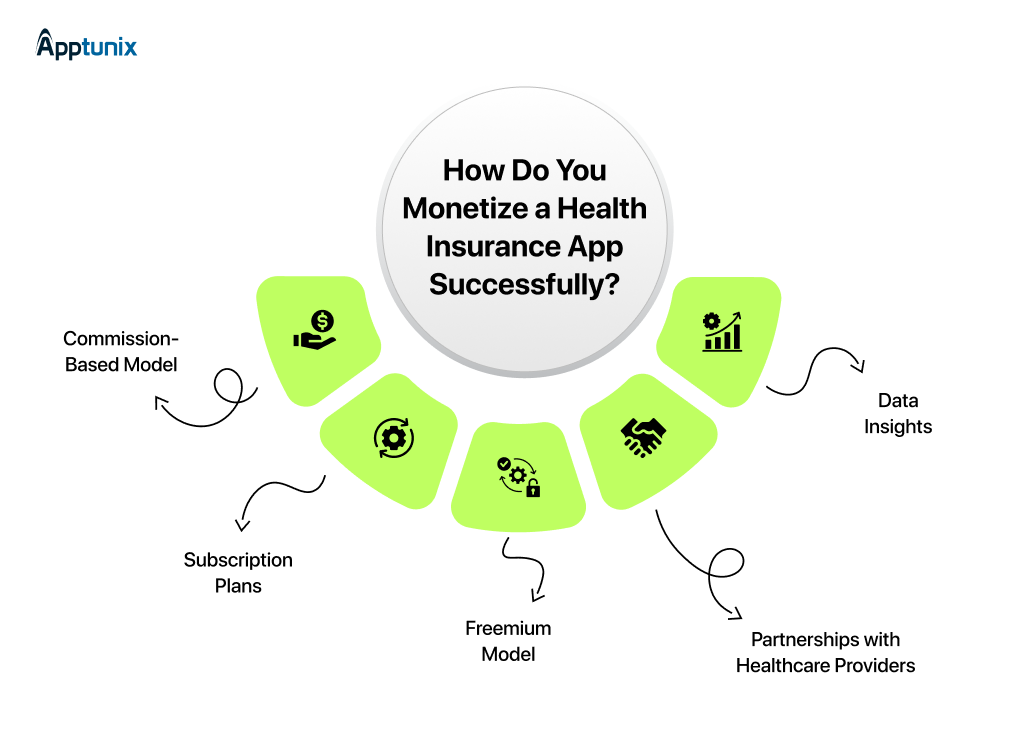
1: Commission-Based Model (on policies sold)This is the most common and straightforward approach. Every time a user purchases or renews a policy through your app, you earn a commission from the insurer. The key here is volume; your UX needs to be smooth enough to drive conversions.
2: Subscription Plans (premium features)Introduce paid tiers like priority claim processing, support, or access to telemedicine. This creates recurring revenue while improving user retention.
3: Freemium ModelLet users access basic features for free (policy tracking, claims status), while charging for advanced features like AI-based health insights or personalized policy recommendations. This lowers your entry barrier and builds a large user base quickly.
4: Partnerships with Healthcare ProvidersYou can partner with hospitals, clinics, and diagnostic centers to offer services through your app and earn referral fees or revenue shares. This also strengthens your ecosystem and increases user engagement.
5: Data InsightsWith proper compliance and privacy safeguards, user data can provide valuable insights to insurers and healthcare providers. This can open up an additional B2B revenue stream, but only if handled ethically.
Of course, no matter how solid your plan is, you’ll run into challenges. The key is knowing what to expect and how to handle it before it slows you down.
1: Regulatory ComplianceChallenge: Complex legal requirements because HIPAA is complex, and state insurance regulations vary.
Solution: Work with compliance experts early and hire a healthcare attorney or compliance consultant from day one. It sounds expensive, but a HIPAA breach can burn a hole in your pocket in fines and remediation.
2: Data PrivacyChallenge: You are handling sensitive health data, and people will absolutely sue if you lose it. Plus, the regulatory authorities will not only fine you but might also ban you.
Solution: Offer end-to-end encryption, collect only necessary data, perform regular backups, and conduct disaster recovery tests quarterly.
3: User AdoptionChallenge: Building your app does not guarantee users will come. Users resist switching due to the industry’s sensitivity.
Solution: Insurance adoption is often top-down. Get the insurance company to promote your app to their members. Make the initial setup frictionless and launch with one strong use case rather than trying to do everything.
4: Legacy System IntegrationChallenge: Insurance companies run on old mainframe systems. Connecting them to your modern app is no less than a nightmare.
Solution: Use middleware platforms (like Mulesoft or custom API layers) to translate between old and new systems. Don’t try to connect directly. Budget heavily for discovery, testing, and integration QA.
Building a health insurance app isn’t easy. But it’s genuinely meaningful work. You’re reducing friction, improving health outcomes, and removing moments of stress from people’s lives.
The market and the opportunity are real. The technical challenges are solvable. Executing your plan with the right partner and with the right strategy, you can build a successful health insurance app. That’s why many founders choose to work with an experienced health insurance app development company that understands both the technical and business complexities of this space.
This is where Apptunix comes in.
With over 13+ years of experience, Apptunix has delivered 3000+ projects for clients across 50+ countries, building scalable, secure, and user-centric digital products. Our expertise in healthcare app development services allows founders to move faster without getting stuck in avoidable roadblocks.
Schedule a 30-minute call with our team. Tell us about your idea, your vision, and your concerns. We’ll give you a reality check on your timeline and budget and an honest assessment of whether we’re the right fit for your project.
Q 1.How much does it cost to build a health insurance app?
The cost typically ranges from $40,000 to $300,000+, depending on complexity, features, integrations, and compliance requirements. Basic apps cost less, while advanced apps with AI, telemedicine, and real-time integrations are significantly more expensive.
Q 2.How long does it take to develop a health insurance mobile app?
A basic app can take 3-6 months, while a fully-featured, enterprise-level app may take 9-12+ months due to integrations, compliance, and testing requirements.
Q 3.Why is health insurance app development in high demand?
The demand is driven by:
Q 4.Should startups build or outsource health insurance app development?
Most startups choose to outsource to an insurance app development company because:
Building in-house is possible, but requires significant expertise and cost. It is better to outsource if you are looking for custom health insurance app development services.
Q 5.What is the future of health insurance mobile app development?
The future is driven by:
Apps are evolving from tools into full healthcare platforms.
Q 6.What is the difference between a health insurance app and a healthcare app?
A health insurance app focuses on policies, claims, and coverage management, while a healthcare app focuses on medical services like consultations, fitness tracking, or diagnostics. However, modern apps often combine both to create a complete ecosystem.
(1 ratings, average: 5.00 out of 5)
Get the weekly updates on the newest brand stories, business models and technology right in your inbox.
Pallavi Nautiyal is a seasoned Tech Consultant at Apptunix, specializing in the intersection of global finance and decentralized technology. With a deep-rooted expertise in banking infrastructure, digital payment gateways, and Web3 ecosystems, she guides businesses through the complexities of modern financial engineering. Pallavi is recognized for her ability to architect secure, compliant, and scalable solutions—ranging from smart contracts and crypto-wallets to robust digital banking platforms. Her strategic insights help organizations navigate regulatory landscapes while leveraging the power of Blockchain to ensure transparency and seamless user experiences in every transaction.
32 Views 12 min August 27, 2026
177 Views 12 min June 24, 2026

197 Views 12 min June 22, 2026
Book your consultation with us.
Book your consultation with us.


One Central, The offices 3, Level 3, DWTC, Sheikh Zayed Road, Dubai
+971 50 782 1690