10 Best Construction Project Management Software & How To Build Your Own?
27 Views 10 min August 27, 2026

Reena Bhagat, the CTO and Head of AI at Apptunix, is a seasoned technology strategist with a deep-rooted expertise in emerging technologies. With a focus on AI/ML integration, product engineering, cloud management, she leads the technical vision for high-performance SaaS infrastructures. Reena is recognized for building secure, scalable, and decentralized systems that solve real-world complexities. Her passion lies in leveraging data science and future-tech to create resilient digital products, making her a trusted authority for organizations looking to lead in the age of intelligent automation.
Cybersecurity software development has shifted from an IT line item to a business survival decision. A decade ago, security was something you bought; today, it is something you engineer.
The companies making headlines after a breach rarely lacked security tools. Many had firewalls, monitoring systems, and security policies in place. What they lacked was a security foundation built for modern threats.
That shift is reshaping how organizations approach cybersecurity software development.
By 2026, all modern enterprises will function within a cloud ecosystem, APIs, mobile applications, remote working environments, and AI-driven tools. Each new connectivity point creates additional access for automated attacker scripts. Consequently, many organizations are moving away from generic, mass-market tools. They choose to build cybersecurity software customized entirely around their private data infrastructure.
IBM security data underscores this structural pivot. The average U.S. data breach cost has spiked to a record of $10.22 million. Worse, containing a network compromise takes an average of 241 days. Off-the-shelf software simply inherits third-party supply chain vulnerabilities that compromise your long-term valuation.
Mitigating this risk profile requires partnering with a vetted, enterprise-grade cybersecurity software development company. You need an engineering team that builds memory-safe code and zero-trust data access controls.
Let’s dissect the exact roadmap senior architects use to construct resilient, production-ready security software.
Cybersecurity software development is the process of engineering software with built-in defensive protocols from the first line of code. It serves as a proactive risk-engineering system. This system shields application layers, data pipelines, and cloud infrastructures from malicious exploitation. It establishes a structural trust mechanism that prevents automated exploitation.
This engineering standard directly protects company valuations. It stabilizes user acquisition and prevents data breaches that kill market trust. It also ensures ironclad compliance with global frameworks like GDPR, HIPAA, or SOC 2.

Most enterprises do not invest in cybersecurity because they expect an attack. They invest because they cannot afford the consequences of not doing so.
A single breach can halt operations, expose customer data, damage reputation, and delay growth plans.
That is why organizations are prioritizing custom cybersecurity software development. They need security systems built around their infrastructure, risks, and compliance requirements.
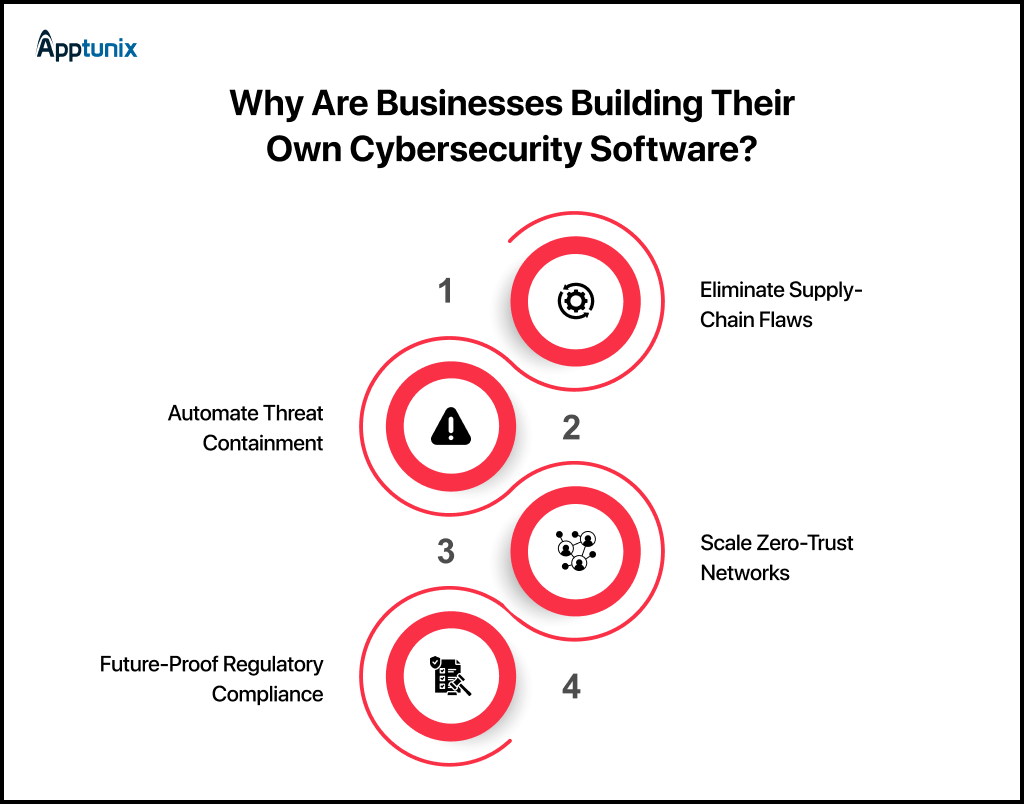
The top 4 Key benefits include:
1. Eliminate Supply-Chain FlawsMost business hacks are caused by weak third-party applications. External access threats are eliminated with custom cybersecurity software. It guarantees that your core product logic is entirely owned and monitored by your internal engineering team.
2. Automate Threat ContainmentModern attacks move too fast for manual intervention. Custom cybersecurity automation software intercepts threats instantly. It isolates compromised database segments the moment anomalous behavior occurs, preventing widespread lateral movement.
3. Scale Zero-Trust NetworksOff-the-shelf platforms have trouble capturing complex and unique user footprints. Enterprises get bespoke cybersecurity solutions with the exact micro-segmentation they need. These always check all identities, data packets, and API calls throughout your network.
4. Future-Proof Regulatory ComplianceRegulatory mandates like GDPR, HIPAA, and SOC 2 require distinct auditing workflows. Custom cybersecurity platforms build automated reporting pipelines directly into your infrastructure. This eliminates manual prep work and simplifies your annual audit processes.
If you are interested in how cybersecurity can help to secure the fintech industry, explore: Cybersecurity in Fintech
Capital allocation makes sense once you understand the ROI. Translating that strategy into working code requires a highly disciplined execution framework.
Many businesses focus on features first and security later. That approach often creates expensive problems. Successful cybersecurity software development starts with risk, architecture, and long-term resilience.
Here is the cybersecurity software development process followed by leading security product teams in 2026.
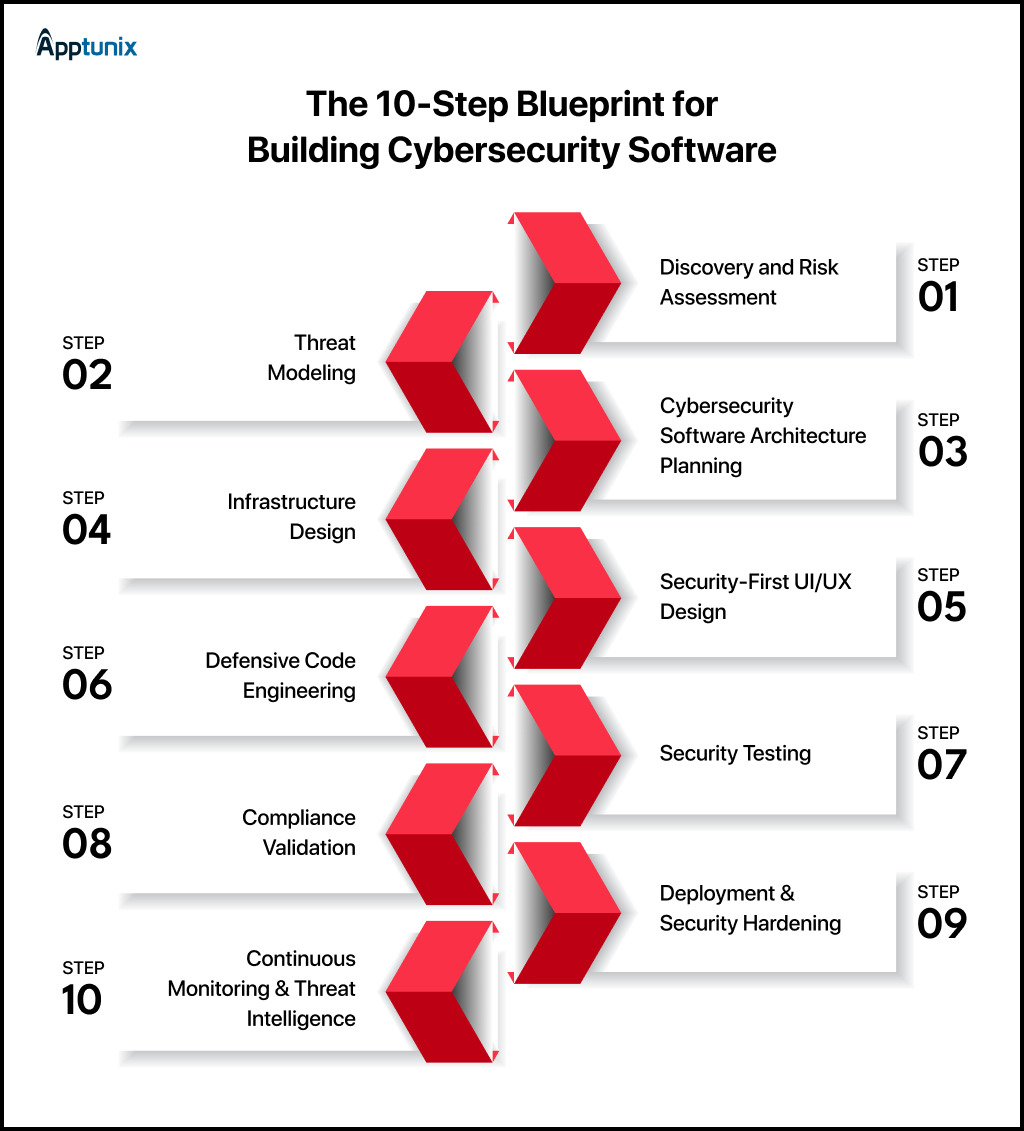
Step 1: Discovery and Risk AssessmentEvery successful project starts with understanding what needs protection.
Teams identify critical assets, user roles, compliance requirements, and potential attack surfaces. This stage also evaluates business risks, operational challenges, and security objectives.
At this stage, key questions include:
The goal is to align the software with actual business risks rather than assumptions. Without this phase, even technically strong solutions can fail to address real-world security challenges.
Step 2: Threat ModelingBefore designing infrastructure, engineers conduct a rigorous threat modeling process to anticipate potential attack vectors. Using structural frameworks like STRIDE, development teams map the application’s complete attack surface. This step identifies trust boundaries, analyzes data flows, and uncovers implicit trust assumptions early.
Step 3: Cybersecurity Software Architecture PlanningThis phase translates threat models into concrete engineering rules. System architects design the primary system defenses, establishing a strict Zero Trust security platform model. Rather than relying on network perimeter walls, the system continuously verifies every single user, device, and internal API interaction.
Step 4: Infrastructure DesignSecurity software must operate reliably under heavy workloads.
Infrastructure design focuses on creating a secure environment capable of handling large volumes of security events and data.
This stage covers:
This is especially important for cloud security software and large-scale cybersecurity platforms processing millions of daily events.
A well-designed infrastructure improves resilience and operational efficiency.
Step 5: Security-First UI/UX DesignSecurity should never create friction for legitimate users.
The interface must balance protection with usability. Features like multi-factor authentication, permission controls, and security alerts should feel intuitive. Strong adoption often depends on how simple security workflows appear to end users.
Step 6: Defensive Code EngineeringWith the architecture set, engineering teams begin writing the core application logic. Developers use memory-safe programming languages like Rust or Go for critical modules to eliminate common vulnerabilities. Throughout this phase, the team utilizes custom cybersecurity software architecture standards to enforce strict input validation.
In 2026, generative AI cybersecurity risks will be factored in at this stage too. Development teams harden systems against AI-generated exploit patterns and LLM-assisted injection attacks. AI in cybersecurity software development means defending against AI-powered threats, not just leveraging AI for speed.
Step 7: Security TestingSecurity software must withstand real-world attacks. Testing validates whether the platform performs as expected under hostile conditions.
This phase typically includes:
For products handling sensitive enterprise data, testing often becomes one of the longest development phases.
Step 8: Compliance ValidationBefore launching into production, the fully assembled application undergoes independent verification to ensure it meets all applicable regulatory requirements. Compliance specialists run automated audits against controls derived from NIST SP 800-218 or GDPR. This process generates tamper-evident audit trails and cryptographic proof of code validity.
Step 9: Deployment and Security HardeningAfter testing, the platform moves into production. Deployment includes infrastructure hardening, encryption validation, access control verification, backup configuration, and monitoring setup.
This stage ensures the software remains secure under real-world conditions.
Step 10: Continuous Monitoring and Threat IntelligenceCybersecurity software is never truly finished. Threats change every day, and new vulnerabilities are discovered regularly.
The need to constantly keep an eye on system activity, analyse security events, and adjust defenses is a constant requirement for organisations. Modern solutions integrate cyber threat detection software, AI security monitoring, and AI threat intelligence to spot suspicious behavior in less time. Agentic AI cybersecurity systems go further. They investigate alerts and execute containment actions autonomously.
The most effective platforms treat security as an ongoing process, not a one-time project.
Many enterprise security environments are fragmented by disconnected tools. If you’re exploring how to build cybersecurity software, these essential capabilities should be embedded into the codebase from day one.
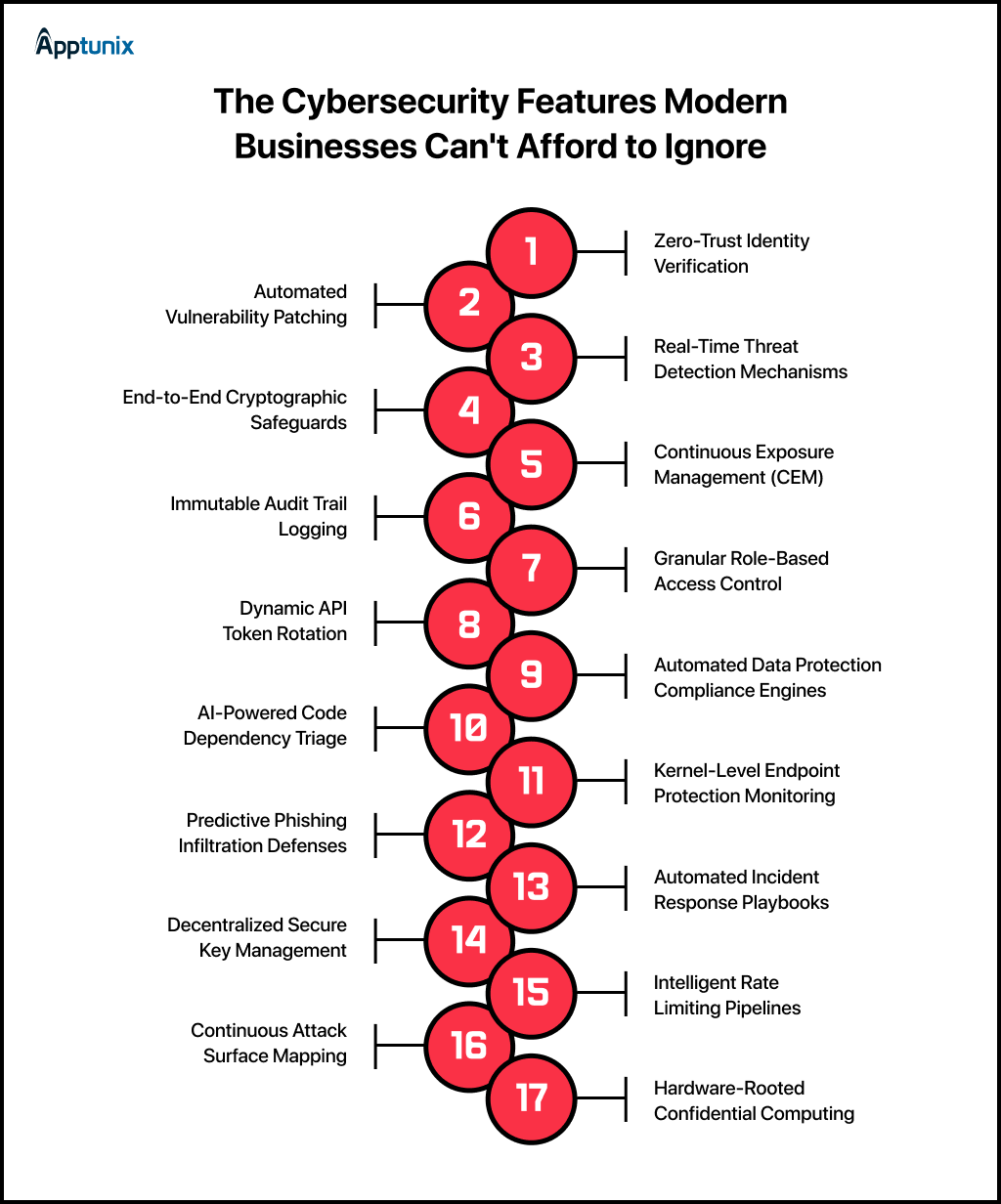
1. Zero-Trust Identity VerificationContinuous authentication blocks unauthorized user access across every application layer. This micro-segmentation system shields proprietary databases and eliminates perimeter vulnerabilities completely. It stops lateral threat movement across your network.
2. Automated Vulnerability PatchingThis engine updates outdated components inside live production environments automatically. It minimizes vulnerability exposure windows from weeks to seconds. This workflow will protect your software from zero-day exploit cycles.
3. Real-Time Threat Detection MechanismsMachine learning models analyze live system telemetry to catch subtle behavioral anomalies immediately. The platform intercepts active credential theft and insider threats before data extraction begins.
4. End-to-End Cryptographic SafeguardsSensitive data assets are secured with advanced encryption algorithms while at rest or in transit within databases. This safeguards enterprise data against hardware interception and unauthorized access attempts to servers.
5. Continuous Exposure Management (CEM)This module proactively simulates complex multi-stage attack paths to discover hidden operational vulnerabilities. It prioritizes remediation based on real-world exploitability, keeping defenses ahead of automated attacker scans.
6. Immutable Audit Trail LoggingAll changes to the system are recorded on a distributed ledger that is tamper-proof. Structural logging provides a reliable digital forensics layer for internal investigations and external law enforcement.
7. Granular Role-Based Access ControlInternal users’ access to the system is restricted in highly specific ways, according to the absolute strict principle of least privilege. This safeguard minimizes human error and stops disgruntled employees from damaging systems.
8. Dynamic API Token RotationShort-lived credentials are issued for each internal microservice connection via automated identity systems. This protocol will prevent malicious attackers from intercepting long-term access tokens and exploiting web application backdoors.
9. Automated Data Protection Compliance EnginesContinuous infrastructure scanning tracks adherence to global mandates like GDPR, HIPAA, and SOC 2. The module generates automated audit evidence, eliminating manual compliance reporting costs.
10. AI-Powered Code Dependency TriageOpen-source libraries are automatically scanned for vulnerabilities in secure development pipelines during compile times. This mechanism is designed to prevent infected third-party code packages from infecting the core application layer.
11. Kernel-Level Endpoint Protection MonitoringLightweight background agents monitor connected device events to intercept malicious software actions directly. This module safeguards your remote workforce from targeted phishing and firmware tampering attacks.
12. Predictive Phishing Infiltration DefensesIntelligent email filtering systems analyze communication patterns to catch complex social engineering campaigns early. This defensive feature shields corporate bank accounts and administrative credentials from theft.
13. Automated Incident Response PlaybooksProgrammed containment workflows isolate compromised cloud networks within seconds of an alert. This fast response preserves operational uptime and eliminates manual intervention delays entirely.
14. Decentralized Secure Key ManagementCryptographic secrets remain isolated inside dedicated hardware modules away from application source code. This architecture prevents severe source code leaks from exposing production infrastructure passwords.
15. Intelligent Rate Limiting PipelinesAdvanced traffic filters drop malicious high-volume request streams targeting your public web infrastructure. This operational layer preserves server availability and lowers cloud hosting costs during active attacks.
16. Continuous Attack Surface MappingDiscovery tools catalog public-facing assets to find forgotten staging environments and open cloud ports. This feature removes unmonitored entry points during comprehensive cybersecurity software development.
17. Hardware-Rooted Confidential ComputingSecure enclaves encrypt highly sensitive enterprise metrics while actively being processed inside cloud memory. This hardware-isolated protection prevents privileged system operators or infected host kernels from viewing raw processing data.
Pro Tip: Don’t try to ship all fifteen features of cybersecurity software at launch. Prioritize the features that map to the specific risks you identified in Step 1, then layer the rest in over subsequent releases.
The effectiveness of AI-powered cybersecurity software depends on its underlying technology stack. Organizations that want to build cybersecurity software must carefully select technologies for data processing, threat detection, automation, and security operations. Each layer directly impacts performance, scalability, and long-term resilience.
The ideal tech stack balances security and performance. The next critical metric is aligning that architecture with your realistic capital expenditures.
When exploring custom cybersecurity software development, you need clear budget expectations. In 2026, the cost to develop cybersecurity software generally spans from $40,000 to $300,000+.
Where you land depends entirely on the product scope. A lightweight security software development project sits at the lower end. Conversely, AI-powered cybersecurity software development requires a remarkably higher investment.
1. Architectural ComplexityBasic data logging requires fewer engineering hours. Building a dynamic Zero Trust security platform spikes your development budget.
2. AI Engine IntegrationStandard signature matching is highly affordable. Integrating an advanced AI threat detection software module increases engineering costs.
3. Compliance Engineering OverheadBaking in GDPR, HIPAA, or SOC 2 compliance requires specialized audits. This structural verification adds to total expenses.
4. Development Team SelectionChoosing local firms yields peak hourly rates. Partnering with an offshore cybersecurity application development team optimizes your capital.

Building defensive software requires more than hiring general application developers. It demands an engineering partner that treats security as a core architectural constraint. Apptunix brings over 13+ years of product engineering experience to your project. We help enterprises transform complex security requirements into resilient production systems.
1. Tailored Custom DevelopmentWe engineer your entire codebase completely from scratch. This custom approach ensures absolute software ownership and eliminates third-party supply chain risks.
2. Enterprise Architecture ExpertiseOur teams build enterprise cybersecurity software using micro-segmented systems that follow rigid global standards. We ensure your platforms easily satisfy ISO 27001, SOC 2, and GDPR.
3. Advanced AI IntegrationOur AI integration services help organizations strengthen security with lightweight machine learning models. These predictive algorithms analyze live telemetry to identify and block anomalies instantly.
4. Cloud-Native EngineeringWe deploy secure infrastructure utilizing declarative Infrastructure as Code templates. This specialized containerization completely isolates sensitive enterprise cloud workloads.
5. Continuous DevSecOps ApproachWe inject automated vulnerability testing scanners directly into your CI/CD pipelines. This workflow neutralizes logical flaws before software hits production.
6. End-to-End Operational SupportOur technical partnership extends well past your product launch. We provide ongoing system monitoring, patch management, and regular penetration testing.

Q 1.How long does it take to build cybersecurity software?
The development timeline depends on complexity, features, integrations, and compliance requirements. Basic cybersecurity software development typically takes 3–4 months. Mid-level platforms require 4–8 months. Enterprise solutions with AI, SIEM, XDR, or automation capabilities can take 8–12 months or longer to build and deploy successfully.
Q 2.How much does cybersecurity software development cost in 2026?
The cost of cybersecurity software development generally ranges from $40,000 to $300,000+. Pricing depends on platform complexity, AI capabilities, compliance requirements, infrastructure, integrations, and security testing.
Q 3.Should I build custom software or buy an off-the-shelf platform?
The right choice depends on your business goals. Off-the-shelf software offers faster deployment and lower upfront costs. Custom cybersecurity software provides greater flexibility, stronger integrations, better scalability, and enhanced control over security policies. Businesses with unique workflows, compliance obligations, or specialized security requirements often benefit more from a custom-built solution.
Q 4.What compliance standards should cybersecurity software support for enterprise use?
The required compliance standards depend on your industry and operating regions. Most enterprise cybersecurity platforms should support:
Q 5.How is AI used in cybersecurity software development and threat detection?
AI helps cybersecurity platforms detect threats faster and reduce manual workloads. Modern solutions use AI for anomaly detection, threat intelligence analysis, automated incident response, security monitoring, and predictive risk assessment. AI improves accuracy, accelerates investigations, and helps security teams respond more effectively to emerging threats.
Q 6.How do I choose the right cybersecurity software development company for my project?
Look past general software agencies and evaluate specific security credentials:
(6 ratings, average: 4.33 out of 5)
Get the weekly updates on the newest brand stories, business models and technology right in your inbox.
Reena Bhagat, the CTO and Head of AI at Apptunix, is a seasoned technology strategist with a deep-rooted expertise in emerging technologies. With a focus on AI/ML integration, product engineering, cloud management, she leads the technical vision for high-performance SaaS infrastructures. Reena is recognized for building secure, scalable, and decentralized systems that solve real-world complexities. Her passion lies in leveraging data science and future-tech to create resilient digital products, making her a trusted authority for organizations looking to lead in the age of intelligent automation.
27 Views 10 min August 27, 2026
169 Views 10 min June 24, 2026

186 Views 10 min June 22, 2026
Book your consultation with us.
Book your consultation with us.


One Central, The offices 3, Level 3, DWTC, Sheikh Zayed Road, Dubai
+971 50 782 1690