Operations Management Software Development: A Complete 2026 Guide

With over 20+ years of experience in driving global digital initiatives, Nikhil Bansal is the CEO & Director of Apptunix. He specializes in orchestrating large-scale digital transformations, enterprise-grade software solutions, and high-level business strategies that redefine industry standards. Nikhil is known for his ability to bridge the gap between complex business challenges and innovative technology, helping Fortune 500 companies and startups alike achieve sustainable growth. A visionary leader, he empowers enterprises to navigate the digital landscape with agile, ROI-focused models and future-ready business strategies.
155 Views| 15 mins | June 16, 2026
Read Time: 15 mins | June 16, 2026
Operations Management Software Development

Quick Summary:

  • The Market Shift: Enterprises are abandoning fragmented, off-the-shelf operations tools. Rising SaaS subscription fees and data silos are eroding margins, pushing market leaders toward proprietary operational ownership to protect their data and workflows.

  • The Timeline & Investment: A baseline MVP typically requires $40,000 to $80,000 and a 3-to-6 month runway, while a robust, enterprise-grade ecosystem can exceed $300,000+. Final costs are driven heavily by feature complexity, compliance mandates, and geographic team alignment.

  • The Architecture Pitfall: While sleek front-end dashboards drive initial internal adoption, 90% of custom operations platforms fail on “Day 1” due to poor database architecture that chokes under real-time data synchronization and heavy concurrent user workflows.

  • Partner Selection (Green vs. Red Flags): Success hinges on your development partner. Prioritize vendors who insist on rigorous discovery phases and post-launch support. Run from agencies that skip requirements gathering, overlook QA, or lack deep workflow-automation experience.

  • The Bottom Line: With distributed teams and tightening compliance demands, custom automation is no longer a luxury—it is a competitive necessity for scaling efficiency and securing market dominance.

Are you dealing with team communication issues, missed deadlines, and unauthorized leaks of resources? Do you have to face difficulties in meeting customer demands manually? If it is, then Operations Management Software Development is all that they need.

This solution aids in coordinated task administration, workflow optimization, and smooth cross-teamwork. Businesses can invest in custom business operations management software to eliminate ineffectiveness, save their money, and have complete control over business operations. An operations management system can help you stay one step ahead of the competition, whether you’re trying to improve collaboration or streamline workflows. Fascinated?

Well, don’t just be fascinated but get the most out of operations management software by developing one for your enterprise. In this guide, we’ll go through every detail you need to have a really good grasp of as a way to build your business operations. Regardless of what your requirements are, benefits, tech stacks, features, or the development process, all of this will be addressed in this blog.

What is Operations Management Software?

Operations management software is not only the latest trend, but it’s also the foundation of a modern, efficient business. Think about every process in your company: assigning tasks, keeping track of stock, monitoring performance, managing supply chains, and effective communication between teams. Won’t it be great to have a single platform that brings in every operation under a single roof? Exactly, this is what business operations software does.

This is not about standard solutions, but about specific solutions in the area of operations management that can be modified to fit your specific business needs. From daily tasks to strategic decisions, software plays a crucial role in optimising business operations, even for a manufacturing giant facing production bottlenecks or a service provider dealing with customer inquiries.

In addition, features like cloud computing, easy sharing, and intelligent processes made possible by AI integration services may automate manual tasks, offer real-time insights, and guarantee that your entire company functions like a well-oiled machine.

Step-by-Step Custom Management Software Development Process

Creating a custom operations management software isn’t a universal procedure. Each business has its own processes, team composition, and compliance standards, and so should your development process. The eight-step process we, as a custom management software development company, use to provide enterprise operations management software that is purpose-built, scalable, and ready from day one is detailed below.
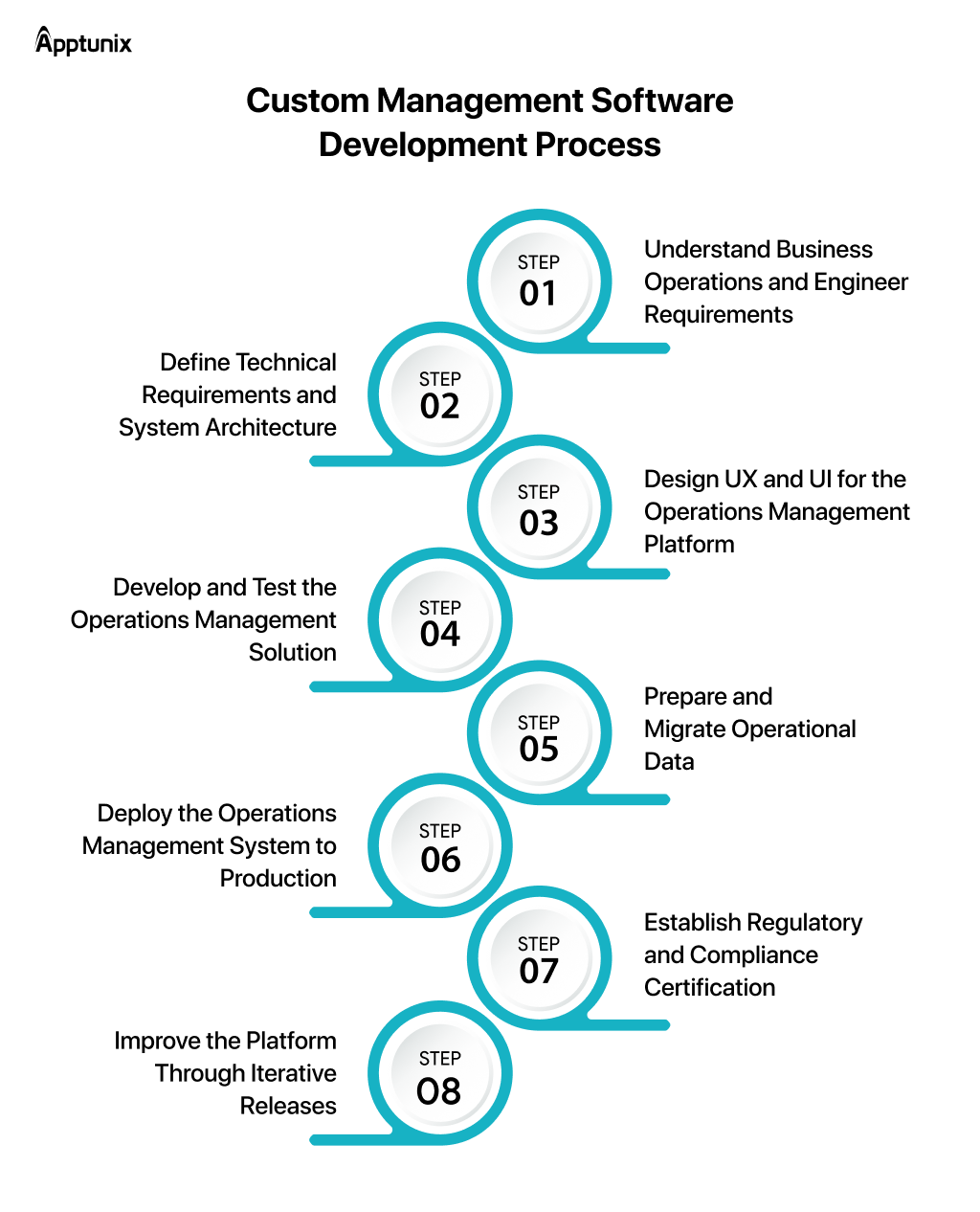
Custom Management Software Development Process

Step 1 Understand Business Operations and Engineer Requirements
Each project that is executed in operations management software is an undertaking that starts with assessing the current operational processes, tools, and workflows you are using. We explore the current process of task assignment, tracking, and reporting and determine where manual efforts, communication issues, and system restrictions are causing friction.

We identify the operational processes that your teams need to execute and the obstacles they’re facing in doing so, and determine if these are being hampered by your current IT environment. This involves assessing the available data and its flow between teams and identifying any areas where integration is causing delays or bottlenecks in delivering or making decisions.

Requirements for the business are collected using structured workshops with team leads, operations managers, and end users to get an understanding of the process flows and opportunities for improvement. We also synchronize this phase with your strategic goals: planned headcount growth, IT investment cycles, or longer-term operational goals—so that the software that we design is useful today and scalable for the future.

Last, but not least, potential risks unique to software operations management are addressed early, productivity issues when transitioning, complexity of data migration, training needs for remote teams, and any industry-specific regulations.

Step 2

Define Technical Requirements and System Architecture

After establishing the business requirements, we proceed to write detailed specifications for the operations management system. This includes establishing the architectural pattern (modular monolith, microservices, event-driven, or service-oriented architecture) depending on the size of the team, complexity of integration, and your expectations for scalability.

We build the integration architecture that dictates how your operations management platform is going to communicate with the tools you have in place: project management, HR, ERP, DevOps pipelines, and cloud infrastructure. The process comprises the mapping of data flow, identification of data that needs to be transformed, and choosing the right communication protocol for every connected system.

Security is built in at this point, not added on. The technical specification includes role-based access controls, data encryption standards, audit logging, and compliance hooks for regulatory frameworks like GDPR, HIPAA, or SOC 2.

At this point, a comprehensive QA strategy is also developed, including functional, integration, performance, and security testing, and testing is planned from the beginning of development.


Step 3

Design UX and UI for the Operations Management Platform

Operations management software, like any other software, does not work until it is used. That is the reason why UX design is considered as a strategic decision rather than a mere touch. Your target users: operations managers, team leaders, engineers, and executives – have a wide range of goals, mental models, and complexity tolerances, and our UX designers and business analysts work together to establish a thorough understanding of them.

Users’ journeys are documented throughout the platform, from job assignment to task evaluation on the dashboard, report production, and compliance documentation. A user-friendly information design is made to ensure that the end user can find the information with minimal effort.

Wireframes are generated to describe the content arrangement and key functions, which are subsequently combined to build interactive prototypes. Before any production line code is written, these prototypes are tested with real users from your organization. Once the usability has been validated, the UI designer transforms the wireframes into a full-color, smooth interface mockup and passes them on to the front-end developer for implementation.


Step 4

Develop and Test the Operations Management Solution

Development takes place on two parallel lanes. In the back end, we develop your operations management system’s server-side logic, API layer, and connectors, which include real-time data processing, workflow automation engines, and the reporting infrastructure. Front-end development converts validated UI designs into an entire functional and responsive client interface that interfaces effectively with the back end.

Testing is not only a final gate but is also run concurrently with development.

Functional testing ensures that each feature is functioning in the manner it is supposed to. Performance testing confirms that the system will operate in the intended manner under realistic loads without degradation. Security testing tests access controls, data handling, and API endpoints for vulnerabilities. Integration testing validates that the data will be transmitted and received properly between the operations management platform and other systems that are integrated.

User acceptance testing (UAT) is performed by real users from your organization prior to a feature being deemed complete. The system is deployed with comprehensive training materials in parallel to enable teams to get up and running smoothly from the first day of deployment.


Step 5

Prepare and Migrate Operational Data

The process of moving the historical operational data, task records, resource logs, performance data, and compliance documents demands careful preparation. First, we conduct an audit on your current data sources to detect any duplications, inconsistencies, or mismatches in the formats of the data that might affect the integrity of your data after moving it.

We establish the formats supported by the new data operations system and control all necessary conversions. The migration is a well-defined ETL (Extract, Transform, Load) process, where the data is extracted from the legacy data systems, transformed to the new schema, and loaded into the production system, with full validation at each step.

The ETL test is performed thoroughly and through automation if possible—ensuring that each record is delivered complete, correct, and unaltered. The passing over is without loss of operational history.


Step 6

Deploy the Operations Management System to Production

There’s a well-defined promotion ladder from staging to production. The operations management platform is initially launched in a staging environment that replicates the production environment, identifies any production-environment-specific issues, and validates integrations under realistic conditions prior to go-live.

After staging validation, the system goes to production and is integrated into your corporate infrastructure. There is coordination of deployment to ensure that live operations are not disrupted, as well as rollback procedures in place and anomalies monitored and detected shortly after deployment.


Step 7

Establish Regulatory and Compliance Certification

Compliance certification is not a sideline, but a primary step in construction when the operations management software is utilized to manage sensitive data for businesses, employee details, or in regulated industries. This can be GDPR, HIPAA, SOC 2, PCI DSS, or industry-specific regulations, depending on the sector.

Our compliance team documents everything that is developed at each stage of the development process – from architectural decisions to authentication and authorisation designs, through the handling of data, audit logging configurations and security controls. This documentation package shows that this software and the process used to develop it meet the requirements of the relevant standard.

Compliance work will be ongoing from initial deployment and can be continued and extended to the certification audit, penetration testing, and remediation process, all handled by our dedicated team.


Step 8

Improve the Platform Through Iterative Releases

Operations management software is not a one-and-done project. The platform needs to grow with the business, as team structures change and operational demands and requirements change. Post-launch development is an iterative release process that provides continual enhancements to capabilities while keeping the system stable.

Every release cycle is a well-defined process:

  • Understand the evolving needs of operational processes and scope for release.
  • Talk to business people and validate and prioritise the feature set.
  • Create and present interface prototypes of new modules.
  • Create and run internal experiments.
  • Develop to staging and execute integration/regression tests.
  • Do user acceptance testing with representatives from the operations team.
  • Review results, collect feedback, and outline features for the next Release Cycle.

Operations Management Software Must-Have Features

Here are some characteristics of Operations Management Software that are required for the following:
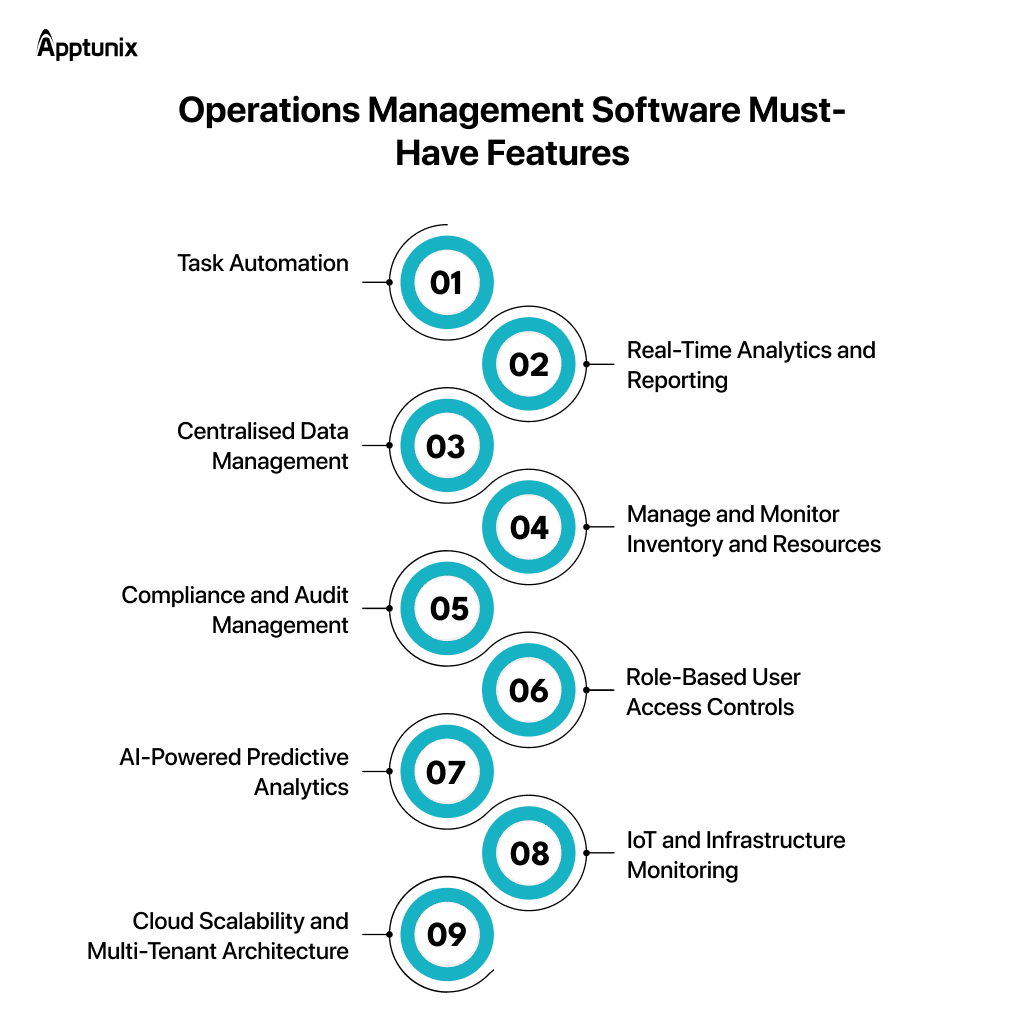
Operations Management Software Must-Have Features

1. Task Automation

Task automation eliminates repetitive and manual tasks that eat up developer and manager bandwidth. Assignments are automatically sent to the right people, approvals are generated and followed through, and escalation thresholds are set and reached, and statuses are updated automatically without the need for manual effort. Automating operations management in a software development firm is a wonderful situation with fewer dropped balls and faster cycle times at each sprint and release.

2. Real-Time Analytics and Reporting.

Bad decisions are based on obsolete information. Real-time analytics provide operations managers with an up-to-the-minute perspective of team speed, resource use, and the state of the project and budget. Custom dashboards display the metrics that are important to your particular business, and automated reporting means that you don’t have to do manual data collection to keep stakeholders informed. One of the most costly features to have in any enterprise operations management software platform.

3. Centralised Data Management

Complex software teams don’t have an option when it comes to a single source of truth. The data is managed centrally, so everyone who needs it has access, and the specifics of the project, the team’s abilities, etc are stored together in one location and accessible at the right time to the right people. This removes the version control hassle and information silos that hinder software development operations management teams at every point in delivery.

4. Manage and Monitor Inventory and Resources

Personnel, equipment, software licenses, and facilities are the resources utilized by software teams. An effective resource tracking system in your operations management system will give you insight into who is doing what, overburdened teams, and available capacity. Project planning in an accurate manner and the early identification of burnout risk is critical at a project level to prevent its effect on delivery.

5. Compliance and Audit Management

But operational risk management software for app development should be capable of more than just keeping track of tasks. It should have controls in place, be able to track and record compliance with industry regulations, and have an audit trail. The compliance management features integrated with the toolkit reduce the time and effort spent on managing compliance processes, and reduce the regulatory risk to the organisation from SOC 2, ISO 27001, HIPAA, and GDPR compliance.

6. Role Based User Access Controls

It is not necessary for all team members to have access to all aspects of the system. Sensitive data, financial information, and administrative tasks are accessible only to qualified users with granular, role-based access controls. Another key factor in compliance and audit for enterprise operations management software is access control.

7. AI-Powered Predictive Analytics

To transition from reactive to predictive, advanced operations management platforms are incorporating AI. By using data from previous projects, machine learning algorithms can predict when something is likely to go wrong and suggest changes to resources or other adjustments before it reaches critical levels. It can save weeks of recovery time per quarter of a software development company operations management.

8. IoT and Infrastructure Monitoring.

Whether developing cloud infrastructure, CI/CD pipelines, or physical infrastructure, IoT and infrastructure monitoring integration enables development teams to transfer assembly line monitoring data to the operations management system for real-time monitoring of operational information. Alerts, anomaly detection, and automated remediation workflows connect the software and the infrastructure layers and give operations managers a comprehensive view of the entire delivery stack.

9. Cloud Scalability and Multi-Tenant Architecture

Growth should never outpace your operations platform. Cloud-native architecture ensures that your operations management system scales horizontally as your team, project volume, and data grow. Multi-tenant support allows large organisations to manage multiple business units, client accounts, or geographic regions within a single platform, without compromising performance or data isolation.

Operations Management Software Development Cost & Timeline

The cost  of operations management software development varies depending on scope, team, and integrations. Operations management software development has no fixed price, but it can fall under the band of $40,000 to $300,000+. Whether you’re starting a new project and want to build an MVP or a full-blown enterprise operations management platform, the table below provides a realistic budgeting guide.

Tier Estimated Cost Timeline Best Suited For
Basic MVP $40,000 – $80,000+ 3 – 4+ months Startups & small dev teams who require basic task automation/reporting.
Mid-Range $80,000 – $160,000+ 4 – 6+ months In the development of software companies that need integrations, analytics & role-based controls.
Enterprise $160,000 – $300,000+ 6 – 9+ months Compliance, AI, IoT & Multi-Tenant Requirements for large-scale organisations.

What Drives the Cost?

Most of the difference in cost and time between projects is due to the four variables that are covered here. Knowing them in advance can help you scope effectively and not come up with any surprises during the project. So let’s see what drives the cost of operations management in software development?

Feature Complexity

Basic task management and reporting are on the lower end of the spectrum in terms of cost. Adding AI-driven analytics, predictive dashboards, IoT monitoring, and custom workflow automation engines increases development effort and length of time.

Team Location

In North America or Western Europe, onshore teams come with a higher day rate, but they do have benefits in time-zone alignment and communication within the domain. Nearshore or offshore teams bring down the costs, but will need more disciplined project management.

Third-Party Integrations

Integrating your operations management platform with your current tools, such as Jira, GitHub, Slack, Salesforce, SAP, or cloud infrastructure, increases integration development and testing time. Cost and time scale up as the number of systems scales up.

Compliance & Security

Platforms with GDPR, HIPAA, SOC 2, and PCI DSS compliance will need more architecture level work: audit logging, encryption of data stores, access control documentation, and compliance review cycles, which extend the engagement timeline.

There is no such thing as a bad investment when it’s the right one. Typically, businesses can expect to save 20-40% in operational overheads in the first year of deployment of purpose-built operations management software. Even an engagement at the enterprise level offers measurable ROI within 12-18 months when considered in the context of the cost of manual processes, missed deadlines, and resource waste.
Why Does Your Business Need Operations Management Software Now?

The market is not waiting. According to Mordor Intelligence, the global IT operations management software market is projected to grow upto USD 71.82 billion by 2031. However, blindly following the trend is never a good move. You must know the particular reasons why your organization needs operations management software. These include: 
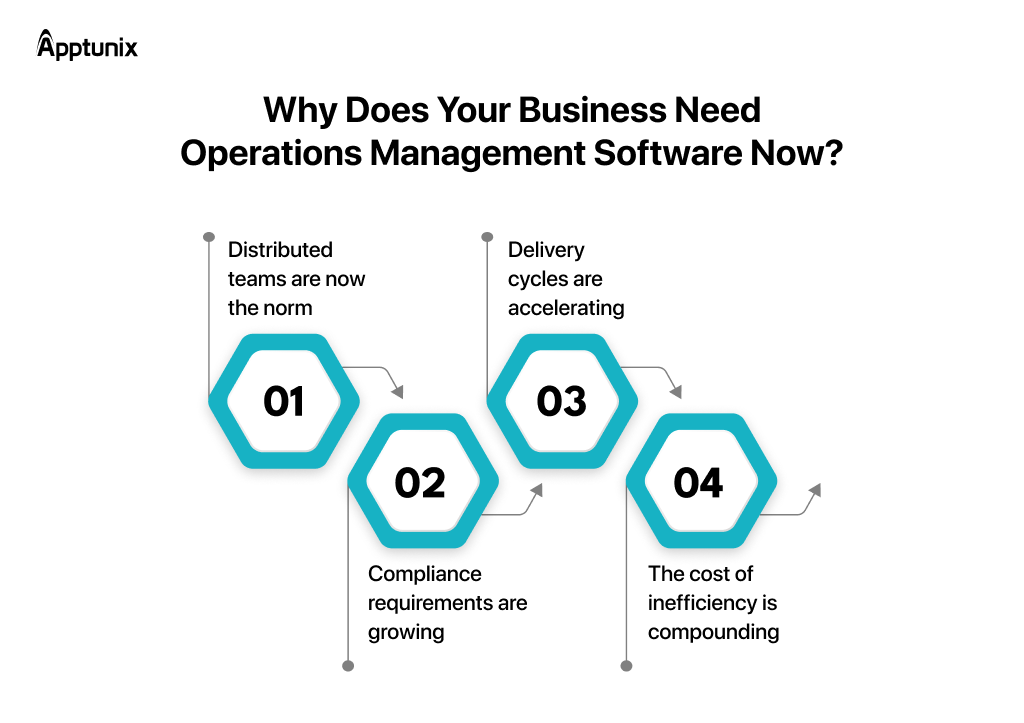
Why Does Your Business Need Operations Management Software Now

  • Distributed teams are now the norm. Informal coordination is no longer reliable due to remote and hybrid work. When there’s no single operations platform, misalignments increase.
  • Delivery cycles are accelerating. Customers want things to be released quickly. Manual and spreadsheet-based tracking don’t match up to today’s rapid development pace.
  • Compliance requirements are growing. Operational risk management software programs for app development must log and enforce controls automatically to meet regulatory data handling, audit trail, and access control requirements.
  • The cost of inefficiency is compounding. All the time spent on rework, miscommunication, or manual reporting is a margin killer. As they are a drain on operations, these can be eliminated through custom operations management software development, which pays off at scale.

Also Read: B2B Procurement Software Development To Manage Complex IT Workflows!

How to Choose the Right Operations Management Software Development Partner?

The partner you select affects everything – the quality of the platform, the stability of delivery, and the value your business will receive over the long term from your investment. Most software development companies can code. Fewer people know the operational domain in depth, their way around the right discovery questions, and how to build a system that truly reflects the way your teams operate.

Let’s take a look at a realistic approach to assessing any operations management software development partner you are looking at for your operations management software development project.

Five signs that differentiate the strong partners and the rest:

01

Proven Experience in Operational or Workflow Platforms

It’s not just a generic application development experience that’s required. From workflow automation, multi-system integration, and real-time data processing to operational logic, all these must be understood by the building operations management software team. Request examples – not mock-ups but real platforms – illustrating this.

  • Have they created platforms for managing tasks, resources, or workflows at scale?
  • Are there case studies where they incorporate tools such as Jira, SAP, Salesforce, or DevOps pipelines?
  • Are they able to talk about the issues their clients were having, not only the technology they provided?


02

A Discovery-First Engagement Model

The best partners don’t ask for a proposal; they ask questions. The one clear indicator of an operations management software development partner that will provide what will work in practice, not just in a demo, is having a structured discovery phase, which maps existing workflows, identifies integration needs, and confirms technical assumptions prior to the first line of code.

  • Do they follow a well-defined discovery process, or do they go straight to scoping?
  • Will they write about your workflow prior to suggesting an architecture?
  • What do they do when requirements change during the project?


03

Full-Stack Technical Depth Including AI, Cloud, and Integrations

Modern enterprise operations management software is no longer a stand-alone application. It is integrated with your current tool suite, runs on cloud infrastructure, and increasingly integrates AI to provide predictive analytics and workflow automation. Your partner should have depth in all of these layers and not be a front-end/back-end generalist.

  • Are they capable of providing AI capabilities like predictive analytics, anomaly detection, or intelligent scheduling?
  • Have experience building cloud-native architectures on AWS, Azure, or GCP?
  • What are their experience and expertise in integrating APIs into multi-system environments?


04

A Transparent, Agile Delivery Process

Expensive surprises arise when development is opaque. Seek an enterprise software development company that holds regular sprints and demos working software, and has a shared sense of progress against the timeline and budget. There is no such thing as being too transparent when delivering; it is the way you safeguard your investment.

  • At development, how many times will you see working software, not status updates, but demos?
  • How are the changes in the scope communicated and priced?
  • How will they report on the project, and how will they utilize project management tools?


05

Structured Post-Launch Support and Iterative Development

Deployment is not the end of the race! As your team grows, your workflows mature, and your business needs evolve, your operations management platform will need to adapt. The product is finished already, and the partner is leaving you with a product without a defined model. Enterprise operational software doesn’t work that way.

  • How do they support their products after they’re launched? (responsiveness, next steps, etc.)
  • How do they continuously maintain their features post go-live?
  • Are they making releases in an iterative fashion, or are they just applying fixes as they become aware of issues?


Also Read: Service Management Software Development–Enterprise Blueprint for Scalable Operations

Quick Reference: Red Flags vs. Green Flags

Employ this handy reference whenever assessing a proposal or when in preliminary conversation with prospective operations management software development firms.

Red Flags Walk Away Green Flags Move Forward
Proposes ideas before inquiring about workflows. Has a systematic discovery process before taking any offers.
No evidence of operations or workflow platforms experience. Has worked with operations, resource management, or workflow platforms before
Gives a set price before completion of scoping. Gives a “scoped estimate” with explicit assumptions included.
Can’t identify the testing frameworks and QA approach they will take. Outlines QA strategy (functional, performance, security, UAT) early on.
Treats post-launch support as an optional add-on. Provides a clear post launch support and iteration process.
No integrations with ERP, DevOps, or HR tools were found. Can provide live connections with existing systems.


Questions to Ask Every Partner Before You Sign

Include these in your initial discussion. Look at the quality of answers, rather than at whether there’re any answers.

” Can you show us a platform you’ve built that manages workflows, resources, or operational data at scale? “ ” How do you handle scope changes mid-project without derailing the timeline or budget? “
” What does your QA process look like for an operations management platform specifically for integration testing? “ ” How do you approach compliance requirements? Do you have experience with GDPR, SOC 2, or HIPAA? “
” What does your post-launch support model look like, and how do you handle iterative feature releases? “ ” Who will be our primary point of contact, and what does day-to-day communication look like during development? “

The right operations management software development partner doesn’t just create what you ask for. They question what you have already assumed, unearth the things you haven’t even thought of, and provide a platform that addresses operational issues that you won’t face for six months after launch. This degree of collaboration is what differentiates software development firms from firms that have an understanding of operations management.

Also Read: Enterprise Portal Development for Scalable Business Operations

Wrapping it Up!

Operations are no longer an afterthought in software development; they’re a competitive advantage. Investing in custom operations management software development can save businesses money, speed up delivery, and scale with ease without the hassle of manual processes. The technology is at hand. There is a measurable ROI. The issue isn’t whether to construct; it is when to construct. Identify your needs and select a partner that has real operational domain expertise, then begin by creating an MVP to quickly demonstrate value. Every day you wait is a day your competitors pull ahead.
Frequently Asked Questions(FAQs)

Q 1.What does operations management software do for a software development team?

Operations management software integrates task, resource, workflow, and data management and coordination within a development organization. It eliminates tedious tasks, reveals real-time performance insights, implements access management, and integrates the tools and teams that rely on each other. This translates to reduced rework, fewer delays, and improved decision-making across the entire company.

Q 2.How long does it take to develop a custom operations management platform?

This will be determined by the size of the project. The delivery of a simple MVP with core task automation and reporting takes between 2 and 4 months. The integrations and advanced analytics will usually take 4 to 8 months to implement on a mid-range platform. Enterprise systems that are fully compliant, multi-tenant, and use AI typically require 8 to 18 months to be discovered and deployed in production.

Q 3.How much does operations management in software development cost?

The price range for operations management in software development is from $40,000 (for a simple MVP) to $300,000+ and beyond (for enterprise-level platforms). The key factors that drive up costs are feature complexity, location of the team, number of third party integrations needed, compliance/ security requirements. 

Q 4.Can it integrate with our existing development and business systems?

Yes. A sound custom operations management platform will be developed with integration in mind. Examples of integrations are Jira, GitHub, GitLab, Slack, Salesforce, SAP, AWS, Azure, and others. The scope of integration is determined in the discovery process and is constructed and tested prior to launch to guarantee that the data can be transferred successfully between all the integrated systems.

Q 5.Should we build a custom solution or buy an off-the-shelf product?

Off-the-shelf tools are fast to deploy and cost less upfront, but they impose their own structure on your workflows, and they rarely fit complex or regulated organisations without significant workarounds. Custom operations management software development gives you a platform built around your actual processes, your integration requirements, and your compliance obligations. For organisations with unique workflows, multi-system dependencies, or strict compliance needs, custom builds typically deliver higher long-term ROI than adapting a generic tool.

Rate this article!

Bad Article
Strange Article
Boring Article
Good Article
Love Article

Join 60,000+ Subscribers

Get the weekly updates on the newest brand stories, business models and technology right in your inbox.

Related Posts

Robotic Process Automation in Healthcare: Use Cases, Benefits, and How to Get Started

Robotic Process Automation in Healthcare: Use Cases, Benefits, and How to Get Started

21 Views 15 min August 12, 2026

10 Generative AI Features You Can Add to Your App Right Now

10 Generative AI Features You Can Add to Your App Right Now

60 Views 15 min August 10, 2026

Types of AI Agents: Examples, Use Cases & How to Choose the Right One

Types of AI Agents: Examples, Use Cases & How to Choose the Right One

30 Views 15 min August 6, 2026

Partner with tech catalysts who transform ideas into impact.

Book your consultation with us.

Let’s Talk!

Partner with tech catalysts who transform ideas into impact.

Book your consultation with us.

Let’s Talk!

Speak With Our Experts

Submit
Apptunix global office locations map
UAE office location icon

UNITED ARAB EMIRATES

One Central, The offices 3, Level 3, DWTC, Sheikh Zayed Road, Dubai

+971 50 782 1690
USA office location icon

UNITED STATES

42 Broadway, New York, NY 10004

+1 (512) 872 3364
UK office location icon

United Kingdom

71-75 Shelton Street, Covent Garden, London, WC2H 9JQ

+44 7481 338539
India office location icon

INDIA

3rd Floor, C-127, Phase-8, Industrial Area, Sector 73, Punjab 160071

+91 96937 35458