
10 Best Construction Project Management Software & How To Build Your Own?
32 Views 13 min August 27, 2026

Pallavi Nautiyal is a seasoned Tech Consultant at Apptunix, specializing in the intersection of global finance and decentralized technology. With a deep-rooted expertise in banking infrastructure, digital payment gateways, and Web3 ecosystems, she guides businesses through the complexities of modern financial engineering. Pallavi is recognized for her ability to architect secure, compliant, and scalable solutions—ranging from smart contracts and crypto-wallets to robust digital banking platforms. Her strategic insights help organizations navigate regulatory landscapes while leveraging the power of Blockchain to ensure transparency and seamless user experiences in every transaction.
Here’s a number that should alarm every EdTech entrepreneur trying to build an app through e-learning app development: Only 2% of education app users are still active by Day 30.
As per the AppsFlyer’s report on education apps. You can build an interactive onboarding flow, be competitive with your prices, and still helplessly watch 980 out of every 1000 users silently leave your app within a month. No warning. No feedback. Just gone.
Most platforms lose their users even before they can ever experience the value the platform has to provide, often due to factors such as poor user experience, lack of engagement, or insufficient marketing efforts. So are users running from education? That’s absolutely not the case. It’s whether or not you are able to provide users with the value that gives them a reason to keep coming back.
As an E-Learning App Development Company, Apptunix has helped EdTech startups, enterprise L&D teams, and university digital programs in e-learning App Development. Throughout our journey, we noticed that there is a clear difference between apps that retain users and those that don’t. And that isn’t marketing. It’s not even content quality. It’s the decisions made during e-learning App Development – decisions like adaptivity, progress mechanics, integration depth, and UX friction.
That distinction is precisely what this blog unpacks. If you are past the question, “Whether or not you should build an e-learning app?” And are focused on building something that actually works long-term, something learners return to, complete, and recommend. Then what follows is specifically written for you.
E-learning app development is the process of designing, building, and deploying software applications that deliver educational content and track performance across three primary user roles: students, teachers, and administrators.
Before we jump to a solution, it is crucial to size the problem clearly.
In MOOCs, the very format that was meant to democratise education, the number of learners who actually complete the course is just 32.2%. By contrast, cohort-based courses have completion rates of about 90 per cent, much of this due to the removal of the ‘I’ll do it later’ escape hatch. That discontinuity is no coincidence. It’s architectural.
Better are apps that build habitual behaviour through motivational systems. Apps that do not wear out. Duolingo, perhaps the most-researched e-learning case on retention in the industry, has built its entire product around streaks, push notifications, and social comparison. The result? Duolingo now has a market cap or net worth of $5.20 billion. The enterprise value is $4.17 billion.
Therefore, the lesson of how to increase user engagement in e-learning apps does not apply to copying Duolingo. It is because retention is not a content problem only, but an engineering problem. And it starts at the design stage of your e-learning app development.
Also read Why E-learning Mobile App Is Important for Business In Coming Years?
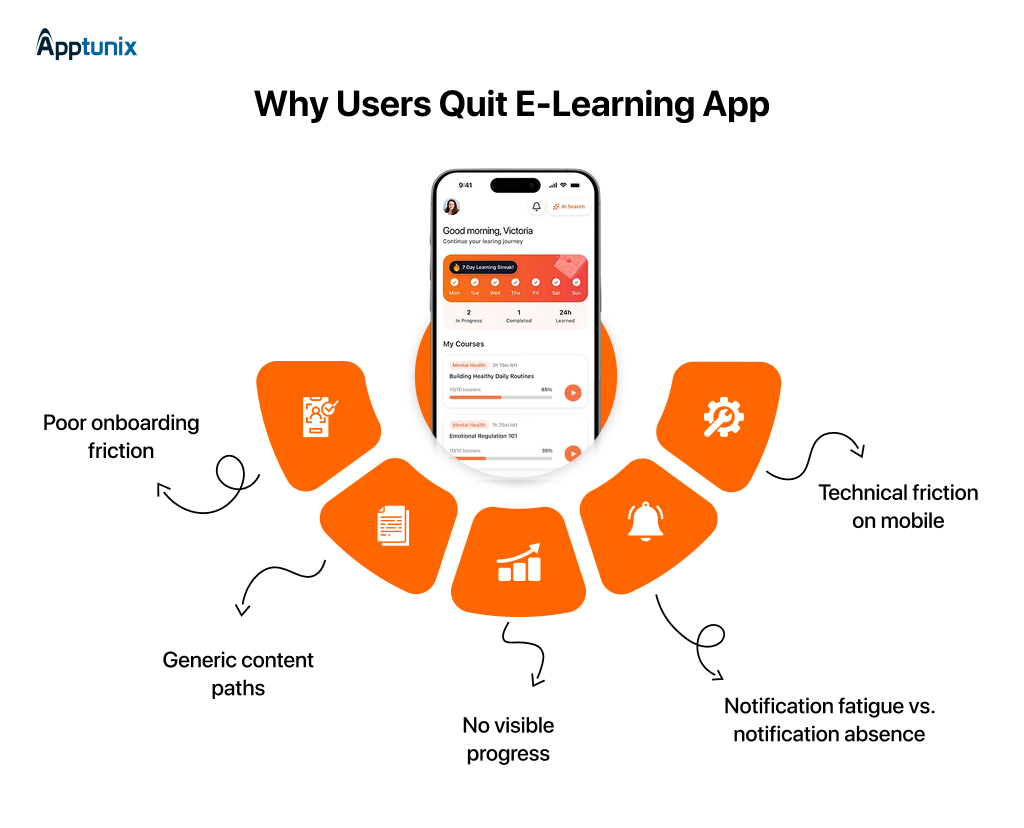
Most analysts blame “Low Motivation”. That is like blaming gravity when you twitch and fall. Motivation is just a symptom, following are the actual causes:
Apps that activate users within the first 3 minutes see nearly 2x higher Day 1 retention. Users’ first interaction with your app should deliver value, not forms. If, during onboarding, you ask learners to set goals, verify their email, and fill in details to personalize the experience before they even encounter a single piece of content, you’ve already lost them.
If you are serving a user with 5 years of experience with surface-level content, they will surely leave. Research across 69 peer-reviewed studies found that 59% showed adaptive personalisation positively impacts academic performance – which means platforms that serve the same content to everyone are leaving significant retention points on the table.
Human beings need closure. If users cannot track their progress, the goal feels unreachable. If the learner has no idea about the content covered and the portion left, the goal may feel abstract. Abstract goals don’t motivate users to return. Progress bars, skill trees, and completion milestones – these are not just interactive features. They serve as the core pillar for customer retention.
Both extremes kill retention. Spamming users with constant notifications will force them to disable notifications from your app. Send no notification, and they’ll forget they ever downloaded your app. Critical to any current online learning app development, a brief is the smart notification logic triggered by any of the following thresholds: inactivity, streak risk, or upcoming deadlines.
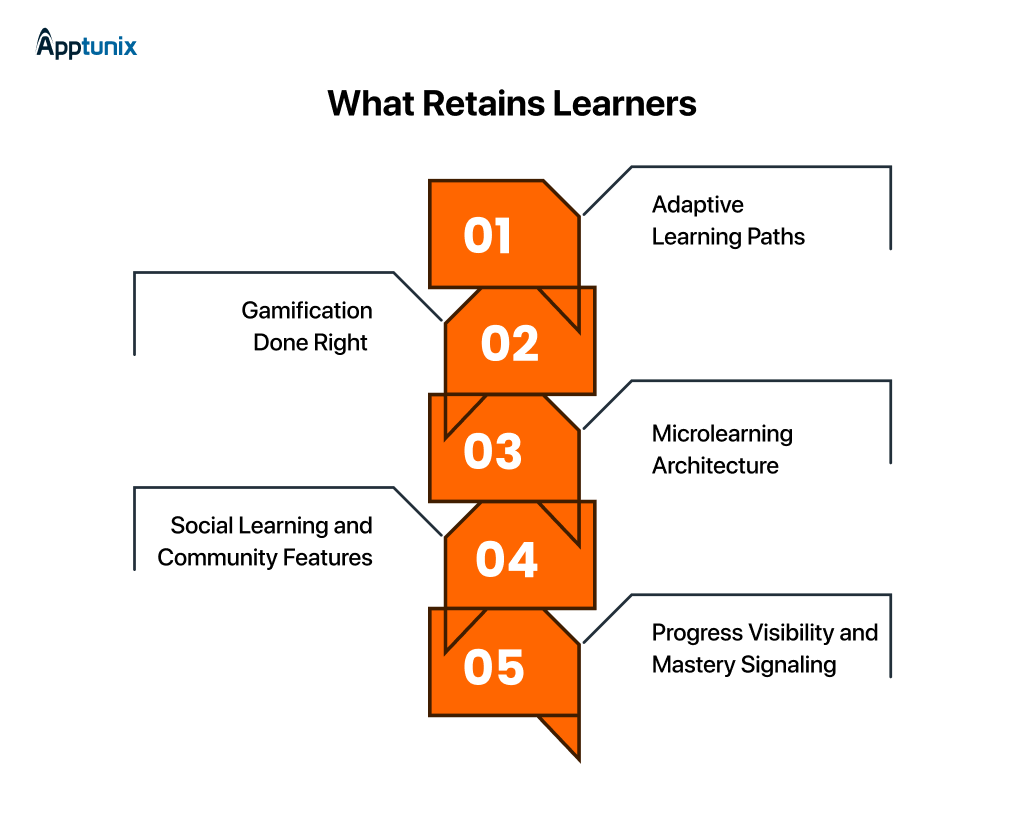
If you want to retain your learners, there are several factors that must be taken into account:
The most significant shift in e-learning mobile app development in the last two years is the adaptive content delivery going mainstream. This does not just stop at “beginner/intermediate/advanced” tracks. The new adaptive systems use real-time performance quiz scores, skin patterns, time-on-task, quiz scores, and skip patterns to adjust dynamically to the next content surface, difficulty, and format.
Technically speaking, with regard to implementation, this implies that your data architecture must not be assumed to treat learner behaviour as a second-class input, but rather as a first-class input. Each contact, a halted video, a skipped quiz question, and a reopened module are indications. It should be read on your platform.
The act of slapping a leaderboard onto a compliance training module is not gamification; it is decoration. The design of intrinsic motivation loops – challenge, effort, feedback, reward, and progression – adjusting to the current state of the learner, is real gamification in e-learning applications.
Here is what can make the difference between good gamification and empty mechanics:
This is being accelerated even faster by AI. AI-enabled gamification drives 47% more user interaction and 38% higher retention than non-AI approaches.
It is not the attention that is declining; it is just that it is being redistributed to the content that earns it. Video lectures are most engaged at 6-9 minutes, but then the level significantly decreases. Interactive sessions that take less than 10 minutes to complete have completion rates near 80 per cent as opposed to much lower rates with traditional long-form content.
This has a direct architectural impact on EdTech entrepreneurs and L&D managers creating learning apps. Atomic units, single-concept modules, standalone skill exercises, and bite-sized assessments, which can be performed during a commute or a lunch break, are all the atomic units of your content.
Microlearning has been demonstrated to make learners more engaged (25%), and knowledge retention improved (15%), not because short content is inherently superior but because it eliminates the friction of commitment. The learner who thinks that I will just do one module ends up doing three.
The difference between MOOC completion rates and cohort-based course completion rates is nearly completely accounted for by a single variable: social accountability. When learners have a sense of belonging in a cohort, a study group, or even an anonymous leaderboard, the chances of returning are significantly increased. The engagement in forums is associated with 2x the odds of completing versus learners who engage with content in isolation.
Probably one of the most underestimated UX choices of e-learning app development is the visualisation of progress. Not merely “Module 3 of 10 completed” but skill level progression, mastery confidence ratings, and learning path branching responsive to what the learner has already demonstrated they know.
Corporate platforms are becoming more and more linked to gamified scorecard performance, straight to workforce capability frameworks, rather than hours logged. This type of signaling is important to motivate learners and also to the enterprise buyers who authorise your LMS contracts.
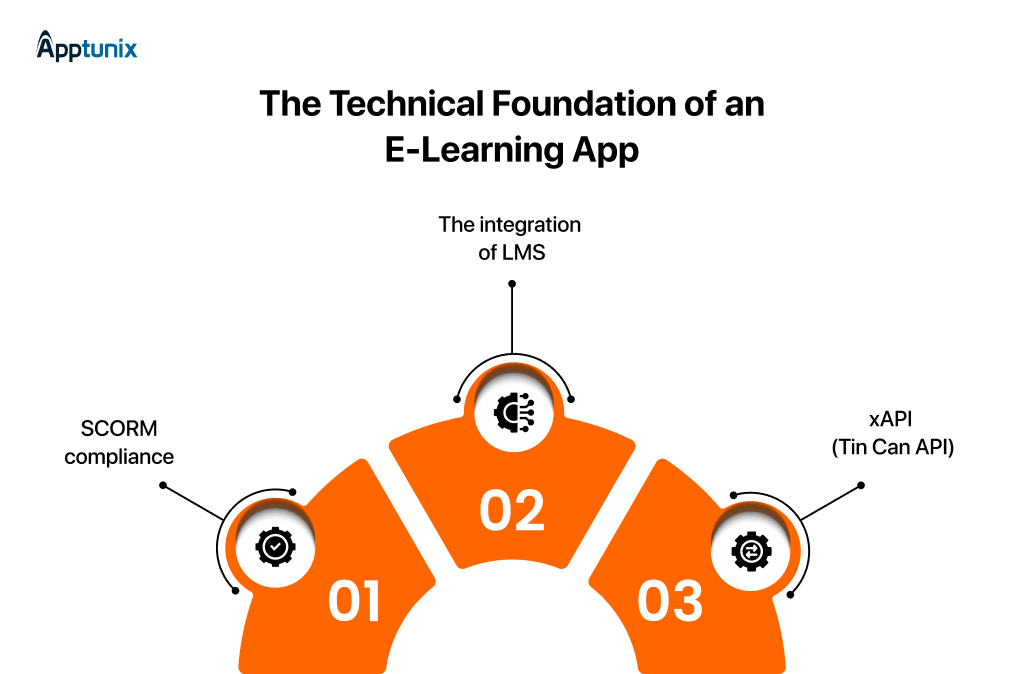
Mechanics of engagement receive the press. However, the platforms that achieve enterprise and institutional contracts are constructed on a more prosaic basis: compliance with standards and level of integration.
SCORM compliance, the Sharable Content Object Reference Model, is still the lingua franca of the corporate learning world. Any e-learning application development targeting enterprise clients, industries with strong regulations, or institutional purchasers must have SCORM-compatible content delivery baked into the application at the inception stage. It is painful and costly to retrofit it.
The integration of LMS is also not a bargain to be offered to platforms targeted at L&D teams. HR systems, single sign-on, calendar syncing, and completion reporting – these aren’t feature requests; they are procurement requirements. Over 41.7% of Fortune 500 companies utilize e-learning platforms to train their workforces, and they will have IT teams that will enquire about API documentation even before they enquire about your course library.
xAPI (Tin Can API) is the new standard that should be developed. Compared to SCORM, which only records completion data in a browser-based setting, xAPI records a broader range of learning experiences, such as offline activity, simulation results, and mobile interactions. For platforms that care about learning analytics, xAPI support becomes more and more the distinguishing factor.

Creating a successful e-learning app is more than just pushing courses into the system; it’s about crafting an experience that keeps learners coming back. During the development process, user engagement, scalability, and retention become critical factors.
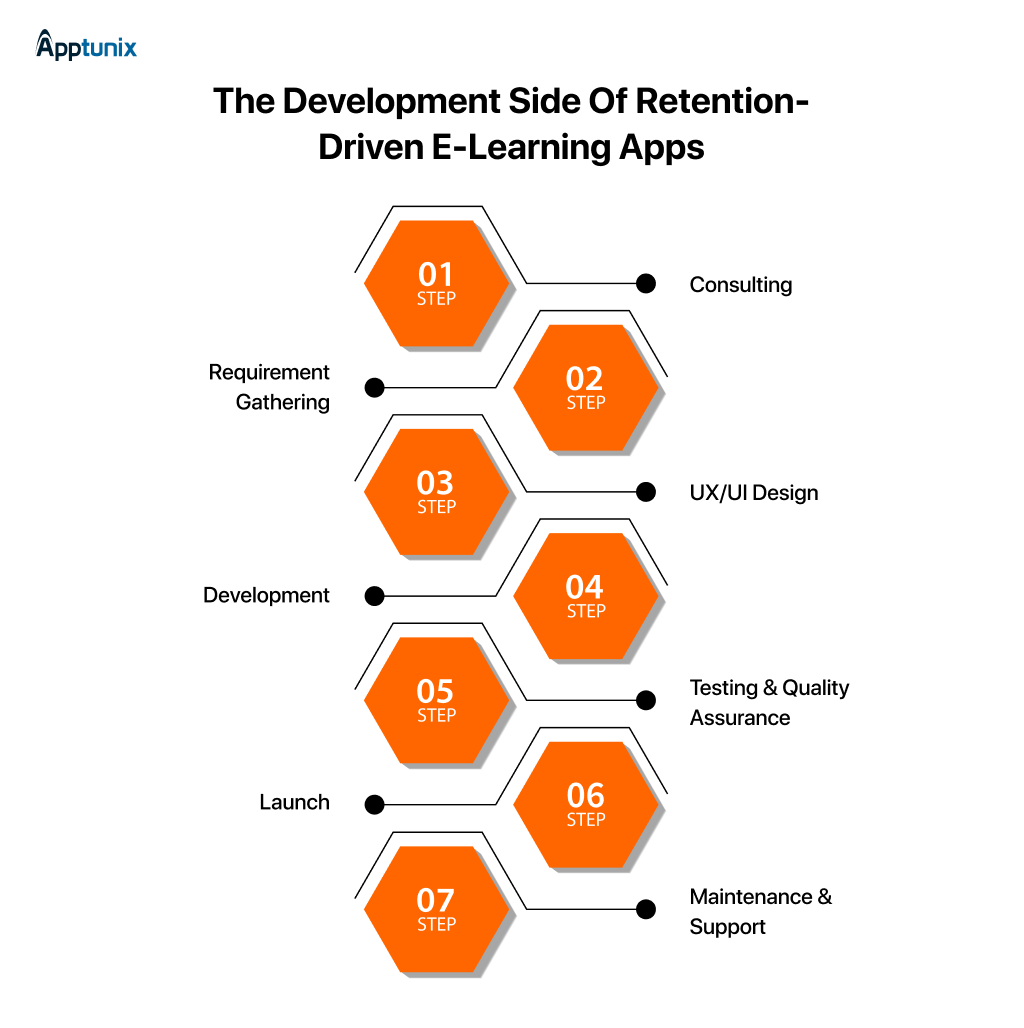
All high-impact e-learning platforms start well before the first line of code is written.
The consulting phase is a foundation on which everything else is built. Development teams are closely engaged with stakeholders during this phase to:
Even if technically correct, a platform that doesn’t have the foundation will fail to address the right issues. Consulting ensures that all decisions that follow are deliberate, informed, and goal-driven choices.
A good e-learning application should be rooted in an understanding, not an assumption, of the people who will be using it. The test phase is not just about the bare list of features.
Teams do a lot of market research to come up with what learners need, what the competition is lacking, and where there are real opportunities. The output drives:
The more detailed the needs are gathered, the less expensive the pivots will be during development.
Decoration is not design; it is the main reason for learner engagement and retention.
User-friendly, engaging interfaces help to minimize cognitive load and create a seamless learning experience. In this stage, designers pay attention to:
A good interface isn’t just pretty; it makes completing the platform more efficient, and more people spend time on the platform.
This is where strategy turns into a working product. The development phase brings wireframes and requirements to life. The platform is constructed layer by layer by experienced engineering teams; each layer is scalable, maintainable, and efficient. Core work includes:
Speed is important, but it’s important not to create technical debt that accumulates over time.
No e-learning platform should reach learners before it has been stress tested for all scenarios. The QA teams use a comprehensive testing strategy to ensure the platform operates seamlessly in the field. This covers:
Quality assurance is not the last line of defense – it is a parallel process to detect problems and minimize resolution costs during development.
You may have a great platform, but if it is not strategically deployed to the right audience, then it is not going to have the impact you are looking for.
The launch phase has two primary goals: to ensure that the platform is live without errors, structurally and operationally, and to ensure that it is reaching as many people as possible with as little downtime as possible. Teams coordinate across:
It isn’t simply going live that makes for a successful launch; it’s ensuring that the right learners can access the platform and remain.
Launches are not the end of the world. Post-launch maintenance guarantees that the platform continues to carry out, scale, and develop with the requirements of its users. Ongoing support includes:
In the rapidly evolving world of digital learning, platforms that commit to continuous improvement have a sustainable competitive edge over those that stop at launch.
Also read How to Develop A Language Learning App Like Duolingo?
The following is an entire breakdown of the cost of developing an e-learning app. Budgeting can vary significantly in scope, but here is a realistic budgeting outlay of teams planning to develop mobile learning apps:
Basic features like:
with an expert Education App development company, it typically costs you anywhere between $30,000 to $80,000+.
A mid-level platform that includes:
Dynamic learning paths, push notifications, gamification, basic LMS integration, and offline support can fall in the range of $80,000 and $120,000+.
Full SCORM/xAPI compatibility, AI-driven personalisation, live session infrastructure, multi-tenant LMS architecture, and analytics dashboards can cost $120,000-$200,000+, especially in regulated industries such as healthcare or financial services.
The fees/figures cited are representative of recent industry trends. However, the E-Learning app development enterprise you choose, complexity of the app, and the architecture that will be used in the backend will be pivotal in determining the final price. So it is advisable to connect to a professional and inform them about your needs so that you can obtain the correct estimate.

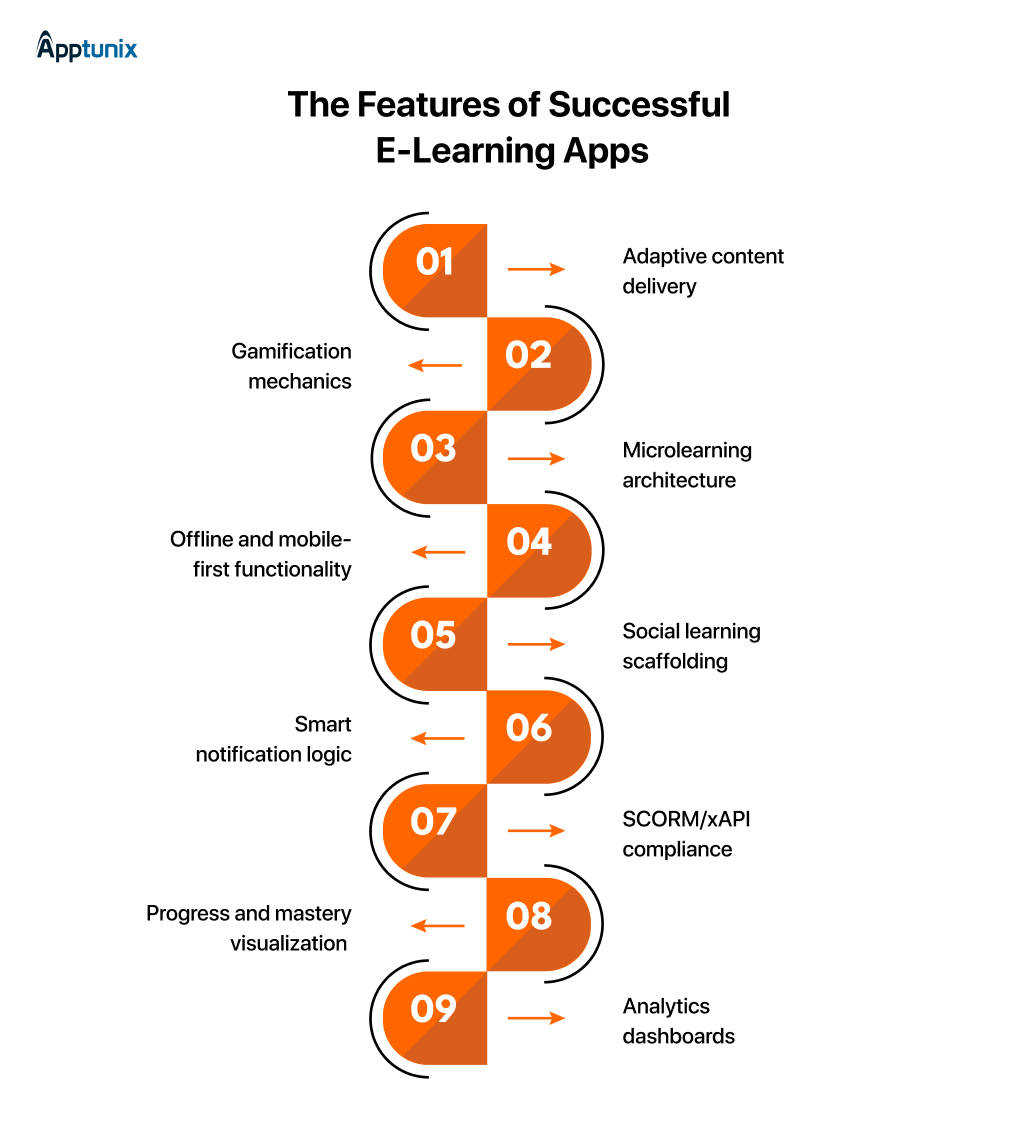
The elements of good e-learning applications that are continually tied to retention are all tied together by one common thread: they all remove friction and enhance motivation. The next step is clear, attainable and have a reward.The non-negotiables for any serious platform in 2026:
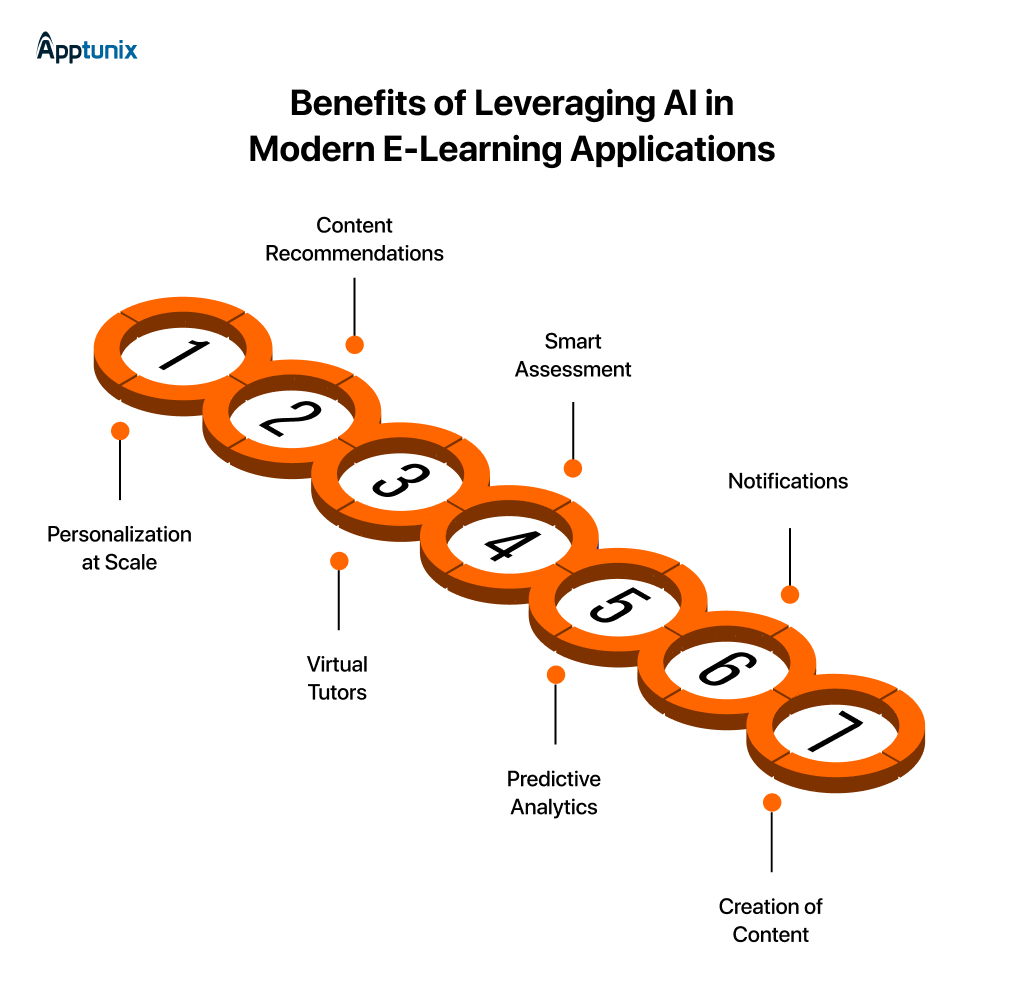
From traditional classes to e-learning platforms, AI in education has come as a revolution. AI is not an option in e-learning anymore; it is the fuel that drives retention, personalisation, and platform intelligence in 2026.
E-Learning platforms face a retention crisis not because of poor content, but because product design often hinders growth. Students remain engaged when platforms make growth feel attainable, visible, and enjoyable, but quickly leave those that make the experience unnecessarily challenging.The best e-learning apps focus on the learner’s psychology, not instructor convenience. That means investing in adaptive personalization, smart gamification, a solid SCORM foundation, and mobile-first design. These are not afterthoughts. We develop e-learning applications at Apptunix, which are designed to be retention-driven. We have shipped LMS app development and SCORM integration to AI-powered adaptive learning and gamification platforms used by EdTech startups, enterprise L&D teams, and university digital programmes around the world.
Q 1.How much does E-Learning App development cost in 2026?
The cost to make an eLearning app can range from $30,000 for a simple version to $200,000+ for a large online education platform with artificial intelligence that makes learning personal, LMS integration, and SCORM compliance. What affects the cost is the scope of the project and the technology. How deep the features go, especially things like making learning fun in e-learning apps and adaptive learning.
Q 2.How long does it take to build an E-Learning mobile app?
The features of eLearning apps that really make a difference in keeping users engaged include paths that change based on the learner, making learning fun, breaking learning into small bits, being able to use the app offline, tracking progress, and following SCORM and xAPI rules. For platforms used by companies, it is also very important to have a learning management system that works smoothly and dashboards for analytics that are based on roles.
Q 3.What are the most important features of successful E-Learning apps?
To keep users engaged in eLearning apps, you can use things like making learning fun, such as streaks, points, leaderboards and artificial intelligence that makes the learning experience personal for each user. You can also use features for learning and smart notifications that remind users to come back when they have not used the app in a while. Apps that get users started within 3 minutes see users come back nearly twice as much on the first day.
Q 4.How do you increase user engagement in E-Learning apps?
Increasing user engagement in e-learning apps requires a blend of gamification, personalized content, social interaction, and mobile-optimized design to transform passive consumption into active participation. Key strategies include using microlearning, sending targeted notifications, and providing real-time feedback to keep learners motivated and invested in their progress.
Q 5.Why do users quit E-Learning Apps so quickly?
Users stop using learning apps because the introduction to the app is not good, the content is not interesting or relevant to what they know, they cannot see how they are progressing, or it is hard to use on mobile devices. A good strategy for making learning apps should fix all these problems by making the learning experience personal, easy to use, and breaking learning into small bits that make even short sessions feel rewarding.
Q 6.What is the difference between an LMS and an E-Learning app?
A Learning Management System is a platform used to create, manage, and track courses in companies and schools. An e-learning mobile app is what the learners actually use. Nowadays, making online education platforms usually means combining both: a Learning Management System to deliver content and track progress and a mobile learning app that is easy to use and looks good.
Q 7.Is gamification really effective in E-Learning platforms?
Yes, making learning fun in eLearning apps is one of the best ways to keep users engaged. Studies show that using games in learning can increase the number of users who come back by up to 90%, and 83% of learners say they are more motivated when learning is made fun. The key is to give rewards for achieving something, not just for being active.
(1 ratings, average: 5.00 out of 5)
Get the weekly updates on the newest brand stories, business models and technology right in your inbox.
Pallavi Nautiyal is a seasoned Tech Consultant at Apptunix, specializing in the intersection of global finance and decentralized technology. With a deep-rooted expertise in banking infrastructure, digital payment gateways, and Web3 ecosystems, she guides businesses through the complexities of modern financial engineering. Pallavi is recognized for her ability to architect secure, compliant, and scalable solutions—ranging from smart contracts and crypto-wallets to robust digital banking platforms. Her strategic insights help organizations navigate regulatory landscapes while leveraging the power of Blockchain to ensure transparency and seamless user experiences in every transaction.
32 Views 13 min August 27, 2026
180 Views 13 min June 24, 2026

197 Views 13 min June 22, 2026
Book your consultation with us.
Book your consultation with us.


One Central, The offices 3, Level 3, DWTC, Sheikh Zayed Road, Dubai
+971 50 782 1690