Fleet Management Software Development: Cost, Features, Process & AI Guide for Enterprise Fleets
88 Views 9 min June 24, 2026

Reena Bhagat, the CTO and Head of AI at Apptunix, is a seasoned technology strategist with a deep-rooted expertise in emerging technologies. With a focus on AI/ML integration, product engineering, cloud management, she leads the technical vision for high-performance SaaS infrastructures. Reena is recognized for building secure, scalable, and decentralized systems that solve real-world complexities. Her passion lies in leveraging data science and future-tech to create resilient digital products, making her a trusted authority for organizations looking to lead in the age of intelligent automation.
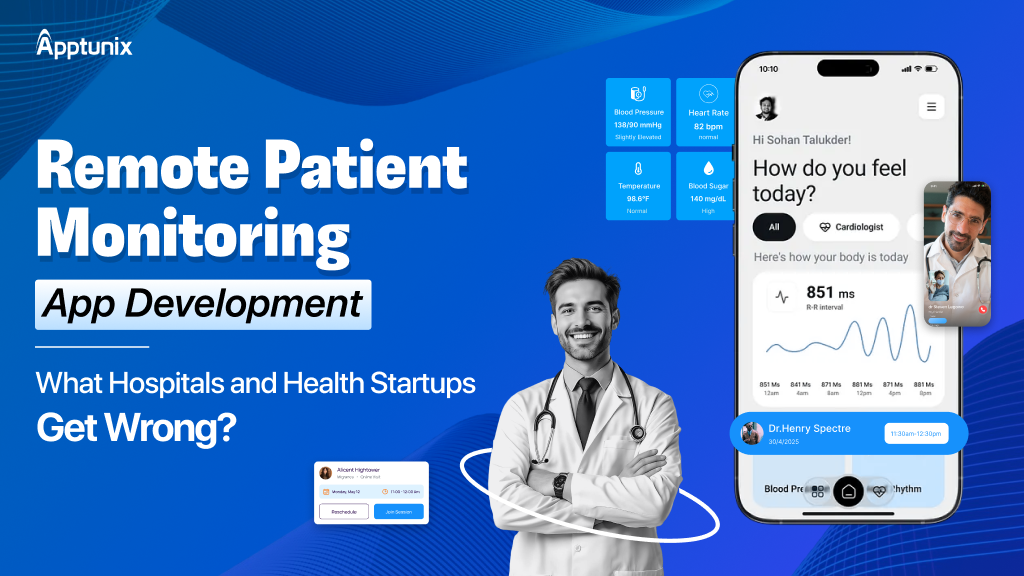
The healthcare industry has seen a sea of changes after the pandemic outbreak. With hospitals being overwhelmed, in-person consultations becoming rare, and doctors looking for means to monitor patients remotely, RPM has become even more essential.
From a necessity driven by the pandemic situation, remote patient monitoring app development is being considered a long-term strategy for the future of healthcare.
The growth of the remote patient monitoring software market is tremendous, reaching from $27.7 billion in 2024 to $56.9 billion in 2030, with the market expected to grow at an annual rate of 12.7%.
Hospitals have recognized the importance of improved chronic disease management, entrepreneurs have identified great potential in digital health, and patients prefer to be monitored at home.
But despite the growing demand, RPM adoption still lags behind expectations.
The biggest reason behind this is poor implementation.
Most hospitals and healthcare startups develop an AI remote patient monitoring app in the same way as other SaaS applications, without taking into account the specifics of medical processes, legal constraints, interoperability, real-time data processing, and adoption problems.
As a result, they end up with an application that performs well in demos but fails to adapt to real-world clinical use.
In the healthcare industry, each error made by developers can lead to critical consequences for patients’ lives. For example, a delayed alert, bad interaction with devices, or complicated interface may affect patients’ health negatively.
In this blog post, we will discuss the most common mistakes of startups in RPM app development, successful practices used by leaders, and how you should start your RPM application development process.
Healthcare is moving from reactive treatment to proactive monitoring. That shift changes everything.
Instead of waiting for patients to deteriorate and visit the ER, providers can now continuously monitor vitals, behavior, medication adherence, and recovery remotely through connected devices and apps. For founders, this creates a massive opportunity.
The remote patient monitoring market has exploded over the last few years. Globally, RPM devices are expected to grow from $71.3 billion in 2026 to $289.8 billion by 2034 at 19.2% CAGR, signaling huge potential but underscoring the need for robust apps. This growth is driven by:
And the demand isn’t slowing down. Conditions like diabetes, hypertension, COPD, heart disease, and post-operative recovery increasingly rely on continuous remote monitoring.
What’s interesting is that RPM is no longer limited to enterprise hospital systems. Now, even early-stage startups are entering the market with:
The barrier to entry has dropped technologically. But operationally, it’s still extremely difficult.
Healthcare organizations know RPM improves outcomes. And if the market is also growing so fast, why are most RPM apps struggling?
It’s because most RPM solutions create more operational problems than they solve. Clinicians already deal with alert fatigue, fragmented systems, poor EHR integrations, and overwhelming documentation requirements.
Now imagine giving them another disconnected platform with inconsistent device syncing, complicated onboarding, and other data reliability issues.
Healthcare teams don’t care how impressive your RPM app’s features are if the workflow becomes harder.
That’s the core challenge in digital health app development. You’re not just selling software. You’re asking healthcare professionals to trust your system in high-stakes clinical environments.
This is where most RPM initiatives quietly fail, not during fundraising or demos but during real-world deployment.
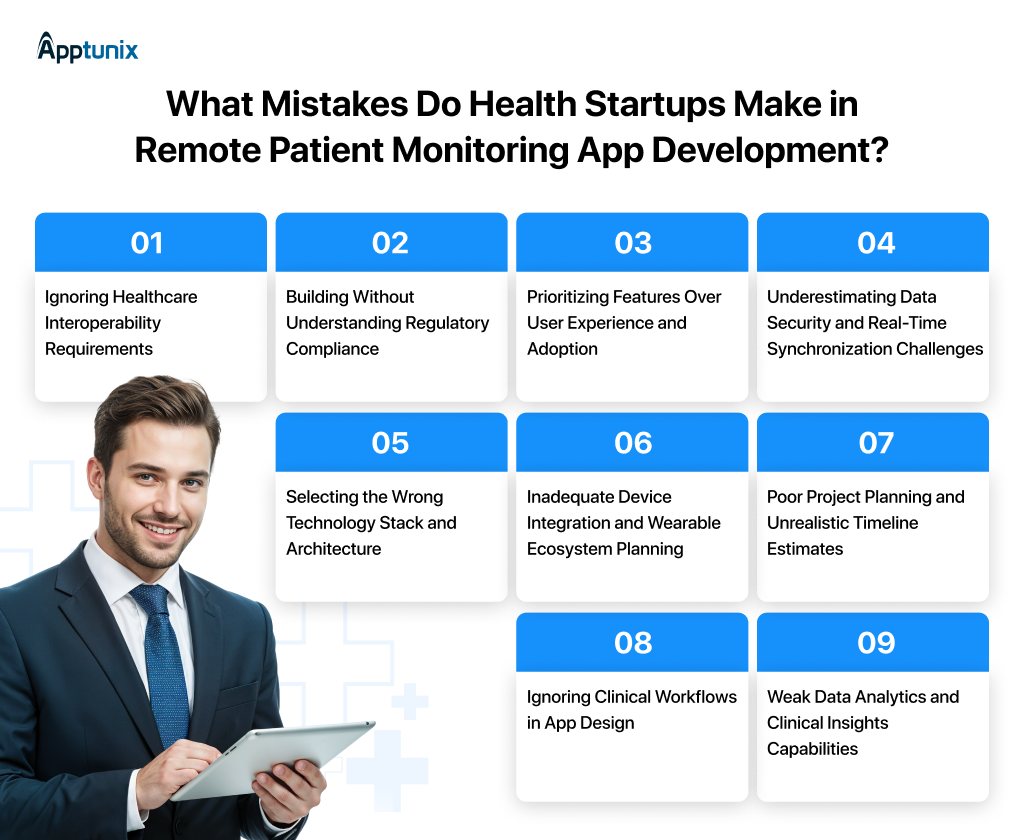
One of the biggest mistakes in remote patient monitoring software development is building isolated systems. Healthcare already suffers from fragmented infrastructure.
Hospitals use:
If your RPM solution doesn’t integrate smoothly into that ecosystem, adoption becomes painful. Founders often underestimate standards like HL7, FHIR, SMART on FHIR, ICD-10, and HIPAA data exchange protocols.
Many startups treat compliance like a late-stage legal checkbox. That’s dangerous. Compliance must shape architecture decisions from day one. Depending on geography and use case, RPM platforms may require:
The challenge becomes even bigger with custom remote patient monitoring software that uses AI decision-making or predictive diagnostics.
If your app influences clinical decisions, regulatory scrutiny increases significantly. Founders sometimes spend months building features only to discover that their data storage setup is non-compliant and device certifications are incomplete.
Retrofitting compliance later is expensive and messy. The smartest health startups build compliance into architecture from the beginning.
This mistake destroys RPM adoption faster than almost anything else. Founders love features.
Many RPM platforms become overloaded with different alert types, customizable dashboards for seven different user roles, integrations with twelve wearable devices, AI-powered predictions, and a mobile app that syncs to the cloud.
The patient opens the app on day one. Gets overwhelmed and abandons it by week two. This is the core failure pattern. Founders build for hospital executives who are buying, not for the patients and clinicians who use it.
If onboarding requires tutorials, complicated device pairing, or technical troubleshooting, your app is overly complex.
The best RPM app development strategies focus on:

Healthcare data is among the most sensitive information in the world. And RPM platforms generate enormous amounts of it continuously.
Vitals, ECG data, oxygen levels, sleep patterns, medication adherence, and movement tracking all flow in real time. That creates technical complexity that most startups underestimate. Common issues include:
Now, combine that with strict healthcare security requirements. You suddenly need end-to-end encryption, role-based access control, secure APIs, real-time anomaly detection, and more.
Many startups choose technology stacks based on developer expertise rather than long-term scalability. This becomes costly down the road. Consider this:
Wearables are the foundation of modern RPM solutions. However, the wearable ecosystem is far more complex than it appears. Startups often integrate one device successfully and assume scaling will be simple. It isn’t.
A custom remote patient monitoring app development strategy requires:
The teams that win don’t try to support everything at launch. They pick 3-4 core devices, get those rock-solid, and then expand methodically.
Building healthcare software usually takes longer than founders expect. Why? Because you’re coordinating compliance reviews, security testing, clinical validation, integration requirements, and more.
A typical SaaS MVP timeline doesn’t apply here. Here’s a realistic timeline breakdown for a serious RPM solution:
That’s 18 months with a good team. If you’re doing it with limited resources, double it.
Founders build what they think healthcare providers need instead of observing actual workflows.
For example:
Without workflow alignment, RPM apps become operational burdens.
The best digital health app development teams design the apps with clinicians, not for them. This means developing a role-based design, understanding alert fatigue, and testing usability with actual clinicians.
Collecting data is easy. Generating useful clinical insights is hard. Many RPM platforms overwhelm providers with raw information but fail to surface:
This is why many founders now spend time analyzing real-world case studies before starting remote patient monitoring software development, especially to better understand scalability challenges, compliance planning, clinician workflows, and patient adoption patterns in production environments.
Successful RPM products rarely happen with guesswork. They follow disciplined execution frameworks.
The most successful healthcare platforms are built with a balance of technical scalability, regulatory readiness, and real-world clinical usability. Here’s a practical framework that businesses can follow to build reliable, future-ready remote patient monitoring solutions.
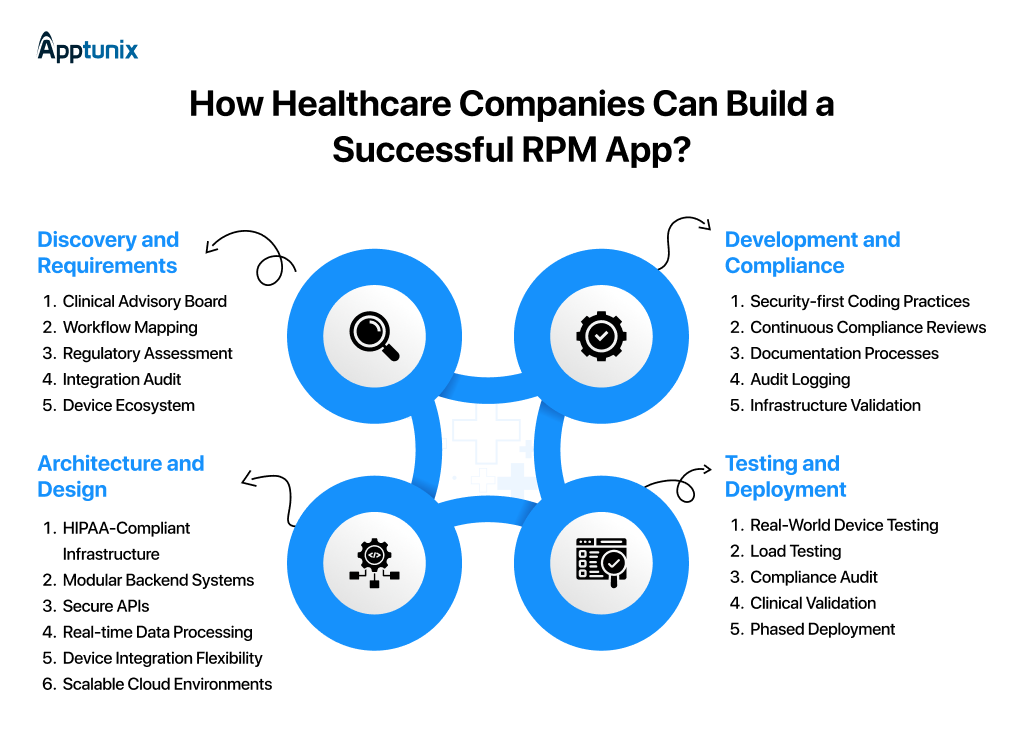
Before you write a single line of code, do this properly:
Budget at least 8-12 weeks for this. It feels slow, but it prevents catastrophic mistakes later.
Architecture and Design
With clear requirements, it is time to design properly:
Key priorities include:
On the design side, simplicity wins. Healthcare UX should reduce cognitive load, not increase it.
The best teams run development and compliance simultaneously. That means:
RPM testing is far more complex than standard app QA. Before launch, you need:
This is important because real patients don’t behave like test environments.
If you are planning to invest in remote patient app development, understanding the cost structure early is critical. Development cost can vary significantly based on complexity, scalability, integrations, and regulatory requirements.
In most cases, businesses can expect development costs to range anywhere from $40,000 to $400,000+, depending on the product scope and architecture requirements.
Here’s a general breakdown of the remote patient monitoring app development cost by stages:
Beyond initial development, businesses should also factor in ongoing costs such as compliance audits, cloud hosting, device integration updates, maintenance, security monitoring, and feature upgrades, all of which are essential for scaling a reliable and secure RPM ecosystem.
Healthcare technology is evolving rapidly. And RPM platforms are evolving with it.
This is where the industry is heading fast. With the rapid rise of AI in healthcare, AI-powered remote patient monitoring apps are increasingly helping providers:
For years, interoperability was treated like technical plumbing. Now it’s becoming a major competitive advantage. The easier your platform integrates into clinical systems, the faster adoption grows.
Founders who master interoperability will win enterprise healthcare deals faster, with integration depth as a key differentiator.
Patients increasingly care about data ownership and transparency. Healthcare platforms are coming forward with:
Building privacy-first RPM solutions that give patients control will appeal to a growing segment of health-conscious users and privacy-conscious enterprises.
Remote patient monitoring app development is not just another healthcare trend. It’s becoming foundational infrastructure for the future of care delivery.
But building a successful RPM platform requires much more than adding wearable integrations or launching a patient dashboard. Health startups need to prioritize interoperability, compliance, clinical workflows, security, scalability, and user adoption from day one. Because in healthcare, even small product decisions can directly impact patient outcomes and operational efficiency.
For businesses planning to invest in remote patient monitoring software development, partnering with an experienced healthcare app development company can significantly reduce risks, accelerate time-to-market, and ensure regulatory readiness.
At Apptunix, we offer specialized healthcare app development services, helping startups, healthcare providers, and enterprises build scalable, secure, and future-ready healthcare solutions. With over 13+ years of industry experience, we have successfully delivered 5000+ digital products across 50+ countries, including advanced healthcare and digital health platforms.
If you’re planning your next healthcare product, now is the time to develop an AI remote patient monitoring app that’s designed for long-term growth, clinical adoption, and better patient outcomes.
Q 1.What is Remote Patient Monitoring app development?
Remote Patient Monitoring app development refers to the process of building digital healthcare platforms that allow healthcare providers to monitor patients remotely using mobile apps, wearable devices, IoT sensors, and cloud-based systems. These platforms help track patient vitals, medication adherence, chronic conditions, and real-time health data outside traditional clinical settings.
Q 2.How much does Remote Patient Monitoring app development cost?
The cost of Remote Patient Monitoring app development typically ranges between $40,000 and $400,000+, depending on the app’s complexity, compliance requirements, device integrations, AI capabilities, and scalability needs.
Q 3.What compliance requirements apply to RPM app development?
Remote patient monitoring software must comply with healthcare regulations, depending on the target market and functionality. Common compliance requirements include:
Compliance is critical for protecting patient data and ensuring legal and operational security.
Q 4.What is the difference between telemedicine and remote patient monitoring?
Telemedicine primarily focuses on virtual consultations between patients and healthcare providers through video or chat platforms. Remote patient monitoring, on the other hand, continuously tracks patient health data using connected devices and wearable technologies.
Many modern digital health platforms combine both telemedicine and RPM capabilities for a more connected healthcare experience.
Q 5.What industries benefit most from remote patient monitoring solutions?
RPM solutions are widely used across multiple healthcare sectors, including:
The growing demand for connected healthcare experiences is expanding RPM adoption across the healthcare industry.
Q 6.Should startups build an RPM MVP before full-scale app development?
Yes, many healthcare startups begin with an MVP-focused RPM app development approach to validate market demand before investing in enterprise-scale infrastructure.
An MVP typically includes core monitoring features, basic dashboards, limited device integrations, and secure patient data management. This approach helps reduce upfront development costs and accelerates product validation.
Get the weekly updates on the newest brand stories, business models and technology right in your inbox.
Reena Bhagat, the CTO and Head of AI at Apptunix, is a seasoned technology strategist with a deep-rooted expertise in emerging technologies. With a focus on AI/ML integration, product engineering, cloud management, she leads the technical vision for high-performance SaaS infrastructures. Reena is recognized for building secure, scalable, and decentralized systems that solve real-world complexities. Her passion lies in leveraging data science and future-tech to create resilient digital products, making her a trusted authority for organizations looking to lead in the age of intelligent automation.
88 Views 9 min June 24, 2026

94 Views 9 min June 22, 2026
104 Views 9 min June 19, 2026
Book your consultation with us.
Book your consultation with us.


One Central, The offices 3, Level 3, DWTC, Sheikh Zayed Road, Dubai
+971 50 782 1690


Offer Ends Soon
Get a quick expert response in under 5 minutes.